Author: remap_content_admin

  • Celebrities vs You

    I’m showing my age here, but there was a moment in US cultural history where for the first time, fresh-squeezed orange juice became ubiquitous. Late 80s, early 90s. Before then, OJ came frozen in cans and had a flat, metallic taste. (Seriously).

    Then 300 million people collectively said, “WTF?”. Another collective change in taste is upon us but this time the consumable in question is the cult of celebrity.

    Except the people at the top haven’t quite noticed.

    Sidebar: I recently wrote about the messaging blunder the Biden administration will make tonight – avoiding The Big Lie that the presidential election wasn’t fair. Thomm Hartmann describes what’s at stake here:

    By not repudiating Trump’s Big Lie that “voter fraud” committed by Black people in America’s big cities stole the election from him, these politicians and media outlets amplify and strengthen his appeal to his white authoritarian followers.

    The future of Trump’s modern American fascist movement is now largely in the hands of the Biden Administration, the CEO of Facebook, and the mainstream American news media.

    We’ll see whether the Democratic party takes this unusual opportunity to kickstart the long process of setting the record straight. But as I mentioned yesterday, inauguration-day attention is focused on celebrities.

    This despite the fact that the trust and appeal of Hollywood is at an all-time low. The Guardian, Vanity Fair, and the New York Times have all remarked on this; the last offers a good summary: “Among the social impacts of the coronavirus is its swift dismantling of the cult of celebrity”.

    But most journalists don’t get that while the pandemic accelerated this trend, it’s not the root cause of it. Makers of digital media, content, solutions, products, etc., do get it.

    The digital knowledge worker gets that relatively anonymous people on the Internet are now producing more relevant and higher quality content, for their niche, than Hollywood is able to produce. From news, to fashion, to entertainment, to travel, there’s someone thousands of people on the Internet, most with a relatively small audience, making something 10x better than Hollywood can gin up.

    The takeaway: in the future/present, every business owner should own at least one of these:

    • newspaper
    • radio station
    • TV station

    You know what these look like already – LinkedIn or website blogs, email newsletters, Twitter feeds, YouTube channels, podcasts, Twitch streams. You know what the audiences look like – 100 to 1000 people, who either look like customers/supporters/members or know someone else who is.

    The Inverse Correlation of Celebrity to You. As the cult of celebrity and network/cable TV become less relevant, anonymous people can become more relevant.

    If they publish.

    My best
    Rowan

  • Elephant In The Room Messaging

    What do ABC, CBS, NBC, CNN, MSNBC, YouTube, Facebook, Twitter, Twitch, Amazon Prime Video, Microsoft Bing, NewsNOW from Fox, AT&T DIRECTV and U-verse all have in common?

    They will all be streaming presidential inauguration TV hosted by Tom Hanks. 

    The programming will be produced by the same Emmy-award winning TV producers who produced earlier pandemic-era political events. It will dust off Obama-era messaging strategists to see if their 2000s-era approach still works.

    And the show will consist of lots of celebrities – pop stars, sitcom stars, Hollywood actors, etc. The kind of faces you see on glossy magazines in the checkout line at the grocery store. That’s Entertainment!

    Rhetorical question – can US-Americans living out a catastrophic pandemic relate to celebrity entertainers who hardly ever die of COVID and never lose their jobs or homes?

    We’ll get to hear from pop superstars Justin Timberlake and John Legend during the inauguration. The last time their names came up was when Ellen Degeneres filmed herself, in her virus-free Malibu mansion, calling them during the pandemic lockdown.

    What did she have to say: “Hey, I’m so bored”.

    They’re waiting for the world to go back to the way it was.  A boring wait, apparently. So now what – spice things up with a victory lap?

    Meanwhile, there will be other shows.

    The primary alternative show will feature professional propaganda artists like Tucker Carlson mocking this star-studded victory lap. Which is itself great television.

    But this show will also question the legitimacy of the election and, thereby, of democracy itself. To make the case, it will broadcast the righteous anger of Trump-Qanon mobs and counter-mobs at various capitols, interspersed with the sort of fake testimony that courts refuted.

    This will show will air live on Fox News and its dollar-store imitations, Newsmax and One America News Network.

    Meanwhile a real-life show will feature a militarized US capitol, with thousands of soldiers in camouflage fatigue holding machine guns behind concrete walls and razor wire.

    Messaging

    The message of the last “show” I mention is that the military now polices US democracy. It’s already etched into the Internet and will be featured on all news channels.

    The losing, opposition party’s message will be a twist on that: look how many people are upset about the inaaguration. Therefore, the election was fraudulent. Therefore, why not, per the words of the president’s lawyer, “trial by combat”? Which is kind of like saying democracy itself doesn’t work.

    This assault demands a proactive response from the winning party. As they respond, here are the wrong messaging approaches:

    • Using the words “Celebrating America” in connection to the inauguration. This is not a time to celebrate. And in this context, America smacks of fake unity – it’d be more honest to just call it “Celebrating the Democratic Party”. 
    • Having a “primetime special” in the first place to commemorate an inauguration. For one thing, TV is dead((People think TV is dead because, “everyone’s watching Netflix” but it’s YouTube that has replaced TV; more Americans watch YouTube than network TV and Netflix combined; more Americans use YouTube than Facebook)). For another thing, entertainment is not appropriate.
    • Resurrecting, ‘Hope and Change’ or similarly over-optimistic slogans that won’t resonate.
    • Leaning on buzzwords like inclusive and diverse; these words are also stale slogans and there’s little if any truth to them.
    • Pointing out that the military supports democracy – this is cold comfort, as Beau of the Fifth Column observes
    • Pretending that the low-attendance at the inauguration is solely due to COVID when it’s obviously also due to security. As Ogilvy tirelessly reminded us, your customer is as smart or smarter than you.

    Speaking of pretending, what is the worst thing about all of these messaging approaches? They ignore the elephant in the room.

    Good messaging isn’t illusion. Good messaging is thinking hard about what is both truthful and useful information – and expressing it elegantly. By the way, this is just as true for a consulting or tech business as it is in politics.

    It’s an illusion to ignore massive elephant in rooms – or pull our attention from them with glitz.

    If millions don’t believe you won the election, don’t pretend otherwise.

    At the same time, be clear that you know exactly why they hold this mistaken belief.

    This should be the central message of inauguration: we’re inaugurating the legitimate president, because the election was not stolen

    Secondary messaging should be that there was “The Big Lie”. That we understand why people were led to believe there was election fraud. We call it The Big Lie.

    This is also the time to introduce the relevant facts, notably that nonpartisan court decisions favor the fair elections narrative 60-0. But they also tell the story of The Big Lie, of claims so outrageous that most judges refused to even hear cases.

    The trick is to blend emotion into this logical argument. It’s always a mistake to leave your emotions out of your message; this is true in the case of your business. In this case, however, it would be a blunder for either side to cede “emotional high-ground” of indignation to the other side. 

    So the Democratic party should tell The Big Lie story with the same emotion Biden directed at the politicians who refused to wear masks when locked into tight quarters during the capitol riots. He said, “What the hell is wrong with them?”

    *    *    * 

    I’m not saying you will win over the lunatic fringe with proof and passion. And even among rational but misinformed people, you won’t undo years of propaganda in one evening. 

    But when a lie gets big enough, you have to address it. Why not do so on the night you’ll have the most reach, especially knowing that your messaging will live on repeat forever on Youtube, where most of us now take in news and opinion.

    Messaging isn’t a one-time fix; it’s a marathon.

    Kind regards,
    Rowan

  • 2021 Flannery Cohort?

    You know when you are in an high-energy conversation, ideas flowing from all sides, the enthusiasm building, and you say, “Here what’s what I think you should do: __________ “. And you say it with total certainty?

    Whatever fills in that blank is often very valuable – it reduces a risk for your customer, or clarifies their next steps, or inspires them to take action.

    If you solve problems with your thinking, ideas like that  are a big part of what makes your business valuable. 

    But how do you get those ideas? One way is just to talk, talk, talk. To be honest, this is sometimes be the best way. Much as we groan about back to back meetings all day long, they are where you hone your ideas through talking about them back and forth.

    But this approach is tedious and wasteful. It only works for one or two people in a meeting, if that. It leaves most people numb. But worst of all, you don’t always get to talk about the right thing. Instead, you get bogged down in trivial issues, low-value issues, issues that you’ve covered before.

    So how else can you hone your ideas as a consultant, analyst, designer, programmer, or other knowledge worker? How can you talk about the most expensive problems you know how to solve? 

    *      *      *

    I wrote yesterday that I intend to make 2021 another year of “daily publishing”, where most days I’m thinking about how to make life better for my customers in some way.

    In 2021, that’ll mean following Flannery O’Connor’s wisdom:

    “I write because I don’t know what I think until I read what I say.”

    My challenge for you is pretty simple – join me in writing and reading aloud in public. Every week, we’ll publish at least one email newsletter article and at least one follow-up video on YouTube. Prior experience, technical knowledge/equipment, your area of focus, etc., none of that matters – my tech stack is Loom and a YouTube account. (It’s actually a lot bigger than that, but that’s the general idea – low-cost or free tools. I’ll share with you exactly how I do it).

    You can do it on your own, or think of it as joining a cohort with me, the Flannery Cohort. If there’s enough interest, we’ll meet up on Zoom every now and then to review progress. The cost to join? $0.

    But while there’s no monetary cost, there’s a significant time cost and ego cost. You should be willing to (a) spend about 10 hours a week and (b) look stupid.

    This is what it takes to get better – and this is an investment in your business.

    If you can afford this investment, consider it!! I’ll finalize the 2021 cohort by the end of the month of January. Hit reply or forward to anyone you know who wants to take this leap.

    Rowan


  • 2020 vs 2021

    Congratulations, you survived 2020 (:

    Did you read aloud to your loved ones at all during the year from hell? I’ll talk about that later but either way, I trust that you thrived despite the pandemic and the reality of remote work, as I hoped for 9 months ago. Or that you at least made a transition.

    I’m writing to you today about how 2021 will be different from 2020 with respect to my own marketing strategy. Maybe this will help you – on that note, I also have a challenge and an opportunity for you that I’ll describe later in the week.

    I know that the marketing strategy of my little business is a very narrow subject. But I’m less certain about the rest of the world. All I know is that the dual chaotic forces of the pandemic and of right-wing fascism are both global and unavoidable; let’s count on another year of uncertainty and hope to be pleasantly surprised.

    To counter uncertainty In 2020, I continued a “daily” publishing experiment that I’d begun in 2019. The results were interesting:

    • Over 100,000 words published in the last 14 months
    • Over 13,000 words unpublished over that same amount of time
    • 132 articles published in 2020 alone
    • One article for about every two work days during that time

    You could call this my 2020 coping mechanism.

    But it was more than that. I noticed that I wrote or thought about what I published almost every single day of 2020. This is why I still think of it as daily publishing.

    I came to a few other realizations through repeatedly writing about them:

    • That marketing is primarily about making something new/better, not just promoting or selling something
    • That there’s a difference between transforming and optimizing and you should know which is your focus
    • That a marketing consultant should look at all work through the spectrum of business model design – are the marketing activities aligned with your core business activities?
    • That knowledge workers can and should productize their value in a way that lets it be sold and delivered with little friction
    • That knowledge workers should define their own terms and ideas for themselves; that this is the core of brand messaging
    • That good marketing lets you connect your religious/philosophical beliefs and values to the work you do and the things you make
    • That positioning isn’t a one-off decision; it’s an ongoing practice
    • That content marketing, though often horrible in practice, is still the highest-value marketing activity

    I’m pretty sure this all of this will be true in 2021, including the last point.

    But I capped my 2020-survival with a holiday break from publishing and thereby a break from thinking about all this daily – marketing strategy, business model design, brand messaging, ideation, words themselves, etc., and so on.

    This hiatus let some thoughts well up, perhaps.

    Which leads me back to a Flannery O’Connor quote that had jumped out at me in 2020.

    “I write because I don’t know what I think until I read what I say.”

    To be honest, I’m not sure what she meant. Did she mean read to herself or read aloud – or does that distinction matter? 

    I think it does matter and this why my 2020 content strategy will alter a little. In short, I will write these newsletter articles less frequently and read aloud a lot more.

    2021 Is The Year of Video (for me)

    Audio was hotter than Hades in 2020 (and it still is). Spotify spent 800 million acquiring podcast content and apps, Conan O’Brien is a podcaster now, and more people listen to Joe Rogan than almost any TV host alive. A podcast is the new blog; this is good because it’s hard to fake decent audio content.

    But after some flirtations with audio podcasting in 2020, I decided to experiment with video. In December, I began reading aloud on YouTube, mostly doing straight reads of my own content, mixed with ad-libbing, and a sort of walk-through of the articles, books, videos, and other content that I have linked to in the article in question.

    I like this approach not because I’m good on video – I’m pretty terrible honestly – but because it lets me show the viewer what I am looking at and inspired by, something I can’t do on an audio-only podcast.

    Video is a weird and difficult format for me. And I’m not sure I’m going to stick with the “read aloud” format; but it’s a place to start.

    Keep in mind: email marketing is still the king of all marketing.

    Thus, I will still write to this email newsletter, but less frequently – maybe just once or twice a week. This will give me the time I need to work on video content; my four experimental videos from last month don’t even have intro thumbnails. Do you know what that means and why it matters? I didn’t until recently. I have so much to learn!

    I’m curious what you’re wanting to learn this year – and what your marketing strategy looks like.

    If you’re like me, you don’t know what 2021 holds but are looking forward to it anyway. Here’s to a safe and successful year.

    Warm regards
    Rowan


  • Undervalued Aspects of Digital Marketing

    In my recent experience, four things make digital marketing work

    1. An improvable offering
    2. Effortful creative work
    3. Problem solving
    4. Iteration

    The first and most important – the offering, aka product or service – is in a class of its own. If it’s no good, what’s the point of marketing it?

    Well there is one point, actually: to get people to try the offering so you can improve it. While every offering is in theory improvable, I’ll leave it to you to gauge whether you can improve your offer in a practical, cost-effective way. 

    Describing your offer in your marketing makes you improve it (as long as it’s possible to do so). I have seen this effect with everything with craft beer to software to translation services. You build the thing you depict.

    That’s why high-effort creative work is also so important – it can change the product itself, as well as communicate its value.

    Creative work is what people think of as things like visual design, messaging, and storytelling. It’s the building block of all digital marketing. If it doesn’t yield a continuously useful website, then it’s not good creative work.

    Unfortunately, creative is fairly subjective. I believe I can tell in an instant if it’s gonna work in the context of digital marketing.  Maybe that’s because I’ve been paid to work on over 1,000 professional websites over the past 20+ years. This makes me believe that I have acquired a skill for assessing the marketing value of almost any website within a few minutes. 

    Putting These Concepts Into Practice

    But I can’t prove that I’m a good judge of (and maker of) creative work; I can’t prove any of it.

    All I can do is provide assurances. I can:

    • Point to research by objective third parties. For example, Jacob Nielsen did research that proves that carousels are a useless convention. I know why this is true and I know what the exceptions are. But research doesn’t necessarily apply to you. And it’s expensive.
    • I can also provide testimonials, case studies, and even – uggh, sorry former clients – references. But quid pro quo is a thing.
    • Lastly, I can write about it on newsletter and blog, or speak about it on video or podcast. 

    I find the last type of assurance works best on me because it’s pretty much impossible to fake.. If I can hear someone speak and also read their words, I have a much better idea whether their offer is for me.

    People call this content marketing but that term has become so degraded by trash content, I prefer to think of it as just writing and speaking in public.

    Here’s the takeaway – the best kind of digital marketing is writing and speaking that evinces evidence of a solution that can and will be improved, contains hard-won creative expression of some kind, talks about solutions to business problems, and is performed iteratively.

    If you find this person and need what their business sells, hire them.

    Here’s the other takeaway – be this person.

    Best
    Rowan 

  • How to Use Book Summary Services

    [Watch and listen to me read this]

    Problem: to be an effective _______ strategist you have to read a lot, especially books. But time is scarce and perhaps the Internet has damaged our attention spans.

    Solution: book summaries?

    By the way, I’m not talking about abridged books, such as the 100-page versions of literary classics. I’m talking about 10-page versions, more or less. Barely more than bulletpoints. Examples of the form are Four Minute Books, MentorBox, and Blinkist.

    These online book summary services typically trade in  Business and Personal Development, aka BPD, as well as Big Idea books. Blinkist and Mentorbox have other types of books in their catalogue, but the focus is on business nonfiction. 

    Disclaimer: other kinds of publications (fiction novels, netflix series, cookbooks, whatever) are also concept containers and might help you think creatively. 

    A good nonfiction book is kind of like a large concept container, pretty much the biggest type of concept container that we work with. The concepts are not new, but the container is.

    And a good book summary explains each of the concepts in a simple way, but it also compresses the container itself – the interconnection of ideas, the key stories, etc. That’s not easy. 

    Doing your own summaries

    Summarizing books (or anything really) is probably always worth it if you are the one writing the summary. Especially if you take a Feynman Technique-eque approach, which among other things has you teach what you’ve learned to a child. Thus forcing you to keep it simple.

    For that reason, book summary services are worth looking at because they provide so many excellent models of summarization. 

    One of the toughest concepts for knowledge workers to explain simply is their own business model but also their positioning. The “what exactly do you do?” question. Beyond, “works on the computer”. This isn’t a bad thing to apply summarization techniques to.

    If you don’t have a real child handy to explain your complex concepts to, you might look the Flesch-Kincaid readability tools. These grade your writing by reading level, down to 3rd grade, by evaluating things like averages sentence length, word length, transition words, and other elements of your writing. (There are WordPress plugins that use these).

    But the professionals have more advanced techniques.

    Niklas Göke, for example. His Four Minute Book service began with summarizing over 365 books in a single year. This is not only super-impressive but must have been an intense learning experience.

    But then he’s a full-time writer, whereas the context here on Second Opinion is non-writers whose business model requires them to write part-time.

    Reading others summaries

    Four Minute Books,Blinklist, Mentorbox are all based on the same promise as the pre-Internet business Cliff’s Notes: less for more.

    That is, you put in less time, you get the same value from the book. Or maybe not the same, but the value-for-time ratio is still attractive.

    I’m mean why not — Kindle Analytics data shows that one of the most popular big idea books in the last decade, Thomas Piketty’s Capital, is put down after the first chapter.

    What happens at the conclusion of the first chapter (and the introduction)? Does the book get worse? No, it continues to hold one’s interest. But the book’s primary idea is already been forked over. This means that the first-chapter-reader is more than able to answer the “what’s it about?” question at a dinner party.

    Social capital extracted; mission accomplished.

    That said

    we’re not all first-chapter-readers. At least not all the time. I’m sort of a reading flexitarian here and I bet you are too. Depends on the book, right?

    Sometimes we really lust for that web of related ideas, data, and narratives that are tied to the central premise. Mmmm yes!! You tell me.

    Or or.. we may merely want space to look at the main ideas from different viewpoints. I like this, sometimes you go back and forth between rejecting and embracing a book’s idea before you realize how great it is.

    That’s not possible, of course, if the book just doesn’t have much to say. Or doesn’t have interesting stories. Some books are full of brilliant ideas and data, but repetitive, poorly edited, and lack interesting stories. Often they’re too wordy. It’s like listening to an attention-hog humanities professor lecture you — in your free time. In this case, bring on the book summary!

    The key drawback

    Creativity.

    In Murakami’s Norwegian Wood, the character Nagasawa says, “If you only read the books that everyone else is reading, you can only think what everyone else is thinking”.

    This is the problem with the major book summary services on the market — they’re all pulling from the same Bla Bla Bestseller List.

    Or whatever — they are selling the summary to as many other people besides you as possible, or the business model wouldn’t work.

    So even if you suck the marrow in four minutes, or twelve minutes, it’s the same marrow that the rest of the BPD-book-reader public sucks. How do I conclude this analogy — so your soup tastes the same?

    You cook your soup with the same ingredients. The same ideas.

    This is why Malcolm Gladwell says to mine the public library system. Because libraries are:

    • only partially swayed by what’s hot and what sells
    • much less swayed by recency bias
    • curated by librarians, who are experts in books

    In conclusion, it depends. It depends on the book and it depends on what you want. If you want to be up on what others read and trend to repackaged-common-sense business books, maybe because they motivate you or stimulate your imagination, consider the book summary services.

    But book summary services such as Blinkist, Four Hour Books, Mentorbox are in the box. If you want to read and think outside of the box, they can’t, by virtue of their business model, be the only way you consume books.
  • The Right Word

    Do you ever need help finding the right word? I do. So do millions of others on Google and Reddit.

    So do the people I work with. They say, “I just can’t find the right word”. Or, “I don’t want to use words like that“.

    Fair enough, though the fix isn’t usually “one word to the rescue”. The fix is rewriting – and rethinking – the whole thing, whatever that thing is.

    As you rethink – your elevator pitch, your product name – you will hopefully consider many words deliberately. Here, I’d suggest a traditional dictionary as a first stop (and not the world’s de facto most popular dictionary, Google.com).

    For most people, at least. But for people like you – knowledge workers, entrepreneurs, experts creating new solutions – I have another suggestion.

    Dictionary, Thesaurus, and Glossary

    Two of the most important tools in marketing are the dictionary and the thesaurus, which is basically a dictionary subtype. But a thesaurus doesn’t always provide you with useful synonyms. A given word may have 15 synonyms in a thesaurus without any one of them helping you say what you want.

    That’s because as terms get more complex, the more they differ from their so-called synonyms.

    For example, it’s fair to say that sofa is a synonym for couch. But is digital transformation a synonym for automation? Is The Why Conversation a synonym for the Socratic Method?

    No, terms such as these that you might use are complex and nuanced. So the thesaurus becomes a place not to “find the right word” but to get hints that stimulate your thinking. 

    Speaking of which, this is how linguist Noam Chomsky thinks of a dictionary.

    “What we call definitions are not definitions, they’re just hints. If you take the OED, the one you read with a magnifying glass, they give you a very long definition of a word. But they’re not really definitions, they are just hints that a person who already knows the concept can use to understand what’s really going on”

    What we call definitions are not definitions, what we call synonyms are not synonyms. Just as grammatically correct is not necessarily correct and every good copywriter knows that correct grammar is a silly conceit.

    Ok, Now What?

    Here’s the takeaway – if a term is important to what you do, you should probably define it yourself rather than relying on the hints created by the professionals for the mass market.

    To be precise, you as a knowledge worker should make your own dictionary, or glossary, as Jonathan Stark does so well. You can think of this partial dictionary as a glossary, which the OED defines as, “A collection of glosses; a list with explanations of abstruse, antiquated, dialectal, or technical terms; a partial dictionary.” 

    Some of Jonathan’s entries are long enough to be short-form blog posts, such as, “The Why Conversation“, which is like (but not synonymous with) a Socratic-method-for-business. This method, also known as “Peeling the Onion,” draws out assumptions that would otherwise hinder progress. 

    Other digital publishers deliberately use entire posts as term definitions, like Seth Godin’s Viral Marketing.

    And if you consult the most complete dictionary, the OED, many entries far exceed blog-post-length. The publicly-available OED entry for “dictionary” is almost ebook length, about 4,500 words.

    You might need to write that many words about the thing you make to find the right word – or better yet, create a new definition of the right word, custom-crafted for yourself and your audience.

    Let me know how it goes!

    Rowan

  • Stupid Enough

    If Nigerian scam artists are so successful at using SPAM, why are their emails so full of grammatical errors, typos, and – frankly – stupidity?

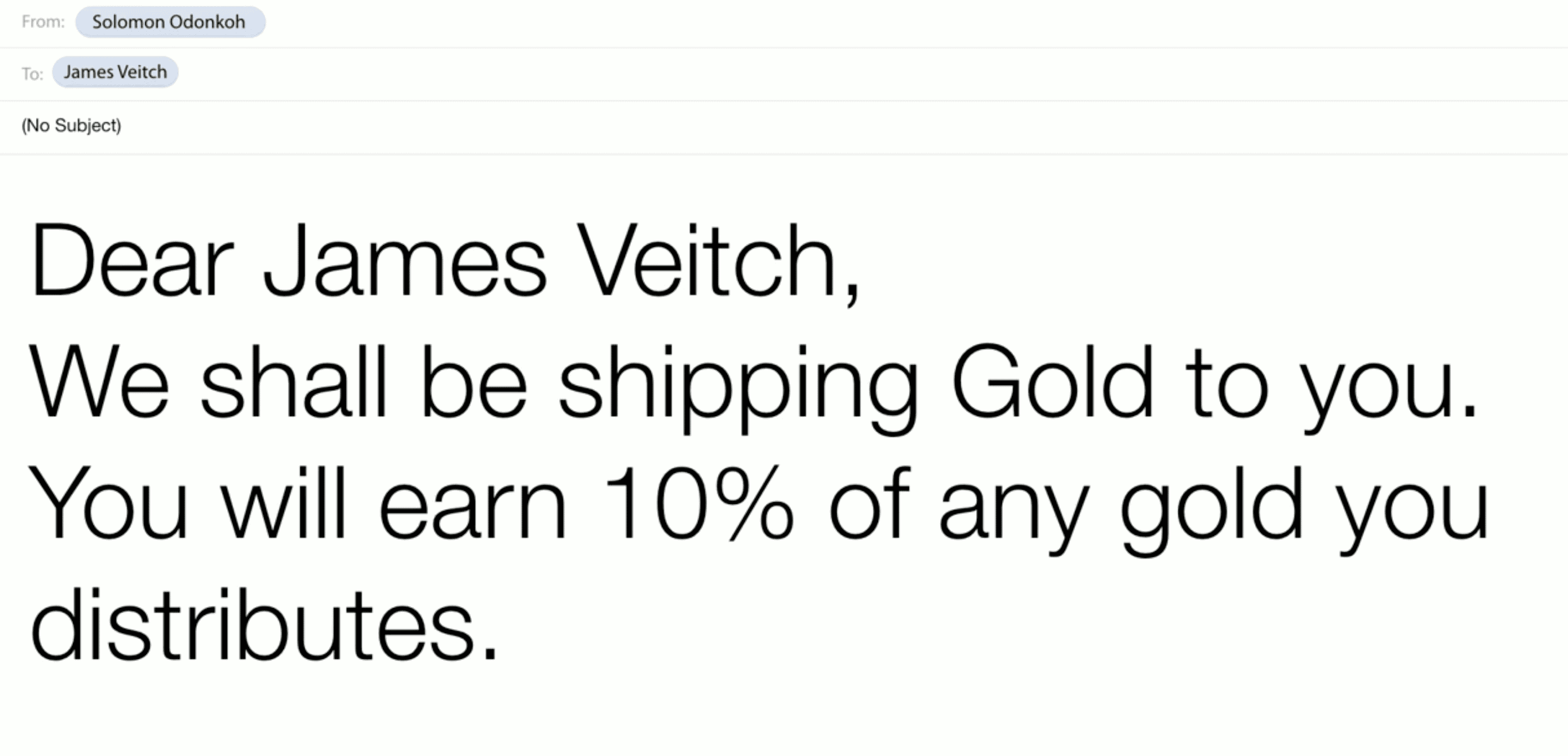
    You might have seen the TED talk by the hilarious James Veitch: “This is what happens when you reply to spam email”. The speaker got a lot of laughs when he presented a spam email from a Nigerian scammer:

    Click 'enable images' to see this screenshot from the TEDX talk on spam email

    After reading the text of the email aloud, Veitch deadpans, “I now knew I was dealing with a professional”.

    While this is a funny line, I’m afraid the joke’s on us. Watching this video, we’re lulled into a line of thinking that goes like this, “we’re sophisticated, the scammers aren’t”.

    But is it the other way around?

    Nigerian spammers have been at this for 25 years because it works. In fact, they’re clocking the bank. And they could afford to hire a proofreader or a Grammarly subscription. 

    But they write their opening emails with laughably bad grammar on purpose; they ask this question:

    Are you stupid enough to send us money?

    Are you stupid enough to send half of your $1,200 stimulus check to a Nigerian prince, to secure his subsequent transfer of $12,000?

    Because if you don’t object to:

    • a business proposition coming from Nigeria in the first place
    • incorrectly capitalizing the word Gold
    • conjugating the verb distribute incorrectly

    Then you just might not object to sending money to someone you don’t know over the Internet. 

    In this use case, typos and bad grammar are a filter to determine whether you are the right kind of customer. Waisting time following up with clever people who won’t send, let alone TEDx comics, isn’t part of the Nigerian scammer business model.

    But here’s the funny thing – the same is true for you.

    Sidebar: this question over whether marketing is evil is the wrong question. The right question: is the marketer evil?.  I’m assuming you’re not. On top of that, you have something valuable to offer. 

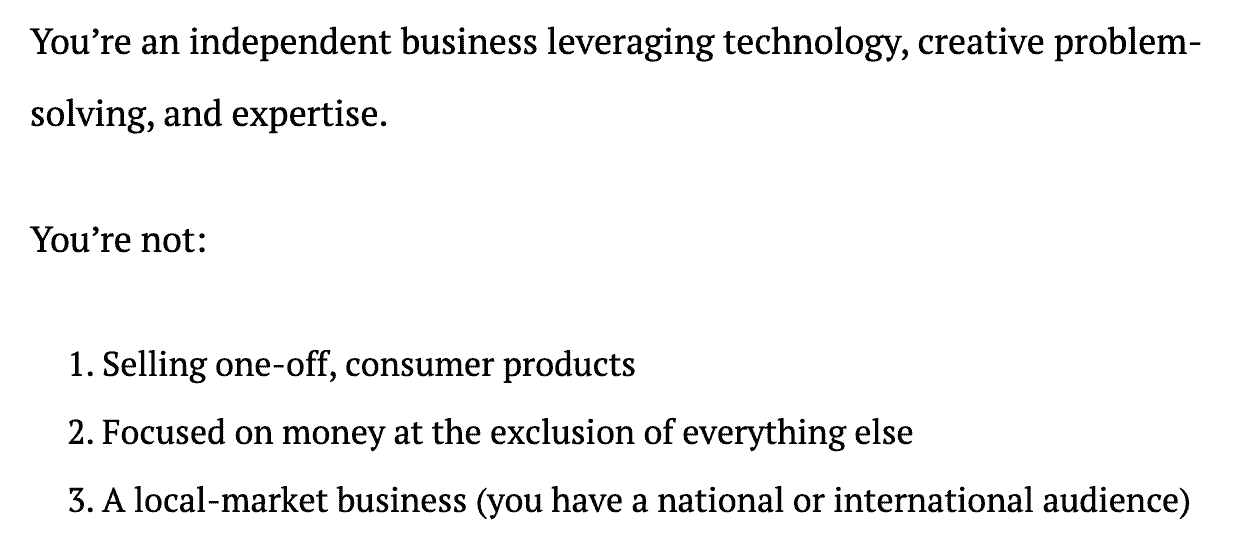
    This means you can use the same qualification technique that a slimy Internet con artist uses. Here’s how you say it: you are this and you are not that, that, or that. Here’s an example from my own business website.

    Note that there’s nothing wrong with falling into the “you’re not” category. You could have a very interesting business person and be an interesting person to talk to, as I point in subsequent paragraphs. It’s just that you’re not my ideal client. Some marketing agencies focus on local-market businesses, such as doctors, auto dealerships, or NYC law firms. Others focus on nothing but Amazon.com physical product entrepreneurs. They’re probably more profitable than I am. I’m just not interested in solving those problems, nor I am good at it. 

    The takeaway is that is to say who you’re for and who you’re not for. Somehow that will translate into marketing copy.

    In marketing, this is called qualification. It’s also used in direct sales, dating, connection-making, and all walks of life. The challenge is to use it deliberately and skillfully.

    Nigerian scammers have many more decades of experience at this than we do, however. So it may take some time. But aspire to their standard: hook the right reader in one or two sentences; while disqualifying everyone else.

    Warm regards,
    Rowan


  • Social Proof vs Authenticity

    As you may know, you must present “social proof” of the value of your complex solutions. The more complex and/or expensive the product or service you sell, the more important is this proof.

    But what kind and why?

    I see that most marketing professionals gloss over this subject without having thought through the specifics. What types of social proof make sense for their customers?

    Let’s plot social proof on an authenticity spectrum. The spectrum runs from generic and unverifiable on the low-authenticity side to personal and verifiable on the higher-authenticity side of the spectrum.

    You might be surprised at what the highest-authenticity proof looks like. More on that later; first let’s talk about the villain in this story.

    Generic proof. In consumer goods marketing, this includes statements like “4 out of 5 dentists recommend X toothpaste”. Or quoted words such as, “it really tastes like chicken”, attributed to no one in particular.

    It’s not proof at all in the most prevalent sense of the word, but it still works because that’s how we’re wired as a species – we value a thing based on what others in our tribe say about it. These made-up statements trigger that phenomenon, even when our rational mind knows they are BS.

    Providers of business services and products, like you and I, also use generic or impersonal proof.

    An example is stock photos of models in biz-casual attire at a conference table. Or an image of a trekker, photographed from a rear angle, contemplating the vastness of the Himalayan mountains. We see this all the time. When you overlay words over a photo like this on a website or a deck, you imply a connection that doesn’t exist. Those office workers aren’t you; those mountain climbers aren’t your customer. They didn’t say the things that seem to be attributed to them.

    But it is expensive and psychologically taxing to put up a real photo of yourself, on your homepage. Especially when it’s of a group of people. But what are your customers buying? Whether you sell software or services, they are buying solutions and the people behind them, as discussed here. 

    Another example – testimonials that real words from a real customer but hide their name, for whatever reason. This actually works if the testimonial is long enough and has some other qualities.

    Which is to say, generic social proof isn’t always a bad idea; it can be easier to create and it can still work. But there are better options.

    Personal and verifable.

    It’s amazing how well numbers work. And how much better they work if they come from a verifiable source, such as a study conducted by a name brand organization, a university, a government agency, or a person associated with one of the above.

    A small-print citation at the bottom of a screen is effective marketing copy.

    Personal social proof is another effective hack. People confuse personal social proof with authority. A name, photo, and bio, or a real person goes a long way without that person being a known authority. Any real person will do.

    And that brings us to the best kind of social proof. You.

    The proof we have discussed so far tends to materialize as testimonials or case studies, whatever medium that comes in. It also comes from other people. 

    But the most effective social proof I have experienced comes from publishing my own content. It is verifiable (it comes from me, really!) and it’s very personal. 

    Interestingly, it’s not actually entirely authentic. When you publish a lot, you realize that you’re speaking on behalf of your professional self. Your professional self and your true aren’t the same; they have different interests and goals.

    Now technically speaking, creating content isn’t by itself a form of social proof. But when you publish on the Internet, and people react to it in some way, it becomes social and it becomes proof.

    Testimonials and case studies still matter. But we really want to hear from you – we want your take. That’s all the proof I need.

    Have a wonderful weekend
    Rowan

  • Business Genres

    Genre helps make sense out of a story faster. Western. Victorian. Detective. Half of it is pre-downloaded to your memory banks. Thus with the scene set in your head, the creator can focus you on the original story.

    When the plane crashed in the first scene of Lost and the survivors stepped out onto a sandy beach with palm trees, we knew the genre even without realizing it: castaway narrative, just like the Tom Hanks movie that preceded it by a few years.

    In positioning your business, your product, your solution, you are almost always picking a pre-existing business genre.

    But business genres are harder to pin down than counterparts in books/movies. They can be technology platforms or languages, business philosophies, schools of design, or company formations, product-based, and more.

    In the world of niche-market expertise businesses, there are 5 to 10 overlapping uber-genres and 100s of sub-genres.

    • SaaS is an uber-business genre; project management SaaS is a child business genre.
    • Technology consulting is a genre; Salesforce consulting is a child business genre
    • Web Development is an uber-genre; sub-genres are Drupal or Squarespace development
    • Digital marketing is uber-genre. PPC advertising and outreach marketing are child genres.

    If you identify your business according to an uber-genre, people will be uncertain. We know what a thriller is but it’s more interesting to know whether it’s a legal thriller, a psychological thriller, etc. This means we have to ask the followup question – what kind of

    Business genre names evolve rapidly too: in the 80s and 90s, digital transformation was called “automation“; it’s still called that in the profit-rich and change-immune energy sector. 

    This is the point: you’re rarely creating a new genre from scratch, like Daniel Defoe did with Robinson Crusoe.

    The is the bigger point – genre isn’t enough. The series Lost didn’t retell Robinson Crusoe; it imposed a completely unique story on the genre.

    I’m assuming that you know what genre or genres you fit into (probably multiple).

    Great, so you don’t have explain that part in your messaging. In fact, please don’t. Everyone has seen it a thousand times already.  

    We know the genres.

    What you must do is discover  – and capture in the form of published content – how your business and its solutions create something new on top of the business genre you work in. Once you publish on it for a while, writing up the messaging gets easier.

    My best
    Rowan

    P.S This advice goes against law 5 of The 22 Immutable Laws of Branding (The Law of Singularity”) and the book it inspired: Blue Ocean Strategy. If there’s a blue ocean out there for you, then jump in!