Author: remap_content_admin

  • Business Model vs Marketing Plan

    What does a business model have in common with a strategic marketing plan?

    • It’s goals-based
    • Who is more important than how
    • It has a basic profit & loss cost structure
    • It responds to a specific problem(s) experienced by some type(s) of person

    They have a lot in common. But there are some important differences, especially when it comes to execution activities.

    A marketing plan can be executed by anybody – business owners, employees, contractors, consultants, or even software. It can last one day or one month. And it can be executed in a variety of methods, styles, and tempos. One common theme, for example, is iterative campaign work on one or two-week cycles. You leave the fishing line in the water for two weeks before adjusting it.

    Those adjustments are the tasks that comprise the execution of a marketing plan.

    But tasks like those aren’t part of a business model. So what is? What activities are part of a business model?

    Core practices

    Core practices are essential activities executed by you, the company leader, and your cohorts, based on your business beliefs.

    For example, if you believe that it’s important to frequently speak one-on-one with each of your employees at your 20-person organization, then you might have a daily core practice of 4 15-minute Zoom calls with employees.

    Unlike menial tasks and to-do items, you get better and better at your practices. Those 15-minute Zoom calls become more and more effective.

    A business model accounts for core practices because they are (part of) where value is created. They should be focused foremost on creating long-term value for customers. Keeping customers first, getting customers second.

    The B2B expertise business model says, this business works because the key people have these daily practices which, over time, make the value proposition stronger and stronger

    Contrast that with the urgent, routine, or short-term activities – even the ones you do frequently, like checking email, paying bills, typing in passwords, or creating calendar events. Those are business activities but they aren’t part of your business model.

    Marketing campaign activities are less mundane. They’re interesting and creative. And they help you acquire new customers. But that doesn’t make them part of your business model – because they don’t create long-term value for customers. 

    Take action. Identify your core practices. Keep three that best pass this test: 

    Do you get better at them over time and do they let you create more long-term value for customers?

    Et voila, now you have documented an important part of your expertise-services business model.

    Feel free to hit reply and let me see what you came up with; I’m happy to offer some my thoughts.

    Best
    Rowan
  • Assessments vs Quizzes

    We love to assess ourselves and others. Crystal’s unique value proposition is that you can know how to communicate with anyone. It uses AI – that’s the anyone part (supposedly). I’m not sure, but maybe the people also use Crystal to assess their own personalities.

    Other consultants recommend assessing the personalities of all of your clients. Or if you have an employee-based business, assessing staff personalities to ensure fit-for-role. (These manual approaches will get you much better results than AI, for now). This is a management science concept that goes back a century, ever since psychology influenced business. The military uses it, the police, big orgs, etc.

    Dan Pink’s assessment tool is a little more focused though. It tells you whether you are an ambivert – in between an extrovert and an introvert. (Chances are good that you are an ambivert; his thesis is that most of us are).

    Therapists and other doctors assess patients with intake forms designed to get something out of you wouldn’t ordinarily disclose.

    Marketers and other creative professionals use assessments called creative briefs. I call mine a written interview; have a copy if you like.

    Some of my clients provide their customers or prospects with assessments. They assess how well they do X – to determine if they might need help with X.

    Cosmo magazine’s approach is a little simpler – they’re not trying to sell you anything but the $5 magazine.  All they have to say is, “quiz inside” to improve sales. Does the quiz help readers? No.

    But here’s the thing – it’s tempting to see random quiz results. It’s fun to take quizzes. But it’s really tempting to actually learn something about yourself. And useful.

    Takeaway: the people you are trying to sell something to – can you help them assess whether they should buy the thing you have?

    Happy assessing ( :
    Rowan

  • The Fallacy of “That’s Not My Voice”

    Problem:

    You’re an independent, niche business trading in technical and creative expertise; you’re so small that your name brand will never count in the way it does for the huge organizations. Billions of people around the world have heard of China.  Hardly anyone has heard of you.

    Solution:

    Accept that you are in the relationship game. Your business consists of 50 to 1000 1-to-1 relationships.

    You can view your entire outbound marketing strategy as one of building new relationships. They might not bear fruit for a year or two or three – all the more reason to treat them as relationships.

    Big orgs such as governments, political parties, and corporations know about the relationship game. That’s why they spend so much time trying to fake it.

    • They rarely send emails from real people
    • They never send emails you can respond to
    • They never speak unscripted in public (the last major presidential candidate to write his own speeches was Adlai Stevenson – in 1956)
    • Their employees must follow scripts even during live chat or phone conversations
    • They use automated business phone answering systems – and make them as un-human as possible
    • When they speak and write, they use as many cliches as possible 

    This is partly because it feels comfortable to sound like a robot. At least you don’t sound like a stupid person. But it’s also because it’s hard to capture your authentic voice in writing and recorded speaking. Let alone equip your employees to do so.

    We can avoid the fake-communication traps. For example, we can never, ever let an email be sent in the name of our business that doesn’t come from a real person. With a photo and a name. That customers can reply to.

    And we can speak and write like a real person. But not just any real person – like you.

    I think people know this instinctively but they don’t know how to make it happen.

    They say, “that’s not my voice” when presented with messaging and creative (copy, design) they’ve hired someone to craft for them.

    They say, “I don’t know, that’s just not my voice”.

    I hear this all the time, including from my clients who are themselves marketing agencies. They complain about not being able to, “capture their client’s voice”.

    But here’s the thing: there may be no voice to capture.

    If you don’t voice your thinking regularly, in public, whether speaking or writing, you don’t have a voice. And you never will.

    The next best thing you can do is find a surrogate – a writer or speaker whose voice complements your brand.

    The more talented your surrogate better, of course. US presidential press secretaries are typically quick-thinking, diplomatic, articulate, and opinionated – all at the same time. Through (speech) writing, speaking, and debate, such people have developed their own voice. But it’s not “the voice” of the president they serve under. It’s theirs.

    You have to either create your own voice or find a talented one to speak for you.

    What’s not an option is someone magically creating one for you.

    Best,
    Rowan


  • Find Pygmalions

    There’s a piece of positive psychology that, partly because it predates the 20th Century, the cynics in us should leave alone. Also, it’s true. Also, it’s good for business to be aware of it. 

    It goes something like this: your beliefs about the people you teach with will always influence their behavior – both negatively and positively according to whether your beliefs about their potential are positive or negative. Not might influence their behavior. Always. 

    1.

    Like The Force in the Joseph Campbell-universe of George Lucas, this dynamic has a dark side and a light side, each with their own protagonists. 

    On the positive side, you have the Pygmalion effect, which was popularized by the US-American educator Rosenthal. It’s related to the placebo effect and the general principle of positive feedback loops, but it has to do specifically with what a teach/authority/expert believes about the people she’s teaching. When she believes her clients capable of learning and excelling, they are more likely to do so.

    The Golem effect is the opposite. It’s what happens when you are worried, to the point of neurotic certainty, that your creation will turn into a malevolent monster, as described entertainingly in the only Chabon book I was able to finish, The Amazing Adventures of Kavalier & Clay. (Golems are made from clay, per Jewish legend). I’m pretty certain this happens in schools all over the world when teachers come from more privileged demographic backgrounds than students.

    2.

    Educational psychologists love to scope the Golem vs Pygmalion framework down to how teachers in traditional educations systems affect young minds. 

    But I have seen a new business idea make an adult mind young. Age-based differences in mental plasticity are greatly exaggerated, as established by Anders Ericcson in Peak: The New Science of Expertise

    There’s another problem with the classroom teacher-student model. It’s for everyone, since the US and most modern democracies have universal education, as explicitly stipulated by Karl Marx.

    But your business isn’t for everyone.

    3.

    My experience in writing copy for myself and for clients was that both of us had to believe it 100% or it didn’t work.

    Let’s assume you already believe your product is great. Fine but that’s not the point. You have to find a way to be certain that your customers have positive potential. 

    Here’s the question – can you find and connect with people who, you are certain, have the potential to get better at something, make more money at something, etc., after they use your products and services? These are your pygmalions. They won’t just benefit from your product; they’ll benefit from your belief in them as they experience your product.

    Another way to think about this group – who are they not? Who are your golems? Who are the people who, no matter how great your product or service is, it won’t help them?

    My best,
    Rowan

  • Why a Second Opinion?

    Do you know what people want from me? A second opinion – about their marketing and business development strategy, for the most part. Sometimes they want me to execute it, too, or at least oversee its execution. But behind that is the desire for not just a new perspective but for a different, recommended course of action.

    I hear something like this almost weekly: “something something something, I know about this and that, I’ve tried it before, but I’m not sure, and…. and so I guess what I really need is a second opinion.”

    Many of you have probably experienced something similar. The person you’re talking to has done due diligence, read your industry’s exalted books, and made a sophisticated business strategy. With much input from many smart thinkers.

    But still, you know more they do. You have done it more. Plus, you know the specifics about their business. The authors of the books they have read have no clue about those specifics.

    Therefore, they want a second opinion – from you.

    I got me thinking over this week, what is a second opinion?

    But before I researched the term, memory struck. That one time, years ago, on a bitterly cold Spanish winter. My pain level was 13 on a scale of 1-10. My whole face was swollen and bursting, my eyes were red with tears of pain. Sleep? No way, not while an abscess pounded somewhere underneath the skin against my jawbone, nerves, and gums.

    So I schlepped myself to an emergency room. The good news is that at 4 am, the small clinic was empty and I soon saw the doctor. The bad news is that his approach was to jab/saw at my jaw with a knife, trying to dig under the skin to release the abscess. It was pure agony and accomplished nothing. I questioned his approach and suggested an alternative. I think that made him jab harder. I protested.

    “I am the doctor”, he pointed out.

    What did I want more than anything – at that moment of pain and confusion, at the mercy of an idiotic sadist with a medical degree?

    A second opinion.

    *   *   *

    My “research” began with the usual trio: Google, Wikipedia, and the Oxford English Dictionary. The OED has a few different meanings for the word opinion, including the one that’s part of the term, ‘second opinion’.

    “A formal statement by a judge or other competent authority of what he or she judges or advises on a matter. In a second opinion: the opinion of a second (esp. medical) expert or adviser.”

    So we’re not talking about a blurted thought or an expression of subjective taste.

    We’re talking about a formal recommendation for a specific course of action.

    This is relevant to your work. You are a competent authority. You advise on matters related to areas of your expertise. And if you put them into a formal statement (eg. an audit) then, voila, you deliver an opinion.

    According to the OED, second opinion has been used in both a medical and non-medical context for centuries. But the first known usage was about doctors.

    Therto thei [sc. doctors] acorden alle As for final conclusioun, And tolden here opinioun To themperour.
    John Gower, Confession Amantis, 1393

    The modern English translation: “therefore they [sc. the doctors] agreed on ale, as a final conclusion. And delivered their opinion to the pourer”. If only my doctor had been half as competent.

    When I finally exited that lunatic’s surgery and arrived at the lobby of the clinic, I did something I am still proud of: I refused to pay until I was given a second opinion. And there, prominently posted on the wall of the lobby, was my justification for doing so. The Spanish constitution guarantees medical patients the right to a second opinion. (Sidebar: the newer the constitution, the better).

    It is a stretch to conclude that business owners have the legal right to a second opinion when it comes to something like a growth marketing strategy. But it’s a good idea for them. And it could be a valuable framework for your business.

    Also, I hope I’ve now answered the question posed in the title of this article. I’ve rebranded this newsletter from The Art of Ideation to something more central to my business: Second Opinion.

    My best,
    Rowan

    PS. I’ll soon be sharing some exciting (for me) news about Second Opinion – no coffee mug or t-shirt but something hopefully more interesting to you

  • The Problem With Theories

    I wrote a listicle on Medium, where I have written about things that don’t always pertain to this list. But as I did so, I realized it was relevant.

    The list is of 11 traits that communists, capitalists, and fascists share:

    1. They love management science
    2. They like to do “re-orgs”
    3. They need hierarchy
    4. A few near the top make decisions for everyone
    5. They’re obsessed with metrics
    6. They love centralization
    7. They hate threats to the status quo
    8. They view democratic institutions as an obstacle
    9. They all influence the world’s most powerful countries – Russia, the US, China
    10. They all (not just capitalism) influence businesses
    11. They are theorists whose theories don’t actually fit the real world

    How in the world does this relate to an independent entrepreneur or consultant?

    Two ways.

    1. Theories aren’t how you create value for customers

    Reflecting on how much fascists, capitalists, and communists have in common hopefully helps you question the value of strategic, theoretical frameworks. Strategy consultants loved to set up this dichotomy between strategy and implementation. In that paradigm, theory is hoisted high.

    But what about raw creative ability?

    Marketing is so full of BS theories. Some of them are harmful. A little bit ago, for example, I wrote about the theory of omnichannel marketing as a time-waster. Another example – this concept that what you need is the right funnel formula. The right approach or mix of tools and strategies. There is no perfect formula. That’s the overvaluation of theory creeping in.

    If it creeps in too much, it doesn’t leave space for creative skill.

    Anyone who solves a business problem has this, not just “creatives”. But in marketing, it is creatives – designers and writers. Their skill shapes product and how you present it, message it, talk about it. That matters a lot more than “the strategic marketing plan”.

    Creative skill eats theory/strategy for breakfast.

    And by the way, it’s not the same thing as implementation, execution, “hands work”, or whatever you want to call the work of carrying out strategies that isn’t mentally – or creatively – demanding.

    2. Opposite World

    If you switch many of the items in the original list around, you have traits that pretty well describe the independent expert or entrepreneur:

    • They have no need for management science
    • They don’t like to do “re-orgs”
    • They don’t need hierarchy
    • They’re indifferent to metrics
    • They don’t care for centralization
    • They love threats to the status quo
    • They view democratic institutions as allies
    • Their theories must fit the real world – bills to pay

    My best,
    Rowan

  • Why I Love Trivial Questions

    Yesterday I talked about simple explanations as a form of proof. Simplicity proves mastery of both the problem and the solution. Or does it?

    What if you just memorize and parrot the simple but persuasive explanations of others? Are parrots experts?

    No. Simple explanations by themselves aren’t enough. Even if you arrive at them yourself.

    But they are starting points.

    *    *    *

    Take SEO, which I define as:

    Making content appear near the top of search results.

    That may not be the perfect explanation, but it’s accurate and it’s simple.

    It sidesteps the dozens of complexity rabbit holes that tempt the SEO consultant when she is asked to explain:

    • Ranking content for one keyword vs multiple keywords
    • Short-tail, mid-tail, and long-tail SEO keywords
    • Off-site SEO vs on-site SEO
    • Local SEO vs non-local SEO vs international SEO
    • Google constantly changing its search engine algorithm
    • Google suppressing results it doesn’t make money from
    • Non-Google forms of SEO – Facebook SEO, YouTube SEO, Reddit SEO, Quora SEO, etc.

    Add to all of this the larger context: you can’t really be an SEO consultant without at least understanding content marketing and pay-per-click search advertising.

    How is a person who knows little of digital marketing, let alone SEO, supposed to make sense of all that detail, even if it’s relevant? By starting with something simple and universally true: SEO is making content appear near the top of search results.

    You anchor your deeper explanations in that simple one – the opportunity to elaborate will come.

    *    *    *

    To set ourselves apart from parrots, our simple explanations need to be accompanied with:

    • Rephrasing
    • Elaboration
    • Active listening and learning

    Many fans went to Grateful Dead shows for decades on end because the Dead never played the same song the same way.

    Likewise, there are many ways for you to rephrase or at least elaborate on your problem-solution explanations. The best way is to listen for the words or examples your customers use and echo them back.

    Another way is to use analogies drawing on something they are familiar with. This involves listening and being willing to learn. As Malcolm Gladwell says in his masterclass:

    “Don’t be the guy who knows it all – who has nothing to learn. Maybe you know almost everything, but chances are that almost anyone has something to teach you about your subject of expertise. Listen for that little thing you didn’t know about and ask them to teach you.” (paraphrased)

    A great way to measure the scope of an expert is to evaluate how well they respond to trivial or slightly off-topic questions. Can they connect what they know about to what other people know about? Perhaps I’m over-egging the pudding here, but I think a true expert exemplifies a there-are-no-dumb-questions mindset.

    Not a single person on planet earth knows everything about SEO. Not even close, actually. Not Danny Sullivan, not Rand Fishkin, not Neil Patel, not the designers of the Google search algorithms, or anyone else.

    The same is probably true of your area of expertise. Neither you nor anyone else knows it all.

    But there are people who are able to not just simplify, but elaborate entertainingly, teach and learn simultaneously, and find the hidden gem of relevance in a seemingly trivial question. That’s our challenge.

    My best
    Rowan


  • How to Prove a Solution

    A talkative guy named Claudius and I happened to camp on the same beach in Kauai for four days. The whole time I suspected he’d made that name up – but he evaded the subject. He did explain Stockholm syndrome and the Stanford Prison Experiment. This was very amusing.

    However, Claudius couldn’t explain the theory behind the Stanford Prison Experiment. The theory is that one of the ways in which people are evil, just below the surface, is that they victimize anyone they have control over.

    Now it turns out the Stanford Prison Experiment was a hoax. Students playing prison guards were given sadism-oriented instructions and paid to carry them out, over their instinctive and frequent objections. But the pay was withheld until the conclusion of the experiment, so just a few of the student-guards quit. In short, the experiment was rigged. This group of randomly selected people did not, of their own accord, turn to sadististic, voilent behavior within days of being put in control over another group. 

     *    *    *

    The refrain is that if you can’t explain something simply, you don’t understand it. That’s true as far as it goes.

    But here’s another layer – if you can’t explain something simply, it might not be true.

    Claudius could never explain the findings of the Stanford Prison Experiment because they just weren’t true. Most people want to be friends with other people and treat them well.

    This is why it’s so powerful when you can explain simply how your business solves problems for your customers.

    It says you understand their problems well, but it also says: yes, you really can solve them. 

    Have a great, non-sadistic weekend!

    -Rowan

  • Case Study: Omnichannel Marketing Is BS

    Omni-channel marketing, aka multichannel marketing, often materializes as a marketing-software Rube Goldberg machine. In these creations, a business constantly syncs customer data among multiple applications, platforms, or other data sources. The idea is that the customer experience is smoother, less given to redundancy.

    Technology consultants relabelled CRM (“Customer Relationship Management) software as “CXM” (Customer Experience Management”) software, to help sell massively complex and lucrative omnichannel marketing projects.

    It works in some cases for extremely large and far-flung brands. It actually works scarily well when executed in conjunction with privacy rights violations. 

    But it’s overkill for the rest of us.

    It’s mostly created out of the urge to organize your way into success, instead of innovating.

    I wrote the other day that omnichannel is one form of guru-dogma to avoid:

    …it’s BS even for most large brands. With the exception of warm advertising (retargeted display ads) to visitors of your very important web pages, it’s probably not for you. Create your content, run your ads, build your funnels – and If the same person sees the same message, content, idea twice, so what? 

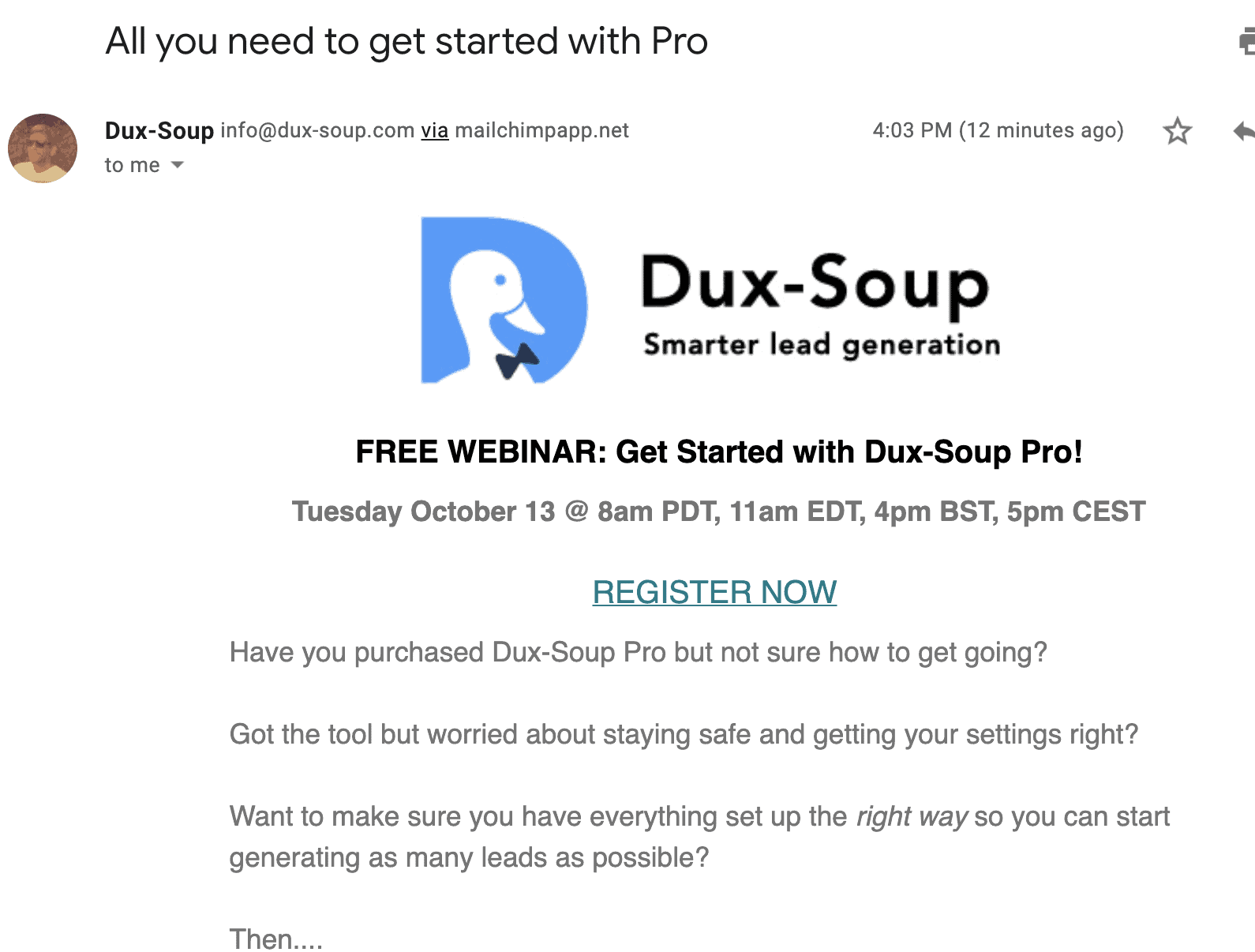
    Then, lo, a perfect case in point arrived in my inbox yesterday. Here’s a screenshot:

    Click 'enable images' to see an example of non-omnichannel marketing

    In this email, Dux-Soup, the nifty outreach automation tool for LinkedIn, informs me of a training webinar about their “Pro” product.

    But.

    Do they know if:

    • I am already a Dux-Soup Pro customer- right now? 
    • I ever was a customer? 
    • I have ever watched their webinars before?
    • And if so, whether I have already watched this one?
    • Or whether I’ve clicked or seen on their ads on LinkedIn – or Reddit, or Google?
    • Or visited their Unbounce landing page?
    • Or whether my Twitter bio has the keyword, “marketer?
    • Or whether I am a native French speaker?

    The answer to all of the above is “no” – they don’t know. And that matters not at all.

    All they know is I’m on their list. They don’t know whether I am the perfect target for this communication, but they know that I might be. Et voila.

    *   *   *

    By all means, segments your lists. Microtarget. Practice rapid-research-personalization. Also – do move data in to your email marketing system. Pulling it from webinars or wherever else.

    But be careful automating, synchronizing, and CRM-implementing, to get your message out on multiple channels and platforms at once. The idea of finely orchestrated outreach on dozens of channels and platforms may be alluring. But as for the technology, processes, and automation behind it – there are better things to spend your time on.

    By the way, I just noticed a new product offering from Dux-Soup – “Turbo”. Maybe that’s what happens when you avoid wasting time on omnichannel marketing – you make something new instead.

    -Rowan

  • How to Listen to Amateurs

    You may hear this “meta advice”: do not take advice on ______ (fill in the blank: entrepreneurship, drawing, basketball, content marketing, etc) from those who are new, failed, low-scoring, or generally unaccomplished.

    Not just because advice from such people is annoying but because it’s not useful.

    I agree to a point – results matter. But so does effort. And no, not just as a consolation prize.

    The Maximum Effort Effect

    Pop quiz: what has longer legs, an elephant, or a giraffe?

    An elephant, actually – longer hind legs. This is something you would definitely notice and know if you spent an hour not just looking at an elephant and a giraffe, but drawing them on paper with a pencil. Or rather, drawing whatever shapes you see in front of you, elephants and giraffes included.

    One of the reasons that drawing is hard work is that it forces you to see things as they really are; you can’t rely on the convenient symbols or other preconceptions in your head.

    I studied the art of giving and receiving critical feedback in a studio drawing class at university.  The art teacher seared this idea into our heads:

    Any “maximum-effort” work of art has value.

    Not economic value, necessarily, but teaching value. It’s like a silent piece of visual advice, just sitting there.

    Our teacher understood that even a great artist can learn from a drawing that seems (and is) terrible, amateur, ugly, unskilled, etc. But only if whoever makes it tries as hard as they can to make it as good as they can. However that turns out. This is the Maximum-Effort Effect.

    And she was right. In my class, there were bad drawings that were just lazy and there were bad drawings resulting from great exertion. If you paid attention, you could easily tell the difference. There was something to learn from the effortful attempt – maybe something that helped your own next attempt.

    Similarly, there’s value to any entrepreneurship advice based on the maximum effort of the (amateur/failed entrepreneur) advice-giver. 

    Maximum effort means physical exertion but mostly mental and psychological exertion. Even in sport, this is true. I played organized basketball for 15 years but one of the best pieces of advice came from a guy who never played anything but “pickup” basketball at the park: “if you want to learn to shoot with your non-dominant hand, select one type of shot (eg baby hook shot) and master it first – before attempting other types of shots”.

    As in sport, in entrepreneurship, drawing, and content marketing, the effort is largely mental and psychological – you struggle to embrace patience, an open mind, consistency, deliberate reading and research, and a willingness to look foolish.

    I value the opinions of any entrepreneur with these qualities, even if they have never built an electric sports car or averaged 30 points a game.

    -Rowan