Author: remap_content_admin

  • Your favorite workaround?

    Have you heard this?

    • “We have a kind of makeshift workaround for that”
    • “Well, we don’t actually use that software at all. We just do blah blah blah and then put the information in spreadsheets”

    Workarounds and spreadsheets – the two key signals that someone needs better a product solution. Probably software, but maybe other kinds of products you make – training, process, certification, coaching, and more.

    My software-company clients often report that their products eradicate the Excel spreadsheet-pain felt by their customers. As they should explicitly mention in their marketing copy.

    To which companies like SmartPlanner and SmartSheets have said, “no problem, we’ll just make better spreadsheet software so you can make better workarounds”.  Notion and Google Sheets fall halfway into that category too.

    This is great; these products work well for some people – digital-savvy people like you and your employees, partners, and colleagues. 

    But if your customers confess to “running their businesses” on spreadsheets, or talk about having “dozens or hundreds of spreadsheets for that”, then they might need your product.

    But how do they know if your product will help?

    Because you have learned exactly what their workarounds are, you know how Excel is a part of those workarounds, and you are able to repeat all this back to them.

    Seth Godin:

    I’m not really interested in helping you become marketing-driven because it’s a dead-end.

    The alternative is to be market-driven – to hear the market, listen to it, and even more important, to influence it, to bend it, to make it better. 

    When you’re marketing-driven, you’re focused on the latest Facebook data hacks, the design of your new logo, and your Canadian pricing model. On the other hand, when your market-driven …. you listen to their frustrations and invest in the changing culture.

    You can be market-driven if you keep asking customers, “What are your workarounds”. Eventually, you’ll learn how your products can replace them.

    My best,
    Rowan


  • This Is Marketing

    I listened to This Is Marketing the third time this weekend and decided to order the print version. Why?

    Because I want to browse the table of contents. I also have the Kindle version but it fails to display the entire table of contents.

    A few observations and This Is Marketing and its table of contents:

    1. The book defines marketing as the author thinks it should be, not necessarily as it is.
    2. The book consists of 236 separate chapters and subsections. On the Audible version, each one is a self-contained audio recording that can be listened to by itself.
    3. The “book” is actually an “audio program”. I love this approach; you’re not listening to someone read a book, you’re listening to a radio program. I have no idea what the production process was, but it feels as though it were made as an audio program first, with the book an afterthought. Also true of Malcolm Gladwell’s recent work, Talking to Strangers.
    4. The book contains 11 case studies but only 1 is from the author’s personal experience: Vision Spring—Selling Glasses to People Who Need Them. The takeaway is to look outside your own work for case studies.
    5. B2B sales and marketing are addressed in two places, including chapter 19, section 17, “An aside about B2B marketing”; that one is a must-read/must-listen for your business.
    6. The book doesn’t give you easy answers. To implement these ideas in your marketing will take some thinking.
    7. While the Kindle version comes with a “Marketing Reading List”, only two books are endorsed in the book itself: Story Driven by Bernadette Jiwa and Impro by Keith Johnstone.
    8. You get the sense that the author is not letting on as much as he knows. In the final chapter, he casually says, “ever since Josiah Wedgewood invented marketing” while making an unrelated point. How so – how did Josiah Wedgewood invent marketing? 

    This is his first book in a while directed at marketers, as opposed to business owners and entrepreneurs. But – per his discourse on psychographics vs demographics – it’s directed to a certain type of marketer.

    It’s also a response to an oughts-era critique of Seth Godin by a pundit at Time magazine. For context, Time was still a respected and influential publication in the late oughts. The Time pundit said of Seth Godin’s oeuvre: “Entry you’ll never see: is marketing evil?”

    Not sure how you come to that conclusion about an author whose first book, Permission Marketing (1999), basically said, “let’s use the Internet to start marketing ethically”.

    A Time blogger also asserted that Seth Godin’s books “largely recycle common sense”?

    Sidebar: notice the qualifier, “largely”? Avoid adjectives and adverbs in your marketing copy that hedge – take a stand. Either make an assertion or don’t; that’s how you gain trust.

    But let’s thank Time and its pundits for prompting Seth Godin to write the 2009 post we’d “never see”: Is Marketing Evil?

    The answers he offered in that post comprise a unifying theme to This Is Marketing. That’s because what lies at the core of the book, “Changes for the Tribe”, probably means change for the better.

    Okay, enough ado.. 

    This Is Marketing, Table of Contents:

    • Author’s Note
    • This Is Marketing
      • How Tall Is Your Sunflower?
      • It’s Not Going to Market Itself
      • Marketing Isn’t Just Selling Soap
      • The Market Decides
      • How to Know if You Have a Marketing Problem
      • The Answer to a Movie
      • Marketing Your Work Is a Complaint on The Way to Better
    1. Chapter One: Not Mass, Not Spam, Not Shameful . . .
      1. The Compass Points Toward Trust
      2. Marketing Is Not a Battle, and It’s Not a War, or Even a Contest
      3. The Magic of Ads Is a Trap that Keeps Us from Building a Useful Story
      4. On Getting the Word Out (Precisely the Wrong Question)
      5. Shameless Marketers Brought Shame to the Rest of Us
      6. The Lock and the Key
      7. Marketing Doesn’t Have to Be Selfish
      8. Case Study: Penguin Magic
      9. You’re Not a Cigar-Smoking Fat Cat
      10. It’s Time
    2. Chapter Two: The Marketer Learns to See
      1. Marketing in Five Steps
      2. This Is Marketing: An Executive Summary
      3. Things Marketers Know
    3. Chapter Three: Marketing Changes People Through Stories, Connections, and Experience
      1. Case Study: Vision Spring—Selling Glasses to People Who Need Them
      2. Consider the SUV
      3. That Riff About the Quarter-Inch Drill Bit
      4. People Don’t Want What You Make
      5. Stories, Connections, and Experiences
      6. Market-Driven: Who’s Driving the Bus?
      7. The Myth of Rational Choice
    4. Chapter Four: The Smallest Viable Market
      1. What Change Are You Trying to Make?
      2. What Promise Are You Making?
      3. Who Are You Seeking to Change?
      4. Worldviews and Personas
      5. Forcing a Focus
      6. Specific Is a Kind of Bravery
      7. Shun the Nonbelievers!
      8. Where Does Love Lie?
      9. “Winner Take All” Rarely Is
      10. A Simple One-Word Transformation
      11. Coloring the Ocean Purple
      12. “It’s Not for You”
      13. The Comedian’s Dilemma
      14. The Simple Marketing Promise
      15. Case Study: The Open Heart Project
    5. Chapter Five: In Search of “Better”
      1. Empathy Is at The Heart of Marketing
      2. A Million-Dollar Bargain
      3. Thinking About “Better”
      4. Better Isn’t up To You
      5. The Marketing of Dog Food
      6. Early Adopters Are Not Adapters: They Crave the New
      7. An Aside About the Reptile People Who Are Secretly Running Things
      8. Humility and Curiosity
      9. Case Study: Be More Chill—More than One Way to Make a Hit
      10. What’s a Car For?
      11. Too Many Choices
      12. Positioning as a Service
      13. Choose Your Axes, Choose Your Future
      14. So Many Choices
      15. People Are Waiting for You
      16. Your Freedom
      17. The Freedom of Better
      18. One Last Thing About Sonder
    6. Chapter Six: Beyond Commodities
      1. Problem First
      2. Does It Work?
      3. The Commodity Suckout
      4. “You Can Choose Anyone, and We’re Anyone”
      5. When You Know What You Stand For, You Don’t Need to Compete
      6. But Your Story Is a Hook
      7. Case Study: Stack Overflow Is Better
      8. Better Is up to the Users, Not up to You
      9. And We Serve Coffee
      10. The Authentic, Vulnerable Hero
      11. Service
      12. Authenticity versus Emotional Labor
      13. Who’s Talking?
    7. Chapter Seven: The Canvas of Dreams and Desires
      1. What Do People Want?
      2. Innovative Marketers Invent New Solutions that Work with Old Emotions
      3. Nobody Needs Your Product
      4. No One Is Happy to Call a Real Estate Broker
      5. Where’s the Angry Bear?
      6. What Do You Want?
      7. Always Be Testing
      8. Scrapbooking
      9. If You Had to Charge Ten Times as Much
      10. Irresistible Is Rarely Easy or Rational
    8. Chapter Eight: More of the Who: Seeking the Smallest Viable Market
      1. The Virtuous Cycle and Network Effects
      2. The Most Effective Remarkability Comes from Design
      3. And Then a Miracle Happens
      4. A Thousand True Fans
      5. But What About Hamilton?
      6. What Would Jerry Do?
      7. Taylor Swift Is Not Your Role Model
      8. All Critics Are Right (All Critics Are Wrong)
      9. Why Don’t People Choose You?
    9. Chapter Nine: People Like Us Do Things Like This
      1. Deep Change Is Difficult, and Worth It
      2. People Like Us (Do Things Like This)
      3. Case Study: The Blue Ribbons
      4. The Internal Narrative
      5. Defining “Us”
      6. Which Us?
      7. It Shouldn’t Be Called “the Culture”
      8. Just Enough Art
      9. Case Study: Gay Marriage in Ireland
      10. Elite and/or Exclusive
      11. Case Study: Robin Hood Foundation
      12. The Standing Ovation
      13. Roots and Shoots
    10. Chapter Ten: Trust and Tension Create Forward Motion
      1. Pattern Match/Pattern Interrupt
      2. Tension Can Change Patterns
      3. What Are You Breaking?
      4. Tension Is Not the Same as Fear
      5. Marketers Create Tension, and Forward Motion Relieves that Tension
      6. Are You Ready to Create Tension?
      7. How the Status Quo Got that Way
    11. Chapter Eleven: Status, Dominance, and Affiliation
      1. Baxter Hates Truman
      2. It’s Not Irrational; Status Makes It the Right Choice
      3. Status Roles: The Godfather and the Undertaker
      4. Status Lets Us
      5. Case Study: Lions and Maasai Warriors
      6. The Status Dynamic Is Always at Work
      7. Status Is Not the Same as Wealth
      8. Six Things About Status
      9. Frank Sinatra Had More than A Cold
      10. Learning to See Status
      11. Different Stories for Different People
      12. Affiliation and Dominion Are Different Ways to Measure Status
      13. Learning from Pro Wrestling
      14. The Alternative to Dominion Is Affiliation
      15. Fashion Is Usually About Affiliation
      16. Sending Dominance Signals
      17. Sending Affiliation Signals
      18. Affiliation or Dominance Is up to the Customer, Not You
    12. Chapter Twelve: A Better Business Plan
      1. Where Are You Going? What’s Holding You Back?
      2. Perhaps You’ve Seen the Shift
      3. A Glib Reverse Engineering of Your Mission Statement Isn’t Helpful
    13. Chapter Thirteen: Semiotics, Symbols, and Vernacular
      1. Can You Hear Me Now?
      2. What Does This Remind You Of?
      3. Hiring a Professional
      4. Imagine that World . . .
      5. Why Is Nigerian Spam so Sloppy?
      6. The Flags on SUVs Are Called Flares
      7. The Flag Is Not for Everyone
      8. The Same and the Different
      9. Case Study: Where’s Keith?
      10. We Add the Flags with Intent
      11. Are Brands for Cattle?
      12. Does Your Logo Matter?
    14. Chapter Fourteen: Treat Different People Differently
      1. In Search of the Neophiliacs
      2. Enrollment
      3. What Do People Want?
      4. The Superuser
      5. The Truth About Customer Contribution
      6. What’s the Purpose of This Interaction?
    15. Chapter Fifteen: Reaching the Right People
      1. Goals, Strategy, and Tactics
      2. Advertising Is a Special Case, an Optional Engine for Growth
      3. More than Ever, but Less than Ever
      4. What Does Attention Cost? What Is It Worth?
      5. Brand Marketing Makes Magic; Direct Marketing Makes the Phone Ring
      6. A Simple Guide to Online Direct Marketing
      7. A Simple Guide to Brand Marketing
      8. Frequency
      9. Search Engine Optimization and the Salt Mines
    16. Chapter Sixteen: Price Is a Story
      1. Pricing Is a Marketing Tool, Not Simply a Way to Get Money
      2. Different Prices (Different People)
      3. “Cheap” Is Another Way to Say “Scared”
      4. And What About Free?
      5. Trust and Risk, Trust and Expense
      6. Be Generous with Change and Brave with Your Business
      7. Case Study: No Tipping at USHG
    17. Chapter Seventeen: Permission and Remarkability in a Virtuous Cycle
      1. Permission Is Anticipated, Personal, and Relevant
      2. Earn Your Own Permission and Own It
      3. Tuma Basa and RapCaviar
      4. Showing Up with Generosity
      5. Transform Your Project by Being Remarkable
      6. Offensive/Juvenile/Urgent/Selfish Is Not the Same Thing as Purple
      7. Suspending Fight Club Rules
      8. Designing for Evangelism
    18. Chapter Eighteen: Trust Is as Scarce as Attention
      1. What’s Fake?
      2. What’s Trusted, Who’s Trusted?
      3. The Trust of Action
      4. Famous to the Tribe
      5. Public Relations and Publicity
    19. Chapter Nineteen: The Funnel
      1. Trust Isn’t Static
      2. You Can Fix Your Funnel
      3. Funnel Math: Casey Neistat
      4. The Sustainable Direct Marketing Funnel
      5. An Aside on Funnel Math
      6. The Truth About Your Funnel
      7. Life on the Long Tail
      8. The April Fools’ Passover Birthday Easter Shirt
      9. There’s a Way Out
      10. Bridging the Chasm
      11. Where’s Your Bridge?
      12. Surviving the Chasm
      13. You Might Not Find the Bridge
      14. Case Study: Facebook and Crossing the Biggest Chasm
      15. Crossing the Local Chasm
      16. Clean Water in a Local Village
      17. An Aside About B2B Marketing
    20. Chapter Twenty: Organizing and Leading a Tribe
      1. It’s Not Your Tribe
      2. The Power of Now, Not Later
      3. Manipulation Is the Tribe Killer
      4. Shared Interests, Shared Goals, Shared Language
      5. It Will Fade if You Let It
      6. Take a Room in Town
    21. Chapter Twenty-One: Some Case Studies Using the Method
      1. How Do I Get an Agent?
      2. Tesla Broke the Other Cars First
      3. The NRA as a Role Model
      4. Getting the Boss to Say Yes
    22. Chapter Twenty-Two: Marketing Works, and Now It’s Your Turn
      1. The Tyranny of Perfect
      2. The Possibility of Better
      3. The Magic of Good Enough
      4. Help!
    23. Chapter Twenty-Three: Marketing to the Most Important Person

    You read all the way through? Then you’ll love the book.

    Have a great week ahead,
    Rowan

  • Playing With Fire 🔥

    Talking about an idea saps my enthusiasm for it – it’s as if I can either “spend” my enthusiasm on talking or doing.

    Can you relate?

    Example 1 – converts fire to thing: Last year, I built a simple productized service. To my self-satisfaction, it had self-service ecommerce payments, monthly recurring subscriptions, and scheduling built-in. I did it because I felt like I had to. Because there had been a small fire inside that I had to put out. I told no one about it until it was done. I have customers using it now; it makes them and me happy.

    Example 2 – converts fire to discussions: I’ve had the idea for a different productized service in my head for about 3 months but for someone reason, I haven’t put the work in to build it. Moreover, I feel my interest waning.  It’s too bad because I see demand for it swelling during the pandemic.

    Reflecting back on example 2, I realize I discussed it with three people. These people were either partners with whom I’d collaborate or prospective buyers. Yet still, conversation with them dampened the fire to create.

    The fire starts as a spark within you and comes from either hate or love. You’ll hear yourself say:

    • I hate these…
    • But that sucks…
    • Oh god, I love that…

    Next, you’ll have an urge to bang out your ideas to a friend via email or chat. That’s how you insta-quench conversation-lust, right? Setting up a time for a live conversation takes too much time.

    Alternatively, you can feed the spark with:

    • Your research and reading on it
    • Writing about it
    • Building it

    Fast forward and you’re bringing a product to market. You and I are product marketers. Meaning we put products in the market then shape and reshape them until they fit. You can call your product “services” too, it doesn’t matter. ((The distinction between products and services matters, but less than we think. There are managed services entrepreneurs who do less busy-work than SaaS entrepreneurs, whether intentionally or not. The distinction is between a business model wherein (a) the owner primarily does the work and (b) the owner’s system primarily does the work ))

    The point is that unlike product research, writing((Sidebar thought: your writing on your business idea gives you (a) marketing ideas and (b) marketing copy)), and building, product talk blows out the flame of your creative enthusiasm.

    Counterpoint: conversation is an amazing ideation tool, especially one-on-one, but group conversation too, if it favors research.

    In fact, you must discuss complex business ideas. There are too many details to work out. Too many unsolved questions that conversation brings instant answers to. (And yes, they are fascinating!)

    The principle of Creative Destruction means your business-mind will spark during the post-pandemic economy. Talking about the pandemic helps; all these new problems. Your product-marketer mind will evaluate the worthfulness of every product and service you’ve been selling, and consider new alternatives.

    The things you have been selling – those you should talk about profusely, yes. But careful with the new alternatives.

    How do find balance between talking and doing?

    My advice is never to talk about your business idea enough that you’d bore a stranger on a plane.((An Italian aviation design firm has proposed airplane seats that will combat boring passengers and coronavirus contagion at the same time))

    That’s just good manners, firstly. But it also still your tongue. Minimum Viable Rant.

    But maybe your audience finds your idea interesting enough to question you – be careful.

    Always end the conversation about your product idea with at least one more thing you have an urge to say, one more point to clarify. And squash it – use that urge to do some work.

    Herzlich,
    Rowan


  • How to Name a Brand

    Three naming stories:

    Long ago, I had a friend whose parents were hippies and named him Sunny Day. He changed his name to John in highschool. Then when he got to college, he reverted to Sunny Day.

    When I became a part-owner of Free Flow Data in 2008, I didn’t like the name. I systematically came up with over 1000 possibilities but settled on Freeflow Digital

    The best name change I ever witnessed was in 2007 when a Salesforce consultancy in the nonprofit space changed its name from The Data Connecters  to Groundwire

    Since then I’ve named a few company brands and product brands – even non-medical face masks for COVID-19 prevention. I tried to name a human being Agamemnon but his wise parent opted for Samuel. Feel free to steal Agamemnon for your child 🙂

    More thoughts on naming:

    1. Meet Perious, Duction, and Hencott. What do they have in common?

    • They don’t exist in the dictionary
    • They are available as domain names, though not as .com’s
    • They’re fairly memorable
    • They have two syllables and 7 letters
    • They seem like English words
    • I didn’t make them up; I found them on Wordoid

    Also, if you put these names together in order to brand three related products, they form a “naming architecture”. Such as releases of the WordPress CMS that are all named after Jazz musicians.

    Some other good naming ideation resources include: 

    2. What do guest, member, associate, resident, supporter, donor, voter, patron, visitor, student, and constituent have in common?

    Sometimes they’re much better names than customer. Or client.

    3. Naming principles

    • Make the name unusual so it carves out its own space in the brain. Jet Blue not WealthTech. Or: Duracell, Bounty, Gain, Tampax, Old Spice. And about 150 other comprising Proctor & Gamble’s house of brands.
    • Make the name unusual to give it a searchability advantage on search engines. Jet Blue not Computer World.
    • Make it easy to spell, say, and pronounce. Jet Blue not Wii.
    • If need be, feel free to use two words to make a name; shorter the better. Jet Blue. But not three… duckduckgo.
    • Don’t worry too much about a short domain name or a .com (or .org) TLD.
    • Your name doesn’t have to evoke the primary language you do business in anymore. Communo works for example; it evokes Esperanto though they do business in English.

    How did you come up with your brand’s name?

    My best,
    Rowan


  • Prospecting Faces

    In about 43,000 scientific experiments a year, we look for answers to our problems in the bodies and brains of mice.

    Dozens of COVID-19 vaccines are being tested on mice right now. I believe one of them will work.

    Meanwhile, one research study sees physiological changes in the brains of mice as they acquire expertise.

    When learning a new task, brain activities alter over time as mice transition to an expert from a novice. The changes are reflected in neural networks and neural activity. As the animal’s knowledge grows, neural networks become more focused. 

    Why bring this up now, in relation to prospecting?

    Because if there’s any marketing activity that instamorphs the brain, it is prospecting. 

    One trick that larger companies use to enforce non-linear, holistic thinking is having everyone do customer support for X number of weeks per year. Sometimes starting out.

    Comprehensive prospecting could work the same way – especially if you get beyond demographic profiling and try to get personal: look at faces and listen to what’s said on forums.

    When you prospect people who might buy your solution, you might find yourself:

    • Imagining a conversation with
    • Repeating the same words as they use to describe their problem
    • Calculating their revenue and overhead, and imagining where your solution fits in
    • Picturing their success

    Fictional Case Study 

    Let’s say car dealers in states with restrictive lockdowns, such as California, are getting just 10% of the foot traffic they were used to pre-pandemic. And the local newspapers just went out of business.

    The economy is shrinking, yes, but some people still need cars – how do car dealers reach them?

    You decide to create a niched-down rideshare ad platform like Vugo that lets car dealers advertise to Lyft and Uber passengers through an Ipad mounted onto the back of the passenger and driver seats. 

    Who are your prospective customers? Secondarily, Lyft and Uber drivers who sell ad space. But your primary buyers are owners or executives car dealerships in California:

    [This is an image of faces - click on enable images to see it]

    Step 1 is pulling up a list of faces (LinkedIn Sales Navigator is great here), step 2 is finding out what they are complaining about and where. Step 3 is letting your brain’s neural networks morph like a mouse expert.

    My best,
    Rowan


  • Positioning

    April Dunford rightly believes that:

    Positioning is the foundation of everything we do in marketing and sales [and product design]. It’s an input and the starting point for messaging, copywriting, sales enablement, campaign planning, content development, sales tool development, and so much more…

    Aristotle believed that all living things – plants, animals, humans, and Gods – had two essential qualities. If you get this, you can understand yourself and trace good and evil. They were ergon and arete.

    Ergon is what a thing does that nothing else does. Arete is what a thing is excellent at, which is also its virtue.

    The ergon of humans in general, argued Aristotle, was logic and reason. And our resulting arete was philosophy. In other words, our practice of philosophy is our virtue; it’s the best product of our logic and reason, and it’s good – morally beneficial.

    What impedes it is therefore evil.

    If you look at what you do as a calling (consulting, tech entrepreneurship, teaching) this starts to make a lot more sense. A calling is good for the world; what impedes it detracts from that good.

    Is Aristotle’s ergon-arete framework is also a solid positioning system?

    Fast-forward 2500 years to 2020.

    In February, Zoom is the business web conferencing software of choice for the tech-savvy.

    In April, Zoom is how friends, families, and social groups around the developed world connect. 

    And in a sign of how fast market positioning changes, some of the tech-savvy don’t want it anymore.

    For years, Zoom was all-in on the high-end B2B market, fanatically inserting “enterprise” into every line of marketing copy; it was the lean, cloud-based alternative to corporate junkware such as GoToMeeting and Webex.

    Zoom’s unique feature was video beauty: high-quality video combined with face filtering on par with Instagram – no alternative makes you look as good, including meeting in person.

    What a brilliant product focus – human vanity.

    Zoom’s second most important feature was being free – for meeting hosts and attendees both. Of course, lots of web conferencing software is free, such as Skype or Hangouts. But not enterprise web conferencing software.

    It’s third-most important feature was being relatively hassle-free.

    Put it all together, mix in a pandemic, and you’ve got 200-million daily active Zoom users who mostly don’t pay a dime and don’t use it in a work setting, let alone in a corporate one.

    So how does Zoom position itself now?

    This tale shows why it’s a mistake to think of positioning as a one-off decision, as evinced by the expression, “the positioning decision”.  A decision implies finality, resolution, conclusion; none of which really exists in the world of B2B technology solutions. The business problems keep bursting open in new, unpredictable ways.

    The “positioning process” is a little closer to how you should approach positioning your products and services.

    Set aside the Ries & Trout definition of positioning for consumer goods. We’re talking about finely calibrated B2B products and services that are made, understood, bought and sold by tiny sliver-droplets of our enormous ocean of an economy.

    In this ocean, Aristotle is more relevant than Ries.

    Imagine for a moment that you asked Aristotle to attribute ergon and arete to “solutions”. He would say: what does it do that nothing else does, what is it excellent at as a result, and what, by extension, is its virtue?

    Good positioning says what your product does in the market category you place it in, so that its strengths appeal to ideal customers.

    Part of its appeal lies in its virtue – how is it good/fair/equalizing/happiness-inducing for the world – and for your customer? How does it make them a hero, as Donald Miller would say?

    Say what you want about security issues, it’s pretty clear how Zoom is good for the world – how it makes you a small hero, in some small way, resisting this pandemic by connecting anyway.

    My best,
    Rowan


  • Comfortable vs Safe

    I know a dealer of rare books whose website has averaged 30k unique visitors a month over the last 15 years. As it should – it contains handwritten descriptions and color photographs of about 10,000 rare, unusual children’s books. You can’t recreate these objects. They are as unique as antique furniture or artwork. Not the most elegant website but content is king here.

    Long ago I advised them to run Amazon ads. Fortunately, they ignored that advice.

    My thinking was that some of their site’s visitors are interested in a children’s book – but not an expensive, rare one. They just want a copy of the book they had as a child. Their website analytics confirmed this theory – about half of the site’s visitors were simply “looking for a children’s book” (the site ranks high for that search on Google, Bing, and DuckDuckGo). So send those non-buyers of expensive, rare books to Amazon to pick up a cheap reprint.

    Now I realize this advice was bad. It would have been good to run ads – but not Amazon affiliate ads, which is what the Amazon Associates program amounts to.

    Proof that my advice was bad came out in this week’s news – Amazon will slash affiliate commissions by 60% to 80%. This will reduce income for a lot of niche online publishers. Some publishers have designed and cultivated a content marketing strategy relying on ads. When you start making money from a given source, you want to amplify that – you turn your own website and its copy into the top of an Amazon.com sales funnel.

    Then poof – the pandemic hits, Bezo’s net worth goes up by 24 billion, and Amazon doesn’t need your warm leads as much as it used to.

    Last week you made 20k on commissions, next week 7.5k – for the exact same value delivered to Amazon.

    Relying on the big ad platforms is a subtle form of digital sharecropping – vice business models such as cannabis know this better than anyone.

    What to do? One approach is to diversify advertising income to reduce risk. Using a tool like Adroll, for example, lets you quickly diversify remarketing advertising across the large digital advertising platforms.

    More precise advice, though, is to create your own advertising agreements directly.

    That’s not nearly as hand-rolled as it sounds – there’s a large ecosystem of independent ad-tech firms that provides products and services that let businesses advertise with one another.

    Who to sell ads to is a non-issue for most of us. If you run a B2B services business, you’re probably not capable of driving a significant number of people to someone who would run ads on your site.

    But on the flip side, you can also buy ads through the independent B2B advertising ecosystem. I already wrote about the new audience intelligence too, SparkToro (which has many uses beyond ad targeting), but there are dozens of other options out there for crafting your own digital advertising strategies.

    Options that let you cut out the gigantic middlemen of our day. 

    All the best,
    Rowan


  • Your Digital Self

    In Mad Men, Don Draper’s character didn’t really exhibit marketing or advertising skill but his selling skills were first-rate. This resembles today’s typical digital/creative agency principal. The Draper character:

    • Listens 80% of the time, speaks 20%; doesn’t say much apart from pointed questions until there’s something to say
    • Analyzes the problem he perceives, not the one that’s dictated to him; this lets him identify the unexplored selling point and propose a strategy for capitalizing on it
    • Leans forward, raises his voice, and creates eye contact when saying the most important thing.
    • Has professional integrity; happy to let a deal die if it’s a right fit in enough ways
    • Transfers happiness from himself or elsewhere to the audience he sells to

    You can do all of that on a Zoom call – sell complex B2B services.

    And Without “pitching”, the one sales act of Don Draper we probably don’t want to emulate in our businesses today.

    I was and am a fan of Win Without Pitching because of this sentence: “Experts write.” Because the book makes a strong case for content marketing – though content marketing by itself no longer does what it once could. I remember writing a blog post in 2007 about Highrise vs CRM software and the next day Jason Fried left a comment. That doesn’t happen anymore for the Internet-not-famous such as me. ((Looking up the post on the Wayback Machine, I see that I wrote, a web based CRM, however simple, should have at least two ‘relationship’ features: (a) form publishing tools, to create contact relationships efficiently and (b) email marketing tools, to maintain contact relationships efficiently.)). Content marketing requires tremendous effort now and it’s worth it to divert some of that into other marketing activities. Still though, “expert write”. That’s what makes them an expert; that’s why ghostwriting is hardly better than advertising.

    Anyway, another question I have about the book is the idea that you don’t pitch at all. I think it’s more that you don’t spend much effort pitching. You don’t have to make a deck or a PDF or infographics or product “copywriting” per se. You compress your pitch into one unvarnished sentence in a normal email. Maybe two.

    Idea assets in sales and  marketing should telescope (verb). Every length from a single sentence to an entire book has its place in your arsenal.

    Just as the book Pricing Creativity makes the case for one-page proposals over 30-page ones.

    Just as 300-page books are pitched as one-page queries to publishing houses.

    Just as a case study can be compressed into one sentence –  why should a case study be a certain length. People think a case study needs a serious tone but length doesn’t help there.

    Here’s a case study: We provided [company] with [thing you provide] giving them [results/implied problem]. One sentence.

    Do longer, traditional-length case studies work better? Maybe and only if they’re extremely well written. Especially if you don’t do any content marketing. But they are also less flexible. You can write 100 one-sentence case studies in the time it takes you to write 1 traditional one. 

    That’s what works for me anyway – if accompanied by my Zoom self. The web-conferenceing-self is partly manifested by assembling the right home studio tools and practicing using them((In the future, every knowledge worker will have a home radio/tv studio; COVID-19 won’t quite get us there though)). Act now and you can still have a more professional office than half the news anchors on “cable TV” – “cable TV” is like the rest of the news programs on YouTube, except better makeup and lighting and slicker virtual backgrounds.

    That’s really the key though: your pitch, your case study, your proposal, whatever you want to call it – it has to be accompanied by you, live. As the author of Win Without Pitching says, a proposal is like a small child: it should never be let out of the house without a chaperone.

    Not sure the pandemic economy lets indulge in the luxury of marketing materials, let alone in-person visits. So I hope we find a way to say our piece in fewer words, with our talk-less, listen-more digital selves taking questions.

    My best,
    Rowan


  • World’s Largest Social Network

    [Click "enable images" to see this new yorker cartoon about email]

    If you’re like me, you go to the dictionary when someone tells you [thing not usually referred to as such] is a social network. Email as a “distributed social network” is more apt. Some facts:

      1.  Email is an enormous network that includes almost 4 billion users and 5.6 billion user accounts. That’s more than Facebook, Instagram, and Twitter combined daily active users. If you own some kind of complex B2B services business, 100% of your present and future customers, partners, and employees are on email. ((Source for global email statistics: Radicati (PDF). Though it has to be noted that this data is pre-pandemic.))
      2. Email usage is tremendous and growing: 140 billion non-spam emails are sent every day. Total email accounts and usage will grow significantly in the coming years, with total increased accounts resulting from the bifurcation of work and personal accounts.((Ibid)) But of those 140 billion, how many are wonderful? 1% at the most? This is our opportunity. 
      3. You control your email; it’s the only large social network not controlled end-to-end by a private 3rd party company. If you own, yourname@yourdomain.com, nobody can take that from you. Just like your yourdomain.com website. A governmental body enshrines this status quo. The Big 5 controls the email client software category – but as part of the open email network. And subscription email marketing software like Mailchimp, as well as outreach email software such as Mailshake, are still diversified, competitive markets. 
      4. Email is a private two-way channel. Any email including the one you’re reading now, can initiate a private one-to-one conversation. This is why it’s amazing that any but the largest consumer brands would use an impersonal email address (info@, noreply@). Email is more conducive to meaningful interaction than social media.

    Switching from fact to conjecture, consider the fact in-person communication shrinks in proportion to the growth of the pandemic and its economic aftershocks. Filling the face-to-face gap: Slack, Skype, phone, Zoom – and email. 

    Armed with these considerations, I’d find a way to use email to grow your business.

    I have no opinion on email for internal operations except for one: there should never be more than 2 people on an email thread; 3 is permissible, 4 or more you’re wasting someone’s time.

    But for communicating with the outside world, I have too many opinions about email to cram into this communiqué. But think of business email as having three branches: subscription email-marketing, transactional emails, and outreach email.

    A few ideas off the top of my head to get you started:

    • High-frequency subscription email marketing is practiced by almost every expertise-based B2B/B2P((I use B2P to mean Business-to-Professional, ie, not necessarily a B2C consumer and inclined to purchase business solutions)) business I can think of. 
    • Transactional email can be multi-episodic. I’m bad about this, but when you signed up for this newsletter, you (hopefully!) got a welcome email. That’s a “transactional email”. I should have a sequence of transactional emails to welcome new subscribers; most bigger brands do and they’re usually terrible. Which gives you a chance to stand out.
    • Transactional emails are usually created by software  (Calendly, Eventbrite, WordPress, Jira) which provide defaults. Don’t use those defaults; write them. Write them in the first person and sign your name to them.
    • If you book meetings or demos, you can also append short (start with 2) transactional email sequences to them.
    • Subscription and transactional emails can have a replete footer just like a webpage, as you can see if you scroll down.
    • Outreach email isn’t just for trying to sell products or services; it’s also for recruiting staff and partners, contacting the press, promoting content, and recruiting event (in-person or not) attendees. And all that without spamming anybody.

    Now is a good time to do some email social networking – if you choose to do so, reply and let me know how it goes.

    Have a great week ahead,

    Rowan

  • Independent Renaissance

    Do you remember this moment from about 18 months ago?

    Senator Orin Hatch: So, how do you sustain a business model in which users don’t pay for your service?

    Mark Zuckerberg: Senator, we run ads. [smirk]

    Because it’s apparently fun to mock older people, that moment was instantly meme-ified and decontextualized, complete with the Zuckersmirk.

    But Senator Hatch was perfectly aware that Facebook runs ads. He asked a rhetorical question to make a point about Facebook’s congenital tendency to impinge on the right to privacy – a perfectly relevant point given why Facebook was under investigation in the first place. Facebook had sold private information about its users to a business called Cambridge Analytica, which then resold that information to Russia so the latter could run more effective political ads in the US presidential election.

    Smirk, huh?

    Did Zuckerberg not know it was a rhetorical question? Or did he pretend not to know, hoping the resulting cheap laugh would obfuscate the enormity of the subterfuge Facebook was party to? Either way, it worked.

    But Senator’s Hatch’s question hasn’t gone away and it has implications for anyone looking to grow their business through paid advertising.

    Since the scandal, many have called for an outright ban on targeted advertising (which would cripple Facebook… but not Google).

    I’m not about to tell any of you to stop running Facebook ads, or Google display ads that use demographic targeting. Or to stop sending emails that track opens, as does Mailchimp, the product I use to send you this email (I have disabled link tracking but I’m not allowed to disable open tracking without running the risk of being labeled a spam emailer).

    But we should all be careful about demographically targeted display advertising in the long term – maybe even the short term. Certainly don’t build a lead generation that relies solely on Facebook ads, such as Sam Oven’s Consulting.com (don’t click it or his face will follow you around the Interwebs for months – unless you’re using Duck Duck Go).

    Because this pandemic is making us question everything.

    For example, the British government has demanded that Google reveal its search algorithms to – this part is amusing – a “working SEO consultant”. Who will win that lottery?! Six months ago, that would have seemed as absurd as Coca-Cola revealing its formula.

    But today close to 2 million people around the world have the coronavirus and everything is on the table.

    We don’t know when our business will return to “normal” but we know the safest harbors for our marketing are those that’ll have respect for privacy.

    The winner then is still content marketing – the more accurate expression of the value of your solutions, the refinement of your expertise. Maybe that’s why Jason Calacanis’s latest venture is pure content marketing – an aggregator of personal daily newsletters.

    But that doesn’t mean advertising is dead; not at all! It never will be, nor should it be. Done right, advertising is a helpful signpost in a crowded marketplace. Advertising existed long before digital platforms feasted off the appropriation of private, personal information and built the massive monopolies called out by Andrew Keen((The book in which Keen called out the Internet as a plutocracy breeding ground is The Internet Is Not the Answer https://www.amazon.com/Internet-Not-Answer-Andrew-Keen/dp/0802124615.

    Soshana Zuboff’s Surveillance Capitalism painstakingly details the intrusion of digital advertising and Big Tech in general into our lives. She makes a strong argument that this status quo isn’t inevitable.
    )). Yesterday I mentioned the new venture of SEO legend Rand Fishkin, SparkToro, which aggregates anonymous audience intelligence in a GDPR compliant way. What does it do?

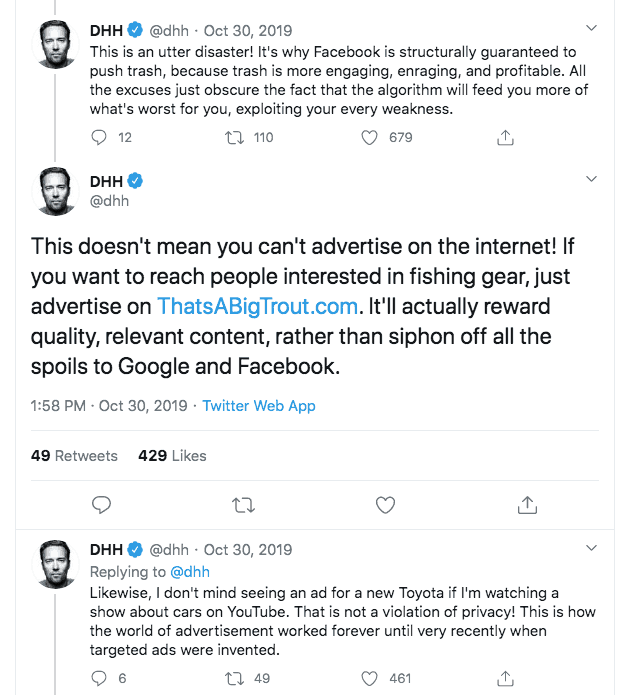
    So if you want to, as DHH says, sell fishing gear, you can sell it directly on a fishing website, instead of spying on people’s Facebook account to see what photos they share with family and friends. And cut out the middle man by brokering your own deal directly, advice I remember reading from the Shoemoney digital marketing blog back in 2006 (looks like he put the site on display advertising cruise control many years ago; wouldn’t look for guidance there now).

    You can use a tool like Pitchbox to do that deal brokering. Or any old prospecting tool combined with email outreach, prospect.io, apollo.io, the list goes on.

    Enable images to view this: three tweets and advertising and privacy from DHH

    Earlier this week, a colleague and I tried to help a major B2B merchandiser distribute non-medical face masks to potentially millions of people. But the Facebook-Google duopoly had at that point put the kaibosh on all forms of advertising even referencing coronavirus or COVID, directly or indirectly. Did they do it out of civic duty or to avoid liability? I don’t know.

    I do know that millions of business and independent professional have the ability to do business directly with one another. Affordable tools keep getting better; guidance keeps flowing through videos, podcasts, newsletters, and blogs.

    So maybe the clear blue waters of Venice aren’t the only silver lining to this terrifying black cloud of a health crisis – maybe we’re in for a true B2B marketing renaissance.

    Have a great weekend,
    Rowan