Author: remap_content_admin

  • How to Evaluate Any Strategy

    I lived in London for a year. In my between my Bayswater apartment and Selfridges department store was a cathedral that had been bombed out during WWII. It had been renovated in a way that visually commemorated a time when the people were drenched in fear. To allay that fear, ‘management’ offered these words:

    We shall go on to the end. We shall fight in France, we shall fight on the seas and oceans, we shall fight with growing confidence and growing strength in the air, we shall defend our island, whatever the cost may be. We shall fight on the beaches, we shall fight on the landing grounds, we shall fight in the fields and in the streets, we shall fight in the hills; we shall never surrender

    These are perfectly crafted words. More than that – they form a strategy. In fact, they perfectly fit the definition of strategy I work with.

    1. A set of ideas 
    2. that inspire
    3. a move to 
    4. a position of advantage
    5. over a long period of time

    Can you find each of these qualities in the Winston Churchill speech above? 

    The military maneuverings – the decoy invasion days before D-Day, for example. That was tactics.

    The strategy was the threat of never-ending guerilla warfare in London and other British cities. And the threat of Britain’s only military strength – it’s navy and air force. All the British positions of advantage were invoked. 

    By the way, the audience of Churchill’s speech wasn’t the enemy – it was his people. Just as Salesforce CEO Marc Benioff’s writings are largely aimed at his own people, to inspire them and also clarify strategy. 

    Take action. The next time someone puts a ______ strategy in front of you – a digital strategy, a marketing strategy, a content strategy, a brand strategy. Whatever they call it. The next time you see the word, ask yourself if it meets these 5 requirements.

    You might have to do some homework to get your answer.

    For example, what is a position of advantage, for your business? If someone offers a content strategy, which usually takes the concrete form of an editorial calendar, ask yourself: what position of advantage does it leverage? 

    And another strategy-qualifier – does it inspire you to do the work? By which I mean, does it prick your professional pride, your high standards as entrepreneur, a craftsperson, a consultant, or however you define yourself?

    If a strategy doesn’t inspire you and your people to charge ahead, bin it.
     

  • Expertise-based Content Marketing

    A scientific study demonstrated that your “Big 5” personality traits (Openness, Conscientiousness, Extraversion, Agreeableness, and Neuroticism) can be altered within hours by … content. [1]

    No wonder content marketing is so effective. 

    On that note, I wanted to continue a little on yesterday’s theme of building bridges between yourself and the people who need your solutions.

    I made the point that you need to choose several marketing channels. And that they should satisfy both short and long-term lead generation goals.

    And crucially, that long-term, content marketing is the most reliable form of lead generation for almost every kind of business that you’d describe as niche, technical, creative, and expertise and/or software-driven.

    Possible exception: you are partially owned by Alphabet and have 2 billion in venture capital funding (Verily, née Google Life Sciences). Then maybe leveraging personal relationships is a more reliable form of lead generation. Or just letting Google do your dirty work and silence your competitors. 

    But I doubt it.

    Content marketing is the most reliable, least risky form of lead generation. 

    Not comfortable, maybe. Not pain-free. But safe. Just like having a job is not safe, compared to being self-employed – it’s just more comfortable.

    Content marketing is probably the safest thing you can do with your business.

    But only if you do it right. Which brings me to the other points I wanted to make today.

    1. You need assistants and conspirators to build a bridge

    I don’t care if you are a business of 1 to 10 people or even just a solopreneur. You need help to do content marketing properly.

    This is one of those cases where two people are a magical number and much greater than the sum of its parts.

    Every solopreneur I know of uses multiple people, contractors or consultants, to polish their content marketing. I do this too, but not well. #goals.

    Nor did I do well at engaging co-conspirators when I had 20 employees.

    2.  The owner (or her expert employees) needs to create the content

    There’s an entire industry, called “content mills”, that exists to let you try to get around this rule. It’s futile.

    What do Qwil (lean SaaS startup with 35 employees) and Salesforce (SaaS-behemoth with 35,000 employees) have in common?

    Their CEOs do their own content marketing.

    Qwil’s CEO Johnny Reinsch writes amusing LinkedIn updates; I’d call him a master of the form.

    Salesforce’s CEO Marc Benioff has written on the corporate blog for many years and has published a book. Why doesn’t Benioff spend those precious hours on corporate governance? Partly, because it’s also a way of leading his workforce . Also true for Reinsch. [2]

    But also because writing about corporate governance makes him better at it.

    That’s the thing about content marketing – it doesn’t just help you get customers, it improves the value of your offer and how much you can charge for it.

    A psychotherapist who creates content about her work provides better results than one who doesn’t. (And therefore earns more – more value created, more value earned). And why better results? 

    Because when you put something into writing (or video, or audio) in front of people you don’t know, you think it through. To avoid others correcting you in public. To avoid misleading people with bad information.

    But also because it makes you think more carefully about what you build/do/sell/teach. Don’t think it’s important to think about what you do? Then you’re just a laborer.

    I want to further explore the relationship between ideation and content marketing, but not this time. 

    Content marketing is safe in the long term, but it’s not comfortable. It’s not easy – if you’ve had any trouble with it (as I often have), reply to this email and let me know.

    My best,
    Rowan


    FOOTNOTES & ERRATA

    [1] Digression on the word content: someone remarked that content is what you put in a box. It just sounds like cardboard. Okay, but it’s useful. I must note though, that the scientific study referenced used writings by accomplished authors such as Henri Bergsen.

    By the way, the name of the study is misleading – the study did not use literature per se. It used non-fiction essays, albeit of literary quality, such as you might find published in The New Yorker.

    [2] In a sense, it’s also true for businesses of one, which, properly configured, aren’t really so isolationist, per the first point above. The book to read here is Paul Jarvis’s Company of One

    Programming note: I wrote this yesterday but once again, ran into a logistical snafu with MailChimp, so apologies for not getting this out to you yesterday.


  • Frumpy Lumpy with a Broken Kazoo

    Recently I wrote that an effective approach for creating messaging is to write a letter.

    That’s not just an ideation hack. That’s actually the essence of B2B marketing for niche tech and digital firms – a letter speaks to just one person, naturally, in as little or as much detail as needed.

    How pleased I was with the feedback I got from offering that perspective.

    This is from reader Brant (thanks Brant!), shared with his permission:


    Then it hit me like a cardboard cutout of a blue elephant, I’m not selling my skill set. I’m not selling a set of tools, or even really a process! What I am selling people is solutions in the form of a bridge between where they are and where their clients are. It doesn’t matter how Business A connects to their client pool if they aren’t getting the conversions they need to keep their doors open. What matters is what Business A can do to harpoon clients and pull them out of the water, in droves. When I’m considering a web project for a client I need to view it more like picking them up by the scruff of the neck and changing them from Frumpy Lumpy with a broken kazoo into the Pied Piper for their industry!


    This really nails it – each of us can aspire to sell, ultimately, that bridge. [yes, insert joke here].

    To repeat:

    “What I am selling people is solutions in the form of a bridge between where they are and where their clients are”

    Maybe your customers are Frumpy Lumpy or Grumpy Stumpy, but if they are not the Pied Piper, then you better help them build a bridge by which their customers can find them.

    And you need that bridge by which your own customers can find you, too.

    What is that second bridge made out of?

    Philip Morgan has remarked that the default state of marketing is failure.

    He has also remarked that most B2B lead generation advice is terrible. 

    I’d add that most B2B lead cultivation advice is quite bad too, though not as.

    Why are all three things true?

    Because most marketing advice consists of letting you off the hook. The hook is what you’re on when you commit to content marketing.

    Building an excellent content marketing program is just as hard as building an excellent software program. But people don’t buy that.

    A couple years ago I wrote that:

    • 95% of your blogs fail
    • you have to invest at least 30k a year in your blog – or risk failure
    • a simpler alternative is a news feed. But this still requires a 5k/year investment

    So pick your metaphor here – bridge, signpost, pan flute – whatever it is, you need it. And it’s a serious investment.

    Which is why bridge is the best metaphor. Or bridges, plural.

    The bridges we build FROM US to our customers are made of things like email outreach, Upwork, paid advertisements, networking/referrals, and more. And those can all be great things.

    But the bridges TO US are made of content marketing.

    This takes long-term thinking and patience. So you have to supplement your content marketing with other lead generation approaches.

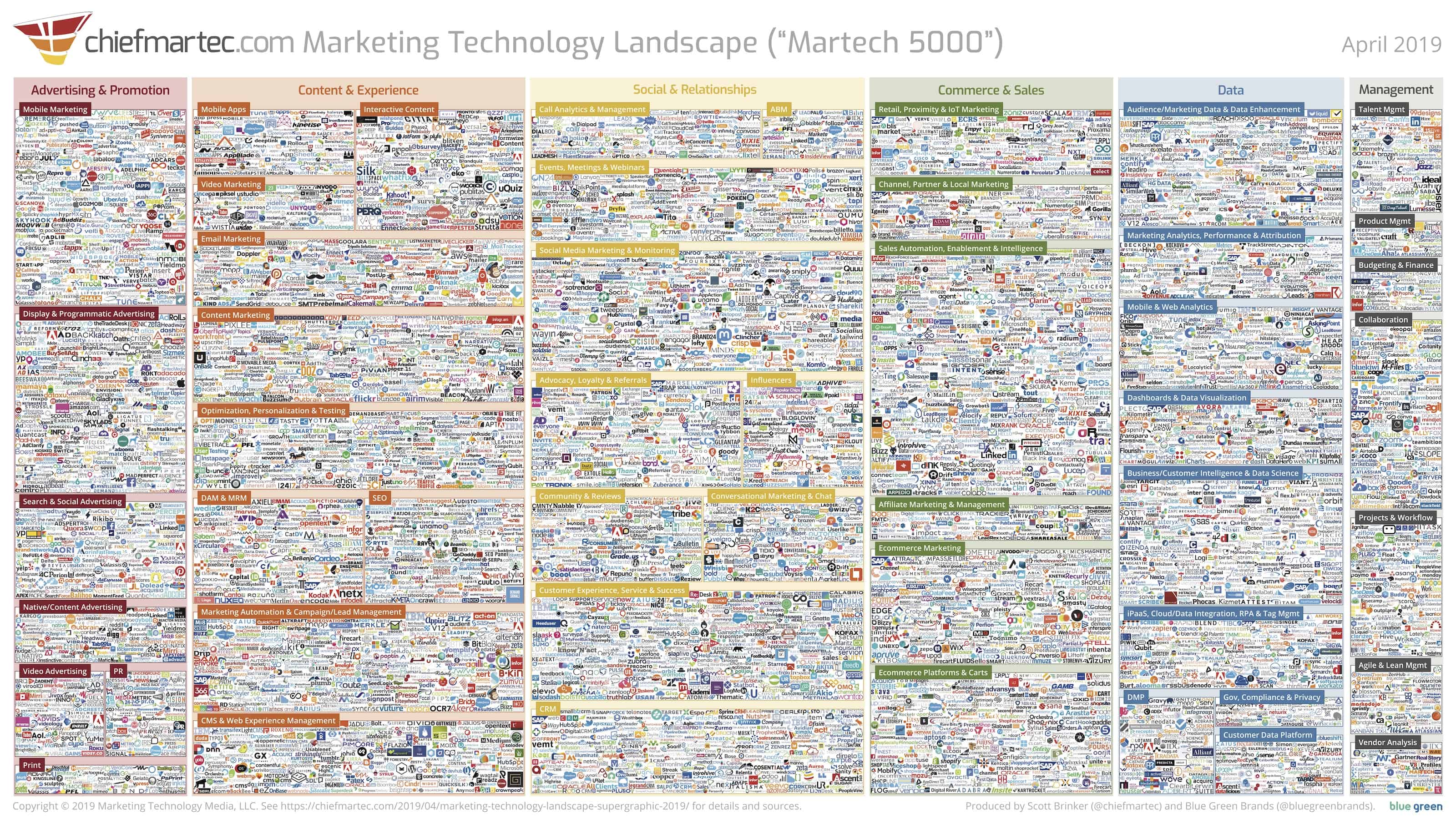
    There are many, many kinds of marketing and business development. There are software products that facilitate methods of marketing which most marketers don’t even know of, just because there are too many of them to know of.

    In fact, there are literally 10’s of thousands of sales, marketing, and advertising software products (“martech”). Not one person on this planet who can name them all, although someone aggregates them into this infographic each year:

    So there’s a lot of confusion.

    Here’s what you do in the face of that confusion – keep two things in mind:

    • a structured and strategic approach to creating valuable content is the form of lead generation that you can most rely on in the long term
    • thinking of this content creation work as a long-term (years) ideation exercise will give it the best chance of success

    Happy bridge-building,

    Rowan


    FOOTNOTES

    [1] The question becomes “what kind of content”, which I talked about in my most recent post. It should also be caveated that content


  • How to Design a Content Marketing Strategy

    Two claims I recently made on this list:

    And I didn’t back either of those claims up. But I have a case study for you  which does: How Drift’s Blog Helped Them Build a Multi-Million Dollar Brand.

    This comes not from me but from the makers of my favorite digital marketing research product, SpyFu, a sneaky competitor research tool. [1]

    And a great brand name!!

    I’ve been frequently mentioning this case study when chatting with clients about how to design a content strategy. It demonstrates how search engine analytics data can answer the content marketing questions I often get from clients:

    1. What to write about? The case study suggests a mix of (6) types of content.
    2. How to write/structure content? They suggesting making better versions of what’s already working.

    By the way, SpyFu didn’t base this case study on the basis of Drift being their customer either.[2]

    So you don’t need to use SpyFu – or any other search engine or paid advertising analytics product – to get some ideas from this case study on how to design your content strategy.

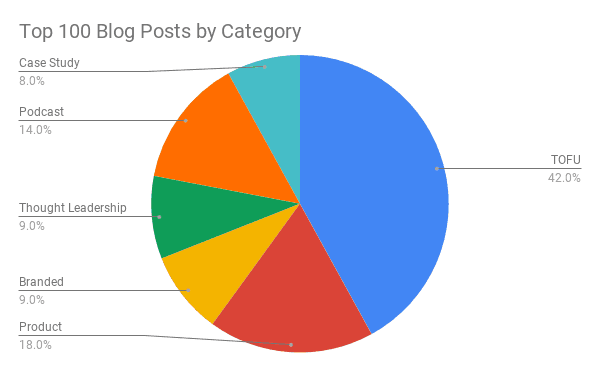
    Just as a teaser, I’ll include their piechart answer to “what to write about?”, because I think it instantly spells out a fantastic strategy.

    Content Strategy Case Study

    The big blue piece, TOFU, stands for Top of Funnel Content (loosely: “broad/general interest” content), by the way.

    The biggest mistake on the web today is basing content strategy entirely on TOFU.

    Drift, however, has adopted a much more mixed approach – and with remarkable results as this case study proves with data.

    If you’re designing a product marketing-focused content strategy, this is a good place to start.

    That case study again: https://www.spyfu.com/blog/drift-case-study/

    My best,
    Rowan


    FOOTNOTES

    [1] SpyFu exposes SEMRush  Rube Goldberg chaos that it is. Ahrefs is better, Spyfu is a lot leaner. Recommended product.

    [2] If you have a new brand, product, service… here is proof that you don’t need client/customer success stories to produce a case study – you just need relevant data

  • Write a letter

    Friends, how are you…? Welcome back from Thanksgiving break and happy (ugh) Cyber Monday to you. 

    My laptop died about a week before Black Friday / Cyber Monday and so it gave me the excuse to spend hours taking in digital, consumer direct marketing over the weekend.

    Thus, I got a massive injection of FOMO (fear of missing out).

    4 hours, 36 minutes, and 38 seconds left to claim this one-time offer and save $1,400

    That kind of rankling thing.

    Even if you understand how FOMO works (and employed it in your own marketing) it still agitates you. One of the many reasons people hate direct marketing in their gut.

    So I want to talk about the other end of the spectrum, which you could call brand marketing. John Caples called it “corporate-image copy” and Ogilvy called it “image marketing”. Like direct marketing, brand marketing can take many formats:

    • slogan
    • tagline
    • article
    • LinkedIn profile
    • video
    • advertisement
    • case study

    and more… it doesn’t have to be content.

    The question becomes then, how to create brand marketing content? Brand marketing sells, in an abstract sense, the value of your business. Its allure. 

    This is trickier than pure direct marketing, where your goal is just to sell; that’s a create constraint-framework for ideating marketing materials.

    So what’s the ideation technique for creating “image marketing” content?

    Write a letter (to one person)

    And when I say a letter, I mean an email. Literally: open your email editor, put the name of a friend or acquaintance who understands your business in the To: line and tell them what’s on your mind.

    This is how you write, for example, an opinion piece.

    Well, not entirely. But it’s how you get ideas for one. Same for anything else.

    It could be a very short letter too – emails don’t have to last more than one line. I’ve actually advocated “pitching” the length to match the email you are replying to – or if you’re not replying, the length of the last email you got from the person you are writing.

    But whatever your length, here are the good things that happen when you write an email letter:

    • You address a very specific market  (By the way, have you ever noticed that the quality of an email quickly decreases in proportion to the number of recipients?)
    • You sound like your genuine self
    • You are not trying to sell anything (usually, at least, in personal emails)
    • You clarify your thinking [1]

    And that is an excellent formula for “image” (brand) marketing. The other pieces still have to be integrated – namely, the focus on your recipient’s painful problem, and the solution you have for it.

    But talking about that stuff in a natural way is essential.

    I’ll circle back tomorrow – thanks for having me back in your inbox,

    Rowan

    PS If you ever got a great idea for your business by writing about it in an email to a friend, let me know


    FOOTNOTES

    [1] Sometimes at least. It takes practice for writing to be a more effective tool for clarity than speaking, and some combination of both is what works for most people. But here’s the thing: it’s almost impossible to describe your complex business in conversation if you have not previously described it in marketing-ready copy

    Just as you cannot see if you do not draw, you cannot think if you do not write


  • Messaging advice from George Orwell

    Did you read Animal Farm? Or the true story action-adventure epic it’s based on, Homage to Catalunya? If you read either, it perhaps affected you, even if you were “forced” to read it in school.

    If so, that’s likely because the author carefully studied how language impacts us.

    In part, his motivations were political. Or anti-political, in that they were a reaction to government propaganda, especially from the Soviet Union. But from anywhere. And later he’d extrapolate from government propaganda to news; newspeak (eg “collateral damage” for “killing of civilians”).

    But the other reason his books and writings leave a lasting dent in readers’ minds is that Orwell considered how language impacts the author.

    Not the reader, the author.

    He believed that it was not possible to think clearly about anything complex without being able to write about it clearly. 

    You hear people say things like, “I know exactly what I think about this, I just don’t have the words to get it down on paper”. That’s the kind of premise he disagreed with.

    See, there’s a distinction between clear writing and artful writing – verse, lyrics. The latter is art.

    Like news and politics, marketing is not art; it makes you more money when it’s clear. Or more impact, depending on your goals.

    This distinction is important to your marketing and to your products and services themselves.

    Show me one SaaS app that doesn’t have words. Or one website. Or, let’s go far afield, one consumer packaged goods. You can’t.

    We have woven words into almost everything – and certainly into the digital products we create. If we aren’t clear on how we describe those products, we aren’t clear on what we think about them.

    How to take action

    So let’s say you agree with the premise – what to do? How to improve your own messaging? How to judge the copywriting skill of someone you may work with?

    Judge by Orwell’s rules below:

    1. Never use a metaphor, simile, or other figure of speech which you are used to seeing in print.
    2. Never use a long word where a short one will do.
    3. If it is possible to cut a word out, always cut it out.
    4. Never use the passive where you can use the active.
    5. Never use a foreign phrase, a scientific word, or a jargon word if you can think of an everyday English equivalent.
    6. Break any of these rules sooner than say anything outright barbarous.

    These were originally published in Orwell’s essay Politics and the English Language [1]. And numerous marketing consultants before me have turned to them for guidance and expounded on them. Drayton Bird, for example. They don’t need my color-commentary.

    My primary observation is, “Wow, I break these rules a lot!”.

    But in tech and in marketing we are almost all guilty doing so, especially rule #5. To be fair, think of rule #6 when evaluating tech jargon; sometimes jargon is useful because of brevity. For example, SEO for Search Engine Optimization.

    But here’s an interesting thought experiment – try applying these rules to the sales and marketing collateral you most love: your proposal template, your website’s homepage, your best blog post, etc. Imagine Orwell

    Then ask yourself, do you think about your business any differently? Or as Orwell puts it in the essay, do they “demand a deep change of attitude”?

    I’m going to take a break from publishing this newsletter for Thanksgiving – and I hope you have a great one, whether this finds you in the US or not.

    Grateful to have you as my subscriber!

    Rowan


    FOOTNOTES

    [1] The Orwell Foundation, which manages his estate, provides this essay for free here https://www.orwellfoundation.com/the-orwell-foundation/orwell/essays-and-other-works/politics-and-the-english-language/.

    Funny side story – I copied and pasted this essay into Grammarly, removing the examples of writing “a little below the average” (not written by Orwell). Grammarly qualified the writing as follows:

    Clarity: “Unclear”
    Engagement: “a bit bland”
    Delivery: “Slightly off”

    So take Grammarly’s advice with a grain of AI-is-still-stupid salt 🙂

  • How to write copy and UX for a homepage

    Course creator Danny Margulies asks: What are some good copywriting guidelines for homepages?

    I have some strong opinions on this. I wrote about them last year but my take has evolved a little bit since then.

    You would think this would be a simple answer, but it’s not… even if the homepage feels simple, the approach that creates it can have a lot of parts to it.

    Caveat: these guidelines apply to niche B2B tech/creative firms (which are sort of the same thing nowadays) selling complex services or products to professionals and other businesses.

    That said, maybe they are of value for other positioning use cases.

    Some basic premises about the purpose of a homepage:

    • The homepage is a lead capture landing page first and an informational page (lead nurturing/client retention) second
    • For the purposes of your copywriting approach, mentally divide your homepage into two visual parts: (1) above-the-fold, what you see when you land on the homepage, and (2) below-the-fold, what you have to scroll to see. Above-the-fold should be about the same for mobile/desktop.
    • The above-the-fold part is for lead capture (book a product demo, schedule a strategy call, subscribe to a newsletter, etc)
    • The below-the-fold area actually has three purposes: (1) nurture returning leads/visitors (2) retain existing clients (3) lead capture

    Above-the-fold checklist

    Based on the premises laid out above, here are guidelines for above-the-fold homepage copywriting. You can think of these as a checklist by which to evaluate your own site.

    • A homepage above-the-fold is a de facto landing page – does yours feel like one, even if it retains some degree of navigational UX?
    • As you would on a landing page, remove distractions from the homepage above-the-fold with a strictly minimalist header
    • To be specific, there should be no more than 5 total things to click on above-the-fold. 3 is ideal.
    • Don’t ever use a home link in your main menu; that’s what the logo is for so it’s a waste of space
    • The logo should be accompanied by a straightforward tagline that supports lead capture. Assume people don’t know who you are; write a straightforward tagline that informs them what you do and for whom you do it (ie. them)
    • The most prominent thing to click on by far should be the lead capture call-to-action (CTA)
    • Always include this CTA twice – in the (sitewide) header on the far right and in the main above-the-fold area 
    • Do not ever have more than one CTA above-the-fold; the header’s CTA and the main CTA should be identical – use the exact same words for both
    • If you use a hero image, it should visually evoke a future state – the state of the prospect after a call with you, after buying your product, after benefitting from your newsletter.
    • For a consulting firm, even one selling productized services, the hero image can be a photo of the firm’s principal(s), since that can evoke the future state of working with that person
    • You can also use an abstract graphic but again, it should evoke a future state somehow
    • If your hero image or abstract graphic doesn’t contain people, be sure to include people another way – a thumbnail photo of either the company principal(s) or of customer(s) is ideal. There should be a human face.
    • Next to your CTA, write a headline that does three things – evoke a painful problem, offer a solution, and make it clear who specifically the solution is for. Sean D’Souza calls this “the trigger”, as I have written about before
    • As mentioned above, the tagline can help your headline do the work of describing who the solution is for; they work together
    • Offer bullets or a mini-FAQ that resolves objections to purchasing that solution
    • Let at least one testimonial be at least partially visible above the fold
    • Testimonials are better than logo bars but include both if you can
    • Transcribe testimonials word-for-word from live-recorded interviews and let them include pre-purchase doubts or objections

    That’s a long list – can you do it all above the fold? Yes, it just takes work.

    Below the fold

    So what does that strict focus on lead acquisition above-the-fold leave you with?

    This is less a checklist than the above-the-fold part above, probably because I haven’t thought or written about it as much. Still, I have some very definite views on this part of your homepage:

    • The footer is the new header. Let it take up as much space as it needs to, even the entire viewport
    • The things that used to go in the header – like the full navigation menu, social/share links, privacy, support, etc, – should go in the footer.
    • The footer serves the purpose of client retention (gives them the information/support they need) and lead nurturing.
    • That said, the footer should also repeat the primary CTA
    • If you have a secondary call-to-action, repeat it in the footer, but do the work of supporting it with a headline, testimonial, human face, etc., as described for the above-the-fold CTA. 
    • What goes below the above-the-fold area and the footer? This could probably be its own section. Here’s where you put the rest of your entire website in a microcosm: content, product information, company bio, etc., with an emphasis on positioning your business as being relevant to a specific audience – or at least to a narrow group of audiences.

    Counterpoint – do not put your whole site into one, long scrolling homepage.

    For one thing, that approach cuts the page load time – you want a lightning-fast homepage. For another thing, it cannibalizes other shareable URLs that should have their own independent identities, particularly your product and pricing pages. Lastly, it’s passé in 2020. It makes it look like you don’t believe enough in your business to give it the complete, professional website it deserves.

    If may have bullet-pointed you to death here, my apologies! 

    My best,

    Rowan

  • Does SEO matter to your business?

    Does SEO matter to your business? Maybe.

    Is SEO a great ideation tool? Definitely. It is without question an indispensable market research tool; keyword research is a method of understanding your buyer that complements surveys, interviews and other forms of research. What a great ideation tool for a content strategy.

    SEO research, however, is not the same thing as investing in optimizing your content for search, which ultimately involves attempting to reverse engineer the world’s most valuable trade secret – the Google search algorithm. Which is now partially created dynamically through AI (Google RankBrain).

    But I’m going to save that for another email.

    Today I’m going to focus on why maybe SEO makes sense for your firm.

    And reemphasize here that I’m addressing smaller, niche firms that creative impact with software and/or creative and technical expertise. Because that hugely impact the answer to the question of whether SEO matters.

    When I co-ran my own niche tech consultancy, my clients were large nonprofits, agencies, and universities. SEO mattered immensely. To this day, online learning startups like Coursera and Udemy and are dramatically outperforming universities on the SEO side of course promotion. (Looking for an SEO specialization? Become an expert in course marketing for traditional higher ed – I’ll help you land your first client just for fun.) 

    And SEO matters to any nonprofit which uses content marketing to attract new supporters. 

    That’s partly because a structured content marketing is a given.

    About that… content marketing. Because this is where it starts to matter whether for niche B2B expertise firms. And this is where the maybe comes in.

    Here are the questions to answer that will get you from maybe to a yes or a no.

    • Do you have a content creation practice? Not do you sometimes create content, but do you have a practice? Something with structure to it that sees you regularly publish content.
    • Do you the owner – or one of your key, permanent staff members – create your content? It is remarkable to me that business owners still try to game Google buy hiring people without expertise and authorty in the business to produce content. It has been lightyears in SEO land since that work, yet go on the freelance platforms like Upwork and Fiverr and you’ll find thousands of business owners of small B2B forms throwing their money into the trash by hiring content producers. That only works if you *really* know what you’re doing – and you have a mass audience. 
    • Do you create content about as narrow an area of subject matter as possible? Because that’s what your audience values and Google or its AI know this.
    • Does your content always have enough value to be shared by some of your readers some of the time?

    And one last trick question – do you publish content frequently? Because don’t worry about that. It doesn’t matter whether you publish frequently. 

    If you answered yes to the non-trick questions, then you should invest in SEO. To call it an accelerant is an understatement.

    You could make the case for investing pre-emptively – you think you’re going to launch a content creation practice, so you invest in the SEO research that partially informs set your content strategy. 

    But that’s cart before the horse. Think of it this way – getting to play with SEO is your reward for doing the work of designing and executing your own content publishing practice.

    My best,

    Rowan


  • How to design a creative brief

    Some questions for you…

    • What’s one thing that your clients get emotional about? How do you know that?
    • What problem are you best at solving and for whom? Any particular industries or types of businesses you like working with?
    • What’s the old 30-second elevator speech? Will it work next year?
    • Do you have customer personas? For each customer persona, can you identify one real person and add a link to their LinkedIn profile? 
    • Do you have between 1,000 and 10,000 prospects (ie. need and can afford you)? How many exactly if you had to guess? What did you base your guess on?

    Actually, I have a bunch more questions than that – in my perversion of the classic client questionnaire, the creative brief.

    Here’s the kind of stuff you’ll usually find in a creative brief. 

    • What’s your favorite color? (bad question)
    • target audience? (semi-bad question)
    • What tone of voice does your company have? (semi-bad question)
    • What’s the budget/timeline/approvals-process? (off-topic)

    And then maybe one or two “insight” questions around the brand strategy, larger strategic business goals.

    Which is great. But my thinking is, “why not design every question in the creative brief to stimulate some kind of business insight?”

    Creativity comes from constraints and the most relevant constraints are business ones, not the color preferences of arbitrary individuals.

    The questions in my creative brief exposes some fundamental biases I’m working with. For example:

    • Marketing is many orders of magnitude more successful if you have specialized positioning.
    • Marketing is supplied by little ideas (which is why I ask about data sources – where people get their numbers from) more so than by big ideas.
    • People use target personas because it’s emotionally easier than using target real people.

    And I could assign a similar bias to almost every one of the 20 or so questions that comprise a typical creative brief.

    Follow the money backwards

    The famous Steve Jobs quote on engineering in reverse by starting with UX applies here. Except we’re talking about money now.

    When you start putting together a strategy for crafting brand messaging, or doing outreach, or content marketing, start from the point of sale and work backward.

    Then take it one step further.

    Start from the point of money entering your bank account and work back from there.

    How did it get there? How long did the transfer take? How many days (if any) spent on contracting? How many conversations led up to that? How many emails were read? Personal emails – marketing emails? What case study was downloaded? What website page was landed on? What keywords were entered into a Google search?

    It’s all connected to the moment that credit shows up in your business bank balance.

    Whatever work you’re doing, think about that next time you design or complete a creative brief. Or heck, let’s abstract this, any time you come across a set of key questions, questions that are evidently meant to be diagnostic. Ask yourself: do are these questions relevant to the actual acquisition of money?

    Not the only question to ask, but it’s unusual. And in ideation, unusual is your friend.

    On that note, let the creative brief be cross-disciplinary. It can cover design, copywriting, research, revenue… anything. Ultimately, it’s nothing but an ideation tool.

    Want a head start? Take my creative brief template as my free gift to you http://bit.ly/2QJOcDW

    Download it, copy it, use it on yourself, use it on your clients, barter it for email subscriptions, whatever you like.

    Have a wonderful weekend,

    Rowan


  • Impostering

    This is a follow-on to my post on giving away your business expertise as a model for how to approach your content marketing[1], a Seth Godin idea.

    Another idea from Seth’s recent intellectual stampede flips the notion of “imposter syndrome” on its head. Most seasoned business consultants tell you to watch out for “imposter syndrome,” and overcome it. Get past it. Don’t believe in it.

    Not bad advice.

    But Seth goes beyond that: “If you are doing work that matters you are an imposter …. if you’re not feeling like an imposter I would argue you are not working hard enough.”.

    I love when a business idea applies equally to the product or the services delivery model (example: improve the impact of your solution by specializing).

    That’s true of this imposter-mentality idea.

    Below is Seth Godin’s full riff on imposter-dom. It comes after an anecdote about self-doubting musicians who felt they didn’t deserve to “stay in one city” and work their way up to playing larger venues – instead they went from town to town, easy-to-book coffeeshop to easy-to-book coffeeshop.

    Why didn’t they take their music label’s advice: stay in one city, work your way up. Play bigger shows, bigger venues.

    Because they felt like imposters.

    To which Seth says:

    “Of course you feel like an imposter. If you are doing work that matters you are an imposter. You can’t certify that you’ve done this exact thing before and it’s guaranteed to work. You can’t, so because you’re a good person and an honest person inside, you feel like a fraud. Because you’re acting as if, because you’re describing a future that isn’t here yet. If you’re not feeling like an imposter I would argue you are not working hard enough.”

    Do you have a vision for the future where X (your clientele) can now do Y thing better – or at all – because of Z thing you offer?

    Especially if there was no good reason your clientele couldn’t do this before?

    In other words, are you helping victims of the current status quo by updating a small piece of the future status quo? Even if:

    You can’t certify that you’ve done this exact thing before and it’s guaranteed to work.

    Feeling like an imposter is not for everyone, but if you want to change what you do and solve new kinds of problems –  in new ways –  it’s not only an accelerant, it might be a requirement. 

    Because a great way to validate your ideas is to stand behind them in public.

    Once you start to make your imposter-dom part of your marketing, you put your commitment to doing something different to the test. You’ll feel it keenly.

    It’s even harder than giving away your expertise for free. And even more work.

    My University didn’t offer a degree in agile ideation for marketing. But here I am, offering change through thousands of little ideas – impostering.

    My best,
    Rowan


    FOOTNOTES

    [1] Forgot to mention, if you’re pressed for ideas on how to share your expertise, do a “tear-down”, a product critique. Here’s one I did of Google Brand presence of large interactive agencies https://www.rowanprice.com/google-brand-score-big-agencies. But they could be of anything – you could critique wine label bottles, footpath design, restaurant-industry mobile apps, musical instruments, or marketing websites for B2B SaaS companies. If you know something important, it’ll sneak out.