Author: remap_content_admin

  • How do you give something away

    Seth Godin always fascinates. But sometimes he catches fire with creative brilliance.

    And then he gives it all away. Every last piece.

    That’s as true as ever over the past month or so, between his blog, his podcast, and his podcast guest appearances. Let me cite a few examples:

    • If you’re working on a book or want to, as a couple of my clients are, you can’t miss Seth Godin’s appearance on The Business of Authority podcast, where he talks about how and why to write a book, and how to take it to market. [0] I’ve followed Seth Godin for 20 years and he’s never been so candid on book publishing.
    • If you produce software products, take in his own podcast episode, “Why is software so bad?“, where he argues that software has traded in craftsmanship (citing 80’s Apple software) for being networked – Internet-connected, portable, mobile, etc. [1] (I would add integrable..)
    • And if you have any interest in SEO and/or content marketing as it relates to your business, you should not miss the post he wrote yesterday, The Google tax. Basically, if you are in any lucrative industry, you will have to compete directly with a Google-owned business sooner or later, and pay Google for the privilege of doing so. So hedge your SEO bets.

    This last article references Aaron Wall’s comprehensive and incisive takedown of Google’s brazen transition from disruptor and innovator to monopolistic behemoth [2].  

    Seth Godin compresses Aaron Wall’s (very impressive) article into a Bonzai tree of a tiny blog post and leaves us with this thought: that more so than any other single entity, public or private, Google is essentially taxing western-style capitalism itself to death – via monopolization.

    In other words, Google’s new business model is to smash disruption.

    So there’s that.

    What to do?

    Give so much away that you change things for your people

    I wanted to decrypt the message from Seth Godin’s Business of Authority podcast appearance:

    If you think people are paying you for your secrets, you’re crazy.

    Once thing I have noticed: sometimes SaaS can learn from services and sometimes vice-versa.

    Not in this case.

    When I rent software by the month, I am paying for the founder’s secrets, whether they are comprised of patents, closed source software, proprietary data sets, or just plain old insight gained from professional experience. The founder’s secrets are baked into the product. Paying for them, not crazy.

    To Seth Godin’s aforementioned point in “Why is software so bad?”, the quality of the design, build, and delivery matters too. Maybe even more than the secrets.

    That’s certainly the case with (a) consultative services and (b) content.

    Of course, some consultants guard their secrets, their processes, their documents, their research, their best practices.

    Their approach is to transact: you give me cash, I’ll give you the secrets.

    Or worse, you give me the cash, I’ll give you my labor, in units of time. Believe me, it’s possible to sell off valuable expertise and skills in such a way – I’ve been guilty of that myself.

    But how to get beyond that?

    Here’s where Seth’s advice to give away your secrets comes in. 

    In my experience, though, giving away your secrets (your expertise) is hard work.

    Not because of latent miserliness, but because it’s not easy to package information usefully. You can’t just brain dump, it doesn’t work like that.

    Aaron Wall is a genius and his aforementioned 4,000-word article on Google’s abuse of its search products is brilliant. Compressing that into a 300-word blog post as Seth Godin did is a masterclass in how to package ideas usefully.

    So here’s an exercise: pick one of the most valuable things you know about your work, no matter how trivial it seems. Something that’s made life easier for yourself or for your clients. 

    You have now something to give could be worth giving. 

    The next question becomes, how to give it away? Does it go into code? Does it go into UI design or copy.. a training manual?

    Or – and here’s the hard work – is it good enough to write, talk, or speak about? 

    That’s a good place to leave it – a content marketing question.

    My best,
    Rowan


    FOOTNOTES

    [0] Read the bit from the transcript:

    Thomas Piketty has benefited from this. His book, Capital, is the most unread book published that year. We know this for a fact. If we multiply the number of people who purchased it times the percentage in the Kindle that was indicated that they read, it had more unread pages than any other book of the year but-

    Yeah but it’s true and after reading 10 pages you knew everything you needed to know to talk about the book and so the book served its purpose. The book was not a ripoff. You got your $30.00’s worth which is after reading 10 pages you knew enough to be able to talk with some confidence about the inequity in our society and recommend that people who disagreed with you read the whole book.”

    [1] It’s a simplification of a complex landscape (there are 80,000 SaaS products in the US alone). But not an over-simplification because his point is worthy: it’s possible to make remarkable software, so why not?

    [2] Rand Fishkin has also written convincingly about this same trend https://sparktoro.com/blog/google-in-2020-from-everyones-search-engine-to-everyones-competitor/. The Aaron Wall article is a gem for its historical breadth, though. http://www.seobook.com/brands-vs-ads. If you ever wanted to understand the larger business significance of SEO as an industry, let this article be your entry point.
     

  • You’ll end up with something stupid…

    Friends, today we are talking about the crown jewel of marketing and business development – content marketing. 

    A year and a half ago, I wrote about ideation as a transformational process, as opposed to a copying process.

    I wrote it partly because I was annoyed at LinkedIn marketers encouraging stealing others’ work as a form of content marketing.

    Because copying doesn’t actually work, for one thing.

    Mantra: if you can find your marketing strategy on Google, it won’t work. Because your audience has already seen it and it doesn’t fit you.

    So instead of copying, you transform old ideas into new ones.

    By the way, that article I wrote was inspired by a statement on the creative process by a Nobel Prize-winning author.

    I’ll reprint the entire statement now and then make some remarks about how to apply it to your content marketing strategy.


    …most everything is a knockoff of something else. You could have some monstrous vision, or a perplexing idea that you can’t quite get down, can’t handle the theme. But then you’ll see a newspaper clipping or a billboard sign, or a paragraph from an old Dickens novel, or you’ll hear some line from another song, or something you might overhear somebody say just might be something in your mind that you didn’t know you remembered. That will give you the point of approach and specific details. It’s like you’re sleepwalking, not searching or seeking; things are transmitted to you. It’s as if you were looking at something far off and now you’re standing in the middle of it. Once you get the idea, everything you see, read, taste or smell becomes an allusion to it. It’s the art of transforming things. You don’t really serve art, art serves you and it’s only an expression of life anyway; it’s not real life. It’s tricky, you have to have the right touch and integrity or you could end up with something stupid. Michelangelo’s statue of David is not the real David. Some people never get this and they’re left outside in the dark. Try to create something original, you’re in for a surprise.


    The last sentence is ambiguous so I have to pick it apart. It means that the best and greatest ideas can not be created through effort alone. You cannot “try” to get them. Instead, you summon them. Or condition your mind to receive them.

    It does not mean you can’t create something that at least has the effect of being original; he is just saying that a try-hard effort doesn’t get you there.

      things are transmitted to you

    He – Bob Dylan, if you hadn’t already guessed – is saying that an original idea is always an echo of prior ideas. Michelangelo’s David, for example, was an echo King David of biblical lore, but also of an echo, of sorts, of a now-unknown studio model with a pretty nice physique. That was the real David.

    How to apply Dylan to your content marketing

    Content marketing isn’t an easy problem to solve. How can you entertain and inform your specific client audience about a given subject – for a long time? 

    First, keep in mind that content marketing ideation, as with almost all[1] forms of BizDev and marketing ideation, is more about little ideas than big ones. Less about home runs, more about base hit, base hit, base hit.

    If baseball metaphors don’t work for you, this article explains the little ideas approach. It’s not that big ideas don’t matter, it’s that they don’t do the bulk of the work.

    So that’s the (shocking, I know) caveat – content marketing for niche B2B firms is different than writing songs that win the Nobel Prize for Literature. 

    But here’s the advice you can apply – start by noticing the details.

    More than that: notice details no one else notices – that are somehow connected to the problem you’re trying to solve for your clients.

    Dylan buries this advice right in the middle of the quote, by citing 5 or 6 sample details to notice:

    • you’ll see a newspaper clipping
    • or a billboard sign,
    • or a paragraph from an old Dickens novel
    • or you’ll hear some line from another song,
    • or something you might overhear somebody say …
    • something in your mind that you didn’t know you remembered

    I won’t tell you where to find or how to organize the details that your content marketing strategy needs. Because it’s not just about where to look, it’s about your state of mind – in which you can connect everything to the problem you’re solving. How do you relate everything in your life to the major problems you solve for your clients?

    Taken to its extreme, you arrive at the state of mind Dylan describes:

      Once you get the idea, everything you see, read, taste or smell becomes an allusion to it.

    Imagine that – imagine nurturing a content strategy idea so fully that you can’t eat dinner without thinking about it.

    Good luck with that and as always – let me know how it goes,

    Rowan


    FOOTNOTES

    [1] There are exceptions to this rule, such as what creatives agencies would call brand strategy and what strategy consultants would call points of view. When thoughtfully conceived, both can transform not just an organization but the organization’s audience as well. They are big ideas… yet they often result from the work of producing 1000’s of little ideas.


  • The big problem

    Do you know what I learned consulting for big orgs? I did project work for IBM, Merck & Co., Tiffany & Co., the United Nations, etc… dozens of major institutions.

    I learned that while big orgs may have big annual revenues and headcounts, their attempts to leverage innovation, at least digital marketing innovation, are basically just one shit show after another. Why is that?

    It’s a byproduct of a bigger problem: big corporations control so much of the world’s income that they can coast on their laurels. 75% of humankind’s GDP is owned by the global Fortune 5000.

    This isn’t too say that large orgs are badly run – just the opposite. They are extremely well run.

    Their collective obsession for the last 100 years has been organizational efficiency, ie. running well. This goes back to Max Weber’s Bureaucratic Theory, one of the foundational texts of any traditional MBA program.

    Weber’s strictly top-down thinking has been steadily reformed over time, but the central focus remains: how to create more profitability through an efficient bureaucracy.

    This strangles innovation and as a result, we’re stuck with short-sighted software, clunky user experiences, defective systems.

    An Alternative Vision of the Future

    If you’re like me, we’d like a world where entrepreneurs and their allies disrupt this global status quo – not with large amounts of capital (and not on the pursuit of it all costs), but on the strength of agile thinking.

    What if tech entrepreneurs could learn to create ongoing marketing programs, not just campaigns, supported by ongoing ideation – the flow of good ideas.

    Because this seems like the least risky approach for us.

    Ultimately, marketing ideation is about reducing the risk of your marketing investments.

    When marketing and advertising occupies a predictable slice of an enormous company’s annual budget, as with the monster companies of the Fortune 500 – but even with the next 5,000 enormous companies – it’s evaluated as a risk.

    That’s not to say marketing investment isn’t risky; it’s to say the risk is assessed and deliberately undertaken.

    This makes it possible to increase the total investment in marketing.

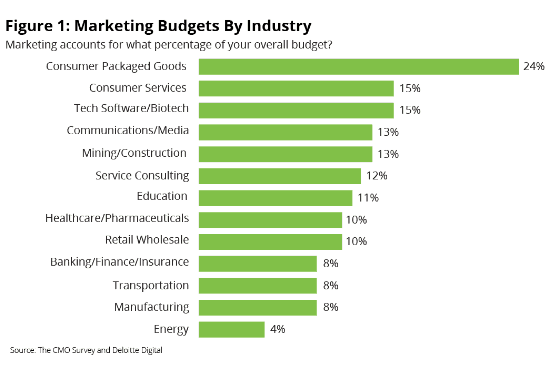
    Look at these marketing budget numbers from the CMO Survey, a survey of large firms conducted annually by Deloitte. 

    For most of you, your counterparts on this list are “Service Consulting” and “Tech Software/Biotech” (though you could make a case for Education, too).

    This means your big firm counterparts are investing between 12% of 15% of annual revenue in marketing.

    How about you – if your revenue is at 1 million, do you feel comfortable investing 150k in marketing? If it’s 150k, do you feel comfortable investing 23k?

    Probably. And why not?

    Because it feels risky. And you know what – it is.

    Big orgs hire CMO’s and their marketing departments not necessarily to come up with great ideas but to manage risk (in marketing/ad-spend).

    Another interesting takeaway from the Deloitte CMO Survey – of the four marketing expense categories, B2B services firms (across all industries) spend more on, “Developing new marketing knowledge and capabilities” than anything else. [1]

    In other words, the large firms surveyed in the CMO Survey are trying to learn how marketing works, so they can do it themselves.

    That makes sense, because of how rapidly marketing has started to evolve over the past 3 to 5 years. Build your own in-house expertise.

    And that’s not a bad strategy for you, as far as it goes.

    The problem with that approach, though, is that you might be stuck forever playing catch up.

    The big firms can outspend you on developing capacities by factors of many 1000s, if not millions.

    I think the chink in their armor, though, is creative thinking. 

    They can study ideation, innovation, whatever you want to call it, till the cows come home. But the ghost of Max Weber is there to stamp it out – with efficiency.

    You solve problems, though, with artistry, expertise, and creativity. Play to your strengths.

    And have a great week ahead,

    Rowan


    FOOTNOTES

    [1] The survey is biannual and published here, if you want to flip through it yourself https://cmosurvey.org/results/february-2019. About 70% of survey-participants have annual revenue over 25 million.


  • Lead pool ideation

    While discussing idea boards, I suggested populating them with materials from online discussion venues.

    Let me repeat that list and add to it a little bit:

    • Reddit
    • Amazon.com comments
    • Disqus comments 
    • Quora answer comment threads
    • Facebook Groups
    • LinkedIn Groups
    • Google Groups
    • Twitter hashtags
    • LinkedIn hashtags 
    • Instagram hashtags
    • Slack communities
    • Discord servers
    • Software support forums
    • GitHub discussion threads

    Just reading this list can be thought-provoking if you ask yourself: where on here are my ideal clients discussing things?

    Part of the idea with the idea board post was to find in these online discussions some emotionally charged language – to use in your marketing copy.

    But online discussion venues are also a place to find prospective clients. They are a form of what you’d call a “lead pool”.

    What is a lead pool?

    A lead pool is a sort of abstract BizDev prospecting concept that describes any place where you find a group of potential clients.

    If you’re selling B2B products and services, you should have at least an ambient awareness of these other categories of lead pools:

    1. Job sites (e.g. Indeed)
    2. Online talent marketplaces (e.g. Upwork)
    3. Hiring and salary boards (e.g. Glassdoor or PayScale)
    4. Conferences/events (e.g. SXSW or the “AICPA Corporate Finance and Controllers Conference”)
    5. Technology/Platform-usage data sets (e.g. BuiltWith)
    6. Paid lead databases – the traditional lead source (e.g. Owler or LeadFuse)
    7. Audience intelligence (eg. BuzzSumo or SparkToro)
    8. Government procurement publicity websites (SAM.gov)
    9. Custom datasets built through scraping the web

    That’s not even a comprehensive list. It’s an oversimplification. There are literally dozens of categories you can carve out. 

    By the way – we won’t worry about whether the categories overlap (Indeed.com provides salary intel, LinkedIn is a talent marketplace and a paid lead database. etc.).

    What matters is understanding and studying this landscape, which contains probably thousands of lead pools, many of which could be useful to you.

    Ideate your own lead pool

    I define ideation as the practice of fusing of two or more elements (such as lone facts, data sets, ideas, feelings, or observations) in order to summon new, valuable ideas.

    That’s exactly what a good prospecting approach will do that others won’t: take at least two lead pools and mash them together in some way to create something new.

    It’s one of those situations where you don’t know what you’re looking for until you find it.

    If you’ve ever designed and run a Facebook advertising campaign, it’s the closest thing to this process – using creative thinking and targeting parameters, you build an audience.

    But this time, you define the targeting criteria yourself, using any data you want.

    You’ll get a much more differentiated audience than you ever would using just one lead source.

    Illustrative Example

    For B2B products and services firms, a common application of this type of lead pool ideation is: conference attendee list + paid lead database.

    Let’s look at a slightly more detailed example.

    As with all kinds of ideation, you start with the problem.

    You provide, let’s say, group courses in workplace wellness for companies with an “office culture”. 

    So who’s your market and what’s their problem?

    There might be a problem is turnover. Turnover is painful, stressful, and costly. Quite a bit more costly than your courses, ideally.

    Their problem might also be productivity.

    Or just general happiness.

    For a company to afford to purchase group courses, they need to be of a certain size, and they need to gather their workers into traditional offices.

    And they also need to believe in the value of wellness.

    Here’s what a company like this do to make their own lead pool:

    • Find the top two dozen HR and Wellness conferences across the country and acquire their attendee lists. Now you have, say, 4,000 company names.
    • Use LinkedIn to determine
      • which of those companies have 10 employees or more
      • which falls into one of an industry category like to still use office culture and to endure high-levels of stress: finance, healthcare, and law
    • That might leave you with 2,000 companies. Use that list to figure out which companies have the highest turnover and lowest satisfaction, on Glassdoor
    • Take that list, now down to 1000, to LinkedIn and find HR executives 
    • Take that list of HR executives, now back up to 3,000 – because you’re using an ABM approach – to Facebook, Twitter, Instagram, and LinkedIn, and find out which ones have an interest in wellness-related subjects, such as yoga, cross-fit, diet, meditation, etc.
    • Take that list, now back down to 1000, back to LinkedIn and use lead-gen tools like Hunter.io or Skrapp.io to get contact information

    Et voila – you have a unique lead pool for your wellness coaching courses.

    But I left something out – the insight you get from executing this process instead of just writing about it. The qualification or quirk no one else would think of that gets you an even better custom list.

    And that insight is also for designing your outreach strategy itself – and even a content strategy.

    But I’ll save that for another email.

    Have a great weekend,

    Rowan


  • Name the problem

    Dear friends,

    Earlier this month, I wrote about the period to make a point. That little, valuable marketing ideas, which might come in sets of 1000 not dozens, are what make or break a marketing campaign.

    Not funnel design, not tech, not the big idea, not even expertise of those implementing your campaign. It’s ideas that matter – their volume and their quality. 

    The “trigger” is an important idea that can generate many more useful ideas in turn.

    If you do your own marketing, hire a marketer, or want to bring out marketing value in your products, web copy, designs, etc., then you should learn to recognize trigger when you see it – or feel them.

    And you should understand how the texture of a trigger differs in B2C vs B2B marketing (I know that most of you are more concerned with the latter).

    Fundamentally, a trigger is what it sounds like – the element that gets people to act.

    In his digital marketer’s must-read, The Brain Audit, Sean D’Souza defines the trigger element as a feeling – alertness, curiosity, and readiness-to-act – that conditions you to take action.

    The most effective trigger feelings are built on three components:

    1. A problem that you, the prospect, experiences
    2. A solution that would alleviate that problem somehow
    3. Positioning cues that affirm that both the problem and solution are specific to you and your business

    Sometimes, you can craft triggers that fit into very small spaces and work on all three elements – problem, solution, positioning.

    That’s the ideal, at least. It’s not easy.

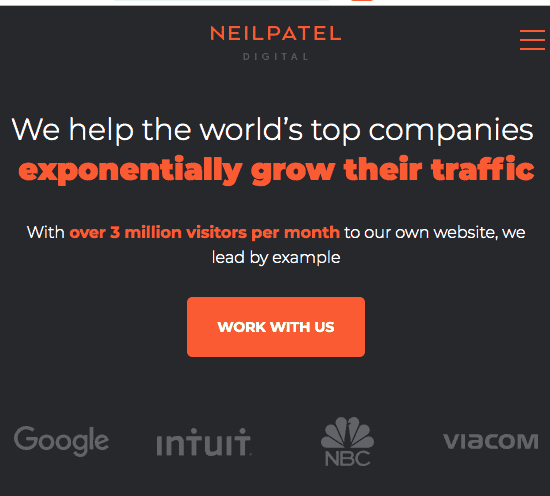
    Here’s an example trigger headline for a digital marketing firm specializing in SEO/SEM for consumer tech and media brands – NeilPatel Digital:

    The three key trigger elements are all here, to a degree:

    • Lack of desired amount of web traffic (implied) – Problem 
    • Digital marketing agency specializing in consumer brand organic traffic – Solution
    •  Logo bar and “top companies” claim are cues that affirm for whom this agency solves the traffic problem (corporate tech and media companies) – Positioning

    The problem is weaker when it’s implied like this – and not directly spelled out as a negative, painful problem.

    But it’s much safer and frankly easier to avoid using negatives, one of the reasons you rarely see them built into compact triggers.

    If you don’t believe that it’s difficult to compose a compact trigger that names a painful problem, go on clutch.co and look at the headlines for for the top 50 firms in any category.

    Don’t stop at the headlines – for each of those clutch.co brands, you could also examine the other places where you can fit a compact trigger that spurs action:

    • Tweets
    • Display advertisements
    • Email subject lines (if you sign up for a newsletter)
    • Slogans
    • Home page headlines
    • Pitch deck blurbs
    • Product/services page headline

    In the B2B world, very rarely will you find the “holy grail” of direct marketing: a compact trigger (ie one of the above) built on a clearly stated painful problem, solution to problem, enveloped by positioning cues. 

    By the way, If you do find a painful problem, it’s usually buried in a bullet.

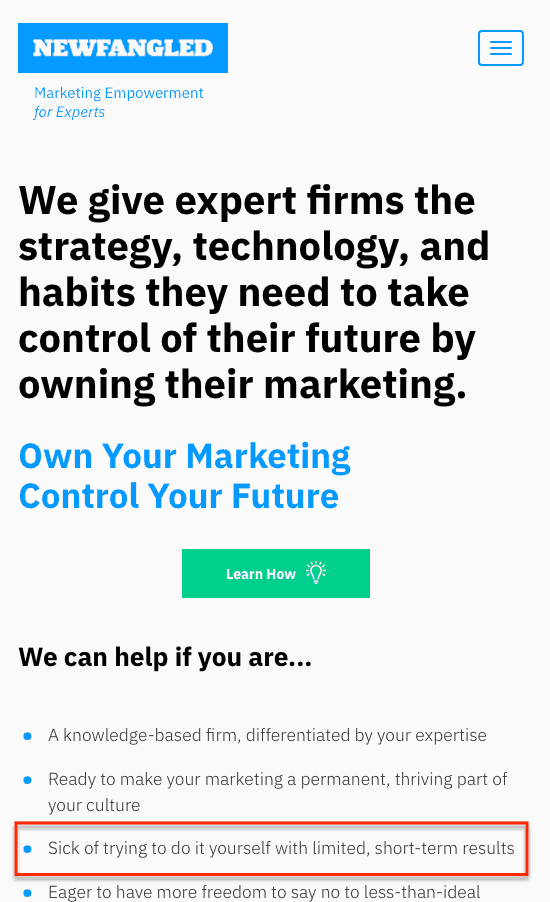
    Case in point: the homepage headline for NewFangled, a content marketing & strategy firm whose own clients are other B2B knowledge firms:

    As you can see, it’s quite a ways down the page before you see a problem or a negative emotion (“sick of”) explicitly stated.

    Often when a firm hires me to come up with a slogan or trigger headline or email subject, it’s already been written by the client –  but has been buried somewhere in the small print.

    This is not a knock or teardown of Newfangled at all, however. And overall their homepage is excellent. Better than mine, let’s put it that way. And better than most.

    More to the point – it’s not all about their homepage.

    Because triggers are emotional experiences that evolve over time. That feeling doesn’t necessarily need to stuffed into one discrete location.

    Deep Triggers: In B2B Marketing, Triggers Are Subtler and Deeper

    You’ll often see watered down triggers (with no explicit statement of a painful problem) in software and services companies that sell to other organizations.

    Even more watered down (if completely non-existent as you’ll note on clutch.co) than in the two examples above.

    Now in my opinion, you want triggers embedded everywhere in your marketing, including in the “top of the funnel” (roughly meaning where people first learn about you).

    It’s OK to develop the trigger later on “in the funnel” (where people know you better) – within longer form content, such as videos, blog posts, podcast episodes, marketing emails, and the like. 

    In fact, that’s where it has the most value by far – the more deeply your prospects experience your trigger, the more likely it is to cause action.

    And of course, they’ll experience it more deeply the more engrossing your content.

    I remember reading a book by the founder of Newfangled at least 10 years ago, speaking of funnels and engrossing content.

    Books like that, thematically focused email marketing and podcasts, and research-based reports, analysis, case studies – this is where the high-value trigger is often buried in B2B firms’ marketing.

    The pain, agony, and sheer stupidity of writing 30-page custom proposals and sending them off to a stranger’s email address.

    Do you know it? Nowhere was this problem better wrapped into a deep trigger than in Blair Enns’s book, Win Without Pitching.

    In that book, he told a group of people their problem and their solution. And in doing so he created a far more powerful trigger than could be ever be packed into a headline.

    But if writing a book isn’t on your to-do list, try it in a smaller piece of content – start with your homepage headline (but first read the article on ideating a slogan, because it’s there to help with the positioning part of your trigger).

    Actually you should try it if you have a website. If nothing else, it’s a fun ideation exercise. And let me know what you come up with.

    My best,

    Rowan


  • Idea board

    [Programming note: I wrote this post yesterday but misconfigured my email provider and it didn’t go out – apologies!]

    In my recent post on the common slogan, “Making the complex simple”, I offered a worksheet that gives you a process for creating something better.

    The worksheet itself is a good example of what you might call a structured idea board, where you arrange an array of solutions to see how they look against one another. And come up with more ideas in the process.

    What’s also useful is an unstructured idea board: a place to gather facts, feelings, faces, studies, articles, books, pictures, art, reports, research, etc. –  things not equivalent to one another… but related.

    The challenge is this: how extremely different can two elements be while still being connected in some way? That’s where you find creative, original ideas that have economic value.

    You might use an unstructured idea board in your work? If so, let me know what name you use for it.

    Look at all the names others have come up with:

    • linkboard
    • whiteboard
    • idea chart
    • organigram
    • organizational chart
    • flow chart
    • mind map
    • org chart
    • entity-relationship model
    • link diagram
    • graphic organizing chart
    • concept map
    • relationship chart
    • “connect the deaths”
    • “the big board”
    • crazy wall
    • murder board 
    • working wall
    • cork board 
    • idea board
    • pinboard

    Just looking at these names is thought-provoking.

    Practical advantages of the unstructured idea board

    At the most basic level, an idea board lets you identify what you are missing – what you need to complete your work.

    I find images, for example, to be extremely helpful for developing writing ideas – not to use in the content but to think about the subject differently.

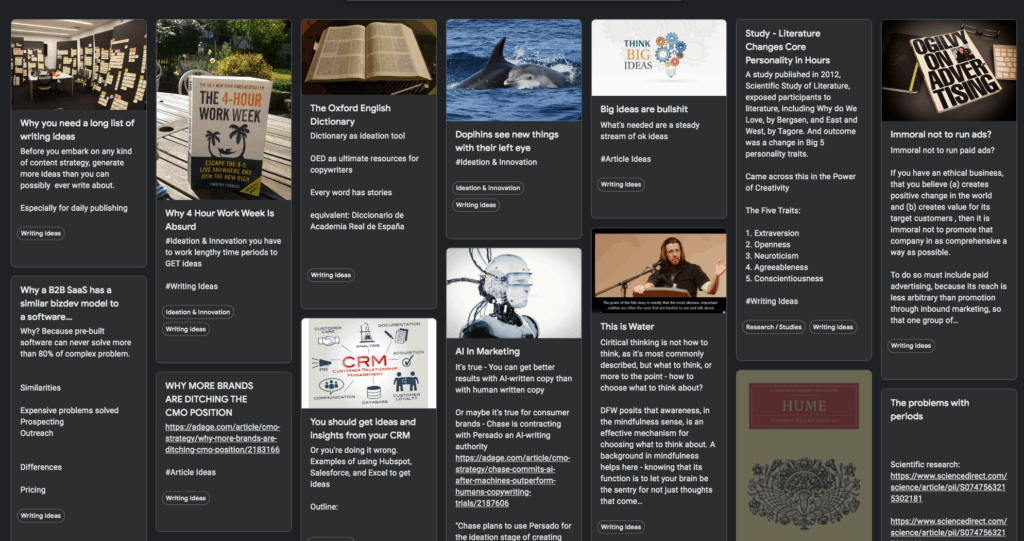
    Take a look at the “Writing Ideas” idea board splayed out across my 27-inch iMac:

    Image of Rowan's Idea Board for Writing Ideas (Google Keep)

    At a glance, I can see which of my writing ideas lacks an image.

    I can also see which writing ideas lack research.

    I know for example, that the “Dolphins see new things with their left eye” article idea was inspired by a conversation I had with someone about a research study on dolphins, in which they were observed to use their right eye to look at familiar objects and their left eye to look anything new. So I need to go track that down – and probably something else besides it.

    But that’s “low-level” practical stuff.

    What’s big-level stuff that goes into an idea board? Emotions. At least in marketing.

    For marketing ideation, get emotions on your whiteboard

    I don’t know how police detectives use idea boards, but marketing runs on emotions, even when you’re selling software and technical services.

    Why?

    Because strong emotions are right next to strong business problems – and that’s where the money is. Or the impact, depending on your perspective.

    A useful piece of digital-era marketing advice is to find where your customers complain. A few places to look online:

    • Amazon
    • Disqus
    • Quora
    • Reddit
    • Facebook Groups
    • LinkedIn Groups
    • Google Groups
    • Twitter hashtags
    • LinkedIn hashtags
    • Instagram hashtags
    • Slack communities
    • Discord servers
    • Software support forums

    (Protip: pay special attention to that last one… even if you’re not in software)

    That list might get you to where your customers reveal their emotions, so look for words like:

    • hate
    • detest
    • can’t stand
    • sucks
    • evil
    • so sick of

    And you should have some powerful messaging – and ideas – to use in your marketing.

    There are even emotional patterns in my own aforementioned idea board on writing ideas.

    For example, the phrasing of many of my writing ideas follows this pattern: Why [something] is bullshit. Or some other strong negative.

    While I might not use that word to title my content, it’s a signifier – that I feel deeply about something and I should explore it more. At the moment I first made the note, probably on my phone’s Google Keep app, I felt pretty strongly about the issue. Expanding the note into a piece of content has to do with getting in touch with where I was emotionally when I made the note.

    In fact, my post about how to do a brainstorming meeting – began with this note: “Why Brainstorming is Bullshit”.

    Strong emotions should drive your marketing strategy, messaging, copy – everything.

    Idea boards tell your brain how to organize

    Mapping your thoughts to an idea board will shape your thinking instead of letting it be shaped by your environment.  [1]

    When I took a studio drawing class in university, the teacher instructed students not to hold the pen the default way. Why not? To prevent your thinking from following the same old regular neural patterns reinforced by holding a pen to make words or doodles. [2]

    It is the same with idea boards – if you don’t make your own, you’ll end up using the three common defaults: your desktop and its folders (real and digital), Word/Google docs, and spreadsheets.

    And you’ll take in information the same old way as if you were checking a bank statement.

    Imagine yourself taking on the task of launching a 3-month marketing campaign: let’s say you are going to do some combination of LinkedIn content, LinkedIn outreach, landing pages on your site, and remarketing.

    And let’s say you want that campaign to go well – and you want to supply it with a steady drip of good ideas. Instead of being the typical hack job that results in worthless LinkedIn-spam.

    To be clear, in content marketing – which is what my sample idea board above is used for, there is no substitute for actually creating the content, doing the work.

    But it’s hard work… so why not make it a little easier on yourself.

    Let me know how it goes.

    My best,

    Rowan


    FOOTNOTES

    [1] I can’t irrefutably back up that assertion with science, though I could cherry-pick a half dozen published studies. But the broad popularity of idea boards in one form or another is a testament to their effect on your brain. Long before the discipline of neuroscience existed, philosophers used the term plasticity to describe the effect of habits and environment on thinking.

    “Some natures are distinguished by plasticity or the power of acquisition, and therefore realize more closely the saying that man is a bundle of habits”- Alexander Bain, The Emotions and The Will, 1859

    [2] Studio drawing is the practice of learning to see. You draw an object or a person placed before you what you see – exactly what you see: lines, planes, curves, lightness, and darkness, etc. And in the process, you notice more than you ever would otherwise. That’s why self-portrait work is transformative. The point for idea boarding is: make your brain take in information in a new way.

  • One Little Idea – Mirroring

    Have you ever gotten an email that represents an enormous opportunity, in which a same or next-day response is pretty much required?

    Take these three scenarios:

    1. Maybe you hear back, unexpectedly, from a dream investor. They’ll hear your pitch, but first, they have an odd and pressing request for info you don’t have
    2. Maybe you’re about to launch a project, but your lead developer describes a complex problem and exclaims: “I’m not gonna go live with it
    3. Your lawyer writes you a critical email and says she needs a response today, but you can spare just 10 minutes

    Emails like this paralyze me. If you take too long to reply, you miss an opportunity; go too fast, you make a mistake. 

    But even if you have all the time in the world, where do you start and what are the rules of engagement – did your parents teach you them? Your highschool English teacher? Your first boss? No.

    So what people typically do in this situation is to write too much. And write for too long. And rewrite, rewrite, rewrite.

    What some bosses do is write too little, as in the proverbial “one-worder”. Makes you look important, sure. But is it effective? Probably not.

    I took those three problem scenarios above from a guide I wrote last years, “The World’s Shortest Guide to Replying to any Business Email”.

    However, some people still have difficulties in this area, so I have just now published the second edition of the guide.

    A guide to writing business reply emails mirroring

    As a special thank you for being my email subscriber, I am linking you to the guide down below.

    But first, let me answer some questions about it – these questions come from the intro page to the guide.

    Who is this guide for?
    Business owners who face a high volume of critical business emails daily – and who want guidance on how to write effective replies

    What problem does it solve?
    Not knowing how to confidently and quickly respond to important business emails from customers, partners, vendors, or employees

    How long will it take to read the guide?
    5 minutes 

    Can I start using the guide today, to respond to important emails quickly?
    Yes

    Well if that sounds like something that can help you, get your copy here (to download as a PDF, go to File > Save as”).

    And if you’re reading this on the web archive, simply subscribe to this newsletter using this link and I’ll send you a copy too.

    But more than giving out a free guide, the little idea I wanted to get out there today is this: mirror.

    Mirror the ideas, feelings, tone, formality, and communications style of whoever it is you engage with.

    There’s a debate as to whether this is manipulative; whether it actually creates goodwill or genuine rapport. [1] Whether it’s nobler to “be yourself”. That’s outside the scope of this conversation, though.

    Here the question is how to get ideas for composing the right words – fast.

    Is this the be-all, end-all? No, it’s for when you are stuck or pressed for time, and the opportunity is too great for you to fashion your own style of response, in your own voice. 

    It’s also to keep you from writing too much. 

    The other ideation technique baked in here: Reply

    The guide to mirroring feasts on the absence of a white screen, which always makes it easier to write something. This is the essence of Socratic Dialogue, right? Or the book I mentioned in the last letter I wrote you, A More Beautiful Question.

    Reply if you’re writing the first email. Or writing anything – your slogan, your About Us copy, your LinkedIn profile.

    Pretend that the apparently empty white screen is not actually empty by actually copying on to the screen what you want to speak to.

    Tip: transcribe spoken words verbatim from the audience you address – that way you avoid replying to your interpretation of what others have said.

    I wish you success in your mirroring and replying… let me know if the guide helps.

    Have a pleasant evening,
    Rowan


    FOOTNOTES 

    [1] The Wikipedia page on mirroring has an excellent definition: “Mirroring is the behaviour in which one person unconsciously imitates the gesture, speech pattern, or attitude of another.” Unfortunately, it’s impossible to quickly tell from the edit history who contributed the most to this definition. https://en.wikipedia.org/wiki/Mirroring_(psychology)


  • How to Do a Brainstorming Meeting

    True story – Manhattan 2001, at an enormous, chaotic digital agency that populates several floors of a converted Soho warehouse. I’m headed to a small meeting room on the 4th floor.

    Inside that room, the new Manager Director has strong opinions about how to run a meeting. For one thing, he believes they should always start on time. 

    At 9:58 or so, he enters expecting to find all attendees seated. He chats and checks his IDF-issued Adi watch.

    At 10:00 sharp, he locks the door. Not at 10:00:29 or 10:00:59, but right on the dot at 10 am. 

    At 10:02, I arrive and try the door handle. Locked. I knock a couple of times – nothing.

    Show up on time or GTFO.

    Usually, I was on the inside. The Managing Director’s reaction to latecomers’ knocks was always the same.

    He shrugs his shoulders, shares a chuckle with us, and keeps running the meeting.

    People learned when to show up.

    Constraints

    At the time we thought this evil or even militaristic.

    What do you think? Evil or reasonable?

    In retrospect, I think it was reasonable if not brilliant.

    It was a refreshing dose of time appreciation in the anarchic dotcom world, where half of us were straight out of Dazed and Confused. (A world captured in the apocryphal New Yorker classic, My Fake Job [1]).

    These meetings were management check-in meetings to some extent. But for the most part, they were brainstorming sessions yielding ideas related to UX, information architecture, etc. Creative work.

    Besides punctuality, there was one more constraint on our creativity: brevity.

    The rule was: “Say what you have to say in one 1 minute or less”. The aforementioned meeting facilitator observed it himself.

    He measured our speaking time with his watch for the first few meetings until we got the hang of it. He then relaxed the one-minute rule slightly. We learned.

    Here’s how one felt in those meetings:

    • Alert, because you were aware of the value of time
    • A feeling of fellowship, derived from alert collaboration
    • Respected/respectful of your peers for being alert and focused
    • Reassured that your time would not be wasted [2] 
    • Reassured that you’d have the opportunity to contribute

    Good mind-conditions for thinking, I’d say. And the sine qua non for a brainstorming meeting.

    The Management Meeting vs the Brainstorming Meeting

    Meetings exist for the following four reasons:

    1. To make decisions that require group assent (which may or may not be part of a brainstorming meeting)
    2. To communicate sensitive or complex information, ideally in fluid response to a series of mini-objections or questions that happen in real-time
    3. To let people meet and get to know each other
    4. To create and validate ideas in a group context (brainstorming); speaking to a group is a form of creative thinking

    I’m not addressing reasons 1-3 here because they pertain to management meetings. All are valid reasons to meet but all are often abused, especially #2. Usually what’s happening is someone who likes to hear their own voice calls a meeting for that purpose, when they could just as well use Slack to simply broadcast information and collect objections or alternatives.

    But here we’re focused on the brainstorming motive. And what besides punctuality and brevity makes #4 work?

    Preparation Research

    Have you heard the question, “what’s the agenda for this meeting?”. It almost hurts to write those words out. It cringes me. I imagine an enormous hall of 30,000 pained faces asking that question on repeat, like a Black Mirror episode. What a tragic thing to have to ask.

    Bad Meeting culture is tragic at worst and a waste of time at best. 

    Agendas are not the solution to the Bad Meeting, but they help.

    Why? Not to create order. Not to “stick to a schedule”. Not to “get things done”. None of that is my problem.

    Here’s why agendas matter: to let you perform the relevant research in advance. This goes beyond preparation.

    If you research in advance, then your ideas could be better. If a group of people researches the same material in advance, magic could happen.

    Maybe it doesn’t matter for some. Maybe if you have been working at IDEO for 40 years and you designed Apple’s first computer mouse back in 1981, you can just show up to a product design meeting, after you fold the agenda up and make a paper airplane. Maybe if you’re Barack Obama, you can just show up to a communications strategy meeting.

    Maybe that’s how sloppy brainstorming meetings became a thing?

    But even then, wouldn’t it help you to focus your attention on the specific problem that needs solution ideas? And wouldn’t it help you to review the same information as others in the group?

    Think about the very best classroom discussions you had in high school or college – and all the collective research (reading, exercises) that went into them. Good ideas pop when a dozen alert people have all read the same material, reviewed the same data.

    Brainstorming Meeting Agenda – Research and Questions

    So here’s what to do, as the organizer(s) of the meeting:

    1. Make and deliver an agenda at least 24 hours before the meeting commences
    2. Call it the Research Agenda
    3. Divide the meeting into agenda items, but call them “Questions”
    4. Name a facilitator [4] to each question in order to accomplish three goals: (a) let every participant lead at least part of the meeting, (b) give each participant an entry point into researching meeting material, and (c) cut down the talk time of the those who love to talk.
    5. Provide links, attachments, etc., to the material so that every meeting invitee has the opportunity to do research. Research can mean simply exposure.

    Is it a lot of work for the meeting organizer? Yes, or they’re probably not doing it right.

    And here’s what attendees do:

    1. Look at the research agenda well before the meeting begins
    2. Set aside some to answer for yourself the questions that will be asked in the meetings
    3. Figure out you know that other people don’t that will help answer the question and refresh your knowledge of it in your mind
    4. Sleep on it, ideally. At least for one night, if not more.

    It’s also a lot of work for participants and I’d look for ways to compress this process down to its bare minimum without compromising it. So that it stays a brainstorming meeting and not a group research project.

    That’s the simplest possible recipe for a brainstorming session. The table stakes matter, of course – the timing of the agenda delivery, the facilitation style, the punctuality of the meeting itself.

    But the most important thing is research and the questions – if you find yourself asking more helpful questions during the meeting, you’re on to something.

    This is so much more work than just showing up – try it and let me know how it goes.

    Rowan

    PS. There’s a Brainstorming Meeting Agenda template for you https://docs.google.com/document/d/1Wosu1QZkifhHR0CH671Rl_ZdLjeMkG-0/edit


    FOOTNOTES & ERRATA

    [1] We now know that the article itself was fake as a piece of journalism. Rather, it was satirical – but without being clear on that point, as David Remnick apologetically lamented. 

    [2] A bit irrelevant but he would also leave the meeting at precisely XX:55:00 – mid-sentence on one occasion. Of course, he was doing this to make a point about the value of time. He was teaching us to respect our own time. And to be fair, he always gave the 5-minute warning. Now whether the meetings needed to last an entire hour is a separate question

    [3] The best article I have ever read on how to design a meeting is from HBR https://hbr.org/2015/03/how-to-design-an-agenda-for-an-effective-meeting. I used it for many years when I ran a consulting firm. It doesn’t quite apply to brainstorming meetings, which should definitely not be so beholden to arbitrary time-constraints, but I have adapted it

    [4] Consensus decision-making is useful here. I learned it at an SCA co-op in the ’90s and then re-learned it in 2011 with David Graeber, the “anti-leader” of OWS https://en.wikipedia.org/wiki/David_Graeber. The key piece here is facilitation; that the asker and owner of the question not dominate the answering of it

    [5] Probably one of the top 6 or 7 books on Ideation is A More Beautiful Question https://amorebeautifulquestion.com/book-a-more-beautiful-question/. He presents plenty of thought-provoking questions, though he does get a bit rah-rah on Silicon Valley and neurodemia (neuroscience-fanboyism + academia + tedx talks), where the obvious is sometimes stated too breathlessly


    UPDATES ON MEETING SCHEDULING TOOLS

    1. x.ai has an AI-based software solution to scheduling meetings. Let’s see how well it works (ie let’s see how well it integrates)
    2. Calendly and Acuity are the best meeting scheduling tools I know of. Acuity has better Google Calendar integration; Calendly is slightly better overall but a bit weak on integrations
  • You’re the CMO Now

    Are you a CMO? Another trick question – to which the answer is yes – if you have any sort of leadership [1] role in your business. 

    At least according to Ad Age which says, more brands are ditching the CMO position.

    Other leadership roles are filling that vacuum, taking on a more cross-disciplinary approach (examples cited: President of Brands, Chief Growth Officer, Chief Experience Officer, Chief Brand Officer, etc).

    Ad Age is concerned with the bigger “brands” that fall somewhere between the Fortune 500 [2] behemoths and the top 10,000 funded startups [3].

    That may not or may not be you – or you may not even sell products and services to companies on this list.

    Regardless, it affects you and it means something for your business right now.

    Consider the discussion points Ad Age has identified to help explain the disappearing CMO trend:

    •  “We’re at that tipping point where we’re trying to decide what marketing really means in this era” (Keith Johnston, Forrester)
    • The word “marketing” … no longer encompasses all that goes into building brands and growing revenue
    • CMO’s were all about outbound marketing … now it’s all about having a conversation with the customer being two-way
    • Marketing has become a balance of left-brain, right-brain. It’s no longer all about creative

    A caveat: to some extent, this whole article is about “corporate governance” and business strategy – how do a board of directors and the CEO of enormous organizations design C-suite leadership roles like CMO? And more to the point – what does that mean for execs at big ad agencies that read Ad Age?

    Interesting questions but not ones I’m concerned with.

    But some of the problems Ad Age identifies here do apply to niche knowledge businesses, like yours and mine.

    • First of all, what the hell is marketing? Good question. I think everyone should make their own definition. Especially if you have decided you, “don’t like it” [4]
    • Whatever marketing is, it indeed requires a balance of the left and right brain
    • Outbound marketing kind of sucks (not always actually, but that’s for another email)
    • And as Seth Godin pointed out many years ago [5], marketing is now two-way

    Hopefully, most of this is a given but it still requires careful contemplation as you allocate resources to growing your business.

    But what’s most interesting to me about this article is this sentence: 

    One reason some companies have moved away from CMOs is that the role, in some cases, lacks financial accountability.

    I don’t know about you, but that’s a sentence I can relate to. Because I’m at least partly concerned with the financial aspect of marketing: will it result in more leads, more demand, higher prices, longer client relationships, a healthier financial future for my business?

    If you’re a leader in your business, you’re the CMO now. [5.1]

    And as CMO, you are responsible for original, ideas-driven marketing that creates financial benefits.

    Ideation seems like an abstract concept, a luxury. It’s not – it’s subject to financial accountability.  At its core, marketing ideation is a profitability accelerator.  A way of surviving and – hopefully – thriving.

    It’s how our Homo erectus grandparents started imagining technology (handaxes) when they looked at rocks [6].

    If we know one thing for sure, it’s that marketing and business development has to eat, breathe, and sleep with (literally, in my view) a continuous supply of original ideas. And those ideas have to be pretty good or better. 

    Congratulations on your new role as CMO!!

    Here’s to sleeping with good ideas,

    Rowan


    FOOTNOTES 

    [1] I like Blair Enns’ off-the-cuff definition of leadership, “directing people to better versions of themselves …  the idea is the focus is entirely on the other person and helping them get to a more beautiful place”. https://2bobs.com/podcast/four-segments-of-new-business

    [2] it’s always interesting to look at trends here… did you know that the fourth biggest employer in the US is Yum China Holdings? It employs 435,000 people https://fortune.com/fortune500/

    [3] This is just the US… which may not be so useful. You can browse some of the data with a free account https://www.crunchbase.com/hub/united-states-companies#section-overview

    [4] If you really don’t like marketing, try defining – and thinking of it – like this: teaching. Teach people what you do and how it can help them. Et voila, you’re marketing. (Seth Godin paraphrase)

    [5] Permission Marketing is the cornerstone of inbound marketing, content strategy, and other ideas that define modern digital marketing. If you don’t have time to read the book, https://www.amazon.com/dp/0684856360, try the blog post https://seths.blog/2008/01/permission-mark/

    [5.1] BTW, don’t tell me that you don’t know enough about marketing – because you’re talking about tactics and tools. NOBODY knows everything there is to know about marketing to tactics and tools. Every years, hundreds if not thousands of new tactics and tools enter the market. The question is whether you can teach people what you do and how it can help them transform.

    [6] One of the joys of living in London was getting to see in person one of the most disruptive technology innovations ever, the lower paleolithic handaxe https://www.britishmuseum.org/research/collection_online/collection_object_details.aspx?objectId=1477908

  • A Little Idea

    “God is in the details”, said Mies Van Der Roh. But did he end that statement with a period?

    When I examined the bold claim that machine learning outperformed human copywriters, I noticed instantly that this competition was flawed.

    Why?

    Because the human in this competition ended his or her headline with a period:

    “Access cash from the equity in your home.”

    This means that the machine had an unfair advantage.

    Here is a small piece of advice for you… 

    Don’t Use a Period in Your Headlines or Messages

    Why not?

    Because periods make people stop reading – that’s the reason usually given, and it’s true.

    But for two other reasons – a period after a headline reduces comprehension and it can impart hostility.

    You’ll often see a quote ending in a period, but a quote is not a headline. A quote is self-contained; it is its own content. Whereas a headline exists only in relation to something else.

    Headlines are everywhere – I define them as simply, “the most visible phrase in a given user interface, digital or not”. Examples include the title of a blog post, an email subject line, or the classic example, an ad.

    Data scientist Daniel Starch established that periods didn’t work well in headlines by doing analytics on a vast data set – 5 million direct mail advertisements.

    In 1930. We figured this out long ago.

    Speaking of History

    Sidebar – in From Dawn to Decadence, Jacques Barzun established beyond any reasonable doubt that the lifestyle we enjoy today was pioneered in the 1880s.

    In a very real sense, you and I live an 1880’s lifestyle: separate residential and commercial zones, mass public transport, ubiquitous electricity, indoor plumbing, networked communications/news, elevators for multi-story building use, mass office work, knowledge workers, urban anonymity/angst, etcetera.

    Of course, that’s been reshaped a little by mass automobiles, airplanes, the labor movement, the ’60s, and other technological and cultural novelties. But not much. Even the Internet culture has only slightly modified our basic 1880’s lifestyle. Interestingly, it has done so with respect to the period, which I address down below.

    Anyway, if we’re living in the 1880s, it should come as no surprise that much of what we know about modern digital marketing was discovered in the 1920s.

    To bring it back around, we have known about the period a while.

    But it wasn’t until the 1970’s that we started to figure out why the period doesn’t work in headlines. David Ogilvy commissioned a research study found that it had to do with – counterintuitively – comprehension levels. 

    When you encounter a headline with a period, you assume it stands on its own two feet. So you try to reexamine it until it makes sense. But it might not make sense, not until you read the rest of the content it goes with – that’s how some headlines work (eg “curiosity headlines”).

    So with the caveat that all rules are made to be broken, here’s a slightly bigger but still small idea: be very skeptical of hiring a marketer who uses periods in their headlines – and in their chat/messaging communications with you.

    And not just because of marketing concerns but because of emotional intelligence concerns: periods can be hostile.

    Linguistics Has an Opinion 

    Over the past 12 years, multiple scientific, peer-reviewed studies1 have been published establishing the hostility and rudeness of using periods in messaging.

    Of course, in a multi-sentence message, they are needed for clarity. But they are not needed to end a paragraph and are certainly not needed in single or fractional sentence messages.

    In a 2016 New York Times interview, linguist and author David Crystal, has come right and said it – the period is now just a harsh emoticon:

    “The period now has an emotional charge and has become an emoticon of sorts. In the 1990s the internet created an ethos of linguistic free love where breaking the rules was encouraged and punctuation was one of the ways this could be done”

    I can attest to the historical veracity of this statement.

    And it’s not just hostile, it stops the flow of interaction, just as advertising researchers discovered for periods after headlines.

    Consider the following:

    Well, no further thoughts on the subject

    Versus:

    Well, no further thoughts on the subject.

    The respondent to the latter message is somehow less invited to respond. If they do respond, more effort is required. A justification is required.

    To this point, another linguist named Mark Liberman has remarked in a New Republic interview:

    “In the world of texting and IMing … the default is to end just by stopping, with no punctuation mark at all … In that situation, choosing to add a period also adds meaning because the reader(s) need to figure out why you did it. And what they infer, plausibly enough, is something like ‘This is final, this is the end of the discussion or at least the end of what I have to contribute to it.’”

    I think that’s a good note to end this letter on.. but let me know if you have further thoughts on the subject

    Rowan


    FOOTNOTES

    1 Here are direct links to three peer-reviewed studies on the period https://www.sciencedirect.com/science/article/pii/S0747563215302181https://www.sciencedirect.com/science/article/pii/S0747563217306192, https://www.researchgate.net/publication/258153166_Text_Messaging_and_IM_Linguistic_Comparison_of_American_College_Data

    Also, the Guardian’s Joel Golby published an amusing analysis: https://www.theguardian.com/technology/shortcuts/2015/dec/09/science-has-spoken-ending-a-text-with-a-full-stop-makes-you-a-monster