Author: remap_content_admin

  • Can you “write” SEO?

    Have you ever wondered while reading something, “Who wrote this, anyway”?

    Well, Google is wondering the same thing. And they want an answer.

    So, while the battle between literate, well-written web copy and SEO rages on, just a word of advice: associate yourself with your content as its author.

    Writing compelling, detailed content without cultivating equally compelling authorship is leaving money on the table. 

    Gone (or at least, going) are the days of “content writers”. And kind of but not entirely gone are the days of ghostwriters.

    Side-note: do you have any idea how many entrepreneurs and agency owners have asked me to write in their name?

    Those days are ending; time to practice writing.

    Here’s why: just a couple of months ago, Google quietly released one of the highest-impact algorithm updates in more than 5 years.

    I don’t know it has an official name, but you might call it the EAT update, an acronym Google uses to describes its core rating methodology. (If you know the name, hit reply and let me know!) in its internal materials, such as its Search Quality Rater Guidelines (SQRG)

    Google’s SQRG (a 165-page PDF document you can download here) was heavily updated in conjunction with the algorithm update. 

    This document repeatedly asks quality raters to consider not just the content but the content’s “creator”, with the acronym EAT standing for the creator’s Expertise, Authoritativeness, and Trustworthiness (hmm, reminds me of Photofeeler.com’s rating guidelines on business profile photos, but I digress).

    Let’s take a look right into Google guidelines – as we speak, actual humans are busily evaluating the effectiveness of Google’s most recent update against these very guidelines; they are asked to consider:

    ● The expertise of the creator of the main content.

    ● The authoritativeness of the creator of the main content, the main content itself, and the website.

    ● The trustworthiness of the creator of the main content, the main content itself, and the website.

    This makes me so happy. 

    As you may know, I’m not “an SEO” (When you you hear “an SEO”, that refers to someone exclusively focused on cultivating SEO expertise; someone who bases her professional services on the practice). I am however, a full-stack digital marketing consultant; SEO is a fundamental part of the stack.

    It’s definitely not dead, either, as has been routinely claimed over the past 15 years.

    And by its nature it’s still the one of the wild frontiers of online marketing; as I wrote in the Cannabis SEO Principle, it is the de facto least-regulated form of marketing available to us (because it relies so much more heavily on automation than other mediums).

    Anway, back to being happy. What makes me happy is when Google makes it easier to reconcile search engine optimization with copywriting, conversion rate optimisation, even good UX design. This is one of those moments.

    Why?

    Because once again, it pushes back on mindless content. Just like the famous Penguin update (actually a series of updates released between 2012 and 2016). Penguin started rolling out in 2012, though most of us didn’t start notice, let alone start to capitalize on it until 2 or 3 years later.

    Penguin instantly made frequent, short “fluff posts” as worthless as they truly are – “search spam”. Seth Godin and a few others wrote valuable, 300 to 500 word blog posts. Short, frequent, and very sweet.

    But most posts of that length are pure garbage.

    What displaced short-form search spam was longer and much more detailed content.

    A study of search results on 1 million keywords by Brian Dean in 2016 showed the top results tended to average nearly 2,000 words. And any cursory examination of “competitive” content on BuzzSumo will reveal that 3,000+ word content items tend to get the highest engagement.

    In fact, Brian Dean and other SEOs codified approaches (e.g. Skyscraper) to writing high-ranking content by, basically, writing long, detailed, useful content and promoting the hell out of it. This was directly related to his extensive research.

    Interestingly, Brian recently revised his “formula” in what he’s calling Skyscraper 2.0. That’s not a direct reflection of Google’s authorship EAT update, but it’s related.

    Because here’s what the Penguin update accomplished – or set out to accomplish:

    1. Favor expertise over frequency
    2. Encourage content authors to do – and present – more research
    3. Expose poor literacy
    4. Encourage authors to take a stand on subject matter

    And while it accomplished all of those goals to some extent, people have found ways to game it by hacking the Skyscraper technique; hiring content creators to pump out long form content. 

    I don’t want to read that crap. Do you?

    They found ways to give Google the impression of expertise, and research, and to entice users to read further by making bold claims and promises. 

    In response Google has steadily released micro-updates designed to reflect user engagement – and user intent. Is the content what the reader expected? How far down the page did they scroll? How much time did they spend on the page.

    Deep user engagement metrics like those are telling. In fact, Brian Dean’s Skyscraper 2.0 approach revolves entirely around user intent – ensuring tight synchronicity between what the article promises (SEO Title + Meta description) and what she gets.

    I believe this is part of why I’ve been able to rank well-researched, long-form articles such as the Cannabis SEO Principle for very competitive keywords (e.g. Cannabis SEO Consultant)  without doing any time-consuming backlinking.

    But the EAT update actually takes it a step further than user engagement and user intent, let alone depth – it makes us answer that question, “who wrote this, anyway?”. And answer it in spades.

    And hopefully after writing this, the author this content will himself update his WordPress installation to neatly open and close each piece of content with information about the author. (I’m sure FB graph, semantic markup, blah blah, applies too).

    But I don’t endorse this purely for SEO reasons; I ignore SEO best practices all the time. The title of this post, for example, (“Who wrote this, anyway? Not an SEO”) is far from SEO optimized because it doesn’t target a specific and relevant keyword that I have any chance of ranking for. But that’s OK,  because it attempts to summarize what this article is about.

    And I’m fine with that compromise; I will side with readable, useful, and well-written everytime when faced with a choice between that and SEO optimization. 

    Answering the “Who wrote that” question, in detail, is a great way to be useful. Nice one, GOOG.

    So will you take action, or just me?

    Yours,
    – Rowan

    p.s. I’d recommend something like the below for every piece of content 👇🏻


    About the Author

    Rowan H. Price is a digital business development consultant with lots of practice in digital marketing and technology consulting. As the former co-founder of a marketing integration agency, he’s worked for large organizations like IBM, the United Nations, the Smithsonian, and Tiffany & Co. Rowan now helps digital experts and entrepreneurs, many of whom have B2B agencies or tech startups. More about Rowan’s professional background on LinkedIn, spy on his pathetic Medium account here, and read other articles by Rowan here.
  • Lead

    Concretely, a person who has some interest in your person (employee, investor, customer, partner, affiliate, etc.)

    In abstract terms, a quantifiable unit of demand for your business

  • Can AI Actually Enhance Communication?

    Is it normal to automate the words you choose? For humans, I mean.  I saw these robots pictured above many years ago at the 2002 Whitney Biennial and never thought I’d be writing a blog post about them 16 years later.

    I guess artists (Ken Feingold) have a funny way of predicting the future, because nowadays I feel like I am not only talking to robots, I am letting robots talk for me.

    I had a LinkedIn conversation recently which was initiated by my automated outreach message (via DuxSoup), but which got an equally automated response. I thought this was hilarious and commented on it. The response to that comment was, you guessed it, another automated response.

    So the entire thread, minus my one real remark, resembled the conversation depicted above.

    What is normal communication

    Now is that normal? Normal is a funny word because it makes the bizarre acceptable.

    For example, it used to be that it was normal to pick up the phone whenever it rung, but that’s far from normal behavior now. Just because someone calls you, doesn’t obligate you to answer.

    It used to be normal to send a carrier pidgeon with a note written on a scroll. Or a raven, if you’re a GoT enthusiast. But that’s asychronous communication, which is becoming the preferred method.

    Smartphones have predicting your messaging intention for a long time, but based on what you write, not based on someone else thinks you write.

    What’s normal changes every day, even if only a little bit. So let’s look at what’s becoming normal today, little by little, and make sure we’re OK with it.

    Gmail completing your sentences

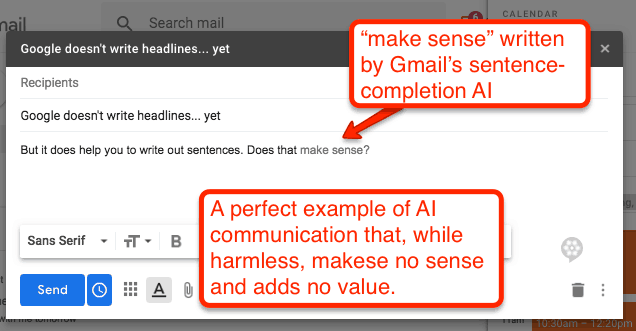
    gmail-ai-communication

    I’ll admit, sometimes Gmail gets it right. And yes, I have let Gmail complete some sentences on my behalf. I’ve let a computer program probably written by an engineering consultant in San Bruno, CA, speak for me.

    The faster emails are written, the faster Google can run against them, so maybe there a financial incentive for them. But that’s not why Google introduced the feature; it introduce the feature because it thinks it’s becoming normal to let software speak for you.

    You’re probably thinking, “no problem, I determine what gets sent out. It’s saving typing and if it’s wrong, I’ll just fix it.”.

    But that’s now how language works. You are forever influenced by what you see.

    The collective result is we’re all communicating a little bit more like the Silicon Valley brogrammers, or just normal nerds. And not just because of Gmail.

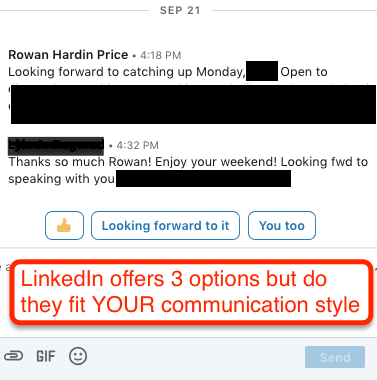
    LinkedIn speaks for you too


    linkedin-automated-communication

    LinkedIn’s communication automation is less subtle than gmail (and always seems to include an 👍  emoji). Nothing wrong with thumbs up – or any of these choices. The problem starts, though, when you stop thinking about what you say.

    Each of these options seem to close the loop on this conversational thread. Do you want to close the loop? Nothing else to add?

    And if you do want to close the loop, do you want to sound and feel like everyone else on LinkedIn?

    As with the Gmail example, maybe this just saves typing; gets you through your day faster. Lke letting a car drive for you, so you can take a work call. But your unique expression is at stake here in a way that isn’t part of letting a software program take over driving your vehicle.

    A more intelligent example of communication AI: Crystal

    crystal-personality-automation

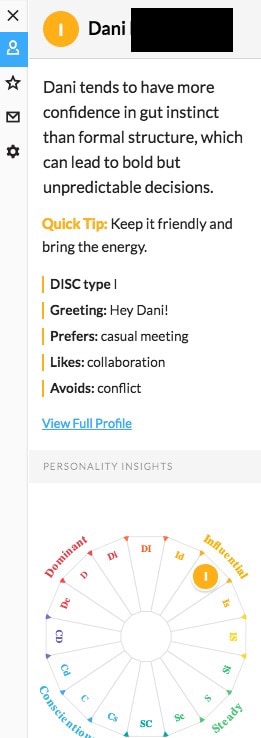
    Cystal App takes the automation of your self-expression one step further and suggests customizations to the way you write based on the DiSC personality profile of your recipient.

    In the example pictured, the recipient has type “I”, one of sixteen major personalityarchetypes that the DiSC system slots humanity into: “I”, for Influencer.

    Apart from being very interesting reading, knowing someone’s personality profile is meant to help you organize your communication in the most effective possible way. This person, for example, prefers greetings like:

    Predictive-Analytics-DiSC

    Hey Dani!

    Not, to take an extreme example:

    Dani:

    By the way, I was had an employee who communicated with everyone this way, Name:

    “Rowan: thanks for the download.” “Rowan: what are your long terms plans for the company?”

    Efficient maybe, but certainly not personalized to either personality or context.

    I’m all for personalization.

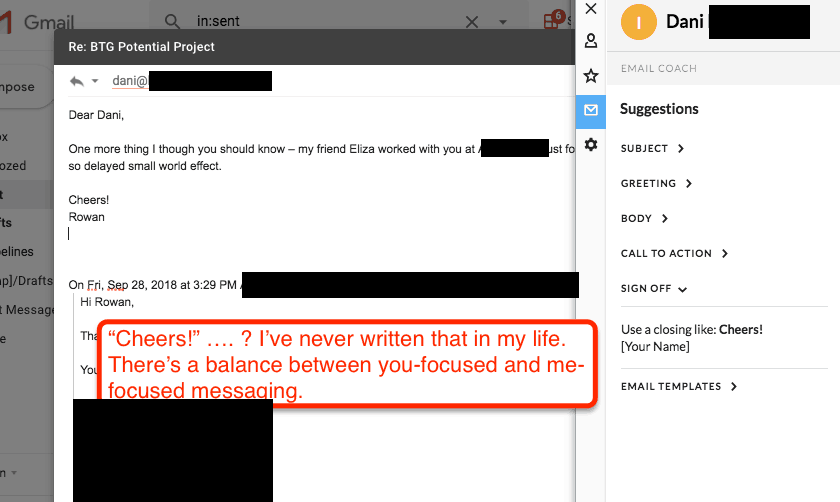
    Crystal uses DiSC to advise you on every aspect of communication. Though as I allude to up above, you must strike a balance between your personality and that of your recipient. I would never use the sign-off, “Cheers”, with or without an exclamation point.

    To thine own self be true.

    If you Google DiSC Personality assessments, you will find all kinds of stuff, including many tests.

    And some businesses coaches administer the test. I personally have taken it in 4 different context, including through a business coaching program and through Crystal app, and the results are surprisingly consistent; not always the same type, but in a close range.

    What sets Crystal apart is that instead of giving a test, it analyzes your digital presence (social media) to derive its DiSC profile assessment. Is it accurate? I think it’s about 80% accurate based on my personal ability to assess personality profiles and on my read of digital presence content that I know Crystal can’t access.

    So as with LinkedIn and Gmail, Cystal might help. And it might actually be much more helpful.

    But you can’t let it write for you. The problem with automating language is that it’s not a mechanical function; it’s an expression of who we are.

    As an aside, that’s why it’s impossible to separate out good identity copywriting (ie brand messaging) from strategy. Describing who you are as a business,=, the problem you solve, whom you solve it for – there’s one, single most accurate way to do that. And it’s going to read the same whether it’s in a vaulted internal document or on the homepage of your website.

    The idea of automating brand messaging then, is ridiculous. Thinking about the DiSC profiles of the average prospect might help. But if are humans and not robots, then we must be careful to think and speak for ourselves.

    How about you, are you happy to let a robot speak for you?


  • Upside Down Homepage UX

    A while back, I wrote that copywriting is 20% UX design. (By the way, UX design is a fancy way of saying “layout for digital interfaces.)”

    Benjamin Franklin knew this and co-wrote and designed a Declaration of Independence with – for his day – ample whitespace. His declaration was not just a transactional document; it was meant to  be read all the way through and inspire action.

    Fast-forward 250 years and UX/layout is still pivotal to inspiring action, or as we now call it: conversion rate optimization.

    In this post, I touch on UX design patterns for homepages. These patterns can be grouped into a technique that has amusingly been referred to by email marketer Bryan Harris as “upside down homepage”, where he looks at every business homepage as a “squeeze page”, a page meant to win email list subscriptions.

    Sometimes the goal is not email subscriptions, but appointments for sales calls. Same principles, either way.

    Why turn your website upside down? 

    Quite simply: to remove distraction from the (one) call to action. The one, single call-to-action that lives above the fold on the homepage of your website. 

    Here’s why it’s called “upside down”: the footer becomes the header and vice-versa.

    What is a header usually comprised of? A logo, a menu, sometimes a utility menu, usually at least 2 or 3 calls to action. Throw in the ubiquitous homepage slideshow, and your visitor is suddenly swamped and overwhelmed by choices. Here are some examples of how:

    (A) not to do it

    (B) heading in the right direction

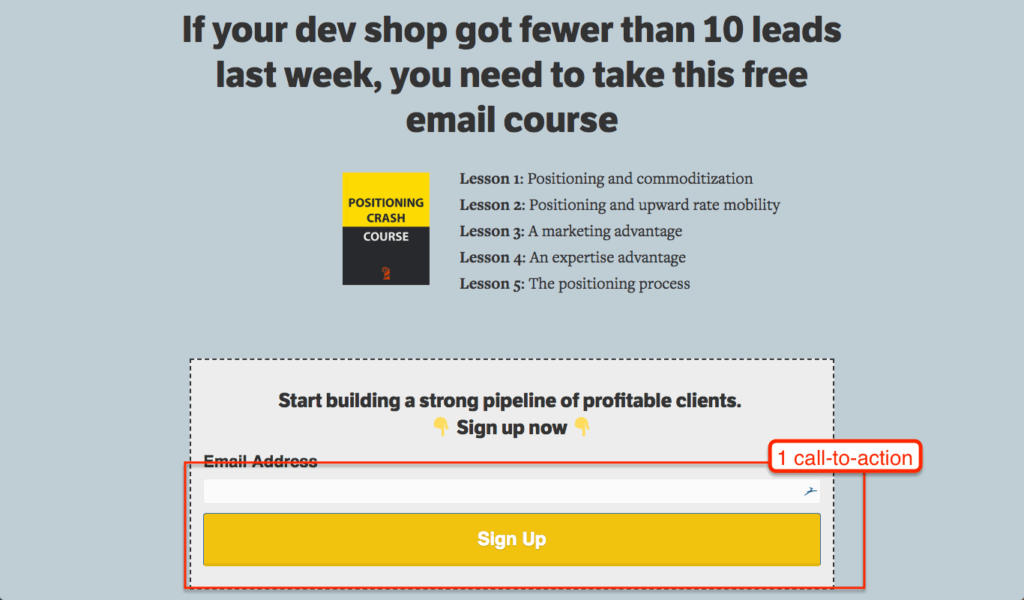
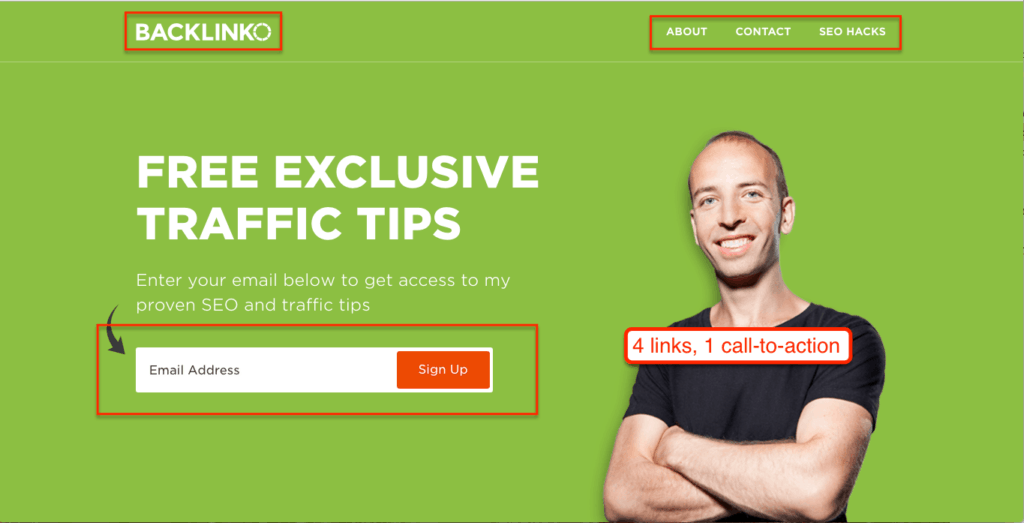
    (C, D ) excellent use of lead generation UX

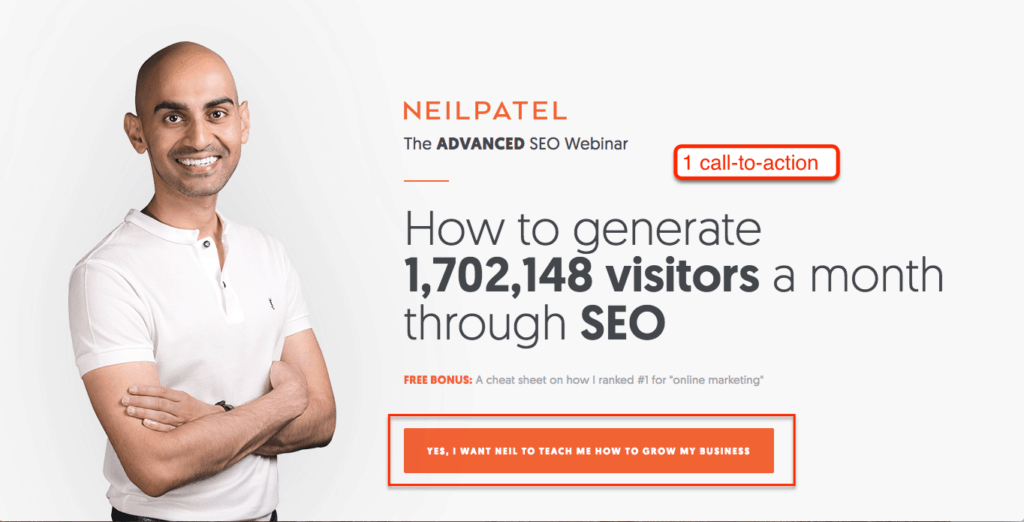
    (E) UX lead generation perfection.

    Each of these examples takes a screen shot at the world’s most common browser window size (1366px x 768px for you UX geeks out there). As such it focuses on what is most likely to be seen, read and remembered when visiting these websites without scrolling.

    In the 5 examples below, the likelihood of the page to convert is increasingly better optimized using the upside down homepage pattern.


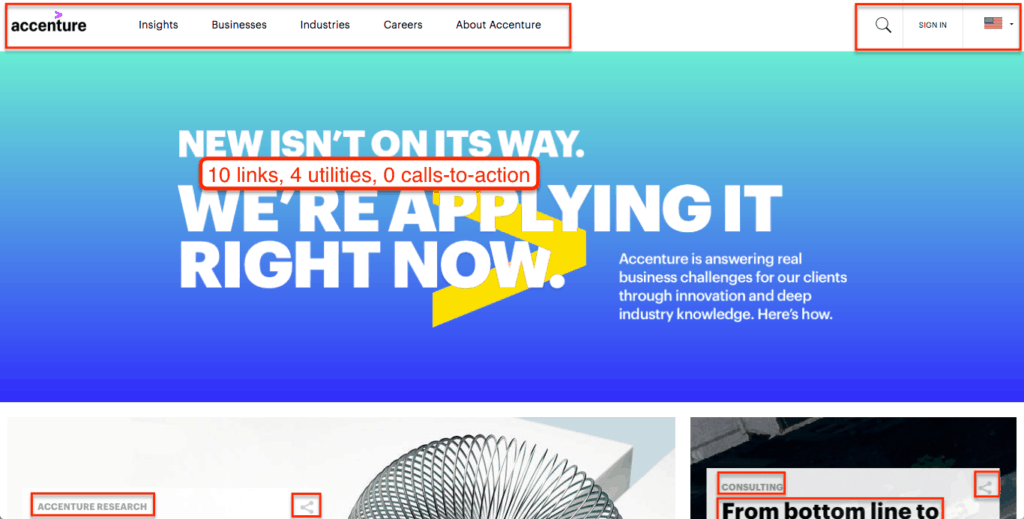
    Example A, Accenture: Not an upside home page, not at all conversion-optimized

    Accenture Bad Lead Generation UX

    Accenture making the classic mistake of not asking the homepage visitor to take action. What’s worse, they use a visual call-to-action convention, the arrow, without actually providing a link. Apparently, you find out about the “new” that Accenture is “applying” by scrolling down the page and choosing what to click on.

    But careful, you might try to click on featured content but end up with either a category listing (Accenture Research, Consulting) or a share button.


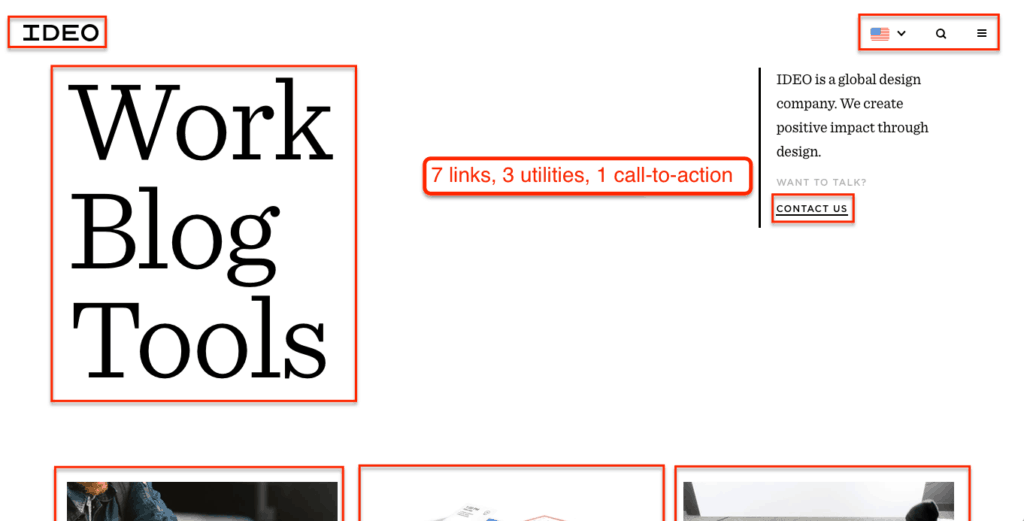
    Example B, IDEO: Moving in the right direction

    IDEO's approach to lead gen UX


    IDEO very original approach to leadgen UX is much better than most design agencies, to be fair. The arrangement of the main menu is quite inventive and makes you think, “these people are bold; these people think differently”. But from a conversion optimization standpoint, this isn’t good work. There is a lone, weak call-to-action. (Their actual contact page gets an A+ from me, on the other hand; go have a look).

    And yes, they are a well-known firm. But so is Apple, Microsoft, and Walmart – all of whom advertise. So IDEO has some work to do.

    Each of the next three examples, in contrast, is a lead generation masterpiece. Let’s look at them all together.


    Example C, Philip Morgan: No distractions, 1 clear call-to-action, powerful lead magnet

    UX for lead generation
    Philip Morgan’s homepage is perhaps the most masterful example of a “lead magnet” in this article

    Example D, Backlinko: Show your face

    Brian Dean's approach to lead generation UX
    SEO master Brian Dean’s upside down UX approach is slightly better than Philip Morgan’s because it shows his face

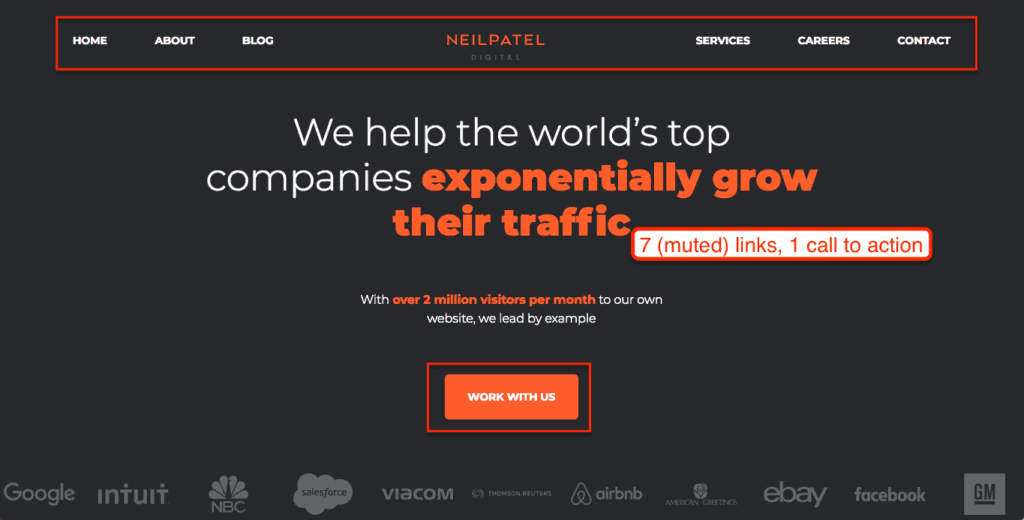
    Example E, Neil Patel: Perfection – no distractions and no form to fill out; just click the button.

    Perfect Lead Generation UX
    Master Digital Marketer Neil Patel’s Website is Flawlessly Optimized for Lead Generation

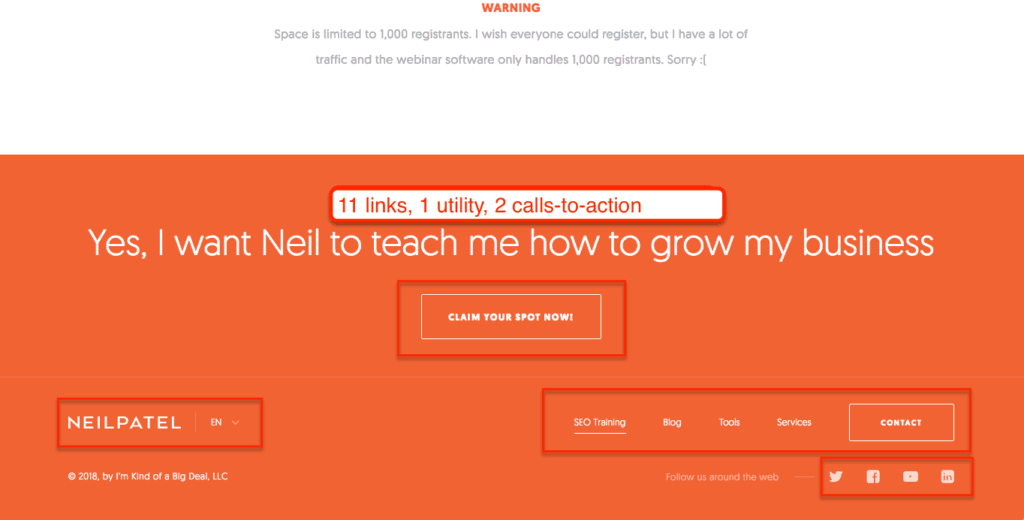
    Let’s also take a look at the footer of Neil Patel’s site so you can see the full scope of the upside down approach:

    Leadgen UX Neil Patel's footer
    The main menu, social links, and other “stuff” in the footer, not the header

    There is so much that is so well done in these last three examples. Each is an excellent illustration of the upside down homepage concept.

    As you can see in the last one, the footer becomes the navigation area.

    To be fair, this has long been a UX convention (large, replete footer sections); what makes it a true upside down UX approach is that the header no longer takes becomes the places where the visitor looks for navigational elements and utilities.

    Philip Morgan’s site (C) is also a prime example of the upside down UX approach.

    Of course, in Neil Patel’s, even the footer is hyper-optimized for conversion, with a dominant call-to-action repeating the call-to-action presented in the header area.

    Both Neil Patel and Philip Morgan offer powerful and masterfully worded lead magnets, acting on a variety of buying triggers, with Philip’s offer very clearly spelling out free value.

    Neil’s offer does less work to spell out value but that’s because he’s relatively famous in the world of digital marketing: to re-establish that credibility and implied value would be a waste of space.

    Some other lead generation UX patterns

    • There are a couple of other interesting trends at play in the three optimal examples, philipmorgan.com, backlinko.com and neilpatel.com.
    • One is the presence of a high-quality photograph of a person (at least in the last two). And not just any person – the consultant providing services.
    • Another is copywriting layout best practices: First a headline appeal, then details, then a call-to-action; and everything evenly and generously supported by whitespace.
    • That copy is supported by a non-busy, monocolor background and plenty of whitespace.

    I’ll caveat this by pointing out that lead generation may not be a strategic priority for some businesses. If your website is less a marketing tool than it is a product, you might not want to focus on lead generation at all. But in all of these examples, whether it’s a product or a service being offered, the website is most definitely a marketing tool.

    Social Proof

    Speaking of which, one more UX design pattern that support lead generation is the “proof bar” – the logos displayed just below the call-to-action. You’ll notice the same effect on NeilPatel.com and Backlinko.com, too. Either logos or (better choice, I think) testimonials accompanied by real people. Or both!

    Brian Dean does this well. Neil Patel doesn’t do this (any longer at least; he used to) but I don’t honestly think he needs to because of his personal name brand recognition.

    Solo consultants have it easier than agencies

    For for most agencies, I think Neil Patel’s site is a little “too perfect” in terms of conversion optimization. That’s because business customers want and need to perform due diligence before hiring a consultant, or even a freelancer. NeilPatel.com represents the ideal UX design for an information marketer’s homepage. Let’s take a look at the home page of his marketing consultancy, Neil Patel Digital:

    Digital agency UX optimization
    Strong conversion optimization blended with helpful links

    As you can see, the agency takes a more balanced approach to lead generation UX on the homepage. There are no social links, share links, utilities, and the link, but the standard main menu is still there – for now, at least. I expect the “home” and “contact” links to be removed at some point when the site is optimized. And that is about the right ratio for a digital agency’s above the fold UX: less than 5 links and 1 strong call-to-action.

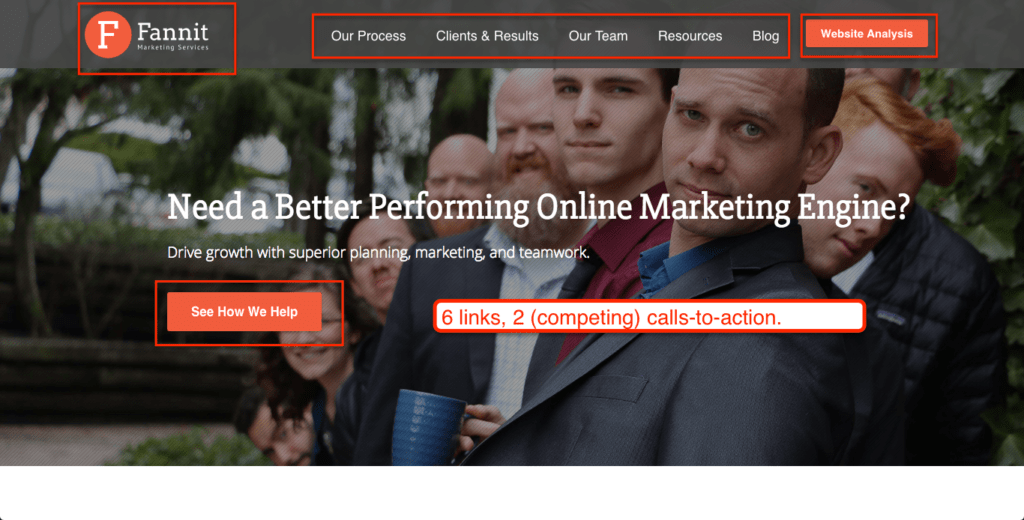
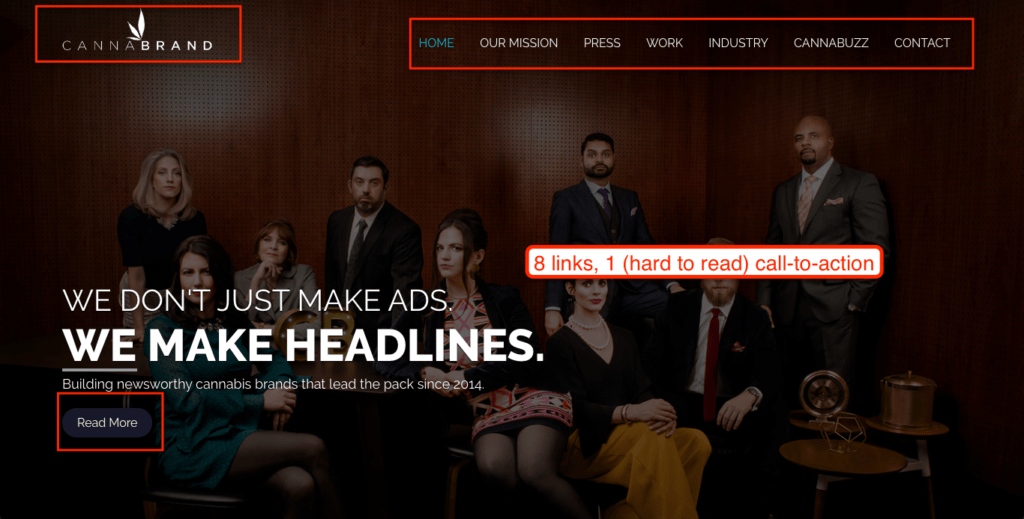
    One more note: IF your agency is “owner-based”, then an approach like Neil Patel’s makes perfect sense. If on the other hand you’re a partnership or rely heavily on employees as senior consultants or business development professionals, then you should present a staged group photo. Below are two perfect examples (with respect to the photo, the rest of the UX and copy have massive problems in both cases):

    Agency Example A, Fannit

    UX lead gen Fannit
    Far too many distractions and competing calls-to-action, but this Hubspot agency’s group photo is compelling


    Agency Example B, CannaBrand

    agency website's leadgen UX design
    Great group photo, too bad the menu is littered with useless distractions and the CTA is hard to read

    Both of these photos are comically posed but the latter has the advantage of being so costume-ish and ambient that it’s almost as if the agency is poking fun at itself and laughing along with you. At the same time, it’s a very high quality photo and shows seriousness of purpose. It also shows the real faces of actual people. I can’t recommend this approach highly enough to services or products agencies (and really, what’s the difference?)..

    But your mileage may vary.

    Which brings us to closing thoughts. First: to what extent should your company embrace the upside down homepage approach and the related UX approaches described in this article?

    And here’s maybe a tougher question: if you only get to keep 2 links in your header, what are they?


    fin


  • Introducing yourself

    When you enter a group of people unknown to you, do you introduce yourself, or wait to be approached? Unless one of you is Barack Obama is subscribed to my email list under a pseudonym, you probably introduce yourself. 

    Because who are you – in your professional world?

    If you’re not the Seth Godin of Marketing, the Jason Fried of SaaS software, or the Ariana Huffington of Online Media, then you might need to introduce yourself to the world. But what world? More on that in a second.

    For now, there may be no queue of people in line to introduce themselves to you, to maybe purchase your professional expertise from you. Or at least not a long queue.

    And I’m not just talking about introducing yourself  at cocktail parties (although as reader J.A. once remarked to me, the whole world is a networking event if you have the right mindset!).

    That reminds me – I’ll tell you a story about a networking event. Last month, I was in the global HQ of Upwork (a freelancing website which is also not a bad place to practice introducing your business). 

    By the way, if you’re a freelancer, then you’re a business – if you introduce and think of yourself that way. Otherwise, you’re not; it’s up to you.

    Anyway, it was for a meetup of “Top Rated” Upwork freelancers in the SF Bay Area and coincided with an internal congregation of Upwork’s global marketing team. There were about 120 people between Upwork freelancers and staff.

    There were two men there who weren’t introducing themselves. 

    One was Danny Marguiles, a Ramit Sethi course graduate who runs an online course specializing in helping freelancers succeed financially using Upwork. Wherever he went during the evening, a line of 3 or 4 trailed.

    I was standing next to the other, a quiet, shy-seeming guy wearing very nice clothes. He seemed interesting and important, because like Danny Marguiles, he had been been invited to address the entire group.

    I had been in conversation during his speech, so I hadn’t caught who he was and introduced myself.

    French accent. Extremely pleasant.  His name was Stephane.

    “What kind of work do you do, Stephane?”

    “I am the CEO of Upwork.”

    A-ha! He wasn’t shy; on the contrary, he possessed quiet confidence, the truest kind. Which isn’t surprising given that investors (Benchmark, T. Rowe Price, FirstMark, etc) trust him enough to lead a large Silicon Valley through an IPO.

    In retrospect, both of these people, Stephane Kasriel and Danny Marguiles, had introduced themselves: to all 120 people at the gathering, by speaking to it.

    So one of the tasks in front of us is to figure out how to introduce ourselves to large groups of people at once. The beauty of it is that it will force you to have something worthwhile to say.

    But it’s hard work to develop something worthwhile to say, to several people at once. How do you figure out what to say?

    There are only two methods I know of: running a successful business for an extended period of time, and writing (or some other kind of self-expression), also for an extensive period of time. If you do both, well, sooner or later there will be a line of people waiting to talk to you.

    But in the meantime we need to reach out, one person at a time. Bird by Bird, as Annie LaMott says.

    But who to introduce yourself to?

    Unfortunately, there are 7 billion people in the world.  To interact with about 10 of them per month would take 6 million years. 

    Fortunately, you don’t need to introduce yourself to everyone of them. Because only a few thousand of them are your ideal customers, apparently.

    … when your testing your positioning with the numbers, aim for 10–200 competitors and 2,000–10,000 prospects 
    – David C. Baker, The Business of Expertise

    This is probably the third time I have mentioned this somewhere. And I see it all over the place nowadays, so it deserves an explanation.

    These numbers (2,000–10,000 prospects) are based, as far as I can tell, on a pattern recognized by David C Baker while working with independent, professional, B2b firms.

    In other words, it’s not based in Economics, capital E, as far as I know (I could be wrong about this).  Therefore it’s actually not provable or scientific.

    But when David C Baker wrote the Business of Expertise, which is where I believe he first published those numbers, he’d been a consultant to nearly 1,000 independently owned high-end services firms over a 24-year period. So he’d identified a pattern.

    In addition, he did extensive research on the subject in 2014.

    I haven’t had the opportunity to ask David C. Baker about this research but as far as I can tell from pieces of information he’s disclosed in podcasts, articles, and his book, the evaluation process was simplify to identify successful businesses, then research and tabulate the numbers of competitors and prospects. So I’m guess some had 8 competitors and some 220, but most had between 10 and 200. Likewise for prospects.

    Wait. What constitutes a competitor and a prospect? Mostly like he defined competitor as having the same or very similar crosshair (horizontal + vertical) positioning. And he identified prospects as being businesses of the right size (not too big, not too large) in the industry (or industries) served.

    By the way, if you’re interested in learning more about this, I’d also recommend reading the “Business of Expertise” yourself (and let me know what you think!). And if you want to really dive deep, I’d suggest Philip Morgan’s body of online courses, which he describes as “specialization school”.

    It’s a good thing smart people like David C. Baker and Philip Morgan have figured this stuff out for us.

    Because for many small businesses, the number is hundreds of thousands if not millions  because they have no vertical marketing positioning. So they are a branding agency for anyone, a Drupal shop for anyone, or an accountant for anyone – without an audience, an industry, whom they specialize in solving problems for.

    That’s because small businesses make the mistake of emulating their larger peers, without realizing that the latter have an invisible positioning clause: they only work with profitable medium and large businesses, or startups with equivalent marketing budgets.

    So a huge agency like Interbrand can say we do branding but mean, “We do branding for big business”.

    So careful who you emulate or you’ll end up with millions of prospective customers – and maybe millions of competitors too. The ones on the job boards charging minimum wage or, if they are slightly more enterprising, sending spam to your email.

    So we’re in a middle place and one way to get to that place is with positioning; an effective first step for lead generation. Another is confidence, of course.

    I can’t think of a better method and I’m so grateful to David C. Baker for sharing those guide posts with the rest of us.

    Because we don’t have time to meet all 7 billion humans on earth. All we can do is “wish them well, wish them happy, and wish them safe” (Andy Hobson will show you how).

    From 7 Billion to 100

    Now let me give you an even smaller number: 100. 100 is the number of new business conversations your business will have each year with prospects in your market. That breaks down to about 10 a month, if you take a month or two off. That’s the low end of the range; the high end is about 20.

    No, that won’t let you talk to all 10,000 prospects, probably ever, but that’s OK (be merciful and leave some opportunities for your poor competition).

    So to get to 10 or 20 new conversations a month, unless you’re Barack Obama, this is where introducing yourself becomes important. At the same time, becoming Barack Obama, in your own world, is also a worthy goal, because the conversations will come to you.

    This is also called inbound marketing. Which is not easy when 2 million blog posts a day are being published.

    So our challenge is to balance the new business opportunities that come with inbound marketing with those that come with outbound marketing: introducing yourself.

    I help services firm with both tasks and encourage finding a balance between the two. 

    So I’m curious: how are you introducing yourself to your world?


    fin

  • Art Marketing

    Is your art itself not content? Would you delegate the creation of the art, like the old Masters did, and Jeff Koons does now?

    Maybe so, but you would set the strategic direction, and decide when the work is finished, otherwise the whole thing is a sham.

    So, yes, you can delegate it but not to just anyone. You can only delegate to someone who knows, or can come to know, your audience as well as you know them. And you have to set the strategic direction for your content, or work with someone who can help you do that.

    And even then, there are certain content creation responsibilities you should never delegate. The Artist’s Statement, for example. I’m assuming your talking about less sensitive written content, like blog posts or press releases, for inbound marketing. Not sure I’d advise that for you; it depends.

  • Principles, Jargon, Campaigns, Pricing, and Meditation

    Five things on my mind this week:

    1. Book I’m reading

    Principles, by Ray Dalio, which I touched on briefly the other day. His approach to life and business, which has led to the creation of the world’s largest hedge fund, is “a game”. The game consists of failing repeatedly, then being presented with a puzzle: an explanation for the failure. These puzzles yield “gems”, which he calls principals. Principals are extracted from his explanations for failures.

    Here’s how he describes the key parts of the behavior that uncovers principles:

    1. Be radically open-minded. Especially useful in determining your own flaws.
    2. Find the root cause. By this, Ray means finding the root cause in yourself for a given business failure. 
    3. Write your principles down. As Einstein said, if you can’t explain something simply, you don’t adequately understand it. Ray gets at this by writing down the principles he learns, because he knows that gives him the surest chance of being able to explain them later.

    To be principled means to consistently operate with principles that can be clearly explained
    – Ray Dalio

    This has a lot to do with content marketing; it’s the hidden benefit I’ve discussed earlier: clarifying your thinking so that it becomes much easier to summon in conversation,

    As you can see, the process and methodology is not just a lifehack; it’s a system for living a principled life. Did it ever occur to you that if you can’t explain your principles clearly, you may not be able to live or do good work by them? 


    2. Words I’m thinking about

    • Here’s a term offered by advice-givers to those of us who are self-employed: lifestyle business. I’ve heard this plenty of times over the past 10 years of being in business for myself and I know what people mean when they use it: a business meant not to create wealth or impact but to sustain a comfortable style of life with relative freedom. Sounds pretty good actually, sounds like a  good lifestyle business. But it’s used semi-pejoratively. And that’s SO strange. What’s the alternative, a bad-lifestyle business? No thanks.
    • Another term on my mind: namesake agency (or namesake brand). For example, Ford. Or Price, Waterhouse, Coopers. Or just a one-person name, such as Seth Godin.

      Some advise freelancers or solo consultants, on the other hand: work under an invented business name to encourage you to make business decisions. Not bad advice, especially if you’re new to the game.

      But another approach: start a namesake agency and talk about it in the 3rd-person.


    3. Marketing campaign I’m impressed with

    • Kai Davis is doing some good work lately. Go check out his series on improving your business as a consultant in a broad and comprehensive way.
    • And as was the case last week, Drayton Bird is midway through the best email marketing campaign I’ve ever witnessed, promoting his “Final Appearance” 1-day seminar (he is 82 and has said this will be his last in-person seminar) on October 25, in Bristol.


    4. Thought leader I’m impressed with

    At this point, I’m not new to the concept of Progressive Pricing, but it is rare that someone speaks about the subject as eloquently as Tim Williams. In this video, he gives wonderful examples of the theory of progressive pricing from multiple industries. He then explains how they can be used by high-end technical and creative services businesses.

    https://www.youtube.com/watch?time_continue=717&v=LZQb56VRZgQ

    By the way, what’s interesting is not just how B2B services businesses can use this for their own pricing, but how they can help their clients do the same.


    5. A business I’m impressed with

    Insight Timer, the meditation app, and low-key social network launched “Courses” recently. Smashing success.

    By the way, Insight is by far the best meditation app on the market that I have yet experienced, partly because it’s fiercely stuck to its spiritual empowerment missions. That means it has maintained the value of its product to those who can’t or won’t pay. It’s a beautifully designed app all the way around.

    Meanwhile, it perfectly nailed its difficult freemium ambitions by launching paid courses this Summer. In doing so, it has dramatically expanded the scope of its impact on listeners, on its teachers (the thousands of meditation teachers who record guided meditations – and now courses), and on its own bottom line.

    It’s one of those extremely rare cases of brilliant strategy and brilliant execution at massive scale.

    we’re introducing three ideas that will create revenue for our teachers and our company. These new features have been designed to preserve the spiritual nature of your community without removing any of the features you already have.

    I don’t know if your ideas will work. But we’re going to give it our best shot. And I hope our community understands the rationale behind our decisions.

    – Christopher Plowman, CEO of Insight Timer

    Your ideas will work, Insight Timer. You’re offering courses for between $5 and $20 that are invaluable (and a fraction of what they’d cost elsewhere), from some of the most remarkable meditation teachers – while providing free guided meditations, and many other features, from those same teachers.

    I doubt there are many for-profit businesses changing the world like Insight Timer.

  • Business at first sight

    When does “at first sight” happen in business? Sometimes it happens we “do” outbound lead generation. Sometimes it happens naturally in the context of inbound marketing.

    But there’s lead generation and there’s lead generation.

    In fact, there are dozens of methods of lead generation for thousands of business models.

    I don’t know about all of them. I can’t even list them all for you.

    But what I can tell you that lead generation is should match:

    • your audience
    • the problem solved you specialize in solving
    • how you deliver that problem (coaching, long-term consulting, monthly campaigns, teaching & training, etc.)

    What do you convey about these subjects on first sight?

    If you consult for a living, we have something common.

    I co-owned and helped grow from scratch a 23-person boutique consulting firm for 8 years, specializing in data-related expertise to the higher education and charity verticals. Data-science, CRM implementation, Business Intelligence. Data integration between websites, CRM, and other marketing assets. We did well, too, but could have done so much better.

    The list of thing I wish I knew when I started that business is longer than  Here’s one thing: development begins at very first sight. In the digital context, of course.

    Let’s unpackage “first sight”; more often that we realize, it consists of one of two things:

    • The homepage of your website, above the fold
    • The appearance of your brand, and a half dozen other key factors, on page one of Google

    Google your business name. What kind of business are you in, at first sight?

  • Business Philosophy

    First of all, let’s get something clear: I’m a “dumb shit”. 

    These words of modesty come from Ray Dalio, self-made (unlike Trump) billionaire hedge fund entrepreneur. They are the opening lines of his the dual-volume Principles (of Life and of Work), which I am reading this week and finding fascinating.

    Despite his modesty, Ray is a deep thinker; I imagine most self-made billionaires are, too. But the point he wants to make from the get-go is that he didn’t leverage intelligence to become a billionaire, he leveraged calculated investment of time. Discipline and fearlessness, over cleverness and brute force.

    And his philosophical analysis of his life and work experience makes him happier than any material successes. He said he’d set the writing and public engagement aside after publishing Principles, but he just keeps at it, which is great. And obviously, he is not dumb!

    Some words of wisdom from an even more notorious business philosopher:

    everything around you, that you call life, was made up by people that were no smarter than you

    “When you grow up you, tend to get told that the world is the way it is … but life can be much broader once you discover one simple fact: and that is that everything around you that you call life was made up by people that were no smarter than you. And you can change it, you can influence it, you can build your own things that other people can use. And the minute that you understand that you can poke life … that you can change it, you can mold it, you’ll want to change life, make it better. 

    Steve Jobs

    https://www.youtube.com/watch?v=0Ydp6bR5HXw

    I read a great article about Steve Jobs after he died which postulated that he was more than a businessman, he was a philosopher. A business philosopher. Like Andy Warhol before him. I don’t believe everything Steve Jobs says (he probably wouldn’t want me too, either). For example, I don’t believe that the only way to be truly satisfied in life is to love what you do. What do you think?

    This may be true for Steve Jobs but I’ve met too many perfectly satisfied Spaniards, who are completely indifferent to what they do, to be able to square that assertion with my life experience.  

    But tacked on to that idea was something similar but a little different: “the only way to do great work is to love what you do” . There is not one single doubt in my mind that this is pure truth. 

    Roll your own philosophy

    I believe it’s essential to hold your own philosophies, no matter how trivial or insignificant. Find things you believe are true. Are they also useful? Then hold on to them with all your might. As I have mentioned, deeply help beliefs are one of the prime drivers of confidence in the consultative sales process.

    This is actually what sets “OK marketing” apart from beautiful marketing. The latter should be something you believe in deeply enough to connect it to your business philosophy.

    What is yours, by the way? 

    That’s not entirely a rhetorical question – if you think of the answer, drop me an email. (Oh and P.S.,  I collect definitions of “Digital Strategy” or just “Strategy”; lemme know if you have one for my collection.)

    And by the way, my ideas are just borrowed from someone else and adapted to my situation. Here are some ideas I like to hold on to.

    • Everything in business can be understood by remembering that we are no greater, and no lesser, than animals with relatively huge cerebral cortexes.
    • By drawing an analogy between our business scenario and a similar scenario experienced by our prehistoric hunter-gatherer ancestors, we’ll focus on the most important variable: human nature. 
    • The subconscious mind is wiser than the conscious one and can provide solutions to creative problems. But it can also be fearful; we have to let our conscious and subconscious collaborate.
    • You never sell. When both sides want to proceed, both sides will know; otherwise, you’re using pressure and coercion, which will come back to haunt.
    • The reason high-end B2B consulting services require conversations is that it’s difficult to understand how they’ll be delivered and build value; trust must be established.
    • There is a gulf between the value that boutique and distinctly digital agencies provide, and the customers who need their services (My role is to bridge that gulf).

    Here’s how I get idea: take two statements like these, preferably from trusted sources, reconcile them to each other, then apply them to your business. For instance:

    • Nietzsche: “Art is the highest form of human activity
    • Gary Bencivenga:, “Make your advertising itself valuable

    Do those ideas complement one another and apply to your work in a useful way? How can your work be artful, whether or not you or in a so-called creative field?

    By the way, what is an artist? I don’t know.. someone who can endow an object with the power to make an impact on the psyche? Here’s an interesting definition:

    making money is art, and working is art – and good business is the best art..

    “Business art is the step that comes after art. I started as a commercial artist, and I want to finish as a business artist. Being good in business is the most fascinating kind of art. During the hippie era people put down the idea of business. They’d say “money is bad” and “working is bad”. But making money is art, and working is art – and good business is the best art.”

    Andy Warhol


  • Clasico, Cialdini, Campaigns, Coworking, Craftsmen-style

    Five things on my mind this week:

    1. Insight I’m agreeing with

    I watched a talk that cold email expert Alex Berman gave last year. When asked about the success factors of cold email outreach, Alex said:

    The biggest factor I’ve found is your website. It’s not even the content of your email, it’s not your subject line, or anything.

    It’s: does your website actually speak to the client?

    I think this applies to almost all forms of lead generation in the high-end B2B services space, which is where Alex and I both work.


    2. Musical performance that is blowing my mind.


    3. Book I am reading again.

    Robert B. Cialdini, Influence.

    I must’ve flunked the first read because I keep finding new ideas, good ideas, useful ideas.

    The fallacy of one-to-many communications for example. If you are having a stroke in a crowded park in a large city, your best chance of appealing for help does not lie in the crowd; there is not as much safety in numbers as we think. So don’t yell out help and expect something to happen.

    This is what you’d say instead: “You sir, in the blue jacket. I need help. Call an ambulance” (Cialdini, p. 116).

    With your personalized, 1-on-1 appeal, you have transformed the mind of your audience from bystander to rescuer.

    This is very close related to the first bullet.


    4. Marketing campaign I’m impressed with

    Drayton Bird’s ongoing event enrollment emails and videos are part of one of the best marketing campaigns I’ve ever seen.

    Am I a filthy, lying, rotten rat?


    5. L’esprit de l’escalier et les coworkings

    By the way, I’m mis-using the expression l’esprit de l’escalier. It translates literally to “staircase wit”, in reference to the amazingly witty remark or comeback – that you don’t think of until the next day. Or until you’ve already begun to descend the staircase.

    Here’s a #protip esprit de l’escalier (should’ve included in this article, Mechanics of consultative selling) for owners of co-working offices: provide “broadcast studios”. And they should be priced for individuals, not groups.

    In most co-works, conference rooms are priced for a group of people, sometimes $20, $30, or $50 an hour. And if they do rent private offices, the acoustics and lighting is usually terrible. Just by figuring out ways to orient a significant portion of seats towards natural light, you’ll win. I think a successful independent consultant only needs two to three hours per day “in studio”.


    Bonus: Quote that I’m contemplating/enjoying

    “here is an Undiscovered Beauty, a Divine Excellence just beyond us. Let us stand on tiptoe, forgetting the meaner things, and grasp of it what we may.

    – Bernard Maybeck, creator of the crown jewel of the Craftsman style

    That’s what’s been on my mind this week, yours?