Author: remap_content_admin

  • Email marketing at work in 6 steps

    Quick, how many business emails have you written? I have written 120,000. Here’s the  paper-napkin calculation:

    20 emails per day
    x 300 days per year
    x 20 years
    = 120,0000 emails

    I could be off by 60,000, because maybe I only write 10 on an average work day.  60k, 120k, 30k, what’s the difference? It’s a lot.

    It’s the same for you. Which is why you’re an email marketer. 

    The short emails count, too. The one-sentence replies. The nothing-but-emoticon replies. Think about it; some of the most impactful emails are the shortest ones.

    Some of the least impactful are the longest.

    Raise your hand if you’ve read every single long email. Didn’t think so.

    Of course, you’re not intentionally selling yourself, your service, with every email. But you are in practice. You’re a de facto email marketer.

    Are you a good de facto email marketer?

    Here are the tell-tale signs of good emails:

    1. Positive, friendly tone
    2. Content or tone personalized to the recipient
    3. Short (my weakness!)
    4. Easy to understand and respond to (another weakness!)
    5. End with a question, if any further action is required
    6. Ask the recipient to do one thing and only one thing

    Now I can find you hundreds of if not thousands of work-context emails contradicting these rules and maybe you can too.

    Secondly, this overlaps with productivity thinking, which advises on how to write work emails. But this isn’t about being efficient and helpful at work. F*#k your co-coworkers. Just kidding, co-workers!! 🙂

    If you isolate those six qualities in your work emails, and work on them, then by definition you are writing good marketing emails.

    I will acknowledge that workplace communication often involves lots of info. If your email gets beyond 5 sentences, copy it into a document and attach it (or link to it). Then extract the most essential 5 or less sentence that talk about the contents of the document.

    Ironically, this is also a commercial email marketing practice.

    In conclusion, practice asking

    Now I will caveat as follows: some work emails not only don’t require a follow-up action, they don’t want one. That is, you don’t think you want a response apart from a thank you.

    But in email marketing getting the recipient to take action is the whole point. So here’s your opportunity to practice email marketing at work. Practice asking for something and make sure it’s just one thing.

    That’s it, that’s your homework. Will you let me know how it goes?


  • Lead Generation Starts at Home(page)

    Here’s what I mean by that, by lead generation starts at home.

    And by the way, this only applies to complex B2B services that create high-value outcomes.

    The kind of services that are sold (and partially designed) through an intelligent, two-way conversations between agency and client.

    When you invite your clients to have a conversation like this, they come to your home. In fact, they often visit your home before they even agree to the conversation.

    And by home, I don’t mean your actual personal residence, or even your office, such as it may be.

    In fact, unless you’re a very large agency located in one of a handful of large cities around the world, they’ll never come to your office until you have a formal client-provider relationship.

    Your website’s homepage is your home

    But they come to your home and they do so right away, often they do so before they even agree to a conversation, let alone respond to your invitation to one.

    And your home is your web presence, which is anchored by, wait for it, the homepage of your website.

    Paradoxically, the website homepage has become a fractional percentage of your digital presence yet more important than ever before.

    Your social media stamps and your content marketing has increased your digital footprint every year.

    Your name is flung accross two dozen platforms and review sites, and so on. (Though by the way, is there a single Google doc that indexes your name and positioning in all of those places? There should be).

    Making the website homepage a lead generation tool

    Most of us think of digital lead generation as happening on a landing page, on some kind of cheesy tool like ClickFunnels, or cooler tool like Lead Pages (or if you know what  you’re doing on your own CMS-driven website, but that’s another story).

    And the landing page is where the beloved lead capture form happens, that grabs name, email, etc.

    But for most B2B firms, certainly ones that do high-value business, most effective place to capture leads is right on your homepage, right above the fold.

    To make this happen, we need to use the upside down strategy, which means taking the complex header and banishing it, or simplifying it way down. Put that header in the footer (and no, don’t put the footer in the head – not unless is extremely simple).

    That “clears the deck” for your one, single call to action. Just one. That is visible above the fold, on your landing page.

    It might be an email subscription or just a request for a consultation, but it turns the formerly decorational and informational homepage into an action center, as we used to say in my digital advocacy days.

    What would it take for you to turn your homepage upside down?


  • Positioning police to the rescue

    This article is about the importance of positioning to business development, especially for digital agencies. Whatever the hell that is. More on that below.
     
     
    One of the best answers”: “There is no “tactic”. There is a “process” of educating and informing potential leads about the relevance and the benefits of your products or services.”

    Here’s the key, though: that process fundamentally consists of positioning.

    In the vast “sector” called “B2B”, you might warm cold prospects by adopting a horizontal/vertical position: (a) what you do and (b) who you do it for.

    This is not a new idea. Al Ries wrote a book about this in 1980 based on concepts he first developed in a trade journal called Industrial Advertising in 1964.

    But his positioning concept is, if anything, more useful today than it was then, especially for B2B services and products offerings.

    By the way, what’s my positioning? Lead generation-focused marketing consulting for expert digital agencies with technical and creative expertise.

    Now the term, “digital agency” is extremely ambiguous to many people. Even I have to define for myself what it means, and I have worked at four of them over the past 18 years:

    • OVEN Digital, a 300-person design-focused digital agency
    • CSTG, a 70-person campaign-focused digital agency
    • Kintera/Blackbaud, a 3,000-person enterprise software company with a 50-person digital agency embedded into it
    • Freeflow Digital, a 20-person marketing integration digital agency (which I co-owned and grew from a couple of freelancers)

    And I have started a fifth, Stampede, a one-person business development digital agency. And I have consulted for, or contracted with, dozens of others.

    So I know something about this business model.

    What do all of you firms have in common? 

    Let’s review.

    Staffing patterns

    • Had at least one person on staff who thought of himself or herself as either a UX designer or a web designer.
    • Almost always had at least one crack software engineer with a computer science degree who tries to turn the company into a dev shop. Or, for more design-focused agencies, a relationship with a partner agency
    • Almost always had at least one crack designer with a BFA who imposes “designer law” on the company. Or, for more technical agencies, a long-standing relationship with such a designer
    • Had a psuedo-flat hierarchy
    • Had at least one person whose title was project manager
    • Extremely difficult to define roles and responsibilities
    • Blatant absence of copywriting-position or role. Instead, writing was done by most senior designers or strategists

    Identity confusion patterns

    What kinds of businesses were they?

    • consulting firm
    • software company
    • PR consultancy
    • strategy firm
    • dev shop
    • web design agency
    • web design and development agency
    • communications firms
    • web development agency
    • design firm
    • marketing agency
    • digital marketing agency
    • technology consultancy

    These are all used interchangeably by the same, or very similar, companies. 

    Who works for these companies:

    • consultants
    • strategists
    • designers
    • developers
    • solutions/software/information architects
    • software/product designers
    • programmers
    • UX designers
    • X marketers
    • Y marketers
    • Z marketers

    And that’s a short list. There are at least 100 more potential titles.

    Why? Why so much confusion and overlap. Because all of these things go together. Because the economy is moving so fast it’s hard to keep up.

    Because it’s a new industry. 

    Digital services is an industry and deserves its own NAICS code.

    Value delivery patterns

    • Primary value delivery mechanism was a website
    • Used or developed CMS software to build websites and train clients how to do so
    • Occupied, to varying degrees, the role of digital marketing strategist to clients. 
    • Used CRM software

    There following words were most commonly used to define deliverables.

    • Strategy
    • Solution
    • Clean
    • User-friendly
    • App
    • Product

    Business development patterns

    • Clients were national or international businesses
    • Best clients had at least 20 million a year in revenue
    • Got most business through word of mouth
    • Like their ancestors, advertising agencies, most digital services do not advertise. Or market.
    • Company uses the following terms interchangeably to define themselves in their 
      • agency
      • firm
      • consultancy
      • shop
      • business
      • company

    I have a simpler way of describing you: digital services firm.

    And if you’re that confused about who you are, then positioning makes more sense than ever. Who you are and what you do hardly even matters. Don’t worry about whether you’re a design firm, a marketing firm, a strategic consultancy, or a dev shop.

    All that matters is the problem you solve and whom you solve it for.


  • Mechanics of consultative selling

    In the 2020’s, successful expertise consultants will ply their trade from an interactive broadcast studio

    This is a reflection on the mechanics of selling complex services through a consultative process. Later, once you have a work agreement, it can be applied to delivering services. And it also applies to audio/video content marketing.

    It’s not a reflection on productivity. Nor is it strategy or anything even close to thought leadership. But it’s extremely important, especially to solopreuneurs or consultants in small firms; it’s about creating the essential communications conditions for a consultive selling mindset to flourish.

    This is the practical advice that I wish seasoned consulting coaches would offer: create, and work from, a professional-grade broadcast studio.

    Clarity first.

    I mean measurable, physical clarity.

    We don’t sell in person, we sell virtually. So your voice should be as clear as a mountain lake. As if you were there next to your client, speaking in their ear. Ok that sounded a bit creepy, but you get the point?

    Your image sharp, like HD television. And to the extent it’s not sharp, it should be de-contrasted, to soften hard lines in your face. The background should be simple. Not pure white necessarily, but not open office space either.

    Diffused lighting, no top or side shadow, plus a direct. soft light on your face, the camera just in front of you. The camera angle is simple too: just above eyebrow line, straight ahead, from at least 3 feet away.

    This means your wireless mouse and keyboard should be set up so that you can control the broadcast while maintaining the right perspective.

    Watch the video but go beyond. Use a wireless earbud (not bulky headphones): not distracting, yet never an echo. Did Dan Rather broadcast from bulky headphones?

    Be able to share your screen at any time, at the click of a button. Your desktop computer becomes a live video feed first, a workstation second.

    Find the right tools to make this happen; create a professional broadcast studio, and consult from it. This is step zero.

    Second: calm delivery.

    You are calm, composed, and poised. After all, you’re not selling. You are hosting a guest in your interactive broadcast studio.

    The technical clarity of your audio and video feeds is a double-edge sword. If you rush what you say, if you are scattered, if you are nervous, it will register painfully. If however, you are calm, poised, and relaxed, those qualities will set the tone of the conversation. Which is important when you consider the following strategic considerations:

    • If anything, rather than selling, you’re being to sold to in the sense that you are determining fit.
    • And because you have a lead generation program in place, there are more conversations like this one just around the corner.
    • So there is no need whatsoever to turn this conversation into a client-consultant relationship.
    • The question isn’t how much something costs, or even whether you should provide that thing.
    • The question is what is the problem that needs to be solved.
    • Of course, you may have the habit of creating the solution – and the price – on the fly, but that’s a good habit to unlearn.

    The calm you convey through your high-fidelity connection will help you can materialize all these good things, plus other important mechanics, such as “next steps”.

    Third: know thy calendar. 

    A broadcast studio always has an events calendar on hand. It describes your availability in the coming weeks and months. Bonus points if you know enough about your client conversation partner to have put their important dates on your calendar. It’s the first, pinned tab on your browser. It’s one of the reasons why it’s so natural for you to schedule a follow-up meeting (if one is warranted based on what you’ve learned).

    Speaking of which, never begin a consultive selling conversation without having written down, until you commit them to memory, times for the follow-up conversation. You don’t search your calendar, while on the call, to find your availability for that conversation; the calendar is just a backup because you already have those times in mind, or in case you need to get more than one meeting on the books.

    Does MSNBC news anchor Brian Williams say to this to his guests, “Wait a second, hang on. Umm…. let me check my calendar to see when we can have you on again. Umm… Tuesday? Wait no, no. Wednesday would work…..”. 

    Fourth: program the interactive feed:

    You have opened between 3 and 10 tabs in your browser before you begin the call. As mentioned, have the calendar ready. But also, your client’s website and whatever else is relevant: meeting notes, diagrams, designs, decks, etcetera. Take some time to figure out what makes sense.

    Conspicuously absent is anything not helpful to the client, including bookmarks and browser extensions. Unless they are relevant to the conversation, all of these things are distractions.

    When Brian Williams turns his broadcast to a screen of pre-programmed information, does he have to “pull it up”. “Hang on, let me find that”. No. His viewers are busy and so are your prospective clients. There will be exceptions to this rule based on the flow of your unique conversation, so make sure you have the obvious things accounted for. 

    And if there is no screenshare, then all of this must be delivered in advance.

    In conclusion, you are running a business form an interactive broadcast studio. Your desktop computer and its appurtenances must be carefully calibrated to realize that communication model. Transform it from a workstation to the technical centerpiece of your studio.

    To snap this back to reality, however, you won’t always have a distraction-free office. Maybe you work from a co-working office, or a Starbucks, or your living room. There are cats, dogs, spouses, kids, baristas, and other people holding conversations. There could even be unreliable connectivity through which to deliver the audio and video waves that comprise your delivery.

    Or maybe you have your own professional office, or office space with a conference room – but don’t assume that’s all you need. I have been in very high-rent office conference rooms with terrible camera angles, echo-y acoustics, and bad lighting.

    Perfectly lit, distraction-free, high-connectivity (“high-clarity”) space – space that by definition you exercise a high degree of control over – is expensive.

    What can you do to bridge the gap between your reality and your “ideality”, the professional sound and video studio completely free of distraction? 

    And here’s the most important question: can you bridge that gap enough to create the right mindset, in yourself and in your conversation-partner, to set the right tone for your conversation?

  • The three elements of charm, according to Drayton Bird

    Yesterday I wrote about the importance of cultivating confidence in the value of what you provide. Confidence can manifest itself as:

    • swagger
    • audacity
    • friendliness
    • authority
    • charm

    I never thought it’d be possible to define that last one, charm. Being charming in business, specifically in marketing, and super-specifically, in copywriting, confers an advantage. It can show up in all kinds of places: product design, web design, copywriting, user experience, marketing materials, and more. But charm isn’t what you might think. It’s not the exclusive domain of presidents and celebrities. It doesn’t require an outgoing personality, wit, a smooth, articulate delivery, or polish of any other kind. It doesn’t even require confidence, though that can’t hurt.

    So what is charm and how can you cultivate it?

    The New Oxford American Dictionary defines it as the power or quality of giving delight or arousing admiration.” And charm has a close verbal sibling, charisma: “compelling attractiveness or charm that can attract devotion in others”.  What these two qualities have in common is that they describe one person, relative to how they are viewed by multiple other people.

    But here’s a much more “inclusive” definition of charm, from copywriter Drayton Bird:

    The person who is charming has the ability so talk to you and make both of you feel as though you were wonderful.


    You see? It’s the creation of a shared feeling. It puts charm in the context of a two-way conversation, of two people. 

    How to Be Charming in Sales and Marketing

    Are there mechanics to charm? There certainly are; many were outlined in the classic, How to Win Friends and Influence People, by Dale Carnegie. But let’s look at how Drayton Bird’s three ingredients break down into places where you can take some kind of action.

    Indirect flattery (modesty)

    “I’m not really wonderful but you are”.

    The secret to indirect flattery is humility. A useful way to think about humility in the context of owning a business that provides an expertise-derived service is this: your services are not valuable because you are brilliant. They are valuable because you have done the work to gain the insight and skill to provide results to your clients.

    Honesty

    Honestly not only the best policy. It’s as rare enough now to make you pleasantly conspicuous.

    Honesty is not about “being blunt” or “telling it like it is”. That mindset is complete bullshit, to be honest. It is about examining very carefully what you think the important truths of a particular business problem are. By examining them carefully, you will understand them. By understanding them, articulating them will come naturally. 

    Liking people / liking to help people

    Number three and four come across naturally, to all human beings. And they are sort of the same thing. Of course, you don’t have to like everyone. There are some people not worth liking. But most people you will like, so ask yourself, how can I help this person.

    So for all three cases, the secret to charm is to figure out how to cultivate these tendencies, all of which already exist inside you.

    And here’s the real secret, they exist in other people too, and by manifesting them in your interactions, you will bring them out, such that you will create a shared feeling of being wonderful.

    Charm.


  • Cultivating Confidence Selling

    I wanted to atone for the article I wrote earlier this summer on the psychodynamics of selling in copy. This article is also about psychology but it’s about the importance of your confidence (not tricks) in your business development efforts, particularly lead generation.

    That article told you how to exploit the deep-seated and instinctive behavioral tics that we homo sapiens have inherited from our homo habilis, homo erectus and other hominid ancestors (thanks ancestors 👊). We cultivated them collectively in our gene pool to survive on this planet. That’s why there’s nothing sillier than humans deriding animals for their instinctive behaviors – as if we were any different!

    Anyway, you might find it a bit creepy to think about how to capitalize on our instinctive behaviors through sales and marketing language. But that is exactly what copywriters and other salespeople do. Does this message sound familiar? – “You should get/rent/buy/reserve this now because I have other people interested in it and there’s limited availability“. It works, doesn’t it?

    And it’s kind of unsettling to know why it works, then put it to use, then see it in action. 

    Which is why I suggested in that article that you should employ genuine goodwill and helpfulness. And be selling something good, something valuable. As David Ogilvy said, “Advertising is only evil when it advertises evil things.

    Why confidence matters

    Now speaking of valuable, I’ve written before about the importance of strong positioning to your sales and marketing efforts; it increases demand by narrowing the competition. It also deepens your skills through repetition – you’re repeatedly solving the same kind of problem so you get better at it.

    So why is it, then, that some services providers run extremely successful firms with bad positioning? In the company-culture world, why are some executives extremely successful despite never having cultivated an area of expertise? Sometimes it’s just connections. Often, they do really good work.

    But not always. So how do they do it?

    The answer is almost always that they have a ton of the emotion we call confidence or self-belief.

    Depending on your personality type, this can come across as charm, swagger, quiet, reassuring confidence, challenging, critical insight, or inspirational leadership. Whatever, the case, there is an outsized connection, for owners of services firm, between confidence and success in business development.

    Who uses confidence to generate demand and sell?

    Liston Witherill, sales coach to consultants, appeals to consultants desire to “sell with confidence”. But who else needs confidence?

    Quick digression on terminology: for me, a lead takes many forms but think of it as a measure of demand for your services. And if you put all this stuff (marketing, lead cultivation, sales, pricing/negotiation) into a big basket, one convenient label for it is business development. A sale, or at least a sale worth pursuing, is an exchange which creates profit, which Harry Browne defines as happiness.

    Question for you – do you practice business development? Do you conscientiously increase measurable demand for your services in a way that yields leads – which can be cultivated and turned into sales?

    In my mental framework, you do, no matter who you are. Or at least you try, like me (I’m working on it!).

    I primarily address what I’m saying to owners of complex services firms but we all sell, every working day, all the time. 

    As an employee, you sell the value of your work to increase your job security, your leverage, and other ambitions. It’s disappointing to put time and effort into solutions which are never realized, isn’t it? That’s partly because the sale is incomplete. You exchanged your work but didn’t back validation, just your wages. This is why generating demand for, and “selling”, your solutions is especially important in a large organization, with 100s of cooks in the kitchens.

    The last time I had an employee position, about a decade ago, I worked at a firm with 3,000 employees total, 500 people in my division, professional services, and 50 people on my team, digital solutions. Making a name for your services as an employee in that context has a lot in common with establishing a great positioning for your firm as a business owner. But confidence goes a long way. (And let’s be honest, it goes way too far, especially in large organizations. But that’s another story.)

    I think this is because it’s almost impossible to express the value of your complex services work in specific terms, partly because they are too complex to describe without a very deep understanding of them (which we’re all working on, right?). And partly because they are unpredictable and imprecise. Which doesn’t mean, “not valuable”.

    In the digital marketing services discipline, for example,  the calculation of ROI in sub-disciplines such as “conversion rate optimization” and “search engine optimization” is much more of an abstract concept than you’d think. So-called performance marketing can only be calculated in grand, over-arching terms because it is always impossible to equalize out all variables when comparing one period of time to another, which is the basic method for performance marketing.

    The fact is that the entire Universe is in constant flux; time itself is nothing. It doesn’t exist other than as a concept whereby we quantify motion. One thing moves relative to another and – voila – time exists. But you’ll ever recreate those unique conditions; Q1 2018 is never the same as Q1 2019. The Facebook Ads’ “lookalike list” is a great concept, but it’s only that: a concept. It is not alike.

    So if you can’t sell services based on precisely quantifiable results, if you can’t prove their worth in advance, where do you turn for leverage in the sales conversation? Positioning is probably the most important strategic factor. But deep confidence is fundamental.

    A formula for success in selling services

    Another sales coach (and marketing expert and author), Blair Enns, has written extensively on the impact of self-belief in the sales process in particular.

    The traditional formula for any kind of work, he will tell you first, for broad context, goes something like this:

    P = M x A

    Performance is equal to motivation times ability

    That formula applies to almost any endeavor. You can even apply it to other species, too. The performance of a dog in finding a buried treat is roughly equal to his motivation (hunger) multiplied by his abilities (smelling and digging).

    Motivation is pretty self-explanatory but it’s interesting to imagine what that might look like. Drayton Bird writes about doing his best work in his early 40s after he had lost everything at a prior business and staked all of his remaining money in a “startup” advertising agency. He had no plan B. Meanwhile, he had a family to support, a reputation to protect, and only one client… He describes his prevailing emotional state during all this as desperation. Later his agency was acquired by Olgivy & Mather and he became well known for this craft.

    The more desperate you are, the better you are likely to do.
    – Drayton Bird

    Now some dogs are desperate whereas others are well-fed. Some just love the game of treasure-hunting. So there are many kinds of motivation but if you’re desperate, leverage that.

    To bring this around from dogs digging up our backyards to professional services, the abilities part of this equation is exactly where positioning comes into play. The narrower and better cultivated your positioning, the greater your perceived, and probably de facto, abilities.

    But this formula gets most interesting when we introduce the self-esteem into it. This entire article is about that one little variable.

    SP = M x A x SE

    Sales Performance is equal to Motivation times Ability times Self-Esteem

    So there you have it: selling complex services to other businesses is a product of your drive, your positioning-based ability, and your confidence, confidence in yourself and the rest of what you’re selling.

    That confidence is what makes it possible to name pricing that reflects the true value of your services.

    And if we don’t name the right price we probably won’t get it. And then both sides lose, because you’ll never, ever do your best work unless you’re getting a fair price. Your compensation is a token of gratitude for the help you’re providing.

    Confidence will allow you to guide your client towards expressing the proper amount of gratitude. 

    How to develop confidence in the value of the services you provide

    Everything we’ve talked about so far begs the question, how do you cultivate that confidence, that “self-esteem”?

    There are essentially two ways, which I’m going to break down in a second:

    • Deeply-held beliefs 
    • Options 

    I think we’ve covered the deeply held beliefs quite a bit, but I’ll restate them as the outcome of your natural and cultivated skills and talents as applied to your market positioning. That creates beliefs.

    There’s a hack for strengthening your hold on those beliefs, though: writing, or let’s just call it self-expression.

    Experts write.
    – Blair Enns

    If you express your thinking about what you do in some way, you may deepen your belief in it (as long as you actually have something of value to provide). So I don’t care how you write or otherwise express yourself, but this is the how.

    Maybe you dictate into your phone or computer. Maybe you have a conversation with your colleagues and record it. Maybe a private journal, maybe a public weblog, maybe you draw diagrams. Maybe you constantly do recorded webinars. But there is something about getting those thoughts outside of your head, and into some other dwelling. It will let you pick out the good things from the rest, refine them, and use them to generate and sell demand for your services.

    Your self-expression can also double as content marketing, which confers long-term lead generation benefits if done properly.

    Let’s talk about options too, because, without them, your deeply held beliefs have no purchase.

    “Options” sounds like lead generation, lead flow, but there’s more to it than that. Blair Enns talks about three kinds of options that matter to business development outcomes: clients, leads, and money in the bank.

    • Clients generally means good client relationships, but mediocre or even bad ones will do. There is something about currently being engaged that changes how you present yourself. You are busy. You are not undermined by your own idle hands. A decent substitute for client engagement is structured lead generation such as content marketing or outbound email marketing.
    • Leads, which again, I define as quantifiable units of demands. The key here is that the lead materializes in the form of what I’d call a lead flow. A lead flow should be steady, reliable, and of sufficient volume to create more opportunity than you can respond to. The goal of lead generation is to create a steady and reliable flow of worthwhile conversations.
    • Money in the bank. Because you are selling complex services, as opposed to widgets, their value is closely related to what’s fair. There are few objective pricing measures for your services and that can result in their value being called into question, at which point you may undervalue your own services because you don’t have enough money in the bank and you sense a chance to fix that problem. 

    Of course, part of the money solution here lies in finance, which as about far from an area of specialization for me as ballet dancing. Remember that this is an entirely relative question.

    What matters, therefore, is not how much money is in your firm’s bank account, and by extension your own, but whether that amount of money is appropriate for your businesses, and your own, financial health. Your risk tolerance comes into play a little but the questions is, do you have control? There is a reason why Ramit Sethi doesn’t accept coaching students who have credit card debt. 

    If you have the right amount of money on hand, that will translate to tangible confidence and express itself in your sales and marketing, including that crucial moment when price is negotiated.

    When you put it all together, you get not just beliefs, but a (great) feeling, an emotion: confidence. 

    In conclusion, business confidence cultivation is an essential practice

    Cognitive behavioral therapists are right: emotions are determined by beliefs, and beliefs are determined by actions. And vice-versa. And, yes, there is a virtuous cycle here. The key is to determine what actions to take. 

    Let’s recap some prime candidates:

    • Making difficult decisions about who you solve problems for – and who you don’t (positioning)
    • Deepening your insight into your services and your clients through self-expression
    • Building a structured set of lead generation systems
    • Being in control of your personal finances, whatever that means to you and your business

    Building true confidence using methods like this is a long game but a crucial one. What if you need to act fast and put money in your account. I also have a very particular opinion: I believe that of everything I’ve talked about here, the surest way to business development success is reliable and consistent lead flow, through systematic lead generation. Nothing builds your confidence like knowing, during a sales conversation, that another such conversation is right around the corner. That’s how I think of lead flow.

    But it’s not the only piece of the puzzle. So how about you, is this is a long game or a short one? And what’s the most effective way for you to build your business development confidence?
  • Re-thinking Hybrid SEO: Add Expertise not Services

    A few days ago, I wrote about hybrid expertise firms, where I argued that small firms need to acquire, contract, or hire talent in multiple expertise areas even while they offer a narrow range of services to a narrow range of clients.

    That got me thinking about blending not just expertise areas but services, too. Whereas that post was directed at agency principals, this post is for anyone in the digital professional services world thinking about expanding their skills.

    One of the most powerful types of expertise hybrids are those that involve SEO.

    But writings about this subject generally known as “hybrid SEO services” have to do with hybrid services within the realm of Marketing Expertise: SEO and copywriting, SEO and email marketing, and the granddaddy of them all, SEO and Paid search, ie., search advertising as on Google AdWords.

    Unfortunately though, it’s when services come from two different expertise areas that they acquire the most problem-solving value and thinking.

    Previously, I’ve defined the four key expertise areas for a digital firm as follows:

    1. Creative Expertise
    2. Technical Expertise
    3. Sales & Marketing Expertise
    4. Business Expertise

    I think there’s a right way and wrong way to do this; like building a hybrid expertise firm, the right way is based on drawing from multiple expertise areas. I

    Each of us inherits inclinations towards one or more of these areas. But there’s being inclined and there’s developing expertise that allows you to think about solving problems in a different way.

    Some people have said: everyone should learn to program. Or, everyone should practice design thinking. And not to become an expert, necessarily but to improve one’s ability to solve problems.

    https://www.youtube.com/watch?v=zlBr4SI-NYY

    It had nothing to do with anything practical, it had to do with using them [software programs] to be a mirror of your thought process, to actually learn how to think … I think everybody in this country should learn how to program a computer … I view computer science as a liberal art.
    – Steve Jobs

    I don’t disagree with the specific point and I completely agree with the larger point.

    It pays to understand the technologies you use in your daily work, as well as those that comprise whatever solution you put in your clients’ hand.

    For example, if you work in either design and branding or in UX design, all of the your creative output will be delivered through the medium of Content Delivery Networks, the now-ubiquitous technical methodology for making apps and websites load fast.

    Meanwhile, most of your output will be delivered through the web using a CMS product such as WordPress. For both visual and UX designers, understanding the constraints of CMS from a business, marketing, and technology perspective will vastly improve the quality your work.

    Being Expertise Multi-Lingual

    Which is exactly the point: understanding your expertise area from the perspective of the other ones that are most important to digital services

    Not because you’ll comply with the another system’s requirements. It’s not about compliance; it’s about blending your way of solving business problems with other ways of doing the same. That’s where the sum-greater-than-parts effect kicks in. What better way of blending thinking than understanding that thinking.

    Everyone on a digital team should have an understanding of the four pillars of digital services: creative expertise, technical expertise, sales & marketing expertise, and business expertise.

    Examples of Hybrid Expertise

    But I’m not talking about just understanding for the perspective of organizating your thinking, which is the excellent point Steve Jobs makes in the video above. I’m talking about actually acquiring another concrete skill – from area of expertise outside the one you have already mastered (and if you haven’t mastered any, this doesn’t apply to you yet) and joining it together.

    Many SEOs make the mistake that they are stronger for focusing on SEO to the exclusion of all other forms of marketing, let alone other service areas. Not Sara does SEO and Volacci.

    Sara does SEO

    There is a woman named Sara Dunn whose YouTube series “Specializing a Web Agency” is terrific. And by the way, if you’re thinking about taking the specialization journey like the comprehensive and structured workshops on specialization offered by Philip Morgan. Philip’s target customers are self-employed software developers (ie freelance consultants or small agency owners) but in my opinion anyone who fits into digital services world can benefit from his approach.

    Anyway, Sara’s specializations are web design and SEO, a perfect example of hybrid horizontal expertise

    In the world of digital services, web design falls dead in the center of Creative Expertise and SEO is a fundamental skill (well, a large collection of related skills, actually) to Sales and Marketing Expertise.

    By blending those two disciplines, she provides customers in her target niche (the wedding industry) with two very different, yet very complementery skills and expertise areas with which to solve problems. For a wedding planner or someone else in the wedding industry asking themselves, “how do I get more wedding clients?“, Sara’s form awnswers that question.

    Volacci

    Volacci is another small agency that marries SEO, a form of Marketing Expertise, to another expertise area, Technical Expertise. In Volacci’s case the particular form of technical expertise is Philip Morgan calls a “Platform Specialization”: Drupal.

    Drupal, as you may know, is not as simple to use and understand as its CMS counterpart, the more popular WordPress. Nor does it have the built-in on-page SEO optimization tools that WordPress comes with (or are easy to add on as plugins).

    Yet it’s a much more flexibile product, meaning that with the right customizations, it’s possible to automate scaled-up SEO optimization, for the kind of large scale sites (1000+ pages) that Drupal is so good at supporting.

    For example, I built and SEO-optimized a 10,000+ page Drupal site in 2006 that, despite never being optimized or redesigned since, now gets 30,000 unique visits a month.

    So in a nutshell, SEO for Drupal represents a huge missed opportunity. And by specializing in both, Volacci solves that problem much more effectively than if it only dealt in either SEO or Drupal.

    The elusive business-SEO hybrid expertise

    So far we’ve looked at the following SEO hybrids:

    • Sales & Marketing Expertise (SEO) <-.> Creative Expertise (Web Design)
    • Sales & MarketingExpertise (SEO) <-> Technical Expertise (Drupal)

    What’s missing? An “SEO-marriage” of Marketing and Business Expertise. For example:

    • Sales & Marketing (SEO) <-.> Business Expertise (Market research)

    Unfortunately, I have no specific recommendation for a firm or consultant that marries these two expertise areas. And when I say marries these two areas, I mean someone who really understands business planning and strategy, such as an MBA, a business owner, or a seasoned veteran of complex consultative sales & marketing who has transcended an implementation deal and become a strategic advisor to her business.

    That hybrid-expert person understand:

    • Whether SEO should be pursued as an inbound marketing strategy, in the first place. This is a form of market research and validation that only be performed by that rare individual with both specializations
    • How and why to re-engineer the DNA of the business model itself to lend itself to SEO marketing opportunities.
    • How to pursue and maintain a position of market advantage by leveraging SEO

    In theory, a good “pure SEO” will advise on some of this. But in practice? Not so much. Most good SEOs are scienticists, deeply immersed in their craft, toiling at away at decoding a complex algorithm, and ranking thousands of webpages at a time for high-value keywords.

    One you master something, you have two paths:

    • Keep mastering it and double-down on learning your craft
    • Sacrifice a little bit of that continued learning to bring a new discipline into the fold.

    What’s your path? And what’s your expertise? Let me know, I’d love to think about this from your perspective!


  • What is a complex services business? (And what isn’t it)

    Is yours a complex services business? It could be if your firm is one of these:

    1. Design agency
    2. Marketing firm
    3. Advertising agency
    4. Software/data service company
    5. Sofware publishing company
    6. PR firm
    7. Web agency
    8. Digital marketing firm
    9. Management consulting firm

    If you’re one of these, you may have some things in common with the rest of the firms on the list: you have a relatively complex sales process. By which I mean you have a sales process that is not only lengthy but highly customized and involves many different personalities and interwoven personal agendas.

    And you should be selling something that is based in digital strategy.

    Let me explain by drawing a contrast: e-commerce.

    Buying a garden shed on Amazon may be a very long sales process, but it’s not a complex one. Even if the product itself is so complex that it needs its own explainer video, the sale itself is simple. It happens with a click. Viola. E-commerce.

    And e-commerce is full of complexities –  but these are unlike the complexities of a complex services firm.

    E-commerce as an area of expertise is anything but simple. I know this because early in my career I helped build one of the world’s largest e-commerce sites, at the time, Tiffany & Co, then went on to create e-commerce solutions for a decade in various verticals within the nonprofit sector. It gets really complex, really fast.

    But the single interaction is not complex for the user, even if it’s for an extremely large amount. A nonprofit client of Blackbaud’s, where I formerly worked, once gave $250,000 in a single online donation. The technical, creative, and marketing expertise that went into creating that moment, not to mention the emotional complexities in the mind of the donor, were profoundly elaborate.

    But that sales process was less complex than the sale of $250 in services from one of the types of agencies mentioned at the outset.

    Not-so complex services business

    Also less complex that high-dollar donations – or luxury jewelry purchases – are the sale of many kinds of services.

    Landscaping services may also cost $250 but selling them is fairly simple, even if there is some negotiation involved.

    And just because the payment might be complex, that doesn’t make the sale complex. The landscaper doesn’t take checks, he tells you, but he has a credit card processing services, but it’s in his office, he’ll have to call you tomorrow to collect payment. Does 1:20 pm work? He had to reschedule. You see? Payment can be complicated, even if the services isn’t.

    How can that be? First, let me recap what factors DON’T involve complex services:

    • The amount of the sale
    • The technology involved in the sale
    • The complexity of the designing and marketing that goes into the sale
    • The fact that what is being sold is a service
    • Negotiation
    • Complexity of payment

    So what’s left over that makes some services businesses so complex. Two things:

    • the personal relationships that are part of the sales (and marketing) process
    • the communication, and simplification, of inherently complex services

    The services sold by management consulting firm, or an advertising agency, or a custom web development shop, are often extraordinarily complex; more so than the buyer realizes into she is well into an engagement. For that reason, they have to be well communicated before services are rendered.

    What makes it even more complicated is the explanation of the intricacies of a service such as custom app development, or content marketing, in and of themselves constitute a form of services: strategic consulting, which is the dispensing of expertise as advice in exchange for compensation.

    The sale itself is not a transaction. It’s an emotional and reasoned transformation that occurs in the purchaser of services after she has gained the trust and understanding necessary to want the services on offer. The rest is just details.

    It’s all about relationships. and then some

    Speaking of emotional, the crown jewel of complexity services is the personal factor: relationships. Have you ever decided to take a long journey with someone? Perhaps a hiking trip, a train trip around Europe, or a cross-continental journey? Don’t tell me that was a simple journey in terms of the relationship because you’re not a robot. Hopefully, it was a wonderful, interesting, and rewarding experience. But here’s what didn’t happen: you and your traveling companion didn’t didn’t get to know one another any better, didn’t deepen your relationship.

    Well, so it is with complex services businesses. Someone on the services provider must get to know the buyer, because how can they be of service, which is at the heart of services as a business deliverable, without knowing how and whether they can serve?

    The owner, the communications strategist, lead developer, senior consultant or project manager, gets to know someone on the client side, really well.

    And that’s before the sale.

    At least if that someone has a talent for complex, consultative selling.

    So the next question is, how does a complex services business generates leads that are especially suited for this kind of interaction? Or before we get to that question, even, how do you know if you need to generate those kinds of leads for your firm?


  • Google Brand Score: Major Creative and Digital Agencies

    Updates (Nov 25, 2019):  I wrote this article in the Summer of 2018. It may not longer be accurate. But my sense is that it will be accurate for 3 to 5 years because big orgs like these change slowly and Google’s strategy of favoring large brands is not set to change anytime soon. 

    Google Brand Score (formerly known as Page One Score) is a formula I have developed to evaluate an organization’s brand presence on page one of Google search results.

    Want to skip right to the part about how to improve your Google Brand Score? Skip to the bottom of the article.

    This is also known as SERP Branding, in the SEO community, but that’s a little wonky, plus it tends to discount the importance of CRO (conversion rate optimization) copywriting, which Google tracks carefully as click-through rate, which in turns affects SEO ranking.

    I use the term Google Brand Score to emphasize the continued importance of Google for most brands, though Bing matters for some – the same methodology can be applied there.

    So this is what you get when someone searches for their name (in PPC marketing, we call this a “branded keyword”) on a search engine, namely Google, but the results hold true for Bing. I evaluate positioning, conversion appeal, and brand presence. This is NOT about traditional SEO (ranking); though it is search engine optimization, of a kind.

    Why Google Brand Score matters

    For B2B marketing, including any kind of lead generation, inbound or outbound, Google Brand Score is remarkably important.

    Prospects want to be impressed when they type your brand name into Google. And if they are making a significant investment in your services, whether you are a one-woman outfit or a 100-person agency, they will almost always type your name into Google.

    One way to look at it is as follows: if a copywriter and a UX designer were able to custom design the presence of your brand on Google search results for your branded keyword, what would they create? And how closely does what they would create (a “10” on a scale of 1- to 10) match the actual result?

    Well, as it turns, you CAN hire a copywriter, UX designer, and on-page SEO consultant to do all those things, and to completely transform your page one score. I list out some of the best ways to do this but first let’s take a look at some real-world examples from companies.

    As the global leaders and design, branding, and digital should each have a perfect brand presence on Google search results, right?

    A teardown of 15 big agencies

    In fact, here’s how the 15 of the world’s largest creative/digital agencies describe themselves to the world, ranked by their Google Brand Score.

    Agency name (Google search term) Title Description Site Link Extensions Google Brand Score (1 – 10)
    IDEO IDEO is a global design and innovation company. | ideo.com IDEO is a global design company. We create positive impact through design.
    • Design Thinking
    • San Francisco
    • Jobs
    • Work
    • Food & Beverage
    8
    Landor Landor | Brand consulting and design A global leader in brand consulting and design, Landor helps clients build agile brands that thrive in today’s dynamic, disruptive marketplace.
    • Join
    • Offices
    • Work
    • Thinking
    • About
    • News
    7
    Frog (PPC) Frogdesign.com | frog Design | Creating Measureable Value‎ e Work To Advance The Human Experience Through Brand, Product & Service Design. Ideation to Real Products. Go To Market Strategy. Leading Innovation Firm. Types: Transportation, Healthcare, Mobile & Telecom, Consumer Products, Retail, Financial Services, Social Impact, Enterprise Software.
    • Business Growth Strategy
    • frog Product Realization
    • Innovative Product Design
    • Customer-Centric Design
    7
    FutureBrand FutureBrand US: The Creative Future Company | FutureBrand FutureBrand is the Creative Future Company, a global brand consultancy. We define and deliver connected brand experiences.
    • Our work
    • Merck
    • About us
    • American Airlines
    • Contact us
    • Country Brand Index
    6
    Interbrand Interbrand – Global Brand Consultancy As a global brand consultancy, we know that growth is achieved through clear strategies, exceptional customer experiences, and world-class capabilities.
    • Best Global Brands
    • 2017 Best Global Brands
    • About
    • Work
    • Best Brands
    • Engaging Employees to …
    6
    Wolf Ollins Wolff Olins At Wolff Olins we’ve defined ‘radical’ to mean four things: fundamental, simple, different and human. But as we explored this together recently, we realized we …
    • Our jobs
    • USA TODAY
    • Work
    • Zocdoc
    • People
    • Approach
    6
    W2O Group W2O Group | Right Data & Actionable Insights for Your Brand W2O Group is an analytics-driven, creative marketing and communications firm that empowers brands with the right data and insight-driven actions. Learn more.
    • Culture & Careers
    • Contact
    • About
    • Healthcare
    5
    Frog (Organic) Frog Design frog transforms businesses at scale, creating systems of brand, product and service that deliver distinctly better experiences for customers, consumers, citizens …
    • Careers
    • Services
    • Austin
    • Work
    • New York
    5
    Huge Huge Inc. Huge is a full-service digital agency headquartered in Brooklyn with offices worldwide. We transform brands and build businesses.
    • About
    • Oakland.
    • Contact Us
    • ATL.
    • Brooklyn.
    • DC.
    5
    Big Spaceship Big Spaceship A modern partner to ambitious brands. We help organizations connect with audiences through a deep understanding of culture and behavior.
    • Careers
    • Approach
    • Work
    • Culture
    5
    Sagmeister & Walsh Sagmeister & Walsh Sagmeister & Walsh is an NYC based full-service design firm that creates identities, commercials, websites, apps, films, books and objects for clients, audiences …
    • Stefan Sagmeister
    • Frooti Frooti
    • Work
    • Otium Otium
    • News
    • Branding
    5
    AKQA AKQA AKQA is an ideas and innovation company. We exist to create the future for our clients.
    • Careers
    • Studios
    • Working at AKQA
    • News
    • Services
    4
    Sapient-Razorfish SapientRazorfish: A Digital Transformation Agency From customer experience to data and AI, SapientRazorfish is business reimagined. Learn how we can help drive your company’s digital transformation. (none) 4
    Pentagram Pentagram — The world’s largest independent design consultancy Pentagram is the world’s largest independent design consultancy. The firm is owned and run by 21 partners, each of whom are leaders in their individual fields.
    • Work
    • About
    3
    Neo@Ogilvy Neo@Ogilvy | Leaders in Marketplace Foresight | Global Media … Neo@Ogilvy delivers marketplace foresight and digital media solutions to performance-oriented marketers around the world. (none) 2

    There are some interesting patterns here:

    1. One area of expertise: branding/design (and copywriting is never mentioned so to claim “Creative” expertise is a stretch)
    2. No specific types of services mentioned other than branding and digital transformation
    3. No specific types of clients, though some mention F500 brand names, boosting their Google Brand Score
    4. There is usually a Wikipedia presence filling out the right column of the search results page; if the brand is smart/lucky, the Wikipedia presence piped in includes a logo.
    5. Sitelinks that are usually non-distinct (About, Contact, Jobs)
    6. Lots of vague and meaningless catchphrases, like “positive impact through design”, or “innovation company”.
    7. Hardly any calls to action in the description text and/or Sitelinks (only 2 out of 15)

    These companies are probably getting most of their work through word of mouth, which makes sense – a lot of them do amazing work and have done since the dotcom era. Smaller firms, on the other hand, don’t have the luxury of being generic, full-service branding firms with no expertise outside of design.

    Let’s just hope they are not relying on the brand presence on Google. With the notable exception of IDEO, which has interesting and easily digestible thought leadership all over the page, these firms have a disastrous Google Brand Score, despite having enormous resources at their disposal, including a (theoretically) superior understanding of the power of branding.

    11 Ways to Improve Your Google Brand Score

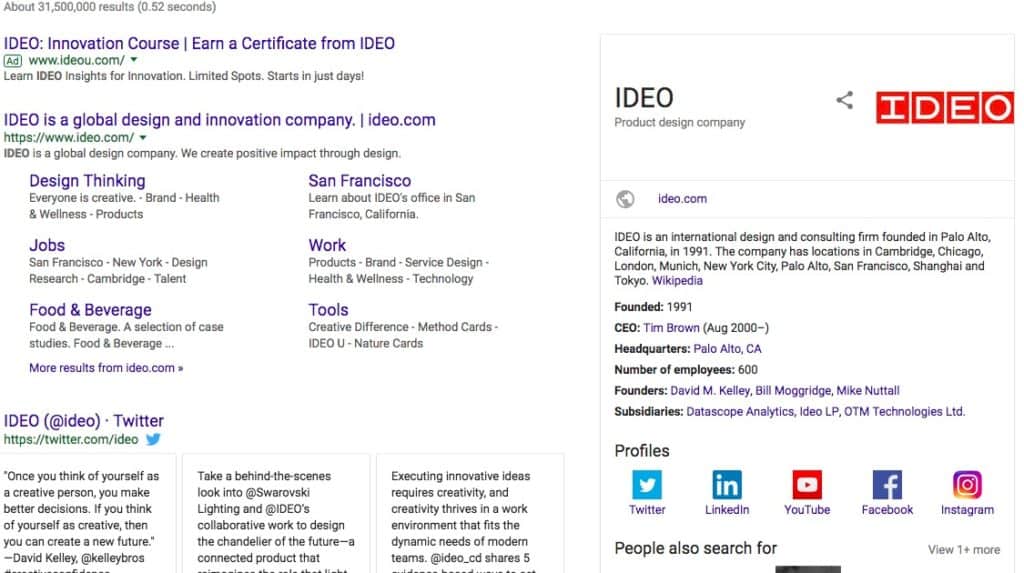
    Below you see a brand with an excellent presence on page one of Google search results. I break down some of the ways it accomplishes this below. By the way, most of this is as applicable to Bing as to Google.

    Google Brand Score by IDEO
    IDEO has an excellent page one score from this top half all the way down.


    1. Using technical SEO, write your homepage SEO copy as though it were a piece of content (e.g. an article or a guide), so that it has an appealing, on-message, and you-focused page title (this is what Google uses to create the clickable title of a search results entry). Also, make sure your home page’s SEO title not cut off.
    2. Same for the homepage’s description, which you should supply by writing a meta description. By the way, this is the only meta tags which matters to normal SEO and also to your Google Brand Score. Make sure you write it as copy: descriptive, informative, useful, and include a call-to-action.
    3. Because Google often picks them up in search results, make your main menu items descriptive. Google often uses your main menu items to create what are called “sitelinks” below your main result entry (IDEO does better than most of its competitors because its first site link is “Design Thinking”).
      • About our software firm > About
      • Lead generation articles > Blog
      • UX Strategy & Services > Services
    4. On the same token as #1 and #2, write the page title and description for each important page likely to be a part of your page one score as if you were optimizing a piece of content.
    5. Create a Wikipedia entry (if warranted) for your brand. If your brand doesn’t warrant a Wikipedia entry, because the general public doesn’t need to know who you are, then you are at a disadvantage. This is Google calculated strategy to improve search results by favoring big brands.
      • Note: the logo that Google pulls into the informational block mostly supplied by Wikipedia comes from your primary website. The lesson there is to consistently use, name, refer and link to your logo. I’d name the actual  file, OrganizationName_Logo.png, and same for the its alt tag. I’d even create an external link somewhere on your site saying, “Look at OrganizationName’s new logo!”.
    6. Run an AdWords Google Ads ad, where you can easily replicate steps 1-3 using AdWords conventions. Research shows that searchers are morely likely to click your organic search result if they have previously glanced at your paid ad. Of the 15 major agencies I reviewed, only IDEO and Frog Design were running paid ads above their organic ones. And fortunately Google makes it affordable to bid on your branded keyword.
      • I’d take full advantage of sitelinks, callouts, and other extensions that puff your Ad up
    7. Maintain an active Twitter feed that is clearly connected to your brand name. Here’s where the best practices of social media management go out the door. All that matters here are recency, regularity, popularity, and being on-message.
    8. Create a branded YouTube channel; we’re seeing a massive uptick in the frequency with which Google pulls YouTube into branded keyword search results. All of the same requirements apply as for Twitter
    9. This is only relevant for very big brands, but have a news feed that also abides by the principles of frequency, regularity, and popularity.
    10. Instead of just having a “Jobs” or Careers page, use Google Jobs and write descriptive, attracted job descriptions optimized for your Google Brand Score – descriptions that let users infer what your business does.
    11. Have an excellent “Google Maps” entry. By the way, this is related to Local SEO, but it’s not the same thing. What you’re worried about here is whether the photography and copy that Google pipes in from Google Maps enhances your brand. Read about local SEO to figure this out.

    There are other ways that follow the same principles, but those are most important approaches currently (always subject to change according to Google’s whims, of course).

    By the way, these aren’t necessarily specific instructions; you’ll have to Google those yourself.  This is just to point you in the right direction. Bon voyage!


    fin


  • Unpacking the Two Best Kinds of Leads: Referrals and Word-of-Mouth

    Some coaches and consultants will tell you this much on their podcasts:

    • Word-of-mouth and referrals are the best possible leads
    • But word-of-mouth and referrals are problematic

    I completely agree. But I have two bones to pick:

    First bone. They will also say never tease out the difference between the two words: referrals and word-of-mouth.

    That’s lazy thinking and proof that writing is a better thought-improvement process than podcasting or YouTube-channeling.

    Here’s a thought, in fact: any time two words are constantly used together to describe something it’s a sign: one word won’t do.

    Instead, two separate words are needed to describe some nuance. For example:

    • crimes and misdemeanors. Two separate meanings.
    • sales and marketing. Two very separate meanings.

    So: word-of-mouth and referrals – also different? Yes, and here’s how.

    A referral lead is most effective kind of outbound marketing.

    A referral reflects a conscious effort, usually on the part of a client, but also a friend of family member, to refer your services. In a sense, it’s sales. It’s very low sell, because the referrer has very little skin in the game of referring you. Other than wanting to help out.

    Word-of-mouth, though. Oh-ho. That’s the grand prize.

    That’s the  opposite-direction version of the referral; that’s when your name comes up in casual conversation, when you’re asked for, sought out and sought after, (“I really need someone to fix this problem I have, fast. Is that one consultant you were raving about available?”).

    In short, a word-of-mouth lead is the most effect kind of inbound marketing.

    Which brings us to the second bone: another distinction that often eludes sales and marketing coaches, even the good ones. And I say this having run my own agency.

    The problem with word-of-mouth and referrals is not that they don’t provide enough volume.

    In theory, if there are enough influential people referring you,  then you’ll never want for your daily lead. You’ll have too many.

    So it’s not (necessarily) a volume problem. It’s a consistency problem that is compoundedwith a cash flow problem, not to mention capacity planning, once your agency gets large enough.

    Word-of-mouth pours in. You hire up. You have 10 employees.

    More word-of-mouth leads, because you’ve haven’t hit The Consultancy 7-Year Mark. You have 20 employees.

    By the way, the solution to having too many employees is to build partnerships and cultivate freelance relationships.

    Word-of-mouth stops flowing because you’ve exauhsted the word-of-mouth network.

    Uh oh.

    Because not only don’t you do content marketing, or advertising, or conferences, you don’t even ask for referrals, (which again, is a form of outbound marketing).

    So now you have problems that beget problems. Scared employees, job-hunting employees, employees that have lost faith in your leadership. Low-ball offers on work. Hail Mary RFPs and other time wasters.

    Because I don’t care if you’re the ex-President of the United States: you can’t control the consistency of referrals. You might create enormous volume but when; how long will you have to wait to make payroll? And what’s the good of a million referral and word-of-mouth leads, or a 1,000, or 10 – if they all come at the same time?

    Fortunately, there are ways to manipulate the flow of referral leads, although that’ll have to wait for another post. If you can’t wait that long, head over to Steve Gordon‘s website and learn about his referral kit approach. And speaking of kits as marketing, David C Baker has published a very thorough orientation kit template. It’ll make you look rather important.