Author: remap_content_admin

  • Hybrid Expertise: Design, Technology, Marketing

    Note: the elephant pictured above does not represent a full-service agency. More on that later. First, let me ask you, What’s the difference between, let’s say, a UX consultancy, a digital ad agency, and a tech consulting firm?  

    In my opinion, less than we think. I think they are all just slightly-different manifestations of the modern digital services firm. This type of firm is being created by the integration of digital services, which is being created by the market’s demand for convenience – it wants multiple types of problem-solving expertise on the same engagement.

    Also, digital has simply blurred the lines between practice areas and entire industries. More on that later too.

    But I do want to draw a line between two closely related terms:

    • A service is something you deliver and get paid for. A design comp. A decision-maker prospect list. 
    • An expertise is not something you deliver; it’s a group of specialized skills and areas of knowledge. Design-thinking. Knowledge of decision-maker traits in a particular market. 

    You might dispense expertise as advice, but it’s essentially non-transferable between people; it has to be acquired for oneself. 

    This article is primarily concerned with the three or four areas of expertise that are most relevant to digital services firms:

    • Creative, which primarily encompasses copywriting, content writing, visual design, and UX design.
    • Technical, which also includes UX design, along with software development, platform-specific knowledge, web development, data science, and more.
    • Marketing & Advertising, which is sort of a mix of all of the above. It’s also called Communications depending on who’s buying it.
    • Business/Management Consulting, which is the youngest of these expertise areas – in both the offline world (it didn’t come about until the early 20th Century) and the digital world. I view management consulting as being concerned primarily with the efficiency of a business.

    When you put these areas of expertise together in the same firm, or a closely partnered-up group of firms and freelance consultants, you get a hybrid expertise firm. By the way, notice I left out the word strategy? Yeah, more on that later but it’s neither a skill nor an expertise; I define it a little differently.

    Previously, this array of qualities only existed in larger agencies that used to call themselves “full-service” (and many still do).

    A short story from the dotcom days. Non-fiction.

    Full service was the name of the game at my first agency, during the dotcom days, in New York City, where I worked at 300-person OVEN Digital. (Interesting sidenote: our first office space was in a cramped three-story building off Astor Place, on the floor right above the Martha Graham Dance Studios).

    My deep belief is that a good design company today is not possible without having amazing technology and strategy teams, because those three components work so tightly together.

    – Michael Felber, Director of Design at OVEN Digital, AdAge 2001

    As you’d expect from Michael’s excellent observation, this “design company’s” makeup was diverse:

    • Art-school types were the designers and illustrators
    • Software/web developers with comp sci or other engineering degrees
    • Sysadmins and DBA’s who were child computer prodigy/hacker types 
    • Literature majors who did information architecture
    • Other Liberal Arts majors who did market research and wrote copy.
    • A CEO with a Wall St. background who regularly closed 7 and 8 figure deals. He once won a contract to build an 80-million dollar informational portal (containing, you guessed it, “all” information).

    So it wasn’t just a design agency, by any means. It was a full-service firm: a software and data consultancy, a design company, a web development company, a UX company, a marketing agency, and a business consulting firm, all wrapped into one.

    Maybe because of my experience at Oven, I’ve never bought into the idea that some people, or some firms, are technical and others creative, or some workers craftspeople (“implementors”) and other strategic.

    Those are fuzzy, mutable lines drawn by people who like to order and file things, God bless them. To my mind, anyone who does any kind of work for a digital agency has the ability to make a strategic contribution.

    That’s why the technology firm should never cede the strategic advisor role to the design firm – and neither of the two should cede that role the management consultancy, as often happens.

    Anyway, the OVEN Digital “full-service” model doesn’t work anymore, unless your firm is massive, like Sapient-Razorfish, Accenture, Capgemini, Ogilvy & Mather, and a few hundred similar if less well-known outfits.

    One of the reasons that firms like these still exist and thrive is that the large corporations who are their customers are inefficient procurers of digital services. The larger the digital agency headcount, the more absurdly inefficient its efforts to render deliverables to clients: overlap, redundancy, and overlooked incompetence are a big part of what you’re buying.

    Yet for various reason, it still makes sense for large clients to work with large digital agencies (WPP, which owns Ogilvy & Mather and 450 other agencies, has 70,000 employees in total); much of it is down to risk management. The Fortune 500 has mostly not figured out how to contract directly with, say, the  7-person UX firm in a way that presents no more risk than contracting with a known quantity like Accenture or WPP.

    Not yet, at least. Small hybrid firms could change that dynamic.

    Smaller, independent businesses of between 2 and 100 people comprise the vast majority of what I’m calling digital services firms, according to research I conducted earlier this year (2018) using American Census Bureau data.

    Digital services firms belong to one or more of roughly six “official” industries (official according to the US Labor Bureau’s NAICS categorization system). What follows are the official industry names and numbers of registered businesses

    1. Custom Computer Programming Services 36657
    2. Marketing Consulting Services 21356
    3. Advertising Agencies 23150
    4. Other Management Consulting Services 95455
    5. Data Processing, Hosting, and Related Services 22604
    6. Public Relations Agencies 6255

    Together these firms account for about 200,000 registered businesses in the US and over 90% of them have less than 100 employees; that’s 180,000 firms that could be digital services firms (the most definitive directory of digital services and product firms, Clutch, lists only 7,000). But how many are hybrid expertise firms? Not many.

    The hybrid firm is specialized (and it’s not a “full-service” agency)

    You might have seen some firms describe themselves as “soup-to-nuts”, or “end-to-end”. Or they’ll say things like “there is no problem we can’t solve” and “we specialize in being generalists”. Here’s another one: “We provide simple solutions for complex problems”. In other words, any problem. 

    As with the aforementioned OVEN Digital, those are slogans you’ll see at “full-service agencies”, especially creative ones. These firms offer 20, 30, sometimes even 50 different services but they have no clear way of describing themselves apart from using the words brand, design, and full service. It’s obvious from how garbled their messaging is that they rely on word-of-mouth (and that they do excellent work). Some, however, have an excellent “Page One Score” (like IDEO), whereas others like Neo@Ogilvy need a lot of work.

    But a hybrid expertise firm doesn’t follow this model because part of having expertise is limiting your focus to a given problem set or industry so that you can develop specific skills or knowledge, as discussed in the Business of Expertise by David C Baker. Instead, a hybrid digital agency is:

    • Specialized in the industries whose problems it helps to solve
    • Specialized in the services it offers
    • Cross-disciplinary in the areas I’ve mentioned: creative, technical, marketing, and business consulting 
    • Strategic because it is able to impart multiple areas of problem-solving expertise to the services it provides

    How can you be strategic without a general understanding of all the useful ways of thinking about problem-solving?

    The more hybrid your expertise, the more strategic your solutions

    Unlike a full-service agency or even “mono-expertise agency”, the hybrid firm’s diverse thinking about a narrow problem set positions it to provide business strategy advice to customers. 

    I define digital strategy as a set of ideas that inspire a move to a long-term position of advantage through distinctly digital methods or thinking

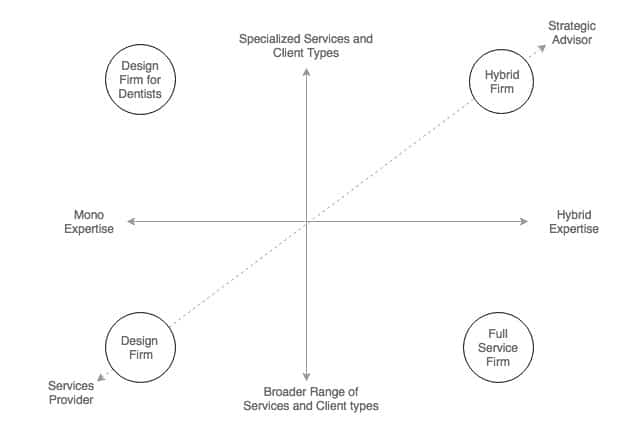
    CHART: Hybrid Digital Expertise Firms Get Strategy Work
    Assuming a Hybrid Expertise Firm is Specialized, It Has More Strategic Insight Than Other Types of Firms

    A firm that relies, for example, only on visual design has very little chance of being strategic (and there’s nothing wrong with that by the way; there is nothing wrong with being a craftsperson).

    But even a design firm that specializes in a certain problem set (as in the “Design Firm for Dentists”) is at a disadvantage versus the hybrid firm. Copywriting is a creative process that lends itself to marketing and advertising; by not adopting a copywriting practice, a design firm voluntarily limits its impact.

    On that note, I’ve mentioned design and UX as important facets of creative expertise, but let me call out copywriting, in particular, but also content writing, for their conspicuous absence from the digital services landscape. Somehow we have elevated UX and visual design to the highest-profile roles, yet we outsource writing to people who, God bless them, don’t speak fluent English because it’s not even their first language. How did this happen? (I actually don’t really know, so that’s an honest question).

    David Olgivy’s direct marketing mentor, John Caples, famously wrote copy – and content (books, articles) – for the firm he owned until he was 83 years old. Modern-day owners of digital firms who do the same often thrive. Basecamp’s Jason Fried, for example. 

    Unfortunately, years of language dilution by lawyers, marketers, executives, and HR departments have turned the powerful, descriptive sentence into an empty vessel optimized for buzzwords, jargon, and vapid expressions. Words are treated as filler—“stuff” that takes up space on a page. Words expand to occupy blank space in a business much as spray foam insulation fills up cracks in your house. 
    – Jason Fried

    By the way, maybe you’ve seen the effect Jason describes in mobile web design and development. How is it that we create a desktop design and a mobile design mock – for the exact same page – but the desktop mock is full of words that don’t exist in its mobile counterpart? Either you need the extra words or you don’t (you don’t).

    The fusion of creative and technical (and other) expertise into services

    Now I am going to hammer the point home some more – sorry! But it’s interesting to think about this semi-abstract stuff in the context of the actual labels that digital firms use to define themselves. Consider the following company labels:

    • web development shop
    • design agency
    • creative firm
    • digital marketing firm
    • advertising agency
    • PR firm
    • marketing agency
    • technology consultancy
    • email marketing firm
    • communications strategy firm
    • political consulting firm
    • web design firm
    • UX consultancy 

    How are these firms alike with respect to the clients they serve? Each should understand:

    • copywriting, and how on-page SEO, brand messaging and UX writing are forms of it
    • the consultative, conversational sales process that management consultants have mastered
    • how and why some business problems are solved through data analysis
    • the role of market research in designing inbound and outbound marketing
    • when automation technology makes sense and when it is stupid
    • the differences, and surprising similarities, between a web development solution and a software solution

    And so on. Not a definitive list but that alone is quite a lot of commonality for firms with so many different labels.

    And in case that didn’t convince, I present to you …. a bar chart! Case closed.
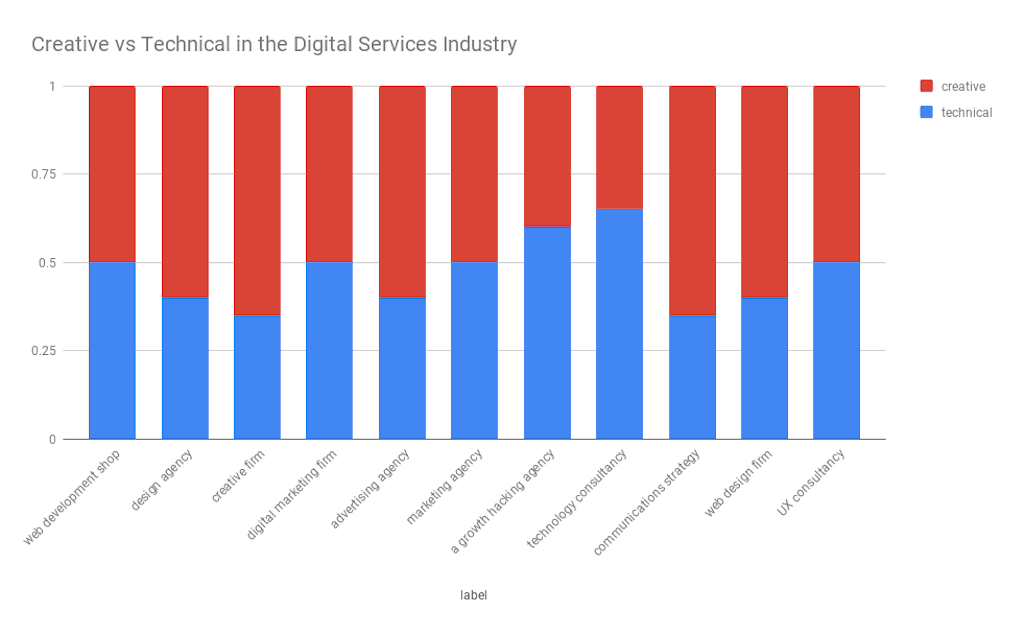
    The Confluence of Creative and Technical Expertise

    Every popular type of digital firm (for lack of a better word) meshes creative and technical services

    SaaS firms are super-specialists

    Just a quick note: we like to think of SaaS (Software-as-a-Service) firms being outside the orbit of us digital agencies. They are products, we are services. But if they solve the same problems as we do, for the same kinds of clients, are they really outside our orbit? 

    I’m not proposing you view them as competitors, necessarily. But it’s worth noting the problem-solving expertise areas they fuse together: 

    • Visual Design
    • UX Design
    • Software Expertise
    • Data Expertise
    • Business Strategy Mindset

    Or at least they should fuse these qualities together. They should incorporate design thinking, they should be built with high-performant, lean, software development processes, and they should be focused on solving very specific problems for a very specific set of customers.

    Here’s another characteristic of a successful SaaS firm: partnerships.  API-based integration, for example, provides a technology solution to the business problem of how to tie one solution to another. The more integrable a SaaS provider is with other products, the more useful it becomes and the more value it creates.

    Hmm, maybe there are some lessons there for digital services firms?

    Niche down and partner up

    How does a digital services firm compete when it needs to:

    • compete with other firms of many possible types and sizes
    • compete with SaaS products, which they’ll never beat on price
    • be both creative and technical and marketing-literate and business-minded and

    This is where I really should defer to the smart people, like Philip Morgan, who is also my Specialization School instructor (highly recommended). I think he might agree that like a SaaS firm, we should worry more about whom we solve problems for than what exactly those problems are. 

    Focusing on whom you serve

    Specialization can be delimited by what you do (sales coaching, UX, data integration). But it can also be delimited by whom you do it for and the unique problems those people have.

    As for your own expertise areas, don’t worry about whether they are technical or creative, consultative or implementation. Because they might be all of the above. I’d be more concerned with whether your services are the best ones for solving problems particular to your types client (ie. if you’re in cannabis or distilled spirits, forget about PPC – learn SEO).

    Partnerships

    But specializing won’t give your firm mastery of creative, technical, and sales and marketing expertise overnight. And to be honest, part of becoming an expert is just sticking with something for years and years. Meanwhile though: hire experts as contractors or employees and form partnerships. 

    Not every services firm is going to hire. There are good reasons for that too, such as keeping headcount low (which in my experience running an agency helps keep profits – and sanity – healthy).

    For that reason, the ability to form partnerships is an invaluable skill for freelancers and small firms. And it is a skill; something you have to practice over time. Some people suggest going on a pub crawl with your partner firms twice a month. But in our remote world, that approach doesn’t scale well.

    Here’s another idea: find people with the same kinds of clients as you – or very similar ones – and figure out what your respective strengths and weaknesses are.

    The stronger the relationships you build, the less you have to rely on your weaknesses. Or things you just don’t like doing. What a great incentive?!

    And so I think that’s the takeaway: form relationships – real, happy, human relationships – with firms, consultants, freelancers, competitors …. people. Sometimes it can just be as simple as finding the right freelancer. But in any case, it can’t be a transactional relationship, with a rushed phone call here or an occasional email there. Not if you want to work together to create true hybrid expertise solutions for your clients.


    fin


    Update: On the very same day, 19 July 2018, that I publish this article, I note that Blair Enns has published a very similar, but MUCH better, article called The Great Convergence is Upon Us. It focuses on larger firms but the ideas are similar – and much more refined and eloquently articulated, of course.

  • The Ethics of Psychodynamic Marketing

    In my work as a marketer, I have a straightforward definition of profitable: you get more money out of it than you put into it. That’s my promise to you, client. I’m your reliable vending machine: stick a quarter in me and I promise you’ll get two quarters back. At least that’s how I feel when I run PPC campaigns. Well, I actually can’t promise anything.

    But it’s a key part of what I propose:  you profit financially by replacing your money with my marketing.

    But Harry Browne has a much better definition of profit.

    Profit is the increase in happiness by replacing one situation with another. This identifies the nature of profit – the giving up of one thing for something that provides greater happiness.

    An individual may discover a new way of doing something that gives him more happiness than he received from the old way. So he gives up the old way and adopts the new way because he values the new way more. He profits.

    – Harry Browne, The Secret of Selling Anything

    Now you’d think the author of one of the most revered and irreverent sales books of all time (The Secret of Selling Anything) would offer a definition more in the vein of “Dan Kennedy” (talented author of the “No BS Guide to _____” series of books). You’d think he’d talk dollars and cents. But according to Harry, happiness is the most important currency by which profit is measured. He also points out that at least two people profit from any exchange. I can’t argue with that.

    As a matter of fact, Harry doesn’t offer this definition of philosophical advice. He offers it as sales advice.

    Selling Happiness not (Just) Financial Gain

    If you’ve ever worked in nonprofit fundraising, this concept will be instantly familiar to you. A donation is an act of replacing money with feelings in order to create happiness. A donation might also yield a meaningful acknowledgment from the solicitor and steward of that donation; perhaps an email, perhaps a postcard. And that acknowledgment nurtures and reinforces the profit derived by the donor.

    A cynic will call this self-serving altruism. I’d call it a mutually profitable exchange, though. And so would (most) fundraisers, who is a nothing more than a specialized type of salesperson.

    But if you’re thinking donor fundraising is an edge case, you’d be mistaken. Harry Browne’s definition of the buyer motive always applies.

    The extent of your own profit depends upon your ability to satisfy the needs and desires of others.

    – Harry Browne

    Mind you, we are both emotional and rational animals, and so logic must also be catered to. You might have read the expression, “People buy on emotion and justify with logic”, which spurs about 5.7 blog posts per day, 365 days a year.

    And if you want to sell your product or service, dear reader, you shouldn’t argue with that either. And that is true even if you sell your services and products not to individuals but to “businesses”. Because the last time I checked, business owners and the decision-makers who work for them are human beings. When they sit at a desk during the day and consider your offer to their business, they are just as human as later that day when considering which bottle of wine to buy.

    There are 30 million registered businesses in the United States and at least as many business owners. They’re all people (with the possible exception of President Donald Drumpf?).

    A fundraiser knows this when she reaches out to a large corporation about her nonprofit’s corporate giving program. A chiropractor knows this when he reaches out to office park manager about a group-rate discount program for offices. And so on. That’s why the primary difference between B2B marketing and B2C marketing is not the audience but the complexity of the sales process.

    Such a good deal, by comparison

    Maybe you’re nodding your head in agreement because I’ve sold you on Harry Browne’s definition of profit. Or just as likely, because you already held a compatible definition before reading this article. But now the question is: how do you use this insight to your advantage? How do you sell on emotion and justify with logic?

    Behavioral economics deals with this question and it gets dicey. Psychological manipulation – are you sure you want to learn this dark art?

    For example, behavioral economist  Robert Cialdini talks about the Contrast Principle – of all of the psychological selling techniques identified by Cialdini, perhaps none is quite so effective as this one, which means we need to do two things:

    • Learn how not to be influenced by it (and other psychological susceptibilities).
    • Learn how to use it in an ethical way that creates value for our customers (which Blair Enns called “Hacking Heuristics” on a recent episode of the 2bobs podcast, with David C Baker.)

    The evidence suggests that the ever-accelerating pace and informational crush of modern life will make this particular form of unthinking compliance more and more prevalent in the future. It will be increasingly important for the society, therefore, to understand the how and why of automatic influence.

    Robert Cialdini, Influence: The Psychology of Persuasion

    A Semi-believable example of psychological selling through perceptual comparison

    Do you want to attract so many fans of your work or that of your organization, that you never have to worry about “selling” again? Lifetime customers, major donors, die-hard enthusiasts that recommend you whenever they get the chance? Fans who sell for you, for free?

    Let’s just say you want that. To never worry about selling again, asking for money from strangers; instead, they’ll come to you.

    And let’s say that you need remarkable content to make that happen – content that proves your worth.

    Well then, reader, I’m asking you to let me help you achieve that goal (never worrying about asking strangers for money again). In this post, I’ve just given you basically everything I know about the psychology of content marketing (Why? Because I like you, you are my reader!).

    In exchange for that free gift, I would love it if you’d consider doing business with me if you need content.

    Here’s another reason – because I can deliver you that remarkable piece of content based on a unique ability to research and know your customer – and your competitors –using techniques I’ve developed over the past 18 years. For only $15,000, in fact, I can provide you with a product that will yield a lifetime of returns: an expertly-researched, 12,000-word technical guide that will establish you and your organization as an international authority on the most important subjects to your organization. Over time, it may yield 100,000’s of thousands of dollars worth of value.

    If I’m reading your mind correctly, however, you might like the high-ROI outcome described but not the sticker-shock price. Perhaps that price makes you choke, shiver, gag, shake your head, snort, or cringe? Perhaps you are experiencing that hot awkward feeling where your whole spine tightens up and you can barely disguise your discomfort.

    Stay with me, then, because this will make you feel better: there’s another fantastic option and it doesn’t cost $15,000 – not even close.

    In fact, for only $1,500, you get an engaging and carefully SEO-optimized guide to the subject that is most important to your customers. It will establish you as the authority because it will be written in your voice. And like the $15,000 dollar option, it’ll be well researched and in-depth: 3,000+ words (the length recommended by the world’s “leading digital marketer”, Neil Patel, who is the founder and CEO of Crazy Egg, and has even been endorsed by President Obama). As such, it will serve as one of the cornerstones of your content strategy for years to come. 

    By the way, most customers choose this $1,500 option. At that price, they could afford 10 expert pieces of content over the course of a year, turbocharging their content marketing strategy and easily setting themselves apart from their competition. (But they won’t be able to for long, because after July 2015, I am permanently retiring my “Authority SEO” content writing practice.)

    By the way, if you can’t afford to invest $1,500, my team can produce an article by tomorrow for $500. It will be at least 500 words long, which visually looks like a blog post length piece of content. And completely spell-checked. It might be really boring and forgettable and zero people will actually read it (a few might skim it). But you’ll have content to put on your website and make it look like you have a blog.

    To recap your options:

    $15,000 for an inbound marketing tour-de-force, in the form of an ebook-length guide to your business that will establish you as the world’s leading authority on your important subject.
    $1,500 for an engaging, expertly-researched, SEO-optimized cornerstone article that will establish your business as an authority and anchor your content strategy.
    $500 for a decently-sized piece of content about any subject, with few grammatical errors, delivered by tomorrow.

    What just happened? A breakdown.

    OK, let’s stop this charade. These are all hypothetical prices and services, delivered as a mock sales letter, meant to illustrate Cialdini’s Comparison Principle, which is also called “Anchoring”.

    And there are all kinds of other copywriting (definition: “sales in print”) methods woven into these descriptions which are designed to make the middle option the most attractive one, including Extremeness Aversion, the well-documented tendency to avoid choosing options at the extreme of a range of choices

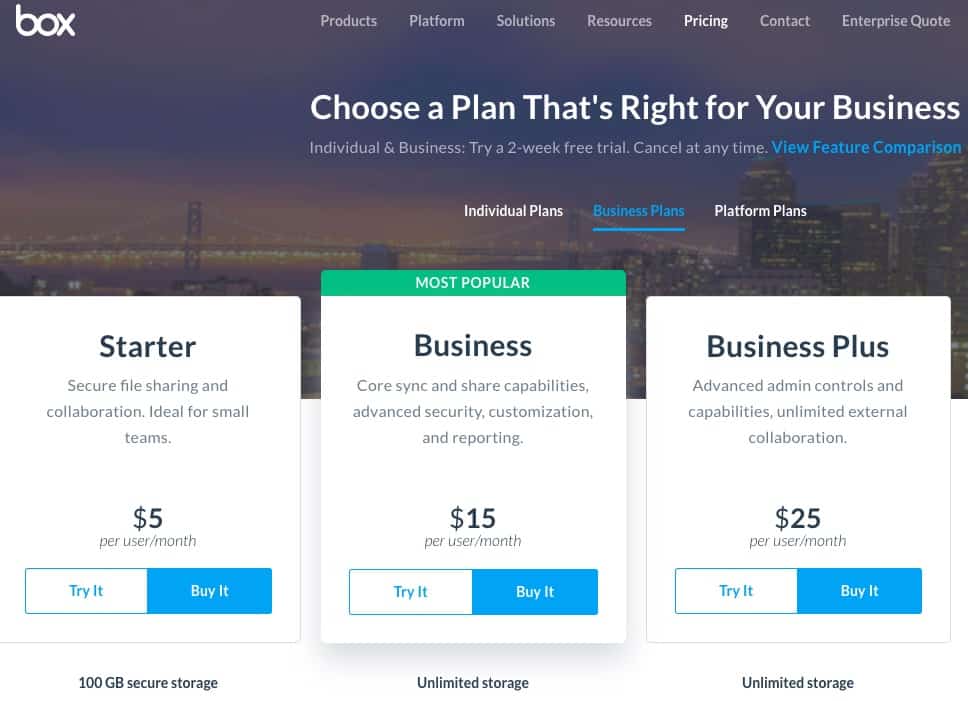
    Extremeness Aversion, by the way, is why I advise my services-clients to emulate my software-as-a-service ones: present three options, with the low and high options framing the desired middle option. The same principle applies to e-commerce and digital fundraising.

    Screen Shot 2018-07-07 at 11.23.07 PM
    Box tells you which option is the “Most Popular”. On what pretext? But their pricing doesn’t favor the middle enough.
    Selling Happiness Through Pricing
    Siteground web hosting tells you which is the most popular using visual language and a compelling pricing strategy

    So let me ask you this, if you were playing along: when you considered the $1,500 offer, did you compare it to the $15,000 one?

    Consciously, you may not have, but subconsciously, you almost certainly did. Our brains make decisions by automatically comparing an option presented to us with whatever other options are present in our awareness.

    No matter what. That’s how we survived as a species.

    By the way, had I supplied no other prominent comparison item, you would have supplied your own, based on previous experiences or even an on-the-fly calculation based on something similar: the time you hired someone to write a college paper, perhaps. By prominently presenting a high-price comparison, however, I made those other comparison points remote and uninfluential.

    Because of this automatic neurological behavior, a price ($1,500) that might otherwise seem high to you seemed more than reasonable to your subconscious mind.

    And that’s after I warned you that I was about to subject you to a psychological experiment: every day copywriters subjects you and me to these methods and they never warn us.

    But wait, there’s more

    Cialdini’s Comparison Principle is just one of his many observations on human psychology that are used to influence prospective buyers. Here are a few others – I threw each into the example sales copy above:

    • Social Proof, which exploits our tendency to believe that a decision is correct if others have made it. (“Most customers choose the $1,500 option.”)
    • The Scarcity Principle, also known as Fear of Missing Out, or FOMO, to true marketing geeks. (“But they won’t for long because after July 2015, I am permanently retiring …”)
    • Liking, the principle that affection engenders buying transactions (“Why? Because I like you, you are my reader!”)
    • Reciprocity, which is self-explanatory. (“Actually, in exchange for what I’ve given you, I’d love it if you’d consider doing business with me!”)

    • Authority, which exploits our trust in fame, titles, and other signifiers (“Neil Patel, who is the founder and CEO of Crazy Egg, and has been endorsed by President Obama).
      Note: have you ever heard of Neil Patel or Crazy Egg? Doesn’t matter, because: founder, CEO, President Obama.

    And of course, there are a few other tricks woven into the example, such as the peculiar effect of using quotation marks to establish credibility (‘leading digital marketer’), a technique which Real Donald Trump uses with disturbing effectiveness. My personal view is that quotation marks evoke the credibility of a testimonial even if none is actually offered.

    And the old standby: you. The selling example uses the word you or yours 48 times.

    The most powerful psychological motivation: still happiness

    But this article isn’t about semantic selling tricks or neurological ticks; it’s about Harry Browne’s observation that happiness, not money, is the true profit motive. And that because of that reality, it’s frighteningly easy to exploit psychological triggers.

    In fact, what most of Cialdini’s observations have in common is that they exploit the happiness profit motive in one way or another. Reciprocity makes us happy. Liking and being liked makes us happy. The comfort of authority makes us happy, as does the possession of a scarce resource that everybody wants.

    All this leaves us with a big responsibility.

    For one thing, it means that when we make a sale (or a barter – any kind of exchange), we’re responsible, to some limited extent, for someone else’s resulting happiness, their profitability. 

    The better we get at digital marketing, the more closely we have to watch ourselves.

    • Do you really have to contact me now (Scarcity) to get a long-form authority content piece? No.
    • Do I like you because you read my what I have to say (Liking)? Well, yes actually! But don’t let that influence too much as you seek profit.
    • Do you owe me anything because I wrote this article (Reciprocity)? Of course not. If anything, I owe you for your attention and for reading this sermon on happiness and selling all the way to the end.

    Seth sort of flips these ideas around on their head by having you focus on whom you’re serving.

    What ethical marketers do is create change on behalf of the people they seek to serve.
    – Seth Godin

    That’s one way to sell and market responsibly: make sure you’re doing it with the kind of people you already know you’re capable of serving. But that’s for another article 🙂


    fin

  • The Cannabis SEO Principle

    [Update – August 25, 2019: do you have a CBD or Marijuana product you would like to market? Please click here to take this 5-minute, anonymous cannabis SEO survey.]

    This article is about a digital marketing concept that a simple two-word phrase captures: “Cannabis SEO”. But it applies to other industries, too, from wine to whiskey to financial services. Even cryptocurrencies. Anything that is regulated or even prohibited.

    And it’s one more piece of evidence that SEO is still the least exploited form of word-of-mouth marketing.

    The Cannabis SEO Principle is a pretty basic supply-and-demand concept. The more limited your advertising and marketing options, in terms of channels available to you, the more valuable SEO (Search Engine Optimization) strategies become. That’s because SEO is perhaps the least regulated major marketing channel in existence.

    It’s not for lack of will, on the part of search engines, that is SEO unregulated. Microsoft and Alphabet, which own the three biggest search engines (Bing, Google, and YouTube), love to regulate things. Like ads on Bing, Google, and YouTube.

    SEO is a de facto unregulated marketing channel. That’s because the search engine business model (automate the aggregation of ad inventory against which to run automated ad auctions) doesn’t allow for manual curation. That’s why Google fought so hard to deny European citizens the “right to be forgotten” in its search index. Ensuring that right makes a tiny dent in Google multi-billion dollar, ad-revenue profits, but it strikes at the core of the search engine business model: automation.

    Cannabis SEO Value
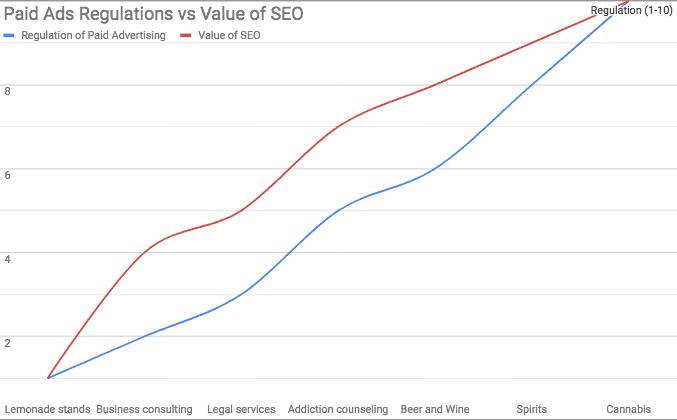
    The Cannabis SEO Principle: the more regulated paid ads are, the more value in SEO.

    And this concept can turn levers in many industries, not just “the vices”:

    • Wine & Spirits
    • Healthcare (addiction counseling, for example)
    • Pharmaceuticals
    • Financial Services
    • Weaponry
    • Gambling/Casinos
    • Cryptocurrency

    As I’ll discuss later, in fact, getting your cryptocurrency business into Google search results is the online marketing gold standard, pun intended.

    If the ability to purchase your prospective customers’ attention is limited by regulations, such as those that Google applies to paid advertisements, then the Cannabis SEO Principle applies.

    By the way, I’m not calling it the “marijuana SEO” principle because the term “cannabis” has become the preferred nomenclature in the marijuana business. Err, I mean the cannabis business. But what I mean by cannabis is legalized marijuana sold for both recreational and medicinal purposes.

    Cannabis Brands Are Desperate To Reach Customers

    I worked with a SaaS client earlier this year, a “cannabis startup” sponsored by Canopy Boulder, a startup incubator and investment fund. This startup’s entire business model was predicated on one odd truth: the majority of cannabis purchases are influenced by “budtenders”.

    (Budtenders are the retail staff who sell marijuana leaf, edibles, and products at dispensaries).

    As a matter of fact, law and custom dictate that marijuana is always handed to the customer by a budtender. Just like shopping for leather gloves in the 1890’s London department stores (and it’s still that way in some of the more traditional European locales). You can’t handle the merchandise yourself. You have to ask to see it and you have to also discuss it with the person who hands it to you.

    The startup’s software products help these influencers, the budtenders, manage inventory (for “free”), using a software product custom designed to manage the large and complex inventory typical to a marijuana dispensary.

    In exchange for use of this free software, cannabis brands get to do budtender-targeted marketing, within the product itself, in the hopes of boosting in-store sales. (ProTip for cannabis brands: develop a “budtender-focused” sales and marketing strategy).

    So if cannabis brands can’t pay to reach the customers, they can at least pay to reach the people most likely to influence those customers’ point-of-sale decisions.

    In other words, cannabis businesses are twisting themselves into knots to reach their customers in creative ways.

    But here’s the thing: SEO has far greater reach. According to search data aggregator SEMRush, the search “types of marijuana” and the cluster of searches with the same intent, collectively account for 410,000 Google searches per month.

    Why Cannabis SEO Principle and not, say, Wine and Spirits?

    At this point, you might be asking why I am picking on cannabis and not wine, beer, or other semi-contraband, controlled product types? Searches like best craft beer or cryptocurrency investments also yield enormous search volume.

    Here’s why – the cannabis market is not only enormous, it’s growing exponentially, with no let-up on paid advertising prohibitions on the horizon…

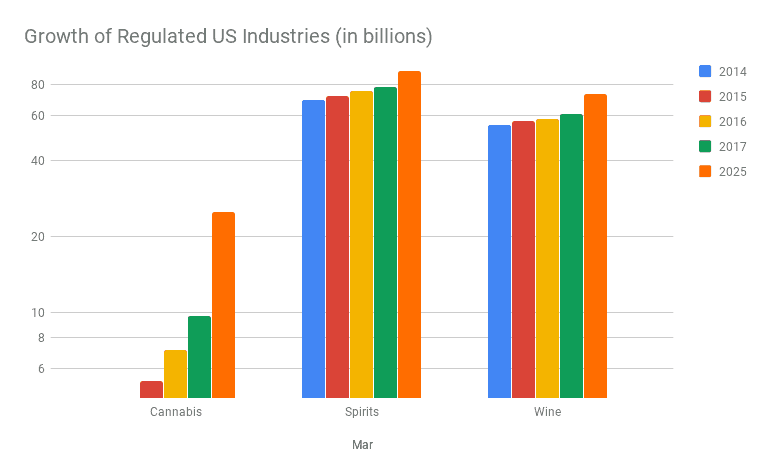
    Demand for vice industries soaring; hence value of Cannabis SEO
    Vices, vices, vices – demand soaring for Cannabis

    As you can see from the logarithmic bar chart above, in the coming seven years the cannabis industry is predicted to grow much more rapidly than its counterparts, the wine and distilled spirits industries. Soon for every two dollars spent on wine in the United States, 1 dollar will be spent on cannabis – legally.

    Cannabis SEO to promote "beer"?
    Hop-flavored, cannabis-infused, carbonated

    Even the beer industry, with 111 billion in US sales in 2017, recognizes the skyrocketing market demand for cannabis products. In June of 2018, one of Heineken’s “craft” brands, Lagunitas, launched a “marijuana beer” line, cleverly named Hi-Fi Hops, in what is sure to be the first of many forays by the alcoholic beverage industries into the cannabis market.

    That’s not surprising when the overall beer market is stagnating, especially among non-craft brands, which are growing like their counterparts in distilled spirits and wine.

    In fact, US (global) demand wine and distilled spirits are extremely healthy, you might say. But in terms of growth velocity, theirs is modest compared to cannabis, which is projected to grow 600% between 2015 and 2025.

    Cryptocurrency and Cannabis SEO

    Cannabis is experiencing the kind of growth we associate with the cryptocurrency market, where the top 1600 or so digital currencies have a July 2018 market cap of 264 billion, up from 0 in 2008.

    In fact, the Cannabis SEO Principle could also be called the “Crypto SEO” Principle (or ICO SEO), but there’s a huge difference – up until Q1 and Q2 of 2018, paid advertising of digital currencies and services was permitted. And it may be permitted on a limited basis if the industry – or part of it – adopts regulations.

    Paid advertising has never been allowed for cannabis, and the growth from 9.7 billion to 25 billion over the next 6 years will have to happen without it, too. That’s why it’s the Cannabis SEO Principle; there is no market growing so fast and so big that is as constrained by paid advertising.

    It goes without saying that if it’s restricted in digital advertising, it’s probably restricted in traditional mediums, quaintly referred to by advertising agencies as “broadcast, print, and outdoors”.

    Social Media Ad Platforms Are Just as Restrictive as Search Engines

    Silicon Valley businesses, once they make it big, hate risk just as much as any other class of big companies, as I found out earlier this year.  I was hired by a cryptocurrency startup to write lead generation copy for a wallet/app adoption campaign. (Don’t worry, I took payment in US dollars, not “coins”.)

    The landing pages I wrote were optimized for demographic profiles that could be segmented on the Facebook Ads platform.  Which was to supply 100% of the traffic. That was in March. Then boom. The hammer dropped. In April and Facebook shut down all crypto-related advertising.

    And it’s not just Facebook. Most social networks banned cryptocurrencies:

    • Instagram
    • LinkedIn
    • Twitter
    • Snapchat

    (Facebook, however, has somewhat  backtracked and began to re-allow some crypto ads in June 2018.)

    But the industry has continued to struggle, no longer able to rely on the cash machine that was search and social media advertising for selling crypto-related services and investment opportunities.

    Non-paid Social Media Marketing Is Also Restrictive

    In terms of marketing strategies, you’d think that the answer to limits on paid advertising lies in social media. To some extent, it does.

    But social media platforms like Facebook and Instagram routinely shut down business accounts that are connected to the Cannabis industry, in particular. “Shut down” meaning user accounts either deactivated or deleted, as DOPE magazine contributor and social media consultant Amy Donohue points out.

    The other major online advertising business besides search – social media – also regulates content heavily. Not only in paid ads but to an extent user-generated content.

    I suppose if you’re in the cannabis industry, the principle of avoiding digital sharecropping becomes an even more important consideration when creating content.

    Let’s take a quick break to take in Seth Godin’s advise on the subject:

    So: social media is not the answer for your cannabis brand, dispensary, pipe, vape pen, dog food, or medicine. Or at least it’s not the primary answer.

    The primary answer is, as Seth Godin tells us, your own platform, your own CMS-powered website (Seth recently migrated from Typepad to WordPress, hence the discussion on his podcast).

    Investment in the Cannabis (and CBD) Industries

    I write to you from California, where marijuana became fully legal 6 months ago. Because it has long been quasi-legal under medical marijuana laws, it already has a strong customer base.

    So strong, in fact, that the legalization of marijuana in California is expected to almost double the size of the US cannabis market, adding up to 4 billion in 2018 revenue to the 9.7 billion sold in the US during 2017. Meanwhile, the legalization of marijuana in Canada will add 4.5 billion, nearly doubling the total North American market size in 1 year.

    The investment community is starting to take notice. I see this in my work on an almost daily basis since I monitor the demand for marketing services on the LinkedIn Pro and Upwork contract marketplaces.

    And here’s what that money is demanding help with, in order:

    • Cannabis & CBD
    • Cryptocurrency
    • Blockchain
    • AI / Machine Learning
    • Online learning/training
    • Niche SaaS software
    • Cloud computing adoption/migration

    What’s notable about this totally unscientific list is that much of that money invested in startup ventures end up going to paid advertising (tech startups: one of Google’s most loyal customer bases).

    But not for the top two categories: cannabis and CBD. By the way, CBD is a little more complex; it is an industry unto itself apart from Cannabis, and to the extent that it is derived from hemp, not marijuana, it isn’t entirely prohibited by the digital advertising industry.

    Anyway, venture firms like PayPal co-founder Peter Thiel’s Privateer head a growing list of investors who collectively offer multiple billions in venture capital to the cannabis industry. Others include:

    • Halley Venture Partners
    • Blast Funding LLC
    • The ArcView Group
    • Green Growth Investments

    Billions in collective assets and nowhere to buy ads.

    Hence the flourishing of “marijuana marketing” agencies and cannabis copywriters and other marketing services providers. I have seen demand for all of these services:

    • Pitch deck design
    • Web design and development
    • Web/conversion copywriting
    • Brand design and messaging
    • Business prospecting and outreach
    • Social media management

    And I’ve seen demand for SEO too, but not nearly enough because there are still countless SEO opportunities waiting to be seized. Case in point: headaches.

    Solving Migraine Headaches: A Sample Cannabis SEO Opportunity

    There are 38 billion people in the United States who suffer from migraines. And 10 million suffer from chronic migraines. Meanwhile, study after citable study, including studies published by the NIH, demonstrate what many people already know: cannabis is an extremely effective migraine treatment.

    No wonder that these Google searches are so popular:

    • marijuana for migraines
    • best CBD strains for migraines
    • best edibles for migraines
    • Indica or Sativa for headaches
    • terpenes for migraines

    And no wonder that Google Suggest knows that one of the number one reasons search for marijuana is to seek migraine relief. (You could argue that in the context of cannabis/marijuana, they aren’t even long tail, which has everything to do with rarity, and nothing to do keyword length.)

    So what shows up in the search results for search terms like “marijuana for migraines”?

    • A Web MD information page which does little to point people towards the thing they are looking for
    • A lightweight Forbes “search spam” article designed to rank for the keywords migraine and marijuana (not hard to outrank)
    • A marijuana addiction recovery treatment center (another product prohibited from advertising on Google AdWords)

    With the possible exception of the Web MD article, none of this content adds value for anyone but the most casual, curious web searcher. Not one of the 10 links on the first page provides any guidance on how and where to acquire migraine relief with marijuana. This represents a strategic opportunity.

    Funnily enough, while doing this research, I encountered a soon-to-banished paid ad trying to capitalize on this opportunity (it cleverly omits marijuana or any of its synonyms):

    And it’s not even a very well search term optimized advertisement. It should say:

    Get Migraine Relief | Delivered from Humboldt

    Ad www.flowercompany.com/migraine-relief

    Get a $63 ounce from Humboldt – and get migraine relief!

    That is the message – a fusion of conversion copywriting and SERPs (search engine result pages) optimization – that Cannabis SEO can deliver to its enormous audience. And they don’t even have to say it without using the word Cannabis (or CBD, or CBD oils, or marijuana).

    SEO Opportunities in Your Market

    The case I’ve made in this article is that the Cannabis SEO Principle applies when the advertising industry, especially the Google-Facebook duopoly, prohibits you from buying digital advertisements and promotions.

    But another reason I wrote this article is to get my readers to think more about SEO as a part of their marketing strategy. Consider the following.

    • In the post-broadcast television and radio world,  SEO is the marketing channel with the broadest collective reach
    • Like PPC and Social Media, SEO offers precisions marketing (“marijuana for migraines in California”)
    • SEO is a marketing channel that takes place on your property and is therefore not subject to the risks of digital sharecropping
    • While platforms like WordPress have helped disseminate “on-page” SEO best practices, off-page SEO (which at its core is good content, though cold outreach is essential too) is rare, as we saw from the search results for marijuana for migraines
    • SEO can be a lead generation channel as well as inbound marketing; conversion copywriting and SEO content go hand-in-hand

    Then there’s the central consideration: what problems are people from your audience not finding solutions to using search engines?

    Even if you’re not a marijuana dispensary, winery, brewery, or cryptocurrency, chances are there are many more than you think


    fin


  • How Digital Agencies Can Break the Cycle of Bad Marketing

    Do you know what the problem is?

    The problem is that content isn’t copy. Content is what you put in a jar or a box. Copy is messaging that inspires action. All good marketing strategies balance content with copy.

    This is why most services firms’ websites end up being a waste of space/money. They operate on the fools-gold premise that an effective website is the outcome of design/UX, technical features, and content, instead of copy. So they don’t focus on lead generation. 

    Which is a shame because there is no more powerful marketing technology, strategy, whatever you want to call it, than your website with compelling copy – copy that sparks a conversation with your customers.

    And because for a high-end services firm, ALL forms of lead generation, online/offline, outbound/inbound, word-of-mouth/complete-stranger, whatever the case may be, must go through your website.

    This is why you should never hire a digital strategist who can’t write. If you can’t write out a strategy in copy that inspires action, is it really a strategy?

    Same goes for positioning statements. You do “[X thing] for [Y type of customer]”. OK, sounds like you just checked a couple boxes. Not compelling, not interesting. Your positioning statement itself need to inspireaction.

    Nothing destroys both inbound and outbound lead generation efforts like content where conversion copywriting is called for.

    Why am I telling you this?

    Copywriting isn’t the end-all/be-all to lead generation, so why harp on it right off the bat? Let me back up. Most of my career I’ve been at digital marketing and technology firms; that’s put me on over 200 large digital projects.

    I also helped build my own multi-million dollar, 20-person consulting firm, from scratch, as a partner.

    The agency world is full of talent, but the work it does usually lacks something:

    1. Effective copy (#1 for a reason: it’s rare)
    2. Market/keyword research
    3. Precise analytics

    I’ve seen this lack in many businesses: SaaS and app startups, coaching/management consultancies, nonprofits & NGOs, UX and web design firms, dev shops, technology/IT consultants – and yes, even ad agencies and marketing firms!

    Where digital marketing projects fail

    Here’s how projects get sidetracked:

    ● First, someone says, “let’s redesign the website”
    ● OR, a new Director of Marketing is hired. Who says, “let’s redesign the website”
    ● Tons of time and money wasted in discovery/planning meetings
    ● Over-focus on the web, at the expense of other marketing channels

    And so on. Lots of talk, no action. Days debating color choices: “But I don’t like green!”

    The end result? A site redesign, instead of a *lead generation* redesign.

    So the site becomes unimportant. It rusts.

    Then 3 years later someone says, “I don’t like the website. Let’s redesign the website”.

    The cycle repeats.

    How do we break this cycle?

    We start by inserting positioning-based messaging into your site. We transform your business strategy into a market-ready copy. Is your offer worth it? Let’s tell your customer why.

    Not that we neglect UX design and technology. We just don’t let it DRIVE your marketing strategy. Web design is not a strategy.

    Copywriting by itself isn’t either, but it’s the essential mechanism for (a) communicating your strategic value as a business and (b) putting a business strategy into action.

    So what’s the magic bullet? The secret recipe? Is it a this “funnel” thing you might have heard of – or is it a special combination of this technology plus that ad channel?

    Of course not.

    Your entire digital presence is a lead generation funnel

    In 1999, Seth Godin was the first to define inbound funnel marketing, in his book Permission Marketing.

    Here’s how that concept is usually defined today, thanks in part to the “Hubspot” jargon: 

    (1) Attract strangers (SEO, blogging, ad copy)
    (2) Convert visitors (Search and social ads, landing page copy, UX)
    (3) Close leads (Web sales copy, UX)
    (4) Delight customers (Email marketing copy, CRM, social re-engagement)

    By the way, notice a pattern? COPY is everywhere.

    But here’s the point: it’s not that funnels are bad or superfluous; there may be a use case for them. It’s that your core need isn’t a system, or a technique, or a trick. Your core need is good copy, throughout your digital presence.

    We start with positioning-based messaging on your site, coupled with a single, persuasive call-to-action.

    So we write good copy.

    Not that we neglect UX design and technology. We just don’t let it DRIVE your marketing strategy. Web design is not a strategy and neither is technology.

    No one platform, technology, approach or channel will help your business grow more than another.

    I often see a pattern where a business says to me, “we just need X”. A demo-conversion funnel. A lead magnet. An Instagram presence. A Hubspot account. An skyscraper content piece.

    It’s this idea that there is a formula for marketing and that you just have to crack it.

    THERE IS NO SECRET FORMULA. Your entire digital presence is a “conversion funnel”.

    I read the masters of copy: David Ogilvy, Rubicam, Caples, Hopkins, and others. They all say the same thing: there are countless tricks and tactics, like long copy (still reading?), but there is no objective standard for how to apply them.

    That’s because you and your business are completely unique. Just as your lead generation strategy should be.

    Join me.

  • The True Cost and Hidden Benefit of Lead Generation Blogging

    My first attempt at content marketing, in 2007, was short-lived and even more half-assed: StrategyDen.com (nothing to do with the current site), a blog about online marketing and technology. I was working full-time as a project manager and consultant at Blackbaud at the time and partly as a result, I didn’t take being a publisher and content marketer seriously. I wasn’t even very clear on what lead generation blogging was.

    This post is an attempt to answer the question I wish I’d had an answer to back then, “Should I publish a blog, and if so, why – and how?” It even puts a number on the endeavor: $30,000.

    Real quick, here’s how I define lead generation blogging – investing in the publication of a blog, over at least a one-year period, to:

    1. Grow awareness of your brand, wherever your blog’s content ends up being read
    2. Grow your audience by luring it to your web presence,
    3. Build trust with that audience by (a) showing them how well you understand what you claim to do and (b) helping them make decisions
    4. Convert some of that audience into leads – and relationships

    (Content marketing is a little more nuanced. It can be any communication medium, not just a blog, and implies a concerted effort to promote content through multiple channels, not just produce it.)

    The point is that we’re talking about a marketing initiative that requires an investment and is expected to deliver a quantifiable return in form of leads who actually contribute to your organization’s bottom line.

    Anyway, back to the true story of how I missed a content marketing opportunity

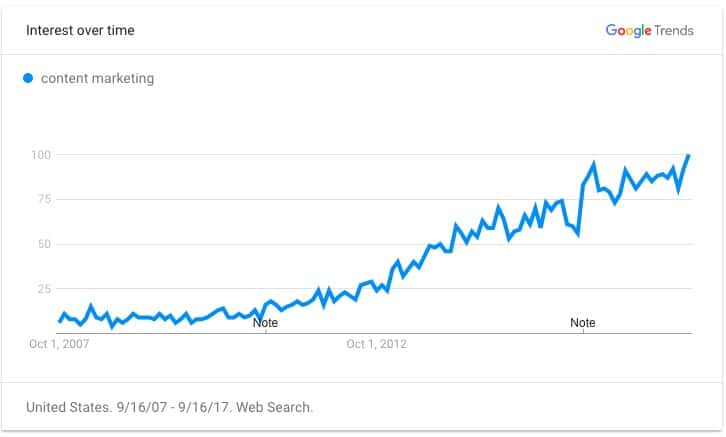
    Growth of Content Marketing
    Google Trends showing the decade-long growth of ‘Content Marketing’ as a marketing concept

    In 2007, marketers were beginning to evaluate the blogging phenomenon and extract from it the concept of content marketing. That concept turned out to be very powerful, one of the many reasons it was very unwise of me not to pursue my StrategyDen blog. It was so easy in those days to get value by writing just a few blog posts. Publish for a year and you were golden – and with very little investment other than time.

    Cases in point:

    • I wrote a (silly) critique of Highrise, the 37Signals CRM product, as being too simple to warrant being marketed as a CRM (“to those who seek a simple web CRM: Highrise isn’t quite it”). The next day Jason Fried himself responded on my blog with a well-written, even-handed, and thoughtful rebuttal comment.
    • A few days later, Pipeline Deals, then a newly minted startup CRM, contacted me to set up a demo of their product, so that I could publish a review of it.
    • I also wrote a post about a data breach on Convio (the marketing and fundraising platform now branded as Luminate and owned by Blackbaud). That post was picked up the same day by a well-known nonprofit tech and marketing blogger, tweeted about, and backlinked to.

    And I was even more of a nobody then than I am now.  But it was easy then to get self-published content noticed, provided it met the basic on-page SEO standards, was based on relevant research or news, and offered some measure of original insight.

    From playing in a small pond to a massive ocean

    A decade later, though, the game has changed completely. Tens of thousands of voices compete daily for the attention of industry influencers like Jason Fried.

    The current climate calls for a much greater quality level, focus and time commitment; content marketing isn’t cheap.

    If your organization has a blog, it competes with tens of thousands of other blogs – and blog posts, every day – for the attention of your existing and prospective customers, supporters, donors, partners and so on.

    In fact, it’s sort of become accepted wisdom that more than 2 million blog posts are published daily.

    Are most of them mindless strings of keyword fluff posing as writing? Of course. But if even 1% are good or better, that means that that 20,000 “good or better” blog posts are published – every day.

    Something you can stop telling yourself (or others)

    After 15 years of advising on digital strategy, few things make me cringe more than hearing another consultant tell a client, “you should have a blog”.

    That’s lazy thinking and unless it’s based on thorough analysis, it’s probably bad advice.

    And what gets me is that it preys on some pretty understandable urges:

    • Generate traffic to your website in a cost-effective way
    • Sway some of that traffic into subscribing to your newsletter or even becoming some kind of customer in a cost-effective way
    • Offer stories and insight to your existing readership to strengthen your relationship with them and inform them of new products or services in a cost-effective way

    These are all absolutely valid ideas except for that often insidiously unspoken premise that accompanies them all: that content marketing is magically cost effective. After all, it’s just typing, typing, typing, done! Or so goes the often covered-up and unchallenged assumption.

    Here’s my perspective, which is the result of seeing over 50 clients attempt a blog – and seeing my own consulting firm try unsuccessfully to incorporate blogging into is marketing strategy: blogging is not necessarily cost-effective, ie a good return on investment.

    On the contrary, it can actually damage your bottom line, to say nothing of your reputation for follow-through ability and in-house expertise.

    And that’s not just because of increased competition that blogging is a difficult strategy for all kinds of organizations, from consultancies and nonprofits to universities and software companies.

    It’s also because publishing a blog has always been much more expensive than is commonly realized. And because it’s more expensive now than ever before.

    The Paper Napkin cost of an (excellent) blog: 30k per year

    My baseline paper-napkin estimate of the cost of maintaining an excellent blog is $30,0000/year.

    Here’s how that breaks down:

    Cost of writing: $20,000

    A relatively senior staff member (because we’re concerned with an excellent blog, not a mediocre one) making approximately $100,000/year is granted the work of writing for a blog. To create an effective blog, she must spend 20% of her available work time writing.

    By the way, to write effectively, you don’t need to publish every day or even every week; you could get away with one or two blog posts per month. But you have to write or edit almost every single day.

    Cost UX and visual design: $5,000

    Why allocate such valuable resources to writing a blog without going the full measure to (a) integrate it into the User Experience of your web presence and (b) enhance its appeal and impact with visuals – artwork, photography, and the presentation of data?

    You could make the case that these are one time costs. But then I also believe that most websites should be updated every two years, and visually refreshed even more frequently.

    Another hidden cost of a well-produced blog: premium photography, illustration, or presentation of data. Some blogs (eg. Signals vs Noise) commission a designer to custom design a graphic for each post, taking a page from traditional print media.

    Cost of content marketing: $5,000

    This the fuzziest of the three cost factors, but it has its place on our napkin. Gary Vaynerchuk has said the content marketing formula is as follows: 20% production, 80% content promotion.

    By that calculus, if you’re production cost is $25k, then your promotion cost is $100k, roughly equivalent to the cost of two entry-to-mid level marketing staffers. But the total time they spend on your blog should be just a fraction of their other content marketing responsibilities (email marketing, news, social media feeds, event marketing, etc). So the cost is amortized.

    Caveats, disclaimers, exceptions, qualifications, and provisos

    Of course, there’s more nuance to it than this breakdown includes. And this is a guideline paper napkin; the investment cost for your organization could deviate by up to 25%. Just remember this: if it’s not painful, it’s probably not the right amount. (Sound familiar, dear clients? Bwaa-ha-ha).

    And while I’m caveating, yes, we have to define excellent! Here’s one definition: it generates leads whose value is greater than the annual investment.

    Most web content, whether presented as a blog or not, doesn’t come close to moving the lead generation needle that far.

    That’s because it’s either bad, average, or slightly above average. A common pattern: one or two excellent, inspired posts followed by a series of average, perfunctory posts. You can almost feel someone checking the box.

    So it’s useful to have a framework that tells you what you’re getting for such a substantial investment. Especially since (a) lead attribution is notoriously difficult and (b) it takes 3 to 12 months to measure the SEO value of newly published web content.

    Common traits of an excellent organizational blog

    Luckily, lead generation isn’t the only way to gauge the quality of your blogging efforts.

    An excellent blog should have the following characteristics:

    • Is written by a subject matter expert with a minimum of 5,000 hours under her belt
    • Is not written by a junior staff member or intern (lol); nor is it ghost-written by a consultant or writer – unless they have the right subject matter expertise (this latter option is no less expensive than the in-house one)
    • The subject matter of each post and of the blog as a whole encompasses your organization’s key topics and adjacent topics too.
    • Published with regularity and, in the same vein, fits into a content strategy

    The more involved the agency principal in the creation of content, the more successful the firm is on the lead generation front
    – Blair Enns

    By the way, the best blogging or other editorial content I’ve read, such as Blair Enns’ Win Without Pitching blog on business strategy, or Emily Nussbaum’s New Yorker articles about television content, are typically grammatically flawless. So if you can make the investment, you should incorporate some kind of internal feedback mechanism; it could be a colleague who proofreads or a contract professional content editor. (Says the guy whose articles are rife with typos!).

    To kill two birds with one stone, I’d recommend an SEO savvy copyeditor who doubles as a content editor.

    But your blog doesn’t need New Yorker quality grammatical perfection to set itself apart.

    In fact, as David C. Baker has pointed out, your concern when clicking “Publish” or “Send” shouldn’t be “Will my audience notice grammatical errors”? It should be, “Will my audience perceive this as insight or just content?”

    When someone reads your stuff, does it contain a fresh insight they want to share or bookmark? Do they want more or less of you after reading it?

    – David C Baker

    Lead generation blogging vs insight generation blogging

    Speaking of insight, by the way, I left out one of the telltale signs – and valuable outcomes – of an excellent blog: not just providing insight to your public audience, but gaining insight it for yourself. This is the hidden benefit.

    Speaking from personal experience, I can think of no activity that better clarifies how I think about a subject than writing about it at length in a public forum.

    For example, I started writing about digital strategy in 2012 partially in response to being asked, “what do you mean by that”. I knew exactly what I meant by it but couldn’t precisely articulate it, which frustrated me.

    In the intervening 5 years, I have edited or revised my definition of digital strategy at least 350 times. I have clarified what I think about the subject.

    In fact, I’m now able to easily summon and describe, with no preparation, my elaborate and complex definition of digital strategy. And I can express it in multiple ways, for multiple contexts. I might be wrong, but at least I’m wrong in a very clear way!.

    For any organization, from consultancy, to nonprofit, even a manufacturer, that ability alone gives you an enormous advantage when speaking to prospects or colleagues in person, whether one-on-one or in front of large groups.

    It also creates a mental building block to stack other ideas on top of. A frame of reference for the value of your product or service, perhaps. A foundational feature that additional or side benefits are closely connected to.

    It’s also an important benchmark; if the writer isn’t gaining insight herself, she’s probably not sharing it with her audience; the blog probably won’t work.

    Organizational thought leadership through written content marketing

    A few paragraphs ago, I was talking about typos, but now? Now I’ve moved onto thought leadership! Before you gag, bear with me.

    Isn’t “thought leadership” Tang to the freshly squeezed orange juice that is true public intellectualism and the pursuit of real knowledge?

    – Bob Lalasc, Science + Story

    The lead generation outcome of content marketing benefits your whole organization. But does the so-called insight generation benefit only the writer?

    This is an important question if your organization foots that $30,000 investment.

    I myself am more Tang than OJ (Orangutang, some say!). And I don’t have a How-To- tip or a formula for propagating the insight gained by one writer with rest of the people she works with at your firm.

    But if the writing is good, it’s very likely that colleagues across the organization will read it and get insight from it that can be applied to work. 

    If you’re interested in the idea of structuring a process for creating thought-leadership across your organization, you should consult the aforementioned Bob Lalasc at Science + Story. Bear in mind, his practice applies to larger institutional organizations that sponsor scientific research. The point is that there is a method out there designed for this challenge.

    One of Bob’s key tenets, and here we are in complete agreement, is that the hard work must be done in-house. Maybe you need to contract a copyeditor, or a writing coach, or an SEO consultant, but the writing itself should be performed by someone in-house at in a senior-level or leadership position.

    The total return on investment of blogging and content marketing in general

    In fact, when I write marketing collateral for a smaller agency or a product firm, such as a white paper or a presentation deck, I do so with two audiences in mind:

    1. their customers
    2. their own people

    After all, part of the value of marketing collateral value is to equip the second audience, whether they are sales reps, customer support, fundraisers, or consultants. And they need to be equipped with not just facts, but ideas:

    • here’s why our service makes sense for your particular situation
    • here’s what we call that problem you just described – and how we have solved it in the past
    • here’s the exact impact your gift of $50  made to our program last fall

    Every organization has one value proposition that outweighs the rest. Over time, it may evolve (Values are permanent, but Mission evolves to fit the market’s needs). But there is always just one.

    Everyone who is a part of your organization should be able to summon your core value proposition, understand it, talk about it, and even enjoy talking about effectively.

    If your lead generation blogging initiative yields that result – and 30k worth of revenue per year – then you will have achieved what so often eludes the rest of us: content marketing success.


    fin


    POSTSCRIPT: I wrote this post as a reaction to the pressure companies and other organizations feel to publish an organizational blog of extremely high quality that reflects well on the brand and actually generates leads.

    I didn’t write it for the individual. If that’s you, I don’t mean to discourage you from writing a blog! If nothing else, write one for the opportunity to clarify what you think about things that interest you. And don’t worry if you don’t like it – just rewrite it 🙂

  • Ideation is the Art of Transforming, not Copying

    Michelangelo’s statue of David is not the real David

    Let’s think about that for a moment. Who was the real David? Who created him? And was he copied by Michelangelo to create his famous statue – or was there more to it than that?

    You may be in a hurry, so I’ll sum up this entire post in one sentence: the works of others provide us a source of ideas, but to make them ours, we have to transform them (not just copy them) into something new. 

    But I make some other points in this article: copying is good for learning but bad for business, all new ideas are combinations of old elements, and are created by pattern-matching. And don’t take experts too literally; they may be indulging in irony.

    I also make an assumption: ideation, the creation of “new” ideas, is a vital concept in marketing, branding, strategy, and business. I haven’t defended that premise (that’s why it’s an assumption) so if I am wrong there, please let me know.

    Anyway, now on to the part of where I go off on tangent after tangent. Thank you for indulging me.

    Social Media says Copying is Good

    Here’s what prompted this post: I was hit with an onslaught of content on LinkedIn this last week on the subject of originality vs copying vs plagiarism in creative work, including marketing. For example, this video entitled: “I Stole This Video Idea”.

    I’m writing this to clarify how I feel about this subject for myself, but if you follow marketing talk, you have probably run into this idea: copying or stealing ideas = acceptable.

    Now I don’t mean to a boring nitpick, and I’m not insensitive to the fact that both copy and steal are being used sort-of-ironically, but technically speaking, copying and stealing are Very Bad Things To Do.

    A man may seye full trooth in game and pley

    – Geoffrey Chaucer

    To be honest, the “copy others’ ideas” theme is not new to me, because I’ve been reading marketing advice and opinion for many years. And before that, I studied creative writing which is littered with the tongue-in-cheek advise: copy great writers, steal their ideas, borrow their conventions.

    Copying is good for learning

    Sometimes the intention of copying is learning, improving your abilities. The idea is that by literally copying well-written material, you will improve your writing style and deepen your understanding in a way that’s not possible from merely reading.

    Hemingway reportedly hand-copied the long passages of Dickens, word for word.

    And Hunter S Thompson reputedly hand-typed the entirety of The Great Gatsby, in a perverse twist on the writerly hand-copying tradition.

    It’s no different in painting; for centuries painters create exact copies of the best works of accomplished painters whose styles they want to absorb and that is a practice in studio art to this day. I myself copied the charcoal drawings of John Singer Sargent, but they were so bad I think I gave my drawing teacher a heart attack.

    Anyway, this is a great learning technique. But what do you suppose would happen to the writer who presented another’s work as his own though? What would happen to a magazine which published the exact same article as last week but with a different writer’s name?

    If they kept doing it, the readers would unsubscribe, they’d go out of business.

    Copying is bad for business

    And that’s the fundamental problem I have as a marketing consultant with copying. I believe every one of my clients is capable of describing the value of their products and services to their customers. I believe they should learn from others, great and not so great.

    Your core messages, your “reason why”, your positioning, and the expression of those things with your voice, your twist – each of you who wants to create new and fruitful relationships with your customers is capable of expressing those things in an advantageous way.

    But you’ll never get there by copying, let alone stealing.

    So when someone tells you to “copy”, take that with a grain of salt. It may be a great creative talent, like Drayton Bird, speaking tongue in cheek. The problem happens when amateur marketers parrot people like Drayton Bird or David Ogilvy without understanding the subtext. (LinkedIn/SociaMedia-sphere, I’m pointing my finger at you.)

    Ideation is Pattern Matching

    Bird and Ogilvy know better than anyone that you’re not actually copying, you’re deriving inspiration. And you’re doing so by seeing connections.

    In fact, it was Drayton Bird who recommended to remarkable book by James Webb Young called A Technique for Producing Ideas, which I wrote about a couple of years ago.  As Young put it:

    With regard to the general principles which underlie the productions of ideas, it seems to me that there are two which are important.

    The first of these has already been touched upon in the quotation from Pareto: namely, that an idea is nothing more nor less than a new combination of old elements.

    That is, perhaps the most important fact in connection with the production of ideas. However, I want to leave the elaboration of it until we come to a discussion of method.

    Then we can see the importance of this fact more clearly, through the application of it.

    The second important principle involved is that the capacity to bring old elements into new combinations, depends largely on the ability to see relationships.

    So what’s the outcome of this process of seeing relationships, of pattern-matching? Here’s one way to think of it: transformation.

    Why were alchemists so sought after in the Middle Ages? Reason: they apparently turned lead to gold. But forget about alchemists; the art of transforming lies not in magic but in the process Young articulates: seeing relationships between old elements: pattern matching, a concept which David C Baker expounds on in his 2017 book, The Business of Expertise.

    It’s the Art of Transforming Things

    In 1929, a professor of English History at Yale said, “If you copy from one book, that’s plagiarism; if you copy from many books, that’s research.”

    Ironically, that sentiment has been copied dozens of times in the media in the decades since he said it.

    Now, why is that idea so enduring? Is that a trick or a joke? No, not at all, because in order to reconcile two sources with one another, you have to make a judgment as to their relative merits. You have to make them fit into a coherent understanding of the subject of your research.

    In other words, you have to transform them.

    And when you do, you’ll have something new, different, maybe even interesting.

    Or maybe not but at least you won’t have someone else’s idea. At least you’ll have something different. And that’s extremely important because, to put it crudely, the business value of your services is directly related to how different they are, or seem to be, from your competition.

    If we steal thoughts from the moderns, it will be cried down as plagiarism; if from the ancients, it will cried up as erudition.

    – Reverend Charles Caleb Colton, 1820

    Right; that’s because it is erudition, Reverend.

    And what better application of erudition than to consider an idea created thousands of years ago, in some extinct language, in the context of your modern day life?

    David Ogilvy famously quotes Cicero in the opening to Ogilvy on Advertising, to re-make the point made by Cicero centuries ago: that messaging has to inspire action without relying solely on logic, but by appealing to emotion as well.

    When Aeschines spoke, they said, “How well he speaks.” But when Demosthenes spoke, they said, “Let us march against Philip!”

    Does that make Ogilvy a copy-cat? Of course not; the mere act of applying ancient wisdom to the modern day is by itself a form of transformation.

    Fortunately, there’s one writer (and brilliant marketer) who understands and deftly articulates the complex relationship, similarity, and difference, between copying and creating:

    It’s the art of transforming things.

    It’s tricky, you have to have the right touch and integrity or you could end up with something stupid.

    Michelangelo’s statue of David is not the real David.

    – Bob Dylan


    fin


  • Greatest Advertisement of All Time?

    Whatever it is, I think the greatest advertisement of all time:

    1. was the greatest advertisement for only one person, or group of people, at one moment in time. And was perhaps worthless in any other circumstances.
    2. started a conversation of some kind, even if only an internal one, and we don’t know what that conversation or mental dialogue was

    In other words, it depends. 

    Greatest Advertisement of all Time: Dancing in the Rain
    Typical North American rain celebration

    For me, for example, I will never forget the 7-Up commercials that ran on TV during my 1980’s childhood. In one, it was the dead of summer and so hot and so dry, you couldn’t even walk across the street. If you did, dust clouds rose up in your wake, clinging to your sweaty back. Might as well just sit in the shade. Crops were failing, farmers were dejected, and no one moved an inch.

    Then there was one drop of rain.

    Then another, and another. Oh lord, what is happening?

    Soon there was a downpour! Everyone lept for joy and danced in the streets with relief. Feels so good coming down. Even at ten, I know this was a gimmicky, manipulative tagline, but I didn’t care; I liked the story that was told. I often replicated the scenario using sprinkler technology.

    Oh, speaking of plot mechanics, what caused that rain to come down? A farmer sitting down in a chair and cracking open a cold 7-Up!

    So it worked. But nowadays… nowadays? I have no use for that advertisement or anything like it. It’s not the right way to communicate with me.

    On the other hand, I can think of an ad that never gets old. Apple’s Think Different television ad.

    Here’s to the crazy ones, the misfits, the rebels, the troublemakers…

    Apple Corp., you had me at crazy ones. That’s me. But that’s just it – that’s me. But it’s not everyone.

    That’s why this is such a hard question to answer.

    But it’s still an interesting question. So while re-reading Ogilvy on Advertising (Ogilvy, 1980), I thought I’d try to see how he’d answer the question. Of course, wise people like David Ogilvy avoid making superlative statements, so he names no “greatest of all time”.

    But David Ogilvy offers hints…

    For example, one of his own favorites was the Dove ad of a woman in a bath, on the phone, saying, “Darling, I’m having the most wonderful experience.”

    By the way, this was part of his long-term marketing strategy for Dove, which established the product not just as a soap but as a skin moisturizer, in a move that prefigured the explosion of skin care products that humankind is currently so blessed to experience.

    Apparently, he’d found through research that “a psychologist had tested 100s of words for their emotional impact, and ‘darling’ had come out on top”.

    Dove Advertisement by David Ogilvy
    The somewhat risque top half of a famous Dove advertisement created by David Ogilvy

    Darling definitely sets the tone. Who doesn’t want to be called darling? And who doesn’t want to be in the mood to call someone darling? Thank you, Dove, for being more than just soap!

    Just a footnote on the headline’s ellipsis. The ellipsis has become a common convention in Internet-enabled communication. In fact, it became so common in the advent of mobile messaging, in particular,  that Internet-sociologists like Clay Shirky, Maggie Jackson, and Nicholas Carr saw fit to weigh in on the ellipses’ raison d’etre.

    If could I synthesize their findings, they think the ellipsis indicates a pause in the conversational flow. A shifting of the foot, a deep breath, a pulling-the-hands-out-pockets to gesticulate or emphasize an idea. An opportunity for you to respond with share your perspective.

    How telling then that many decades before the Internet, let alone smartphones, chat, and messaging, David Ogilvy used an ellipsis, to create a conversational effect, in one of his best advertisements. By the way, her side of the conversation continues in the bottom half of the advertisement.

    Maybe the greatest advertisements spark conversations?

    Are interesting details the key to a good conversation?

    Another of his own favorites (which was also very successful) had the headline: “At 60 miles an hour the loudest noise in this new Rolls-Royce comes from the electric clock.”

    David Ogilvy ad paying attention to details to create his personal "Greatest Advertisement of All Time"
    The top half of an ad that David Ogilvy said was the best he wrote. The ad was based on intensive research and detail.

    But what was so great about that ad was all the straightforward detail, which he learned from interviewing factory engineers. In fact, the lower part of the add is nothing but a series of details.

    Have you ever found yourself reading a list of details in spite of yourself – perhaps from a magazine at the dentist office lobby when your phone is out of power? I had that experience looking over the ad, even though I find it difficult to relate the product. I’m not really a car-person, let a Rolls-Royce enthusiast. (If it gets me from point A to point B, my reaction is “what a great car!”) But I read all thirteen details that Ogilvy wrote about the 1962 Rolls-Royce.

    But based on my careful read of Ogilvy on Advertising, he reserves the highest praise not for his own work, but for an ad written by his counterpart and competitor at Young & Rubicam, one of the largest advertising companies of the 20th Century, along with Ogilvy & Mather.

    The Greatest Advertisement for a B2B Services Agency

    If you’re more interested in B2B marketing, you might like to know that Ogilvy said that the best ad ever run “by an agency” (ie agency soliciting work from businesses) was the one you see below.

    It ran in Fortune magazine in 1930, and was written by Raymond Rubicam himself:

    Greatest Advertisement of All Time for B2B Services
    Raymond & Rubicam ran ads in Fortune for 40 years; Ogilvy singled this one out for praise

    This ad was created in the pre-Raging Bull era of the 1970’s when media capitalized on the powerful imagery provided by high-quality boxing photography. Thus, this ad had an impact on its Forbes magazine readers in 1930.

    But it’s the copy that is so remarkable. Firstly, it sets Rubicam & Young up as the ultimate authority, on par with Webster’s, on the concept of impact in advertising. How can you be a thought leader if you are not the authority on a word that’s a big part of your business?

    In doing so, it presents prospective clients with a very compelling offer, IMPACT:

    That quality in an advertisement which strikes suddenly against the reader’s indifference and enlivens his mind to receive a sales message.

    fin

  • Learning Value-based Selling from Mass Market

    “All else being equal, a buyer will choose the option with the lowest price – but all else is never equal.”
    – Jonathan Starck

    Boom! Absolutely. This insight came from a Jonathan Starck email today (which you can subscribe too here). It’s an important point to keep in mind when learning in value-based sales and marketing, one of my own journeys.

    And it’s refreshing to see this overused expressions “all things being equal” being exposed for the misleading cliche-spawner it is. No matter what business cliche you put it in front of, it usually results in a misleadingly inaccurate statement. (The expression probably does have value in Math and Science; best to leave it there.)

    Jonathan’s audience is (I assume) comprised of those who like me, sell services and/or software products, but the point he makes applies to pretty much all B2B business transactions: your services are not (and could not be) equal to that of any other, so why not embrace value-based sales and marketing?

    As opposed to the alternative; make yourself like every other provider then undercut them. Do you think that’s the strategy that brands use to get into mass market retailer chains? Think again.

    How do wholesale brands embrace value-based sales and marketing?

    And you know what’s a been a trip for me? Doing copywriting work for a big pet supplies wholesaler selling their products to chains like Walmart and Costco. It’s not even close to being just about the bottom line (margins); even with big bad Walmart, they don’t compare one wholesaler’s product to another’s based on a simple set of metrics.

    Believe it or not, the wholesaler to mass market retailer dynamic is very much impacted by emotions, psychology, and abstract value long-term value assessments.

    In every business to business transaction, including this example, you have one complex, three-dimensional human being assessing the psychology of another. It’s just as important as the product portfolio itself.

    Examples of “buyer” psychological assessments

    – “Does this wholesaler have the type of personality that can gain the upper hand over time in negotiating with overseas factory owners? Is his claim to have done so believable at a *gut* level?”

    Or

    – “Is this wholesaler a good manager? Because if he’s not, how is his team in China (or wherever) going maintain the same leverage over Chinese manufacturers that the company owner has?

    Because big retailers know that wholesaling manufactured goods isn’t a “set it and forget it” business process. It’s a set of relationships that need to be carefully managed over time, with the right mindset and skill set.

    And that’s just scraping the tip of the iceberg. Word of mouth reputation for fulfillment reliability, branding flexibility, warehousing arrangements, are among dozens of other factors considered, and leveraged by wise wholesalers.

    Of course, the ultimate test (or tests, plural, more accurately) for a big retailer is whether the product sells. And once the relationship is cemented, margins become more and more important; unless the wholesaler brings a new product or delivery innovation, over time it becomes just another vendor reduced to tighter and tighter margins. But to the opportunity to have your product tested on the biggest brick-and-mortar, there’s so much more to it to than offering a low price.

    You could actually make the argument that wholesalers are doing value-based selling, at least to get in the door. They’re definitely doing value-based marketing.

    Which raises the question: if mass market wholesalers can achieve value-based sales and marketing, why can’t any other B2B product and services firm?

  • Drop and Give Me 20 (Marketing Insights for Nonprofits & NGOs)

    What I want you to give me is 20 insights that emerge from your expertise as applied to a particular focus… As you read your list of 20 things to me, nearly off the top of your head, will I have some aha moments? Will I learn something? … If you can’t articulate your expertise quickly and concisely and in a compelling manner, it’s just simply not true.

    ~ David C. Baker

    I base my feeble-by-Bakerian-standards list on about 10 years of experience in technology, marketing, and fundraising consulting to the nonprofit/NGO sector. It skews towards US-based 501c3 organizations, which by no means represents the entire sector – I also worked for associations, healthcare orgs, political groups, and higher ed.

    (I  also wrote another “20” for B2B firms, partly based on my experiences owning and growing a marketing technology agency that served nonprofits.)

    Here’s what I’ve learned.

    1. Most organizations write most of their content by committee; this is the Achilles Heels of the nonprofit sector across most of the major verticals.
    2. On a related note, “content production” (how writing is often described) is often relegated to ghostwriters and junior staffers. When it is performed by experts in senior positions, it’s not done so within the context of a cultivated writing practice.
    3. A nonprofit’s need for a Mission statement is pronounced but that doesn’t mean it has to be exhaustive or laborious. In fact, all of these things can be efficiently expressed in a compelling way: values, purpose, mission, and vision.
    4. Simon Sinek’s “Start With Why” approach to marketing is a good methodology for defining a purpose statement and makes for good about page copy. A nonprofit’s about page can be very compelling and is a wonderful opportunity to engage potential supporters.
    5. Most organizations are large and complex enough to justify multiple strategies; that’s OK. Devise as many strategies as the company’s mission statement logically dictates you do, and find ways for them to complement one another.
    6. Nonprofits often conceive of other nonprofits, NGOs, or government agencies, as their competitors. In fact, the for-profit world is their competition, particularly businesses who target discretionary income or leisure-time attention. Society spends only 2% of its GDP on social welfare.
    7. The goal of a website redesign is to improve the ability of your organization to communicate clearly and inspirationally to your audience. The goal is not to look good, be impressive, be funny, or be memorable, or be creative.
    8. Copywriting and the art of content creation are severely undervalued, relative to UX design and strategy. This is even more pronounced in the nonprofit verticals than elsewhere, given a) a cultural ethos that draws an invisible line between strategic thinking and writing and b) a lack of supporter/donor focus in written materials.
    9. All websites are content marketing tools, first and foremost. Some are only content marketing websites and nothing more. Most nonprofits tell impact stories at the point of engaging with a digital agency who recommends they do so, instead of as the result of systematic internal processes.
    10. Your website doesn’t need a blog for it to be a successful content marketing or fundraising website. It’s about 10x easier and more practical to publish a news feed than a blog. It’s also much less risky.
    11. Publishing a high-value, lead generating blog costs $30,000 per year, to start, in equity effort (approximately 20% the output of a senior staff member, plus UX, design, and content marketing costs). Outsourcing the writing of a news feed might make sense; outsourcing blogging rarely does.
    12. Nonprofits often invest in redesigning their entire websites when they might be better off rewriting them (and for a much more modest investment).
    13. Email marketing is the highest-ROI marketing function that a nonprofit’s website supports but each communication should be presented as a one to one conversation moving forward.
    14. CRM has been broadly adopted by the nonprofit sector but it’s still underutilized as a mechanism for unifying marketing, fundraising, and development efforts. At its core, CRM is not a technology; it’s a practice that aligns a nonprofit more closely with its supporters.
    15. Paid advertising is widely under-utilized in most nonprofit verticals; even if you don’t have a Google Grant, paid advertising might make sense. If you do have a Google Grant, make sure you optimize for it. Think of paid ads the way David Ogilvy encouraged advertising professionals to think of them: signposts in a crowded market, helping connect one person to another.
    16. Contrary to conventional wisdom, it is impossible to accurately and objectively measure the performance of advertising; also A/B split testing is over-rated because of the high cost of ownership. Also, testing itself requires gut calls and experience to conduct well, just like writing survey questions. It’s one of those “you’ll know when you’re ready” things – if you’re unsure whether you should be testing performance, then probably you shouldn’t be.
    17. Every organization should understand how it is perceived and described (and what its competition is) by analyzing the search keywords that their audience uses to learn about the issues they want to own.
    18. SEO is still broadly misunderstood and underutilized. Especially the art of link building, which is not about being devious but about making meaningful value-connections. Exploiting SEO is an opportunity to unify supporters with their causes and a strategic imperative for most organizations.
    19. Every organization should be able to perform their own cold outbound marketing to generate development leads and SEO value backlinks, using some kind of refined list-building technique.
    20. Positioning was originally conceived by Al Ries as a brand messaging strategy for mass market B2C brands to deal with the information inundation of the day (the mid-20th Century). It’s now more relevant than ever for causes competing against millions of for-profit brands for attention. “Cause positioning” should be able to answer this question: what do you do, for whom do you do it, why do you do it, and – most importantly and most often neglected – how does your audience ultimately shape that formula?


    fin de listicle


  • Drop and Give Me 20 (Insights on B2B Consultancies)

    What I want you to give me is 20 insights that emerge from your expertise as applied to a particular focus… As you read your list of 20 things to me, nearly off the top of your head, will I have some aha moments? Will I learn something? … If you can’t articulate your expertise quickly and concisely and in a compelling manner, it’s just simply not true.

    ~ David C. Baker

    Not sure if I measure up to those inspiring standards but I do have something to say (much to the chagrin of friends and family!). These insights apply to services consultancies with business customers and skew towards digital agencies, where I have 18 years of experience, including co-owning and growing a marketing integration consultancy.

    (BTW, I wrote another “20” for nonprofits, the sector I served during most of my agency career).

    Here’s what I have learned, and yes, this list will evolve over time.

    1. Positioning is the most important process an organization or individual can undertake. It’s more important than branding, or brand messaging. Who cares what your personality is if it’s not clear what you do and for whom you do it? You should probably get objective, outside help to understand your positioning, especially if it’s “crosshair’” positioning: horizontal + vertical. What is the problem you specialize in solving and for whom?
    2. A “Reason Why” is a “Purpose Statement” and can make for very compelling web content. In fact, a statement of values (and the purpose, mission, and vision statements that it spawns) don’t have to be boring. Your mission statement is the right place from which to derive your strategy
    3. A written strategy is a form of conversion copywriting in that it inspires action, in addition to prescribing it with logic.
    4. Do we even need to prefix strategy or marketing with the word digital anymore? No. Everything is digital so the term is redundant. Just marketing or strategy will do from here or at least be a valid substitute. Now you, the digital agency, have expanded your practice area by choosing the right description of what you do.
    5. The goal of a website redesign is to improve the ability of your business (or your clients’ businesses) to communicate clearly and compellingly with your audience. The goal is not to look good, be impressive, be funny, or be memorable. UX design should not be noticed (though photography should be).
    6. Copywriting and the art of wordsmithing are severely undervalued by most agencies relative to the value of UX and design.
    7. All websites are content marketing tools, first and foremost. Some are only content marketing websites and nothing more.
    8. Your website doesn’t need a blog for it to be a successful content marketing website. The only functionality that a content marketing sites needs is whatever helps users find content – navigation elements, search, taxonomy, email opt-ins.
    9. Some websites can also deliver value by offering useful features and functionalities to a specific set of people. Facebook, for example. These websites are essentially web-based products, even if they are a product of one.
    10. The creation and launch of content marketing websites doesn’t need to take more than one week.
    11. The creation and launch of product websites doesn’t need to take more than one month, and should never last more than three.
    12. Email marketing is the highest-ROI marketing function that is supported by a website.
    13. SEO is still broadly misunderstood, even by marketing or digital agencies. Especially the art of link building, which is not about being devious but about making meaningful value-connections. Exploiting SEO is an opportunity and a strategic imperative for most agencies.
    14. Paid advertising is widely underutilized in most verticals; establishing a limited paid advertising practice is advisable not so much for agencies, but for their clients.
    15. Every business should understand how it is perceived and described (and what its competition is) through analyzing search keywords.
    16. Account-Based Marketing is a buzzword that is also a high-value idea. It should probably be the goal of your future marketing efforts if your ideal client has 20 employees or more.
    17. Every business should be able to perform their own cold outbound marketing to generate leads, using some kind of refined list-building technique.
    18. List-building can be used for many purposes: understanding your audience better, creating a cold email outreach list, creating a cold phone outreach list, creating an in-real-life outreach list, creating an SEO backlink list. Even if you have a steady client flow, you should still do some list building, and you should pass this advice on to your clients.
    19. It is impossible to accurately and objectively measure the performance of advertising; also A/B split testing is over-rated because of the high cost of ownership.
    20. A web presence without one or more landing pages is a missed opportunity. Also, it’s advisable to target SEO traffic (or any kind of traffic) with landing pages but this is hardly ever done.
    21. “Business people – with the exception of a few clients I’ve met – are human beings” – Drayton Bird. In other words, it’s not the messaging that sets B2B marketing apart from marketing to consumers; it’s the market strategy.


    fin de listicle