This is a short story about digital marketing and cold calling. Fresh out of school, I got a paid internship in San Mateo, CA. It was in the heart of Silicon Valley, during the dotcom boom, with “NewMedia”, a print and online magazine right in the middle of the digital world — exciting, I know, I know.
And what was my exciting job? Cold calling.
So I spent my days sitting at a desk calling perfect strangers all over the United States and asking them to spend a lot of money.
While its then-competitor Wired Magazine is thriving today, both NewMedia and its conference went the way of the Dodo long ago. Google has nearly forgotten them and I kind of forgot them myself for a while. But I remember a few things I learned during my time there. The more I think about it, in fact, the more that cold calling experience had something to teach me about digital marketing.
A personalized pitch through marketing segmentation
If one fine day you find yourself speaking the same way to a bishop as to a trapeze artist, you are done for. – David Ogilvy
Unfortunately I never spoke with either a trapeze artist or chimpanzee (or did I, hmm…?). Luckily, though, many of those I spoke to were actually vaguely familiar with what I was selling (technically, this was a blend of “warm calling” and cold calling). They’d been to the conference in years past, had heard of it by being subscribers, etc. For one reason another, they lived in a customer database due to some prior relationship with my employer, however tenuous.
One day at lunch toward the end of my internship, my boss revealed something I’ll never forget. “Your leads weren’t picked at random”, he said. “We created the calling lists for each one of you based on our idea of what kind of people we thought each of you would have the most success with”.
In other words, he had segmented his prospects to so that they got the appeal (me, the cold caller) he thought would be most likely to convert. The ones I called, for example, were edgy design firms, while my more polished colleague Andrea seemed to be calling large media companies (and selling bigger ticket packages).
He didn’t leave it at that; throughout our internship, he taught us on what to say and more importantly, what not to say.
What not to say on a sales call (or in digital content?)
Each morning while the crossing the Bay Bridge en route to NewMedia’s office-park digs, I tried to remember all the things I’d been instructed not to say — or had decided for myself never to say again. What a big list it was. This stuff is probably “Telemarketing & Telesales” best practices; I really wouldn’t know.
I’d summarize the what-not-to-says as niceties, most questions, disingenuous remarks, and apologetic remarks.
A partial list:
“How are you?” or the equivalent. Questions like this wasted precious time and opened the door to a negative response (“I’m OK but I’m super-stressed today — actually, come to think of it, can we do this call another time?”)
“Do you have a few minutes to talk?” or “Is this a good time?” As with the above, these opened up a potentially negative response.
“Thank you for taking my call“. Blah. Niceties like this wasted time and never made my callee more likely to buy.
“I’m not really selling anything, I’m just…” Haha, yeah right. I tried pulling this one once and got called out on it.
“Would you be the person responsible for approving conference travel?” I distinctly remember the response to this question when I asked it for the very last time: “No, I’m not. Who the hell are you?” You have to do your homework.
“As you know, the Invision Conference is…”. I never actually said this, but it was offered as an example being presumptuous (or even worse, boasting) about what you’re selling. Why should they know about it?
The tricky part though is that you have to believe in a product without being presumptuous. Believing that your sales pitch is worth their time follows naturally.
Believe in what you’re selling — and how you’re selling it
Here’s another type of question you never want to ask — and an emotion you never want to betray.
“I’m only calling because…”.
There is no only or just – or any apology necessary. You are providing information about a valuable opportunity. The time it takes your customer to absorb that information is worth it to them.
So it is with digital content – you inform your target audience to help them make a decision. And without wasting their valuable time. There’s no need to minimize that free gift.
Now and then the executive director of the INVISION conference dropped by. He once made an observation:
“Rowan, on every call you make you’re using the rising inflectionnn...”. In other words, I was doing that thing where you raise the tone of your phone and make a statement sound like a question.
Which I’ve since discovered is an amazingly effective way to drive someone insane. But in telephone sales, it has a second drawback: it makes you sound uncertain. The real lesson: belief in what you’re selling. Authorities don’t use the rising inflection.
So why examine digital marketing and cold calling together? Cold calling clarifies key digital challenges: target our audience carefully, personalize our pitch, don’t waste people’s time, don’t invite distraction, and most of all, believe what write, and write what you believe. Just don’t brag.
Printed copy has an interesting characteristic. It never changes. I once checked out a copy of “Scientific Advertising”, by Claude Hopkins from the local college library. Of course, it’s got exactly the same content now as when I first checked it out – and as when it was first published close to a century ago. What a different approach from evergreen digital content.
A screenshot from my WordPress editor
When the traditional authorities of advertising and marketing, like Drayton Bird, assert that digital marketing is identical to traditional marketing, they are largely right. The techniques forged by the expert direct mail marketers have not “worn out”. (On the contrary, they form the basis of digital marketing.)
Hardly anything except the changes in media differs from what was written in 1926 by Claude Hopkins in Scientific Advertising. For example viral marketing is just a variation of member get a member which has been around forever.
~ Drayton Bird
OK. But.
But here is where we have a key point of differentiation between old and new: evergreen content is a distinctly digital method and an important part of any digital strategy.
For example, I publish a piece of content that I have revised, by my estimation, 450 times.
Why?
Well, partly because that content defines (for me) digital strategy, which is at the very core of my life’s work and career. Defining it keeps me honest and gives me a framework for designing solutions for my clients. It’s my cornerstone content and defines all other services I offer.
So it’s important for me to continuously curate that definition, which I first wrote in 2011, and first published in 2016. The publication date is totally irrelevant; what it said yesterday is of interest, but what it says today is what matters.
That said, the definition itself has stabilized over the past year. But even so, that doesn’t mean the article should remain untouched.
In fact, even if I never saw fit to alter my definition of digital strategy, I’ll always run into interesting definitions by other people – what better place to aggregate definitions of digital strategy.
I think the question for your business is what is your cornerstone content? For most services firms, it’s either:
A services page
A founder bio
An about page
That’s an extreme example, but it illustrates the point of this article, which is that continuous optimization of content for your target audience is a strategic priority. I guess you could call it the “Wikipedia Content Strategy”.
Your web content, in particular, should be “over-optimized”
By the way, you’ll notice that I’m part of a trend in digital article publishing in which I forgo the “publication date” convention. A decade ago, web content was heavily defined by its publication date. WordPress blog always featured publication date, both in the URL and in the content. And you could navigate content by publication month and date. You still can actually and that’s not necessarily a bad convention for blog posts.
Reductio ad absurdum. Let’s consider the homepage, on the other end of the spectrum. What if you never changed the content of your site’s homepage. And you out a publication date on it to show when it was created. Ludicrous. And your about page, services pages, bios, same thing. How about your pricing page (if you have one, which you should)? Equally ludicrous.
There is an SEO benefit to evergreen content that has been well-documented and will probably be here to stay. Which makes perfect sense.
But the digital content is both SEO content and conversion copywriting at the same time, and it’s the latter function that you should be concerned with. Even if your target audience doesn’t change (unlikely), your understanding of her, or him, will change. Don’t talk to that person 5 years ago. Talk to them today.
When I interned at a publishing house in New Orleans, Louisiana, my friend told me, “you should be writing about your work”.
That’s because when I’d relate to her what a strange place it was, she was entertained. The “house” was run by a hyper-racist publisher from Northern Louisana who hated Cajuns, Bill Clinton, the IRS, and most other people who weren’t from Northern Louisana. He went on expletive-ridden, froth-on-chin rants pretty much every time I observed him. Several times Bill Clinton news got him so worked up he would pick up a newspaper, march into the editor’s office, where I worked, and slam the paper on someone’s desk for effect.
“THAT man is a philanderah and a liah!”
He terrorized his employees with the constant threat of dismissal. He mocked and insulted suppliers and vendors who paid sales calls. And he made the whole staff gather in the kitchen to lick and stuff envelopes — ostensibly to save money on direct mail campaigns. So he was a certified character.
But oddball characters isn’t the kind of writing subject I’m interested in now; I like to write about the business of work and that’s pretty much what this post is about. I think writing in-depth about your work will teach more about it than reading 10 great business books.
Any man who reads too much and uses his own brain too little falls into lazy habits of thinking.
– Einstein
Anyway, I was too busy then with one of my editorial-internet tasks, which was evaluating “queries”, 1-page synopses of manuscripts that writers wanted to get published.
My job was to throw 90% of them out and give the rest to the editor-in-chief.
Three queries I remember were:
long-haul trucker’s exposé of his industry
homemaker’s cookbook on next-level microwave-oven cooking
an insider’s history of crawfish husbandry in Louisana
All three of these authors wrote about their work, so you might say they inspired this post.
The effect of writing on the brain
Writing breaks down lazy habits of thinking. Writing organizes useful thoughts about a subject, thoughts that previously floated around unattached, only being recalled from time to time by happenstance.
It can also be used to understand your emotional experiences, maybe even help you resolve negative ones.
Those aspiring authors whose queries I reviewed as an editorial internet knew all of this this better than most people (whether or not they ever got published).
Whatever thoughts that long-haul trucker harbored about trucking-industry hijinx, they were much more polished after he wrote a book-length manuscript about them. He probably gained a deeper insight into the industry.
Writing publicly about your work
There are some things you’re not meant to do in public, but writing is just fine!
Writing in public at length, on a specific subject, any subject, accelerates the obliteration of “lazy habits of thinking” we talked about earlier; it pushes you to commit to an opinion on a given subject, and that commitment makes you think carefully.
I, for example, write a lot about Good Digital Content; part of my job is to define why it’s different than normal or non-Digital content. I could never have come to the conclusions I’ve reached so far without writing about the subject, in public.
It puts your thinking and self-expression right next to that of your peers. For that reason, you have to try that much harder to prove your case. If your case collapses, you get to revise and make a better one — and you’ll be much more motivated to do so.
What a great idea-filter writing about your work can be?!
Examine with a mental microscope how you and your organization get work done so you can improve it.
Evaluate whether you have enough to say on a subject to justify someone else spending their time reading it a report on it.
Work out different responses to a complex or difficult email — by writing about it for 2 or 3 pages.
Writing about your work helps you throw things out mentally
The end result is that writing about your work helps you throw thoughts in the mental trash bin. Leaving you with the good stuff.
When you’ve decluttered your thoughts on a matter in advance, eliminating repetitiveness, eliminating “lazy thinking”, you open up mental space for a creative, interesting idea, or way of expressing one. You’ve maybe replaced generalisms with genuine insights.
This could make you and your listeners a little happier to figure things out together!
In conclusion, if some of your ideas belong in the trash bin, or if you want new ideas, sit down and write.
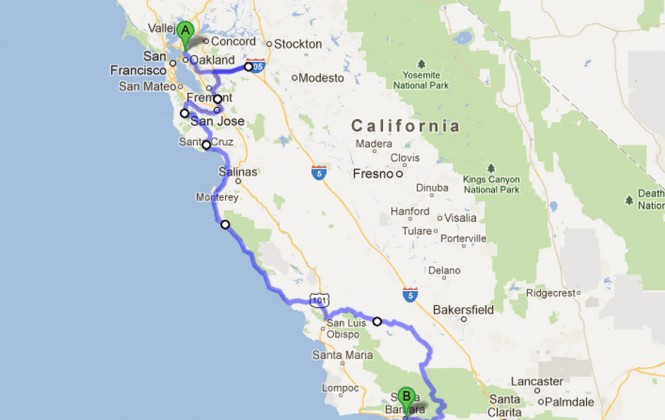
I once drove from my apartment in Berkeley, California to visit a friend in Santa Barbara. I got there 10 hours later (it should have taken 5). The first city I ended up in was Stockton, which had an excellent Vietnamese restaurant but was basically in the wrong direction. Later in the trip, I passed through Santa Cruz, no more on the way to Santa Barbara than Stockton. You get the picture.
Scientific diagram proving that not planning is crazy.
There were very accurate maps back then, made of a substance called “paper,” which never even runs out of batteries. The problem is that I didn’t want to consult them — to plan. That would have involved first figuring out where to buy a map, then actually going to buy it. Also, I would’ve needed to study the map and perhaps even call my friend to confirm the best route. All of this would’ve taken to at least 45 minutes, so naturally, I decided to go on instinct instead.
Give me six hours to chop down a tree and I will spend the first four sharpening the axe
– Abe Lincoln
Planning is undervalued in digital initiatives
Aside from there being slightly less uproarious laughter from beach-goers when I attempted to surf the next day, what would have been different had I invested time in my planning the trip?
One more hour examining map — five fewer hours driving
$2 more on map — $50 less on gas
more energy studying map — less energy being hopelessly lost
Etcetera
I couldn’t have imagined that in advance. In digital projects, it’s the same: lack of planning has more dire results than you can possibly imagine in advance. The “bigger” the project beset by under planning, the more exponentially catastrophic the consequences. And I put bigger in quotation marks because sometimes a wolf comes wrapped in sheep’s clothing — small projects and seemingly trivial features become design and development behemoths.
Overplanning counterpoint
Counterpoint – can you over plan? Can planning be a waste of time? Yes. In fact, overplanning is almost as dangerous as under planning, for two reasons, mostly the second:
Wastes time and resources
Stifles creative problem-solving
The more time a group of people invests in charting a course, the greater its inevitability in their minds, leaving no space for newer and maybe better ideas. High-impact digital projects often involve an ever-changing team of individuals; your goal is to bring in the right people for the right pieces of the work. Make sure your plan isn’t so rigidly planned that new people can’t or won’t attempt to improve on it.
In sum, neither too little planning time, nor too much: the “sweet spot.” I don’t think anyone will dispute the inherent virtue of the sweet spot, but lots will argue the nature of it. It’s difficult to quantify regarding hours worked. While there is an art to this quantification that involves some degree of gut instinct and experience, my semi-scientific analysis of over 130 client projects over 17 years has yielded some numbers or at least some ratios of numbers.
How much time does planning take
An hour at the most would have been all the planning time needed to execute a 5-hour road trip. In terms of planning time versus total project budget (1-hour planning plus 5 hours driving), that’s about a 1:6 ratio for the planning budget. But does that proportion hold up for complex digital projects?
It always depends on the nature of the work, sure, but two trends have jumped out over time: first, planning without a solid strategy in place is risky. Second, the bigger the project, the higher the ideal ratio of planning budget to total project budget.
Total Budget
Ratio
Planning Budget
8 hours (a day)
12:100
1 hour
40 hours (a week)
20:100
8 hours
160 hours (a month)
20:100
32 hours
480 hours (a quarter)
25:100
120 hours
960 hours (half year)
30:100
288 hours
1920 hours (one year)
40:100
768 hours
Abe Lincoln excepted, most people find it tough to accept some of these ratios. I find it hard myself and I’ve been working on digital projects since the late 90’s. But what’s even more difficult to accept is the cost associated with not budgeting planning in the first place — missed deadlines, missed opportunities, and lots of resources wasted. While these numbers may not be exact, I believe they are a good frame of reference. Go beneath them, and you lack understanding, specification, and direction; go over them, and you waste money, have too much specification, and become rigid in your thinking.
What is planning — just guessing?
By the way, Jason Fried has said: “Planning is guessing.” This is fascinating and worth considering.
The Oxford Dictionary of English says that a plan is a “detailed proposal for doing or achieving something” and that to guess is to “estimate or suppose something without sufficient information to be sure of being correct.”
So Jason is implying that “planning is guessing” because you can’t have sufficient information.” But I think you can if you accept the 1:5 planning to execution ratio as a baseline. Just like I could have found a gas station with a paper map, and I could have called my friend to consult him about it. It’s not easy, but it’s worth it, even if you don’t end up sticking to it as your project develops.
There is a catch, though — planning doesn’t have to conclude before production work begins. While that’s the excepted Waterfall planning method, it’s not the way that Agile project management slates work. In Agile, work and planning co-evolve and iteratively drive a project without necessarily knowing exactly what the end product will look like. That means that for some projects that 20% of planning time may not be reached until near the end of the project.
But wherever and however planning time is spent, it’s worth it to target the planning budget sweet spot.
The planning budget sweet spot and why you should target it
No matter how big or small a budget or a set of strategic goals may be, there is a project budget sweet spot for digital projects: 160 – 480 hours.
The sweet spot is the range at which the ratio of planning hours to execution hours remains somewhat reasonable (1:5) yet also corresponds to a significant amount of work.
Beyond this range, planning becomes incredibly complicated and eats up the budget; before this range, your can’t necessarily accomplish much. No matter how big or small a budget or a set of strategic goals may be, there is a project budget sweet spot for digital projects: 160 – 480 hours.
That 160 – 480 range is inclusive of planning and execution phases and any other kind of work that comprises the project, from content production to creative design, to engineering and quality assurance testing.
Break a big project into bite-sized ones
BTW, if what you want to achieve doesn’t fit that range, break your project into smaller, independent projects that do. The sweet spot doesn’t apply to the contract level, which might call for thousands or tens of thousands of hours. But it does apply to how you organize project work that proceeds from a contract. In Agile development, work on a project is broken into cycles called “sprints”; a 160-hour budget might fit in nicely into one of them. A 480-hour might fit nicely into three of them.
Also, a contract can be delivered on by breaking work out into multiple smaller projects that are executed simultaneously and rolled up into a master project. In this way, large projects can be delivered without incurring that frustrating and expensively high ratio of planning time, where planning happens for months and months before anything is built and eats up 40% or 50% of the total budget.
Moving faster with the right planning budget
Most web presences should be redesigned, strategically, creatively, and functionally, every 2.5 years.
Our culture and our economies have entered a period of rapid change. Markets change, customers change, and companies have to as well. Show me a website that is over three years old, and I’ll show you missed opportunities. Most web presences should be redesigned, strategically, creatively, and functionally, every 2.5 years. By positioning your digital projects into the sweet spot of 160 to 480 hours, you’ve got not only a high-ROI ratio of planning to execution but a realistic scope of work that allows for rapid, iterative change.
Thinking ahead: If you implement this approach, you’ll be EBITDA-profitable by 2089!
the production of ideas is as definite a process as the production of Fords – James Webb Young
A Technique for Getting Ideas, was written by ad-industry creative director James Webb Young, better known for his book Diary of an Ad Man, an excellent play on the title of Gogol’s classic.
Anyway, this is a short book that provides a system for the origination of creative ideas.
It asserts that good ideas don’t just appear magically, as depicted in Mad Men; instead, you take action and get them. Or at least your subconscious mind does.
Young, who I’m guessing was influenced by his (germanic) namesake and contemporary, Jung, published this treatise in 1940 for fellow advertising industry creatives.
But the method and the principles behind it apply to getting any variety of creative ideas, including ones we can use today for digital approaches like user experience design, conversion copywriting, or imaginative SEO strategy.
Usage warnings
At the onset of the book, Young issues caveats about the rigorousness of the method and the type of mindsets that will most benefit from it.
First, he warns that compared to our typical ideation approach, his method is very hard work. We have to scan widely but read deeply, stare at things for longer than they hold our interest, interview our subjects extensively, and process and organize a tremendous amount of information. The research is difficult for a few reasons:
It requires total immersion — the kind that may throw your work-life balance off kilter for longer than you like.
It involves uncertainty and risk. You don’t know where it will lead you, so you will go astray and waste many hours of work on nothing.
It often makes the most sense to go it alone
Young believes this approach will only work for people with brooding, speculative minds who are never satisfied with their solutions and are compelled to constantly rework them. I tend to think of most traits as being learned, not inherent, so I’m not sure I agree. But it’s worth noting that Young feels very strongly that his technique will work much better for some than others.
Try to create something original, you’re in for a surprise
Before setting out the method itself, Young introduces two important motifs. The first is that every new idea is a combination of previous ideas. It may be a new combination or a stale one, but a combination it is. This encourages us to borrow from the ideas others. Many great writers and thinkers have echoed this concept throughout the years, including a well known Nobel laureate:
Most everything is a knockoff of something else. You could have some monstrous vision, or a perplexing idea that you can’t quite get down…
But then you’ll see a newspaper clipping or a billboard sign, or a paragraph from an old Dickens novel… or something in your mind that you didn’t know you remembered.
It’s like you’re sleepwalking, not searching or seeking; things are transmitted to you. It’s as if you were looking at something far off and now you’re standing in the middle of it. Once you get the idea, everything you see, read, taste or smell becomes an allusion to it. It’s the art of transforming things…
Try to create something original, you’re in for a surprise.
~ Bob Dylan
Pattern-Matching is the Mother of Ideation
Young’s second guiding principle, which Bob Dylan also reflects on, is that great ideas often combine seemingly unconnectable and incongruous ideas and facts.
Decades before the term multidisciplinary caught the imagination of academics and civil servants, Young codified a far more transcendental and imaginative approach to problem-solving. For Young, it’s not only helpful but necessary to seek out far-flung subjects and vary our approach to researching them; embrace the irrelevant.
Let’s take an example: say we are looking for a better way to promote a fair-trade tea through digital marketing and commerce. We’ve been given this task by an NGO client who has already initiated a program that brings those teas to the Western market, on behalf of small farmers in the developing world. We begin our task with research, but how? What might Young encourage us to set on a shelf next to each together for examination? In applying this approach to finding digital solutions, it’s important we mix traditional methods with those of the Internet age:
Look up the price of tea in China (actually impossible to do, but that’s OK)
Do keyword research on fair trade e-commerce, using Google Trends and SEOMoz’s Keyword Explorer
Find a study of discretionary spending trends by consumers in the United States versus those in the BRICS nations
On the NGO’s website, identify the ratio of visits to the homepage versus to “inside” product pages
Watch a documentary about the Monsanto’s monopolization of the tea farming industry in South East Asia
Write down the top search terms on the NGO website’s in-site search logs
Start a list of the most commonly marketed varieties of fair-trade tea, using more than one source
What were total sales of teas over the last two years, broken down by channel: grocery store distributors, coffee & tea houses, Amazon.com, and telephone orders direct to consumer
What’s that got to do with the price of tea in China? Precisely the right question to ask, Young might respond. As the detectives say on TV, you don’t know what you’re looking for until you find it.
Who knows, maybe you’ll notice a trend whereby every element you examine has a health component to it. For example, you discover that China subsidizes the price of tea for health reasons and that the most common Google search having to do with tea is “best tea for headaches” (for the record, as of 2018 it’s actually bubble tea.)
Making far-flung connections like these will better prepare you to formulate critical digital marketing and strategy questions:
Is there an opportunity to generate more revenue from tie-in products, like the actual tins themselves?
What else do fair trade tea farmers (or anyone else in the supply chain) have to offer that could fit into?
Is it worthwhile to investigate a web and email marketing campaign based on a health theme?
Should the NGO continue to sell fair trade tea on its primary website, or should it launch an independent, e-commerce site just for that purpose? Or some mixture?
If you follow Young’s method, you’ll look for connections like this; you’ll keep asking yourself, “how does this fit with that?”, and you’ll build a question set that points your client in the direction of a digital strategy.
After a point, though, you’ll stop. Stop asking questions, stop thinking, and sleep on it — and then some. Read on to learn why.
The method
Once he establishes the caveats and principles essential to correctly following the method, he lays it out in 5 steps. This is the actual work of getting ideas.
Step 1. Research the subject
Step 1x: Research related subjects
Step 2: Digest research and brainstorm ideas
Step 3: Forget its existence
Step 4: Listen for ideas
Step 5: Qualify ideas
Step 1. Research the subject
According to Young, this is the most important and arduous step and should proceed as follows:
Research your subject by reading everything you can find unique to it, within an appropriate timeframe
After casting our broad net, go deep. Young doesn’t stipulate this, and it will depend on the scope and timeline for our project, I think we should read at least one full-length book on the primary subject.
Write down every interesting fact, thought, and half-thought as you go.
Find answers to each important question that comes up.
Organize what you write down systematically.
Whether you utilize index cards or something else, I’m sure Young would insist that we write it down on paper. I think there is a lot to that. Ultimately, you can transfer key information to your computer, but by writing it down, you register it more deeply in your mind, which is the general idea for step 1.
Young didn’t know about the digital world, but if he did he’d embrace the research opportunities it presents. He’d cull from it as much data as possible; website analytics data, in-site search logs, SEO data, e-commerce transaction histories, usability studies, and more; he’d get out as much information out of it as possible and write down whatever jumped out with pen and paper.
Step 1x. Research related subjects
After studying the primary subject, we broaden the investigation into related topics and issues, employing the same broad sweep, deep-dive, documentation, and categorization techniques. We started with fair trade tea and that led to:
Gourmet beverage e-commerce
Dietary Health & Wellness
Low-tech outdoor video production
Agricultural worker labor issues
Examine any subject in the world in which you see a relationship to your original problem area. The danger is going down the rabbit holes of the trivial and the inconsequential, recognizing that, and knowing when to cut your losses. That’s part of what makes this step so hard.
And then stop. Close the gates of information on this subject. For those of you familiar with the Agile software design and development methodology, you’ll recognize a similarity. In Agile, the “sprint” cycle by definition has not begun until bugs, feedback, feature requests, and any other issues, are completely halted. That frees engineers to completely immerse themselves in solving agreed upon issues during a short “sprint” of development work.
Young doesn’t address when to stop and it’s certainly less clear-cut than in Agile. We have to intuit when it is time to shut down the water hose of new information and ideas; without doing so, the next step is impossible.
Step 2. Digest research and brainstorm ideas
Digesting your research isn’t a passive activity for Young; it’s more like brainstorming. If the key aspect of step 1 is to dive deep, the key to step 2 is to struggle. How thoroughly can you exhaust your attention span and leave your patience and self-discipline in shreds? A deliberate effort is made to churn your mind until it presses out an idea. Can you push yourself to create solutions slightly beyond the point at which they are interesting to you? I imagine Young upright at his desk, alert, caffeinated, writing notes, reading them aloud in different voices. This is a rigorous mental examination, but it’s not solely an intellectual exercise; as the author puts it:
take the different bits of material you have gathered and feel them, as it were, with the tentacles of the mind.
Young was concerned with producing ideas for mid-20th-century advertising campaigns that lived in newspapers, magazines, and billboards, so like us he needed to find the right words and imagery. But because we’re working with digital canvasses, in addition to the mediums of Young’s era, we want to apply Young’s method and advice to digital techniques. UX design, for example, fits in perfectly here: he’d have us create pen and paper sketches of wireframes, sitemaps, personas, user stories, and the like. And once we digitized that thinking, we’d rework and refine layout and words.
We’d make more customer journeys than we could present back to the client, walking our personas through dozens of digital experiences: Web UI, confirmation emails, the 1-800 support line, the box of tea in the mail with a link to the profile of the farm from which it originated. We’d picture, for example, a customer acquiring our NGO client’s tin of tea, opening it at their table, and making themselves a drink. What happens between that moment and returning to a “commerce channel” to purchase more tea? Or between that moment and making a voluntary donation on the NGO website? How do they make that donation? What time of day is it? What feeling comes over our personas during the transactions — satisfaction, relief, connectedness, guilt? And how do you sell those feeling, assuming we want to? And again, what does any of this have to do with the price of tea in China?
Because Young thinks our minds should be completely exhausted at the end of this step in the process, he’d have us answer questions like these over and over again.
By constantly thinking about it.
Sir Isaac Newton, when asked how he came up with the theory of gravity.
Step 3. Forget its existence
This is the most interesting parts of Young’s technique. It must have been quite avant-garde in 1940. In this phase, you do digest your research, but in a new way: with the subconscious mind.
“Stop trying” goes beyond just sleeping on it, though I’d be pretty sleepy at this point. Here we are advised to drop the original subject entirely from our consciousness. We don’t read about, talk about, write about, or think about the matter of our investigations. We forget it ever existed. Instead, we might immerse ourselves in a movie, a game, or in activities that involve people, places, or things completely unrelated to the matter of investigation. I picture Young scheduling his weekends to coincide with this step, so he could thoroughly free his mind of his inquiries. With your conscious mind completely off the subject, it can rest, and let the subconscious take over problem-solving duties.
Young provides the perfect illustration – Sherlock Holmes abruptly dragging the befuddled Watson off to a concert, after intense examination of a case. As Young points out, Sherlock’s creator Sir Arthur Conan Doyle was an artist who understood the ideation process; he knew that his character needed to let his subconscious mind consider the problem after his conscious mind had reached a point of exhaustion.
Step 4. Listen for ideas
Unlike the previous steps, you don’t begin this one actively; it starts by itself when ready. As Young says: “Out of nowhere the idea will appear.”
There isn’t much to say on this subject other than, “be prepared to write it down.” For me, good ideas come at the most inconvenient time, like when I’ve just asked a police officer for directions while driving and then want to say, “Hang on a minute; I’ve just had a fabulous idea for this website I’m working on … OK, go ahead!”
Because the author describes this step as akin to blindly groping for needles in a haystack, document each idea casually, without being so invested in one that it crowds out the next.
Step 5. Qualify your ideas
In digital strategic planning, these ideas we come up with may take on the form of questions rather than, say, marketing campaigns. Be they questions or answers, now is the time to sort the wheat from the shaft.
listen for the spontaneous urge to add to the ideas you present
Young enthusiastically suggests that the best way to know whether an idea is good is the extent to which others will immediately add to and improve on it. So ignore the polite endorsements or analyses, and listen for the spontaneous urge to add to the ideas you present to others. Those are the ideas to cultivate.
Which reinforces the original principle of A Technique for Getting Ideas – so-called new ideas are simply combinations or mutations of previous ones. And that’s a fitting conclusion to this summary of Young’s method.
A postscript on digital marketing
75 years after its publication Young’s technique, which has probably existed in some form since the ancient Greeks, remains relevant. I have tried this approach myself and my take is that it’s hard, effective, and works perfectly for solving problems with digital design and technology.
If I have any misgiving about the approach, it’s that it’s hard to reconcile the solitary nature of it with the team-driven discovery workshop and interviews approach that is so common at the onset of a digital project. Discovery planning is useful because it’s inclusive. It delegates the work of collecting different insight to a large group of colleagues. It’s also much easier to get buy-in on new ideas: the more people that contribute to an ideation process, the more yes votes on whatever it yields.
On the other hand, design-by-committee has its well-known drawbacks. My advice to UX specialists, visual designers, technical solutions architects, developers, digital marketers, and anyone else whose work is guided by digital strategy, is to initiate Young’s method alone and only incorporate other people into your work once you completed your research and brainstorming work. That could look something like this:
Step 1. Research the subject
Step 1x: Research related subjects
Step 2: Digest and brainstorm ideas
Step 2a: Discovery workshopping & interviews
Step 3: Forget its existence
Step 4: Listen for the Eureka ideas
Step 5: Filter ideas and repeat
You’ll probably scale down the scope of your ideation work if, whatever your job title or project role, you are not the principal solutions owner for a given digital project. What’s important is not how much but how well we honor the technique Young has provided us with.
Honor the subconscious ideation process
Don’t let the always-on norm of the Internet age weaken the “Forget its existence” phase of this process. In the world of web design companies, Drupal and WordPress shops, IT and Communications departments, advertising firms, and digital agencies, we’re even more over-connected than our counterparts in civilian life, so it’s hard to “forget” a project you’re working on. Digital communication is too adept at intruding on and obstructing our work. You’ll face challenges that perhaps our author didn’t have to back in his mid-2oth Century advertising firm, but you either let the subconscious mind do its work, or you don’t.
Digital testing of ideas
While the digital era may encroach on subliminal contemplation, it helps realize other parts of Young’s approach. It goes without saying that the Internet expands research opportunities. And software-based approaches to deliberate brainstorming are there too: wireframing and prototyping tools, visual editors, analytics and keywords research products, and quick-build CMS products. But if there is any part of The Technique for Getting Ideas we can significantly improve on with digital technology, it’s the last step where we qualify ideas.
Whereas Young’s yardstick was whether colleagues’ minds lit up with suggestions, we can also test ideas with techniques like A/B split-testing, in which we evaluate the appeal of a product or service against a variation of itself. For example, version A of a box of fair trade tea will feature the “Fair Trade Certified” logo prominently, but version B fades the logo into the background and superimposes a prominent quote from a doctor about the health benefits of fair trade agricultural products. Using digital commerce and analytics tools, we can quickly test the appeal of version A against that of version B.
the opportunity in digital lies in the ease, rapidity, and affordability of testing ideas
A/B testing has been around since long before the Internet age; the opportunity in digital lies in the ease, rapidity, and affordability of testing ideas. Products and services like Google Webmaster Tools, HotJar, New Egg, Applause, and more, can automate and vastly accelerate the timeframe for testing new concepts. In Young’s day, it wasn’t possible to verify the profitability of an idea before it went into an expensive production cycle; after putting all that hard work into getting ideas, he would have loved digital testing.
In the next episode, we’ll cover more approaches to work that will completely obliterate your work-life balance.
Me hizo pensar. Es verdad que es una especie de absurdez autodenominarse visionario o líder de pensamiento sin ironía. Es como calificarse a sí mismo “legendario”. Una etiqueta así le otorga a uno los demás. Pero Drayton Bird no tiene razón cuando habla de la absurdez de ponerse la etiqueta “estratega” porque tiene sentido que el que vende la estrategia se refiere así. Pero bueno, ¿qué significa la estrategia? Y precisamente, que lo que es una estrategia digital?
Dejando de lado el digital, por el momento, vemos la definición lexicográfica. El Diccionario Oxford de Inglés define la estrategia como: “un plan de acción o política destinada a lograr un objetivo mayor o general”.
Eso es bastante vaga y genérica, sin embargo, verdad? Pensando así hace que el que come un desayuno equilibrado con el fin de tener siempre energía durante el día, es un practicante de estrategia. Eso es porque se aplica a cualquier tipo de estrategia. En el contexto de perfiles profesionales del Internet, la mayoría de las personas lo utilizan con respecto a algo un poco más específico: la estrategia de negocio. Los diccionarios se niegan a definir esa frase y Wikipedia tampoco, por el momento, ofrece una definición. Pero el mundo de negocios pone un gran énfasis en la estrategia de negocio, claro. De acuerdo con la investigación de McKinsey, existe una correlación demostrada entre la inversión en la formulación de la estrategia corporativa y el beneficio.
Cada año, muchos libros se han escrito sobre el tema, como por ejemplo de 2011 titulado Good Strategy / Bad Strategy, por Richard Rumelt. Uno de las observaciones interesantes que hace es que una buena estrategia de negocios no suele consistir de una idea o de un punto de diferenciación, sino de un conjunto de ideas – ideas que por sí mismos, aparte, puede no sean únicos, pero que combinados sí proporcionan una ventaja de negocio único. Menciona la combinación de IKEA para iluminar la teoría: IKEA trata de un conjunto de diseño de alta gama, de fabricación asiática y barata, de una ubicua presencia minorista de tiendas enormes, y de una infraestructura super-digitalizada. Cualquiera de esas caracteristicas se puede duplicar fácilmente, pero ponerlos juntos en un conjunto integrado crea una posición inexpugnable de la ventaja para IKEA. Me hace resumir definición de la estrategia de Rumelt de la siguiente manera:
Conjunto enclavamiento de ideas para ganar o explotar una ventaja competitiva.
Algunos de los pensamientos más interesantes del tema de la estrategia de negocio, sin embargo, vienen de Blair Ennis. Las perspectivas suyas son útiles en mi mundo porque están dirigidos a empresas de diseño y marketing, que habitualmente cuentan con personas que se autodenominan estrategas digitales. Él dice:
“La estrategia es una idea que describe un movimiento a una posición de ventaja. Lo que más me gusta de esta definición es que explica que la estrategia se puede transportar como una simple idea.” Toma esa colina, ” desmoralizar a la competencia, ” propio ‘ servicio ”. Algunos consideran que la estrategia es la posición en si (no me lo opongo), y otros lo ven como los pasos necesarios para llegar a la posición (tácticas, yo diría.) Pero en todo su esplendor, la estrategia se puede resumir brevemente en una idea general que describe la posición de ventaja y comienza a implicar la táctica, o pasos necesarios para lograrlo “.
Según Blair Ennis, estrategia es una idea que describe un viaje a una posición de ventaja. No es sólo la idea (ni un conjunto de ideas) son, sino cómo llegar a realizerselas.
Ahí tenemos un buen punto de partida para llegar a la definición de Estrategia Digital, pero estoy convencido por David Ogilvy que el tiempo, tiempo largo idealmente (lo explico en seguida), tiene que aparecer en esa definición. Dandonos cuenta de tiempo nos lleva a la siguiente definición: La estrategia es un conjunto de ideas que describen cómo obtener consistentemente una ventaja de posición a lo largo del tiempo. No es una posición única de ventaja. No es, por ejemplo, un eslogan grande, una sola campaña de publicidad, ni un sitio web. Es un pozo; se puede volver a ella una y otra vez para lograr o mantener una posición de ventaja. En lugar de un gran lema, es una idea de que se derive una serie de lemas o consignas. En lugar de un gran sitio web, es un método o plataforma para la conceptualización de sitios web eficaces de rápida construcción. En lugar de un gran nuevo empleado; es una filosofía de contratación que produce constantemente grandes nuevas contrataciones. Etcétera.
Me despidieron de un trabajo en un restaurante de comida rápida cuando era un adolescente. No había ninguna necesidad de que me pagara, sin embargo. Porque había trabajado 0 días y 0 horas. Me despidieron porque llegaba tarde a mi primer día de trabajo. Tardaba 15 minutos. En mi defensa, un accidente de tráfico me dejó inmovilizado en la carretera durante 30 minutos. Pero no importó el porqué de llegar tarde, porque su estrategia es esta idea: siempre se despide a cualquier persona que llega tarde a su primer día de trabajo, no importa cuál sea la razón. Para un negocio altamente controlado por procesos como un restaurante de comida rápida, es una estrategia que me imagino que produce buenos resultados consistentemente año tras año, década tras década.
En su libro Ogilvy On Advertising, David Ogilvy habla de algo similar. Él lo llama “grandes ideas”. Para Ogilvy, una gran idea es un solo concepto que puede proporcionar de forma coherente los resultados durante un período de 30 años. Marlboro son para los vaqueros rugosos. Paloma no es solo jabón, es una crema para la piel también. Estas son ideas de 30 años debido a que se pueden utilizarlas para obtener resultados una y otra vez por proporcionar constantemente una ventaja competitiva. Ya que hemos llegado a la época digital no estoy seguro de que 30 años sea realista, pero el concepto sigue siendo el mismo – la reutilización; la posición de ventaja tiene que resistir al menos, digamos, 2 o 3 grandes recesiones económicas.
En el contexto de la estrategia digital, la palabra digital sólo significa que se basa en la tecnología de Internet.
Así que cuando se añade uno a otro, se obtiene una definición satisfactoria de la Estrategia Digital:
Estrategia Digital es un conjunto de ideas y tácticas basadas en la tecnología de Internet que lograran una ventaja competitiva a traves de un largo rato.
“What is the definition of digital strategy, anyway?”, a client once asked me during a conference call meeting. In front of 15 people. Luckily, I like to debate things like this with my incredibly geeky friends, so I wasn’t entirely at a loss for an answer. But it’s one thing to know something and another to articulate your knowledge of it. So I stammered a fairly unsatisfactory definition of digital strategy, walked home cringing, and started improving on it.
On much reflection (I’ve revised this 70+ times since 2012), here’s what I think a digital strategy is:
A set of ideas which inspire a move to a lasting position of advantage through digital thinking.
This article is about creating a digital strategy by asking: what is its definition? First I strip the subject down to basics — the dictionary definition of strategy. Then I reassemble it, piece by piece. What are those 6 pieces?
So the next time a strategy is presented to you, analyze it against this definition. If it meets all six criteria, it could be a good strategy.
And it will likely be original.
This definition of digital strategy applies primarily to sales and marketing. But can you really separate the design of marketing strategy from the design of the thing (product, solution, service) being marketed?
No. So you could think of it as a digital strategy for product marketing.
Is the term digital strategy overused or misused?
Many years ago, business thinker and writer David Ogilvy said of his counterpart Drayton Bird: “Drayton Bird knows more about direct marketing than anyone in the world.” …!!
Naturally, I tend to pay attention to what Mr. Bird says, especially when it has to do with my work, where strategy has its place. A while back, however, he commented on Twitter:
Why do people describe themselves so ludicrously here? As in "visionary", "thought-leader", "strategist" etc.
True — to describe yourself as a visionary or a thought-leader is kind of like calling yourself legendary, unironically. Cringe.
“Strategist”, however, describes a job function; and how do you describe your job if not by its functions?
Part of what Bird is getting at is that the “strategist” label gets overused, or even misused. According to Google Trends, the term “digital strategist” has become increasingly ubiquitous.
And as Bird has pointed out, the word strategy by itself is regularly misused to describe a simple idea or a set of tricks.
I use the strategist word to describe my work less and less over time, partly because I have the same reaction to its overuse that Drayton Bird does. And as the 2 bobs (sage management consultant David C. Baker and subversive sales coach Blair Enns), point out, using the word strategist as a descriptor feels kind of like an inelegant hack for saying, “we’re smart”.
Nevertheless, some people are strategists and some digital strategists. The word just keeps creeping back in.
Setting aside digital, let’s look at strategy itself. The Oxford English Dictionary defines strategy as: “a plan of action or policy designed to achieve a major or overall aim.”
True, but too vague. Applies to all walks of life. In the context that Bird refers to, people are using the term with regard to business.
A position of advantage through a set of ideas, not a solitary one
Every year books are written on the subject of business strategy, such as 2011’s Good Strategy / Bad Strategy, by Richard Rumelt. It was the first of many business strategy books I turned to after being challenged to define its meaning on that conference call. The book’s premise is that a good business strategy is hardly ever just one idea or one point of distinction. Instead, a business strategy is a set of ideas that are interlinked and complementary.
By itself each idea within such a set may not be unique or proprietary, but combined they create a unique position of advantage.
He makes a case study of IKEA’s strategic (and digital, by the way) formula:
None of these ideas are patented. And IKEA’s competitors could easily ape any one of them, or maybe even two together.
But it would be extremely difficult to copy all of them at once. By putting these ideas together into a cohesive set, IKEA has created a strong position of advantage in the home furnishings market.
Note that there’s nothing wrong with proprietary IP, be it patented or just kept secret. But that’s not the only outcome of ideation and innovation.
Regardless, I’d summarize Rumelt’s definition of strategy as: “interconnected sets of ideas for gaining and maintaining a competitive advantage.“
Strategic ideas should stipulate action
Some of the best reflections on strategy come from the aforementioned Blair Enns, the author of Win Without Pitching. For Blair, a strategy is not just an idea, but an idea that has action baked into it. Strategic goals and the move towards them are one and the same.
Strategy is an idea that describes a move to a position of advantage.
~ Blair Enns
Most organizations that digital strategists work with already have a strategy. What’s often lacking is an adaptation of that strategy to digital, where uniquely digital approaches bear the most fruit.
So movement over time is an integral part of the definition of strategy we’re creating (one reason a content strategy is such an important digital approach, by the way — it makes you get out the calendar.)
Let us march against Philip
By the way, speaking of “Good Strategy / Bad Strategy” is it enough to describe the move to the position of advantage? Or do you also have to inspire that movement? Here is where strategy and rhetoric (eg. copywriting) become one. Or at least share DNA.
Have you ever nodded yes to a rational appeal to implement a strategy, yet not felt inspired to do so? I have.
To inspire, we have to appeal to something deeper than logic or job duty. To what then?
Values, standards, pride, identity. In fact, our strategic advantages as businesses are probably those things we’re most proud of.
So a good strategy doesn’t just describe a move to a position of advantage, it inspires one.
Mat Ford speaks to the ability of a leader to inspire action in describing the “Burnt Tongue” mental model. And Mat points us to Sir Lawrence Freedman who speaks to the inspirational quality of strategy in his book, Strategy: A History: “Not only does strategy need to be put into words so that others can follow, it works through affecting the behavior of others. Thus it is always about persuasion…”.
But no one puts it better than Cicero, whom David Ogilvy quotes in the introduction to “Ogilvy on Advertising”:
When Aeschines spoke, they said, “How well he speaks.” But when Demosthenes spoke, they said, “Let us march against Philip!”
Sidebar on Digital Transformation
Creating a definition of digital strategy gets confusing because there is digital transformation (concerned with operational efficiency) then there is digital marketing strategy (based in innovation/expertise).
Digital transformation is interesting. The idea is to remake the entire business into a customer-focused firm through digitalization. A side benefit is improved “customer experience”. Wonky digital transformation geeks often say things like, “how can the entire support system, and even the delivery of products and services, create a better experience for customers – up and down the value chain?”.
This is an important question, especially for enterprise organizations looking to reduce the high cost of departmentalized operations rife with hundreds if not tens of thousands of discrete and sometimes analog processes – big piles of paper. How to de-silo and integrate?
So digital transformation may reduce operations costs and may even the revenue needle a little bit by improving customer support, but it’s never going to drastically move the revenue needle like a good digital marketing strategy can.
Ultimately, digital transformation is about efficiency while digital strategy is about business innovation and direction for the long term.
As a matter of fact, a digital strategy needs to be built to last.
“Long term” is a key part of the definition of digital strategy
Speaking of content strategy, the time frame is another vital part of our definition. That’s because a strategy can’t be a one-off thing any more than a business is. It needs to be well that doesn’t run dry.
A strategy is not, for example, a great slogan, campaign, or website. Rather than a great slogan, it’s a set of ideas that inspire a whole a series of slogans. Instead of a great website, a set of engagement ideas that inspire one effective digital campaign after another. A hiring rule that consistently maintains a workforce over time.
Speaking of hiring, someone I know was fired from a job at a fast food restaurant as a teenager. There was no need to cut him a check, though. He had worked there for 0 days and 0 hours. The thing is, he arrived late to his first day of work by 9 minutes. I think he had a pretty good excuse, too. But their hiring strategy was simple. Always fire anyone who is late to their first day of work, no matter what the reason.
For a highly process-driven business like a fast food restaurant, that policy must yield results decade after decade. Or at least three decades, hopefully…
Big ideas create a position of advantage for 30 years
The position of advantage is at the core of strategy. But if you had a position of advantage for 0.02 seconds – is that a goal worth pursuing?
In his book Ogilvy on Advertising, David Ogilvy talked about the inherent longevity of the very best ideas. He called them “big ideas.” To Ogilvy, a big idea got results over a period of 30 years. Marlboros are for rugged cowboys. Dove isn’t soap; it’s a skin cream too. Nike isn’t about better shoes it’s about greatness.
Steve jobs talks about Apple’s positioning in this discourse on Apple’s marketing strategy:
Why does Apple exist? Because it believes that people with passion can change the world for the better. And those people crazy enough to think they can change the world are the ones who do.
These weren’t just clever words. Instead, they were big-picture marketing strategies based on macroeconomic trends, cultural shifts, and psychological insight. This campaign was launched in 1997 and will easily meet the bar set by David Ogilvy of being relevant for 30 years.
The strategic direction set forth by Steve Jobs and David Ogilvy gave Apple and Ogilvy’s clients successful marketing campaigns time and time again, for 30 years or more. Business and life may cycle more rapidly in the digital age than in Ogilvy’s era, but the principle of being lasting is still innate to strategy.
If you can only take the hill for 30 seconds, is taking it really a good idea? Is it really a position of advantage?
Digital strategy and content from distinctly digital methods, also known as Digital Thinking.
Having set it aside to talk business strategy, let’s put digital back in the definition. What is digital? And what is digital business strategy?
Had I asked that of my Latin tutor, back in the days of Bush Sr., he might have said: “Well, a ring, I suppose” (thanks, folks, I’ll be here all week).
Today, of course, digital signifies belonging to Internet tech, not fingers. But more importantly, it signifies uniquely digital methods of communication or information experience. We’ve learned and codified these methods steadily over the last twenty-five years. They’re vital to our definition of digital strategy. The question of how to present ideas and information is also called “digital thinking”.
One of the most valuable digital strategy tools, content marketing (aka creating content and distributing it) requires distinctly digital approaches based on digital thinking. TopDraw.com makes the point that having a digital strategy is very important to your business.
Putting it all together we come full circle to our digital strategy definition:
Digital strategy: a set of ideas which inspire a move to a lasting position of advantage through digital thinking.
Threading in the concept of positioning (what you do and who you do it for), I can use our strategy definition to describe my work as a strategist. So here’s my strategy: “Inspire B2B agencies to gain an advantage through positioning-focused content strategies that generate leads over the long-term”.
What’s yours?
fin
POSTSCRIPT
Other useful remarks on, or answers to, the question, “what is the definition of digital strategy?”
Strategy is the answer to the question: how do we become and remain unique?
“The lifeblood of a strategist is insights, a simple distillation of a ream of information and data into an actionable statement to inspire creative teams or clients.”
“in this case, [digital marketing] strategy is not what you do, but how you do it; the research that underpins the methodology and wraps the engagement…”
“Strategy to a designer is the thinking that precedes and wraps the design solution. Strategy to a CEO is a series of decisions across all aspects of the organization that leads to a sustainable marketplace advantage and corresponding long-term financial success.”
[Note: this article was originally published on my first blog, strategyden.com; a copy exists on archive.org. It also makes me cringe a bit. Jason Fried left a very generous comment but that’s now lost forever.]
“Highrise, I knew CRM, CRM was a friend of mine, and you’re no CRM.”
Actually, CRM and I are still friends, and I count 37Signals design and development strategies as a friend as well. In fact, this weekend I dusted off my copy of ‘Getting Real’, a kind of product development manifesto published by 37Signals. I was prompted to take another look at Getting Real perhaps because I just noticed that Highrise — released earlier this year — is calling itself a CRM. Highrise is a useful and innovative Contact Management tool, but it is not CRM, I’m sorry to report.
CRM stands for Contact Relationship Management (Wikipedia uses “Customer” as of 11/28/07; I think that’s limiting though), with “relationship” being the operative word. Leaving aside the world of enterprise mega-CRMs such as Microsoft Dynamics and Netsuite, I believe that a web based CRM, however simple, should have at least two ‘relationship’ features:
form publishing tools, to create contact relationships efficiently
email marketing tools, to maintain contact relationships efficiently
These basic features are offered by the Granddaddy of web based CRM, Salesforce.com, and numerous imitators, most which offer reams of other “integrated” features. I like the idea of pairing CRM down, simplifying it for the “Fortune 5,000,000″, but Highrise demonstrates that if you keep pairing CRM down, then eventually you are left with a Contact Management tool. Which isn’t necessarily a bad thing.
For those of you living under a rock lately, simplicity is 37Signals signature. 37Signals garnered notoriety few years back with the Zen-like simplicity of its flagship product, BaseCamp, a project management tool that enables web-based communication. (The aforementioned Getting Real discusses the design and development strategy for BaseCamp — a great read for any internet professional, even if you’re not involved in developing product). I can personally attest to the soothing efficacy of Basecamp. It makes me hate MS Project even more than I used to.
Since Basecamp, 37Signals has been churning out other simple, effective web-apps that help you work and collaborate online:
Backpack — a flexible information organizer and calendar, that lets you define what’s what.
Writeboard — a text editing tool, like Writely, that simplifies MS Word and makes it web based.
and lastly…
Highrise — a contact management tool and “Simple CRM” according to 37Signals official marketing copy.
In addition to marketing copy printed on the Highrise website, there is the marketing copy in the title tag, which refers to Highrise as a “Web based CRM”. This is rather pernicious.
I would love nothing more than for 37Signals to rise to the challenge of building a web based CRM. Meanwhile it rankles me that they are branding Highrise as such.
Perhaps 37Signals is trying to reform the stale CRM market by redefining what CRM means. And perhaps this is only a first step, that will later be integrable with small apps that together will comprise CRM.
Or to take a more cynical view, maybe it was just a smart marketing decision to use the phrase CRM when publishing an Address Book app. I am prone to cynicism, but I don’t think this is the case. I think 37Signals have proven themselves to be an honorable, straight-shooting software company.
Whatever the case, let this be a warning to all ye who seek an simple web CRM: Highrise isn’t quite it; and unfortunately, I don’t know of anything else that is.
Just a quick update on the Convio security debacle I wrote about a few weeks ago — the New York Times picked up the story and focused on the poor follow-up response by Convio and the general issue of how database companies deal with security issues.
The article also makes some forceful claims, such as: “A growing number of donors use the Internet to make their gifts, and experts said some charities might have been reluctant to inform them about the breach out of fear that it would affect donations.”
The author didn’t name specific non-profits who might be engaging in this lying by omission, but at other poiints in the article The American Museum of Natural History, CARE, and the Red Cross were mentioned… Wink, wink. Nudge, nudge.
The article also offers some new details for anyone following the story, as well as a bit of color commentary from the Non-profit Technology Blog. In any case, it always interesting to see what new wrinkles the Times can eke out when coming a month late to a technology story.
Who knows perhaps next month they’ll cover the Salesforce security breach, though they may not dig deep enough to realize that Salesforce also has non-profit clients.