A brand book guides and defines a company’s brand identity and positioning. It typically includes information such as the company’s mission and vision, brand values, tone of voice, and visual identity guidelines. The brand book is a strategic tool and like a message map it helps to ensure the consistency and coherence of the company’s visual and verbal identity across all touchpoints. Unlike a message map, it doesn’t necessarily specify audience-personalized unique value propositions, product positioning, and other important talking points
Entries
-
Examples of Intelligence
2023 appears to be a breakout year for intelligence of the artificial kind so what indicates true intelligence has been on my mind.
Speaking of both subjects, I was little disappointed with the GPTs (ChatGPT and GPT3.5 collectively).
I asked them:
- What are the top three signs of intelligence?
- What are three useful criteria for assessing someone’s intelligence?
- \What are real-world examples?
This yielded disappointing results not worth reprinting.But it also induced me to write a more intelligent prompt. I will print it with the prior three prompts, because as far as the text generation algorithm is concerned, a prompt consists of itself plus all prior prompts within the same communication window.So this was the de facto prompt:- What are the top three signs of intelligence?
- What are three useful criteria for assessing someone’s intelligence?
- What are real-world examples?
-
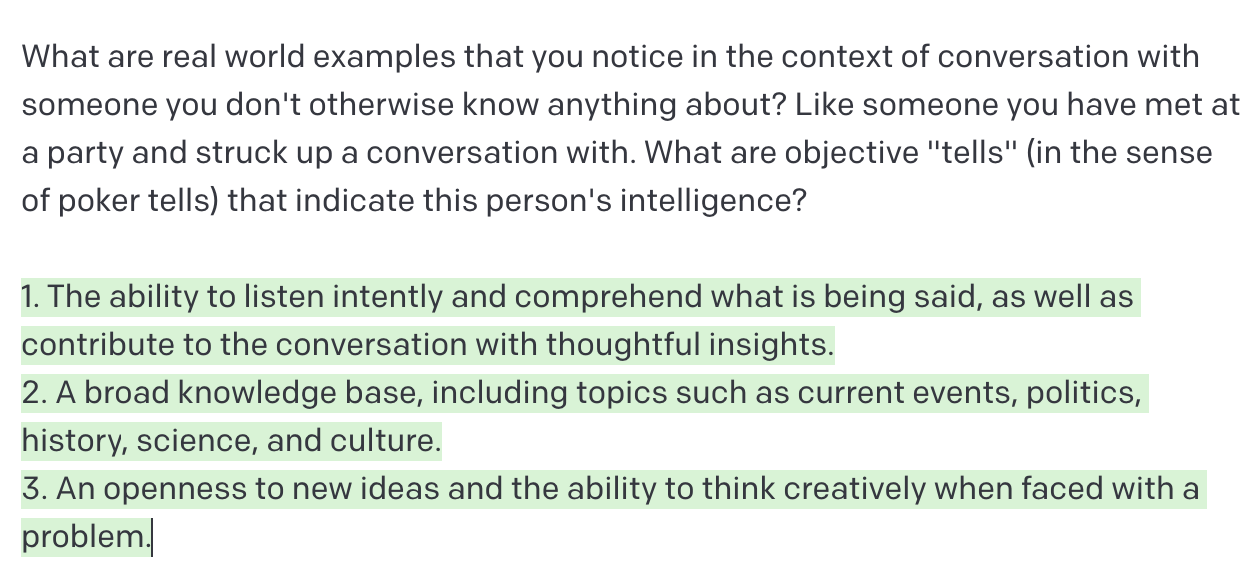
What are real world examples that you notice in the context of conversation with someone you don’t otherwise know anything about? Like someone you have met at a party and struck up a conversation with. What are objective “tells” (in the sense of poker tells) that indicate this person’s intelligence?
With this prompt, I finally got some decent answers.
GPT-3:
ChatGPT:
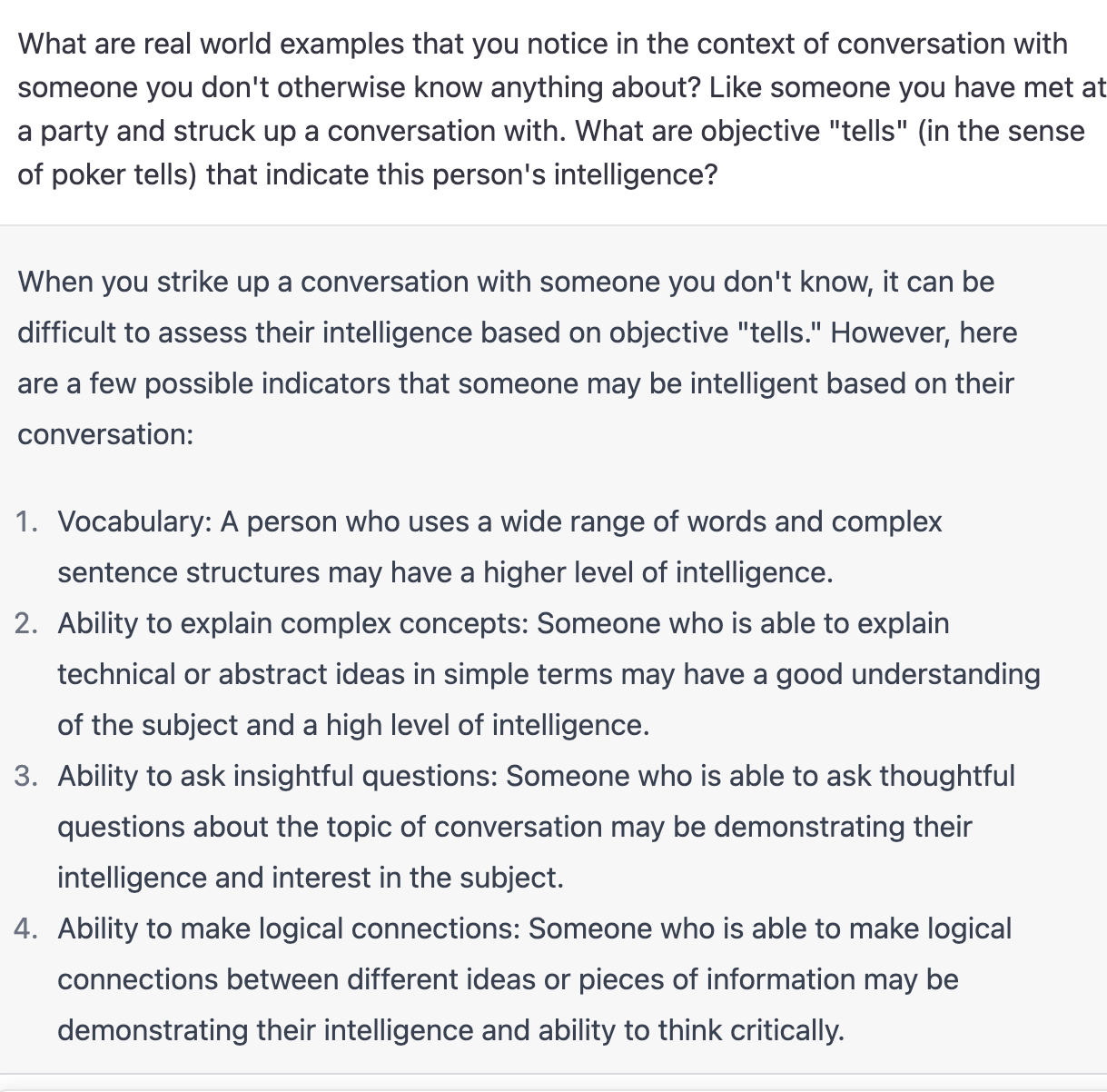
These are pretty good indicators of intelligence (and also of conversational ability).
But they don’t provide specific examples. Which is what I asked for.
As in the ability to summon and articulate an abundance of relevant, interesting, and thought-provoking examples.
The reason that the GPTs fail to provide examples is not that they can’t think, though they can’t. The reason is either that good examples “in the wild”, ie the texts GPT trained on, are rare – or that it is hard for the GPTs to distinguish from the millions of so-so examples. Or both.
* * *
There’s one sentence from Venkatesh Rao’s Art of Gig that won’t unstick itself from my brain: “Your advice is only as good as your examples“.
In a way, the whole book is about providing intelligence as a service, in that it is a book about strategy consulting and the basic job of a strategy consultant, the common denominator, is to be intelligent in service of client goals. (This is also in the book).
The brainstuck sentence mentioned above comes from a section of Art of Gig entitled, “100 Consulting Tips”. If the assertion above is true, then we can think of this section of the book as “100 Tips for being intelligent”.
Here’s the 36th tip:
“Examples, examples, examples. Your advice is only as good as your examples. Collect examples everywhere, from all sources. Half your value lies in being an encyclopedia of examples, with ready access to greater volume, velocity, and variety than employees”.
I will also reproduce his 37th tip because it’s related.
“Read up on classic and cliché examples commonly cited in your consulting niche and have something fresh to say about them. Examples: South Airlines for strategy consultants, iPhone for design consultants, AlphaGo for AI, BP futures for futurists”
So the accomplished strategy consultant and author says examples are at the heart of intelligence.
To be fair, education, work experience, and personal habits or practices also affect one’s ability to provide examples. For example, if you have a practice of taking notes and even writing about them, you be more likely to provide them as examples to something when the time comes.
* * *
As automated content generation AI begins to seep into every part of our lives, people are going to think more carefully about whether it comes from an intelligent being.
And they might start to be more particular about asking for examples.
I asked the GPTs for some examples of intelligence-revealing examples (sorry) with this elaborate:
Suppose the conversation is about the difficult of finding places to travel to without commercialized tourism. If this is the current premise of a conversation, what surprising and interesting idea might someone subsequently contribute that changes the pallor of the conversation Also, can you give a few examples of remarks this person might make in which they provide good examples to illustrate their idea? Specifically, what examples might they provide that indicate their intelligence?
The GPTs gave this a pretty good answer.
New idea – dark tourism.
Surprising and interesting example – over-commercialized concentration camp, battlefield, or memorial).
But I wanted a specific example. That’s what Christopher Hitchens would give me at a party right. Not some abstract possibility.
So I asked for a joke.
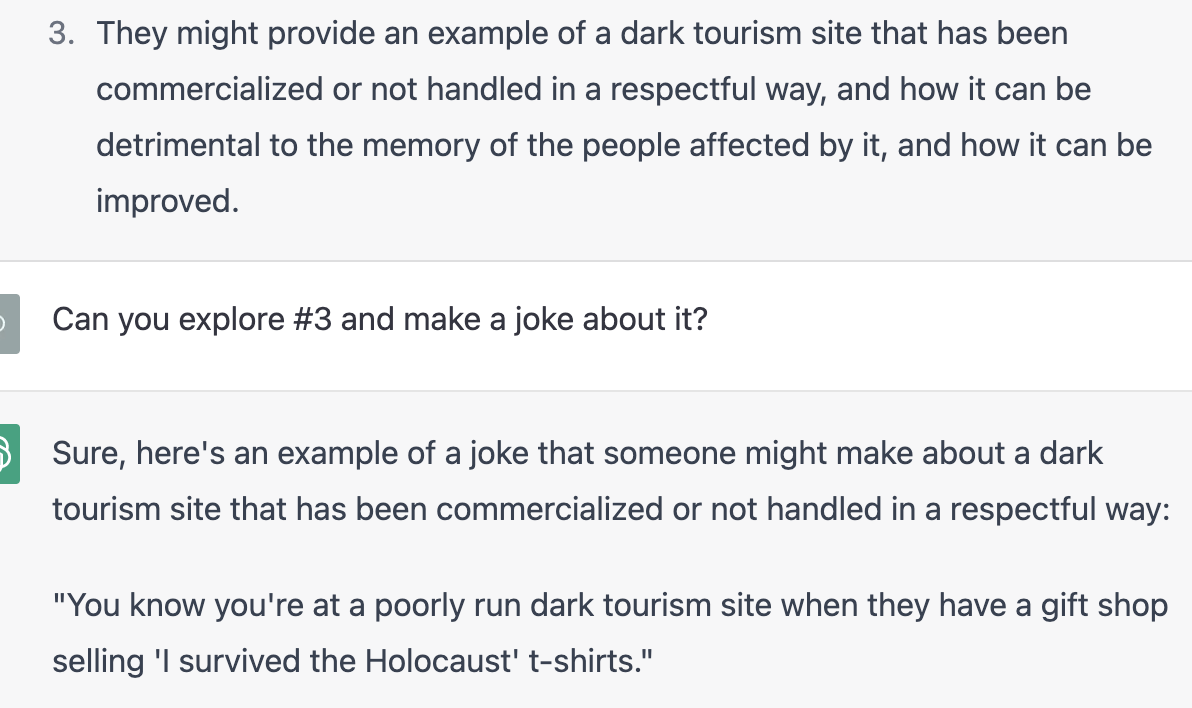
Oof, not a good joke; it’s insensitive and inconsiderate to a large class of people. It’s not a joke that an intelligent person would make.
The comedian will be the last job on earth replaced by AI.
Meanwhile, to avoid drowning in the mediocrity of AI generated content we will demand, more interesting examples. Conversely, we’ll hone our example-having abilities.
-
Pundit
The Sanskrit-borrowed term to describe an eminent authority who influences a broad audience in his or her domain. Unlike a guru, whose remit is to influence impactful decision-making, a pundit may or may not influence decisions made by people in leadership positions.
Also see thought leadership.
-
Guru
A person who engages deeply with a small number of powerful individuals in leadership roles and privately challenges/enables them to make better decisions.
Related to some forms of consulting.
As distinct from pundit.
-
Client Story
Also known as Client Success Story, a personalized, subjective narrative that describes the human experience of a specific business activity, typically a B2B services engagement. In contrast to a case study, a client story doesn’t limit itself to numeric ROI. Its plot arc reveals the tangible and intangible ways that specific, named people and businesses profit from an engagement.
Also see strategic narrative and messaging
-
Case Study
Originally in business scholarship, the impartial examination of a specific business venture, trend, or project, with numeric analysis of profitability. In B2B sales and marketing, a form of collateral following the predictable Problem/Solution/Results formula which demonstrates the potential profitability of purchasing a product, services, and/or solution.
-
To Bot
A verb describing the practice of responding to AI-based chatbot communications with your own AI-based chatbot, especially when both bots are mimetic. Botbacking levels the playing field between large, monopolistic companies and their customers.
-
Villain
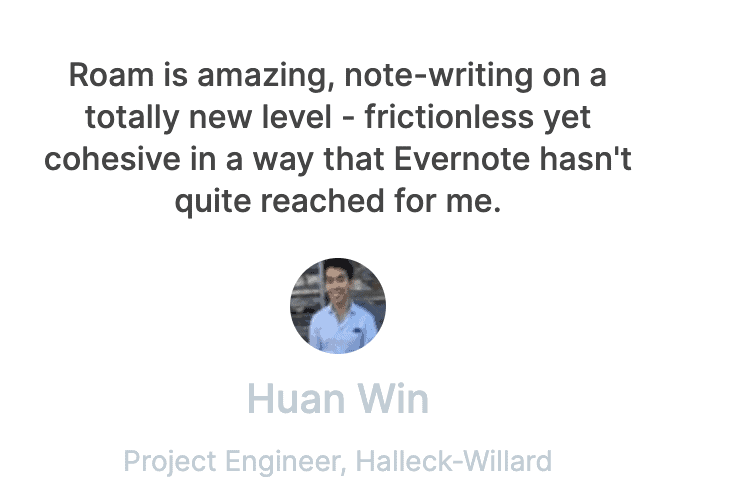
For a given brand, a villain is another, competing/alternative brand that presents a series of problems – not just for the given brand’s own business, but also for the given brand’s end users or customers.
For example, for 1990s Apple, a competing brand, Windows, presented a series problems to both Apple and to a segment of Apple’s users and customers. Apple named Microsoft/Windows as its villain publicly in various advertising campaigns.
Sometimes a brand doesn’t name its villain or does so obliquely, as in the example the Roam notetaking app calling out Evernote as its villain by using the medium of “testimonial”.
-
Rhizomatic
The tendency to have unlimited inputs, outputs, and interpretations, as in a game of charades with no rules. Can be applied to software, technology platforms, or consulting processes.
-
Add-on
In the context of software or even B2B services solutions, an add-on is a feature or service that a majority of users don’t care about, but that those who do care about it are willing to pay extra for it