Entries

  • A Brief History of Thinking Outside The Box

    To get out of the box, let’s first describe it. It’s big and it’s got lots of file folders. It’s comfortable and you work in it. 

    If we cast ourselves back 150,000 years, the box’s mental file folders are full of information about how you hunted and gathered food last year.

    • the rock you stood on that gave you a vantage point over a watering hole
    • the glade where you gathered berries and how you got to them before the birds
    • the stone from which you make rocks for digging up that one kind of root

    As you can see, the box is a treasure trove of intellectual property passed down from one generation to the next. Why do you want to think outside of it? The truth is, as a tribe, you should think more in the box than out. Some of the tribe, probably most of the tribe, should focus on thinking better inside the box. Nowadays we call this process improvement, best practices, trusted techniques.

    But some people just aren’t wired that way. Some people have to try new ways of doing this and I suspect it was always like that. We condescendingly think of our stone age ancestors as unchanging in their ways for 100s of thousands of years until farming was discovered. But outside-the-box paleolithic thinkers were coming up with all kinds of inventive schemes, including running bison off cliffs by observing their group-think lapses in reasoning, or early forms of animal husbandry and agriculture involving controlled burning.

    The point is this: thinking inside the box has happened forever and is good; thinking outside the box has also happened forever and is also good.

    So which should you do? It depends on your natural proclivities – more on this tomorrow.

    Best
    Rowan

  • Communications

    Communications is roughly equivalent to the aggregate of marketing strategy, messaging, and PR but is also a form of context-signaling. The context is non-private sectors, such as nonprofits, higher education, NGOs. government, and especially politics.

    It often means exactly the same thing as content marketing and brand messaging but signals more purportedly pristine motives than turning a profit. Meanwhile, Strategic Communications is a military and Fortune 500 concept that purports total control over all forms of messaging.

  • Platform

    In digital marketing and communications, a space for reaching a well-defined, new, or larger audience. The term is used loosely; thus, a platform could be YouTube as a whole, a specific YouTube channel, or even just the YouTube advertising network. Platforms are assets, conceptually.

  • Framework

    A set of defaults and conventions that make it easier to build something more quickly, more standardized, and more value-focused, then if you built the same thing without that framework. Most frameworks used in business are either computing frameworks or conceptual frameworks.

  • Mood Bullying

    In common parlance, the attempt to alter the mood of another person by coercion or some other kind of subtle pressure (eg, “Why aren’t you smiling?”). In direct marketing, the presumption of how your audience feels, how it should feel, and how it wants to feel – with the goal of selling something.

  • Business Dictionary

    Defines or redefines words and phrases that are important to a given venture (a movement, a business, a community, a nonprofit, an individual’s work, etc).

    As a glossary it provides better understanding of content produced by the venture. It also asserts ownership over new definitions or phrases. Most importantly, a business dictionary is the core set of ideas that reveal the venture’s unique point of view on how to solve important problems.

  • Own Your Words

    Rich. What does it mean?

    The first meaning the mind stumbles upon is money money money. And more $$$ than you need. That’s certainly not me.

    But that’s not what rich means to me, either. What does rich mean to you?

    I remember a long-ago friend telling me of his recent travels. On a hot day by a plaza fountain, an elderly Italian man had tapped him on his chest during their conversation.

    You will be rich – here

    Ok, but back to numbers. How much more money than you need is being rich?

    Hard to answer, but here’s another question – how much money is enough to make you happy? Social scientists have dollar-amount answers, expressed as annual income that ranges from $80k to $120k. Make cost of living adjustments on where you live, yes. And yes, those numbers can be lifehacked.

    But the data shows that while most people get happier and happier as they approach this income level, they stop getting happier once they exceed it. In other words, most people are no happier at 1.2million/year than at 120k/year.  

    Some protest this because they have run afoul of a good work-life balance in life. They claim that they are happier as a direct result of having more money than they need. That those decades of 80 hour work-weeks were worth it. Youth spent crouched at a screen – worth it. I empathize with them but I don’t believe it.

    I believe the social science on happiness vs rich partly because it checks out with my personal, anecdotal experience. In my experience, the people that acquired more money than God bequeathed little else, such as wisdom, contentment, or good jokes. Or at least no more of those kinds of things than the non-rich leave their heirs. 

    Does that change how you’d define rich? To scope that down a little bit closer to Second Opinion types of people, what does it mean for a creative or technical knowledge worker to be rich in the context of your career – how do you define it? 

    Because it’s related to success, I think that’s a fairly important question to anyone who owns a business. And while I’m not sure I have the perfect answer to it, I can at least define the word rich.

    *  *  *

    This digression above serves an ulterior purpose – I don’t actually care how you define the word rich; you don’t need to use my definition. Rather my point is that that I didn’t accept the standard definition of rich. The Oxford English Dictionary:

    Having much money or abundant assets; wealthy, moneyed, affluent. 

    But here’s the larger point – I don’t necessarily accept any definition of any word, if that word is important to my business. Steve Jobs famous advice to entrepreneurs is applicable here.

    remember this one thing – everything around you that you call life was made up by someone no smarter than you are

    Of course, this advice was not meant literally; he was trying to make a point – that you are free (moreso than you may realize) to do things, create things, and even to exist, according to rules and standards of your own making.

    So you are certainly free to redefine terms, or even make up new ones. In fact, making something new often starts with redefining it

    By the way, I’m not saying the OED is wrong per se. As a dictionary-dictionary, it’s technically right. It is superb, actually. Its job is to describe every single word used by English speakers in each of the ways in which the word is actually used, past and present.

    But its job is not to describe what a word means to a specific business or community, let alone to an individual. That’s our job.

    I mean this literally: make a dictionary. Or do what Google does – hire someone to make one for you.

    Look around you in the business world and you’ll notice that the best ventures define their own terms, albeit in an often haphazard manner, eg. through writing marketing copy (“We’re redefining what _____ means”).

    Instead, define your words deliberately. Your resulting dictionary may contain just a few words, that’s fine. And short or long definitions will do.

    But they will be your definitions, your unique IP. And this will improve your product & solutions and the way you talk about them.

    Have a rich week (:
    Rowan

  • Business Model

    At its core, a description of how and why a business solves a specific (set of) problem(s). A business model also describes the capital, time, processes, tools, knowledge, skills and strategy needed to deliver those solutions.

    Also see Strategy

  • Business Model Buyers

    business model buyers

    On the one hand, you have the mythical black box. It accepts inputs and magically transforms them, behind opaque walls, into something valuable.

    This is the diagnosing physician, cybersecurity software, an iPhone, or a food delivery service like Uber Eats. Render inputs and a solution to your problem shows up on your door, neatly packaged in a sheet, a report, a box.

    Some people love finished products like these and most people prefer them.

    On the other hand, you have a form of decommoditization that involves pulling the curtain aside or letting you look under the hood.

    • The pre-1980s consumer vehicles you could repair at home.
    • Open source software that is infinitely modifiable
    • Constructivist architecture that reveals the essential engineering keeping the building standing
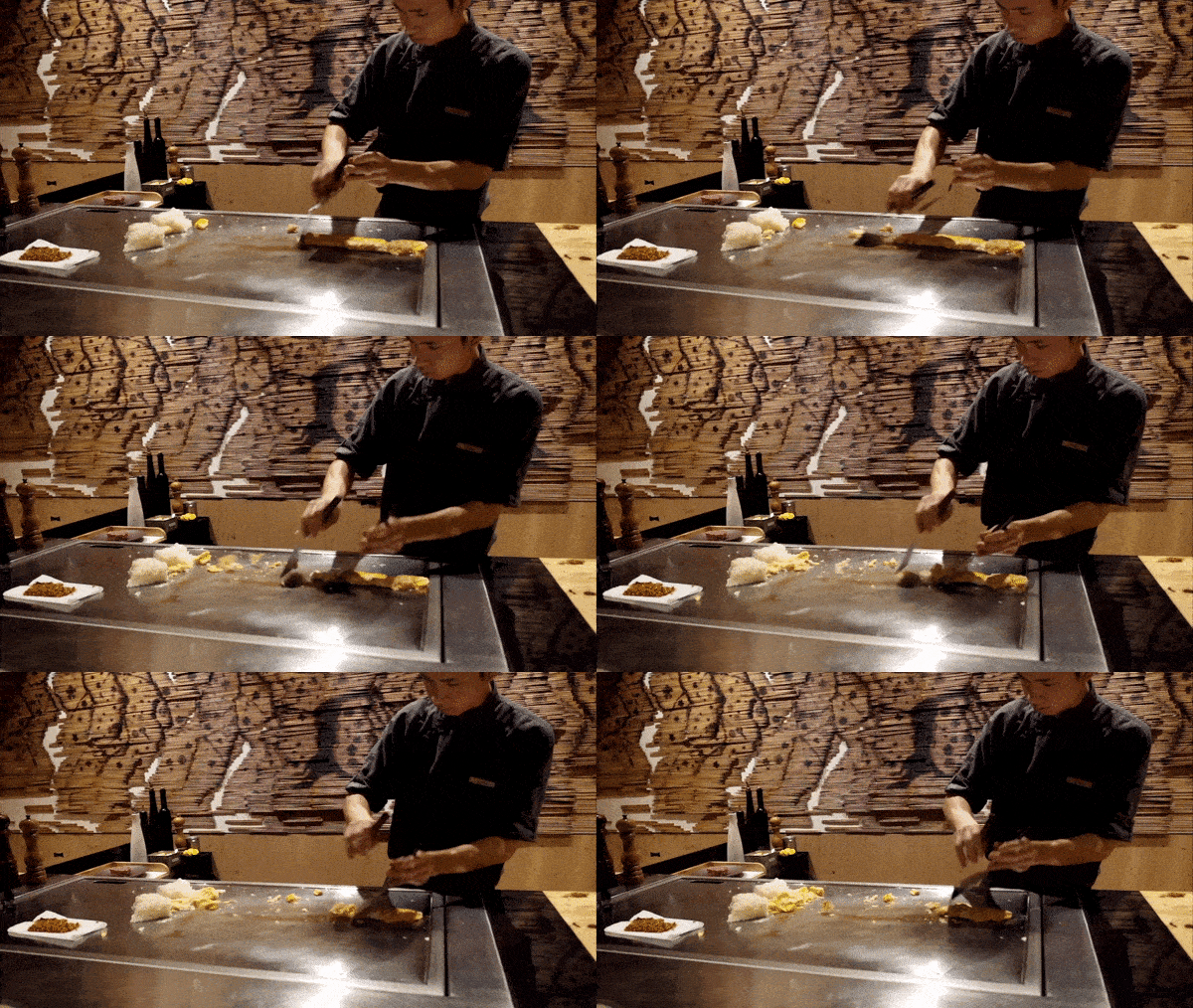
    • The Teppanyaki grill in a Japanese restaurant, which reveals the chef’s magic in front of you.

    You know what early adopters like? Witnessing the expert transform strips of Kobe beef and green onion transformed into something delicious. And at least voicing their opinion, if not actually altering the outcome.

    They want to see, react to, and know about, the grill, the intensity of the flames, the sauces, the process, the people, the tools, the expertise, the customs, the ingredient costs, the personnel costs, the revenue, the profit, the branding strategy. All of it. That’s what they are paying for.

    Early adopters buy the solution and the business model behind it.

    But not just early adopters.

    Way back during the Reagan administration, NBA fans were content with the spectacle of great competition among great players. Then they started to learn player backstories. Movies like Hoop Dreams came out – a decade after NBA halftime shows had gotten fans used to behind-the-scenes player biopics.

    Fans studied the entire arc of player careers, from high school draft, to college draft, to game rotation politics among NBA rookies, to peak performance in late-20s, to typical retirement, to post NBA career paths. What’s he doing now?

    Most fans learned more about the money side of basketball than the game itself.  What were player salaries and bonuses? How did they feel about their salaries? What about entire team finances?

    Fans wanted to learn about corporate governance – why are players traded, what is a “salary cap”, what are the revenue streams? How are TV contracts negotiated and what’s the impact of illegal streaming? What are the relationships like between the NBA itself, as an organization, and the billionaire franchise owners who essentially created it? Fantasy leagues aren’t about identifying with players, they’re about identifying with executives who manage NBA teams as businesses. 

    In short: the modern NBA fan buys the entire business model, not just the product.

    Business model buyers want to know about boring things like customer segments – who buys the product, what type of people are they, how do you describe them demo- and psychographically?

    Talk about meta. They want to know about product positioning – how does the company’s messaging set it apart from alternatives? Are they doing a good job communicating a unique value proposition

    And so on. The entire black box is fair game: core business processes, core assets, strategic partnerships, strategic employees and contracts, cost structure, marketing channels and platforms, and present and future revenue streams.  

    The people who buy Tesla, Kiva, Heifer International, or Cryptopunks? A lot of them want to know how it all works. At least, the ones who buy it first.

    Here’s the thing, if you’re new, or if your product is, you might have to figure out how to sell the business model, too.

    A good place to start is figuring out what it is.

    Best
    Rowan


  • Trust-based Marketing

    A variant of Brand Marketing that emphasizes authentic connection based on trust; trust is built by providing ample proof of value and by giving away value for free