Entries

  • World’s Largest Social Network

    [Click "enable images" to see this new yorker cartoon about email]

    If you’re like me, you go to the dictionary when someone tells you [thing not usually referred to as such] is a social network. Email as a “distributed social network” is more apt. Some facts:

      1.  Email is an enormous network that includes almost 4 billion users and 5.6 billion user accounts. That’s more than Facebook, Instagram, and Twitter combined daily active users. If you own some kind of complex B2B services business, 100% of your present and future customers, partners, and employees are on email. ((Source for global email statistics: Radicati (PDF). Though it has to be noted that this data is pre-pandemic.))
      2. Email usage is tremendous and growing: 140 billion non-spam emails are sent every day. Total email accounts and usage will grow significantly in the coming years, with total increased accounts resulting from the bifurcation of work and personal accounts.((Ibid)) But of those 140 billion, how many are wonderful? 1% at the most? This is our opportunity. 
      3. You control your email; it’s the only large social network not controlled end-to-end by a private 3rd party company. If you own, yourname@yourdomain.com, nobody can take that from you. Just like your yourdomain.com website. A governmental body enshrines this status quo. The Big 5 controls the email client software category – but as part of the open email network. And subscription email marketing software like Mailchimp, as well as outreach email software such as Mailshake, are still diversified, competitive markets. 
      4. Email is a private two-way channel. Any email including the one you’re reading now, can initiate a private one-to-one conversation. This is why it’s amazing that any but the largest consumer brands would use an impersonal email address (info@, noreply@). Email is more conducive to meaningful interaction than social media.

    Switching from fact to conjecture, consider the fact in-person communication shrinks in proportion to the growth of the pandemic and its economic aftershocks. Filling the face-to-face gap: Slack, Skype, phone, Zoom – and email. 

    Armed with these considerations, I’d find a way to use email to grow your business.

    I have no opinion on email for internal operations except for one: there should never be more than 2 people on an email thread; 3 is permissible, 4 or more you’re wasting someone’s time.

    But for communicating with the outside world, I have too many opinions about email to cram into this communiqué. But think of business email as having three branches: subscription email-marketing, transactional emails, and outreach email.

    A few ideas off the top of my head to get you started:

    • High-frequency subscription email marketing is practiced by almost every expertise-based B2B/B2P((I use B2P to mean Business-to-Professional, ie, not necessarily a B2C consumer and inclined to purchase business solutions)) business I can think of. 
    • Transactional email can be multi-episodic. I’m bad about this, but when you signed up for this newsletter, you (hopefully!) got a welcome email. That’s a “transactional email”. I should have a sequence of transactional emails to welcome new subscribers; most bigger brands do and they’re usually terrible. Which gives you a chance to stand out.
    • Transactional emails are usually created by software  (Calendly, Eventbrite, WordPress, Jira) which provide defaults. Don’t use those defaults; write them. Write them in the first person and sign your name to them.
    • If you book meetings or demos, you can also append short (start with 2) transactional email sequences to them.
    • Subscription and transactional emails can have a replete footer just like a webpage, as you can see if you scroll down.
    • Outreach email isn’t just for trying to sell products or services; it’s also for recruiting staff and partners, contacting the press, promoting content, and recruiting event (in-person or not) attendees. And all that without spamming anybody.

    Now is a good time to do some email social networking – if you choose to do so, reply and let me know how it goes.

    Have a great week ahead,

    Rowan
  • Independent Renaissance

    Do you remember this moment from about 18 months ago?

    Senator Orin Hatch: So, how do you sustain a business model in which users don’t pay for your service?

    Mark Zuckerberg: Senator, we run ads. [smirk]

    Because it’s apparently fun to mock older people, that moment was instantly meme-ified and decontextualized, complete with the Zuckersmirk.

    But Senator Hatch was perfectly aware that Facebook runs ads. He asked a rhetorical question to make a point about Facebook’s congenital tendency to impinge on the right to privacy – a perfectly relevant point given why Facebook was under investigation in the first place. Facebook had sold private information about its users to a business called Cambridge Analytica, which then resold that information to Russia so the latter could run more effective political ads in the US presidential election.

    Smirk, huh?

    Did Zuckerberg not know it was a rhetorical question? Or did he pretend not to know, hoping the resulting cheap laugh would obfuscate the enormity of the subterfuge Facebook was party to? Either way, it worked.

    But Senator’s Hatch’s question hasn’t gone away and it has implications for anyone looking to grow their business through paid advertising.

    Since the scandal, many have called for an outright ban on targeted advertising (which would cripple Facebook… but not Google).

    I’m not about to tell any of you to stop running Facebook ads, or Google display ads that use demographic targeting. Or to stop sending emails that track opens, as does Mailchimp, the product I use to send you this email (I have disabled link tracking but I’m not allowed to disable open tracking without running the risk of being labeled a spam emailer).

    But we should all be careful about demographically targeted display advertising in the long term – maybe even the short term. Certainly don’t build a lead generation that relies solely on Facebook ads, such as Sam Oven’s Consulting.com (don’t click it or his face will follow you around the Interwebs for months – unless you’re using Duck Duck Go).

    Because this pandemic is making us question everything.

    For example, the British government has demanded that Google reveal its search algorithms to – this part is amusing – a “working SEO consultant”. Who will win that lottery?! Six months ago, that would have seemed as absurd as Coca-Cola revealing its formula.

    But today close to 2 million people around the world have the coronavirus and everything is on the table.

    We don’t know when our business will return to “normal” but we know the safest harbors for our marketing are those that’ll have respect for privacy.

    The winner then is still content marketing – the more accurate expression of the value of your solutions, the refinement of your expertise. Maybe that’s why Jason Calacanis’s latest venture is pure content marketing – an aggregator of personal daily newsletters.

    But that doesn’t mean advertising is dead; not at all! It never will be, nor should it be. Done right, advertising is a helpful signpost in a crowded marketplace. Advertising existed long before digital platforms feasted off the appropriation of private, personal information and built the massive monopolies called out by Andrew Keen((The book in which Keen called out the Internet as a plutocracy breeding ground is The Internet Is Not the Answer https://www.amazon.com/Internet-Not-Answer-Andrew-Keen/dp/0802124615.

    Soshana Zuboff’s Surveillance Capitalism painstakingly details the intrusion of digital advertising and Big Tech in general into our lives. She makes a strong argument that this status quo isn’t inevitable.
    )). Yesterday I mentioned the new venture of SEO legend Rand Fishkin, SparkToro, which aggregates anonymous audience intelligence in a GDPR compliant way. What does it do?

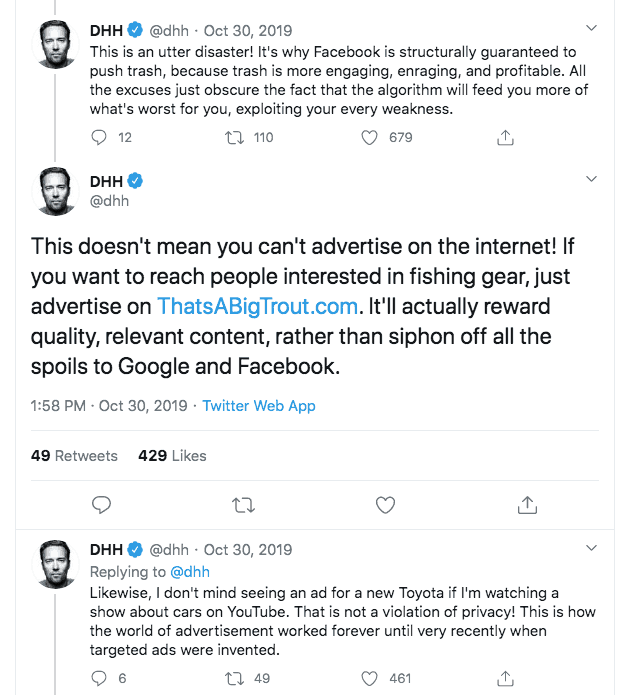
    So if you want to, as DHH says, sell fishing gear, you can sell it directly on a fishing website, instead of spying on people’s Facebook account to see what photos they share with family and friends. And cut out the middle man by brokering your own deal directly, advice I remember reading from the Shoemoney digital marketing blog back in 2006 (looks like he put the site on display advertising cruise control many years ago; wouldn’t look for guidance there now).

    You can use a tool like Pitchbox to do that deal brokering. Or any old prospecting tool combined with email outreach, prospect.io, apollo.io, the list goes on.

    Enable images to view this: three tweets and advertising and privacy from DHH

    Earlier this week, a colleague and I tried to help a major B2B merchandiser distribute non-medical face masks to potentially millions of people. But the Facebook-Google duopoly had at that point put the kaibosh on all forms of advertising even referencing coronavirus or COVID, directly or indirectly. Did they do it out of civic duty or to avoid liability? I don’t know.

    I do know that millions of business and independent professional have the ability to do business directly with one another. Affordable tools keep getting better; guidance keeps flowing through videos, podcasts, newsletters, and blogs.

    So maybe the clear blue waters of Venice aren’t the only silver lining to this terrifying black cloud of a health crisis – maybe we’re in for a true B2B marketing renaissance.

    Have a great weekend,
    Rowan


  • Prospecting

    It turns out that learning isn’t in nearly as much demand as it could be. Our culture and our systems don’t push us to learn. They push us to conform and to consume instead.
    – Seth Godin ((This observation on the nature of learning – versus getting an “education” – comes from Seth Godin https://seths.blog/2020/04/but-what-could-you-learn-instead/))

    This observation seems to be about learning and education but it’s directly connected to business and marketing.

    Because no matter what your ideal client looks like, and no matter how you package and deliver your solution – product, consultation, service – they need to be a learner.

    And they’re only going to become a learner because they do something. Or use something. Something you made from your expertise.

    Yet our “culture and systems” try to derail our ideal clients from doing and using the things we offer. They might look for so-called “done-for-you” services, even though real change in business is never done for you. Or – more likely – they might commit to doing and using – but not to following through, at least not over a sufficient period of time.

    Your marketing challenge as a business owner is identifying who wants to learn by doing – who wants to learn what you or your system or your product will teach them. Finding your best students.

    For owners of complex B2B solutions businesses, this starts with “prospecting”.

    Take action on this. Your best students don’t live in your head and you don’t what they’re thinking. So we can fire up LinkedIn Sales Navigator or Apollo.io – or some other prospecting tool – and start to find out. 

    It’s overwhelming to figure out what to prioritize when it comes to marketing and business development.  How do you follow all the bad marketing advice that slams you like a sledgehammer every time you log on to LinkedIn?

    But you don’t have to.

    What you do have to do, however, is your own prospecting work.

    This is why every one of you should use some sort of prospecting database like LinkedIn Sales Navigator. Not have it, use it. 

    You have to look at your prospective ideal clients one at a time, person by person, and figure out a way to listen to what they are saying and where they are saying it. 

    To deepen your prospecting, you might also try BuzzSumo or SparkToro ((SparkToro hasn’t been released yet but I know it and can recommend it – for some uses cases – because I was a beta tester. I love that you can use it both for advertising and other forms of cold marketing, as well as for content marketing)), which help you quickly figure out what people, media, and publications influence your prospects the most.

    You can delegate and even automate prospecting once you have learned it yourself – and learned from it. And yes, you can hire a minimum wage worker to do it for you. But not until you master it yourself.

    And even if you delegate it, eventually you’ll want to go back to doing your own prospecting. That’s partly because it’s such a wonderful form of ideation.

    • Content marketing – it will feed your content marketing with ideas.
    • Messaging – it’ll help you figure out how to describe what you do.
    • Solution design – it’ll help you fine-tune your products and services themselves.

    Try it – make a list of 20 strangers – and let me know what you learn!

    My best,
    Rowan


  • How to Get Clarity

    Today someone looking for marketing and branding help made the following observations about their business:

    1. “need a branding/marketing expert to help me clarify some things first
    2. “Don’t have the time or interest to do all the work myself”
    3. many moving parts – all different dimensions of creating a business”
    4. “I am running out of time trying to figure it all out

    I’ve seen this before; digital marketing seems so confusing. The more you learn, the more confusing it gets. You think you need to do A before B. Or wait, C before A. Or you’re SOL.

    But if you let it seem confusing to you, the result is being confusing to your audience.

    It’s not that digital marketing or business itself isn’t complex as hell. It is. That’s partly because it changes so rapidly. It’s not possible to study digital marketing in college for this reason. It takes hundreds of forms and bleeds over into related disciplines – branding, design, tech, sales, advertising – in dozens of ways.

    So, yes, there’s a lot to learn.

    Yet at the same time, it’s very simple, in that your marketing is all based on one story which can be compressed into one message.

    By making every part of your marketing fit that message, you get clear.

    In fact, if you had to pick one word to describe the philosophy of marketing maven Donald Miller, author of Storybrand, it might be clarity

    Over and over, clarity is his message. That means consistency, both verbally and visually. That doesn’t mean reduce it all to just a tagline though. Or just a positioning statement. That’s the lazy way to do positioning. 

    A positioning formula (such, “we do x for y, using z approach/skill”) only gets you so far and only achieves so much clarity.

    To clarify the value of what you’re selling, expand on your message by unfolding it into a story.

    How?

    Donald breaks it down into 7 pieces:

    1. A character
    2. Has a problem
    3. And meets a guide
    4. Who gives them a plan
    5. And calls them to action
    6. That helps them avoid failure
    7. And ends in success

    And then there’s a bonus benefit – the transformation that happens when you make it through these steps. Think of Luke Skywalker in Return of the Jedi. He’d been through this story and came out a different person. Yes, Mark Hamill achieved gravitas.

    Joseph Campbell, who advised George Lucas on the Star Wars concept, demonstrated that pattern Donald Miller identifies in Storybrand existed in prehistoric mythology all over the world. Same exact pattern.

    Side question for you – who is the character? When our stone-age ancestors sat around the fire telling stories, who was the character?

    The character is your client. The story you tell is about your client, not about you. You are the guide. And your product is the “special weapon”. We call ourselves Homo Sapiens but we’re really version 2 of Homo habilis – makers and users of tools.

    Some of the most successful books and films let you identify with the main character(s) – even if they come from a different world, different gender, different period of time. I’m not speaking of art films which break convention to entertain the jaded or just the curious, but of the most popular mass-market dramas: Thelma & Louise, The Matrix, Ferris Bueller’s Day Off, The Princess Bride, and yes, Star Wars. 

    I’m not promising to make digital marketing simple. Nor do I advise “figuring out” your story before doing anything else. Your brand’s story is ever-evolving. Because problems change, what you do as a guide changes, etc. Pandemics come – and go.

    But if you haven’t even started to figure it out, it’s really confusing to try to do anything else in marketing. One of the reasons case studies are the consensus go-to when it comes to prioritizing marketing decisions is that when they are done well, they tell your whole story – about your ideal client.

    Take action. Tell your brand’s story in 10 sentences or less. Bonus if you can compress it to one sentence (this is the art of writing a tagline).

    Let me know how it goes!

    My best,
    Rowan


  • Fatalism vs Pronoia

    My clients are falling into one of two camps.

    1. Fetal position
    2. Opportunity position

    The fetal position just means you are laying low. No new hires, no new overhead, save, scrimp, wait it out. This approach comes with comforting maxims such as, “take this time to catch up on your process” or “fix up your marketing assets”. Fix up for whom and for what problem? You might call it a fatalist position. For some, it will work.

    But the latter group, the Opportunity position, is business pronoia – the tendency to believe that the world is benevolently conspiring to provide your business with new opportunities.

    Pronoia during a pandemic? How does that happen and where do you notice it happening?

    For once, start with the news.

    The news is uncovering unprecedented problem types, as opposed to the same old issues that usually comprise its fodder. 9-11 was bitter, horrifying tragedy on repeat, for longer than I care to remember. But the COVID pandemic is no less tragic and will churn many more waters – and business models. That’s how creative destruction works ((Creative destruction basically recognizes that business model churn happens kinda fast in “capitalist societies”, a quaint vestige of a concept referencing a time when the vast majority of the world’s economy wasn’t some form of industrial-technological capitalism)).

    How does that affect your customers, as B2B solutions providers? 

    One of the two eternal truths of B2B marketing is: “Improve demand from end customers of your clients”. You can listen to more about that in chapter 19 of a radio program called This is Marketing, which was also released as a “book”. As a B2B marketing problem, the rise of the LEEDS certification should be studied by anyone who runs a certification nonprofit… why do your customer’s customers read the label?

    So let’s just assume this much is true: there are invisible lines between the problems of the general public and those of your customers.

    What’s happening to the general public? Let’s glance the New York Times:

    Not sure if these stories affect your customers, but somewhere there’s a news story that does.

    No? I doubt that but I’ll make it a little easier – look at what’s happening in digital business world since the WHO declared a global pandemic:

    Pretty sure these stories – and there are more like them – affect you and your customers’ businesses.

    Today I spoke with a high concept B2B merchandising firm. They used to make conference schwag so good you wouldn’t toss on your way back to the hotel room. 

    That was two weeks ago.

    Next week they want to make masks for grocery store workers. And offer businesses the opportunity to join them in the new economy.

    So how are we going to join the new economy – and how do we use marketing((Definition of marketing: building trust and creating clarity by listening, teaching, and guiding over a long period of time)) to facilitate that process?

    Reply and let me know,
    Rowan

  • Is Silly Marketing Bad?

    Tomorrow evening I have made plans to have a beer with a friend I have known for nearly 30 years. Over Internet video. Now my friend and I have shared many a drink over the decades but never over video. In fact, I don’t think we have ever chatted on video. It’s going to be great.

    I can’t be the only one of us to make such plans?

    My brother is doing live music jams over live Internet video with his down-the-block neighbor in Seattle who he’s played with for 15 years – also over video.

    Meanwhile, my mom hosts letter-writing parties aimed to get out the vote. It’s a paradigm shift in the usage of video chat. They used to come over for cofee and snack and write letters shoulder to shoulder; now my mom hosts them on a Zoom conference call. And by all accounts, attendees love it. Why wouldn’t any of us – we’re all stuck inside now, right?

    I asked my 79-year old mom how she found herself partially “changing her little piece of the culture”, as Seth Godin would put it. Her answer:

    “Being willing to look silly”.

    As she explained it, to go first you have to look silly. Her first ever attempt at a  Zoom letter writing party was two weeks ago; she says it was was a comedy of errors starring her. But 14 people attended – and many letters were written. Fun was had. Community. And she noticed that Seth’s advice to “mute when not talking” doesn’t apply to simultaneous letter-writing events. The ambient noise sets the stage. Just let the dogs bark in the background, is her advice.

    Fast forward two weeks and the letter-writing parties are getting bigger. Not only that, but they’re also now turning into training events – what you and I would all webinars. She’s suddenly training Swing Left groups from Colorado and Ohio how to hold their own Zoom-based letter-writing parties.

    Or maybe figure out some other way that, “the digital world enables a new kind of conversation”, as Seth Godin writes in his new mini-manifesto, The Conversation

    In that article, he talks about scaling conversations using the breakout feature on Zoom, where large groups can be quickly broken apart into breakout groups, then put back together again. This brings back school memories for most of us.. “guys, let’s break into groups of four”. Remember?

    But it’s different now. Now the price of oil is 6 times higher than when Cheney was VP. And we’re unmuting ambient noise and dog barks into our conference calls. On purpose.

    So I wouldn’t wait until things get back to normal.

    Or try to go backward in time. I’d find a new way to conduct your business that leverages the rapid, deep adoption of Internet technology that is happening right now (20 years after the futurati hailed it during the dotcom boom). Even if it makes you look silly.

    Have a great and safe week ahead,
    Rowan

  • Jedi Ideation Trick

    Do you have to like your marketing and branding materials? Yes. All of them. Your pride in them should be infectious. Because they are useful, entertaining, galvanizing, and yes, nice to look at.

    Too bad you just hate your own brand sometimes, because whether you like it or not, you have one 😊.

    Case in point – let’s say you’ve written LinkedIn bios for yourself and your company. And you don’t like them. So you rewrite. And you like it less. Rewrite. Repeat. Now how do you feel? Annoyed, frustrated, bitter. Derailed.

    This is the self-perpetuating cycle in which happiness is linked to creativity.

    So do you throw it away and start from scratch? Maybe. But do you really start from scratch? Because now the thing that made you cringe is stuck in your mind, even if your slate is clean and your edit window is blank.

    It’s stuck in your mind and has demoralized your creativity. This isn’t uncommon in creative work and paralyzes marketing efforts among entire teams.

    Here’s the problem: ideas stop flowing.  

    Manufacture enthusiasm

    The quality of a marketing campaign, or a product design, or a consultation – the quality of each is roughly equivalent to the amount of good ideas that go into it.

    We make a big deal out of expertise, but an expert’s mind can fall flat sometimes too. Anyone’s mind can. Expertise doesn’t do much if it’s not yielding good ideas.

    Let’s review some of the primary idea-stifling culprits:

    • Lack of sleep
    • Lack of context
    • Lack of deep research
    • Mental busyness
    • Lack of live conversation, especially in-person
    • Negative feelings

    I have it on good anecdotal authority that all of the above proliferate during global pandemics.

    Fortunately, art critic Peter Schjeldahl has a trick for us that addresses, if nothing else, at least the last item on the list.

    When he comes across something in his work he can’t figure out how to like, or how to appreciate, or even understand, he asks himself:

    “What would I like about this if I liked it?”

    So those new LinkedIn bios that make you cringe – what you would like about them if you liked them? 

    My best,
    Rowan

  • The Business of 18 Months

    … the Trump administration is making contingency plans for a pandemic that could stretch up to “18 months or longer” …
    Lauren Fox, CNN

    To penetrate the buyer’s consciousness and make significant penetration in a given market, you have to contact the prospect a minimum of seven times within an 18-month period
    Dr. Jeffrey Lant, author, historian, and marketing theorist

    Dr. Jeffrey Lant is an unusual marketing theorist, holding a Ph.D. in history and having published 67 books on quite a few topics beyond business and marketing.

    But the quote above comes from his book, “No More Cold Calling”, another gem of a marketing book that is buried on Amazon – it ranks #1596 under “Advertising”. The reason it ranks so low is that Lant may not understand Amazon book marketing ((FYI, no one knows more about book Amazon book marketing than Mark Dawson https://selfpublishingformula.com/)). No More Cold Calls jumps around a lot and can hard to follow but it’s worth reading. I still recommend it to you if you want interesting marketing ideas from a book that relatively few others have read((In Norwegian Wood (The Murakami book, not the song), Nagasawa says, “If you only read the books that everyone else is reading, you can only think what everyone else is thinking” https://en.wikipedia.org/wiki/Norwegian_Wood_(novel) )) over the next, say, 18 months.

    To be clear, I have no idea how long the present conditions will last. And I don’t even think 18 months is a significant time period, necessarily. I’m more of a 5 to 10 years guy.

    But even if the pandemic isn’t an issue in 18 months, we and our customers will still be here.

    That’s why I wrote yesterday about a type of long-term medium-term marketing that is under-utilized by independent tech firms: retargeting. (Also, I wrote about this because ads are cheap right now).

    Why is retargeting, aka remarketing, under-utilized? Firstly, It’s hard to learn it for yourself. Yet it’s also hard to find the right person to do it for you. There’s friction here that is only overcome with chutzpah or big budgets.

    Secondly, it’s more of a helper-tactic than a standalone marketing tactic. By definition, it doesn’t work by itself.

    How it works If you visit the products and services page of my website, and you fit the right demographic and psychographic profile, you may at some point be reminded of those products and services as you are surfing the web, thanks to a “pixel”, a tracking cookie.

    But without visiting my site? You see nothing. That’s pretty much the idea. 

    Now think about the ways someone get to my site. You might click on a link that’s buried into my content marketing (eg. this newsletter), or an outreach email, a message on LinkedIn or Upwork, or you might just do a web search for something like, “complex services firm”, in which case you are also likely to end up on my site about that subject – SEO is a form of content marketing that works with retargeting too.

    That’s the logistics of how it works, at least.

    The psychology of how it works is better explained by Dr. Lant. Or you can just take his word for it and try to get your brand into the mind of your ideal customers 7 times over the next 18 months.

    Be well,
    Rowan


  • Digital Ad Funnels Went on Sale

    Coronavirus is affecting the global ad industry, including digital. Analysts are forecasting significant revenue decreases for the two most profitable advertising platforms, Facebook and Google.

    Not so much they’ll need a bailout, though,((Don’t worry, the US is saving its bailout money for the cruise ship industry, so it can get back to destroying the planet in the tackiest way possible.)) because both companies will continue to be profitable. 

    Meanwhile, what I am seeing anecdotally is a 5% to 15% discount in ad buy costs today vs two weeks ago.

    Yet while ad costs are down – lead-generation conversions are not, at least not for my current clients running FB remarketing ads. Mostly SaaS firms.

    SaaS and tech entrepreneurs – and especially tech consultancies – are usually reluctant to buy ads((With the exception of Series A/B/C+ funded startups; for them, the growth phase reluctance to invest in advertising gives way to basically throwing enormous amounts of cash at Google and Facebook and seeing what sticks.)). One list reader published a research study in which he found that an unusually low number of consulting firms pursue digital advertising as a lead generation strategy. The number was something like 1 in 63 at the time that I got a glimpse of the research. If 45 of 65 consultancies had the gumption to pursue it, it would, of course, be less attractive.

    So even before coronavirus, digital advertising has been an opportunity for niche firms selling complex products and services in a B2B context. Not a strike it rich opportunity, nor a low-hanging fruit one. But something that, properly implemented, can improve the effectiveness and reach of inbound and outbound marketing funnels. 

    Add in lower costs and you probably see where I’m going with this – there’s an opportunity now for lean, scrappy digital advertising. Lean and scrappy as in $500/month.

    Should you experiment? You should if you have any kind of productized service, or if you have free content products (webinars, studies, ebooks) to get in front of people. Depending on about 20 other factors. But that’s consideration factor #1.

    But is there demand? Earlier I said conversions were up, but are people buying? Yes. Does that make right now a perfect opportunity to invest in digital advertising? Not necessarily.

    What makes it a perfect opportunity is that it’s still overlooked by firms like yours, it’s cheap right now, and people will be buying 6 to 12 months from now (or so it seems).

    And what type of advertising does that timeframe lend itself to? A long-term brand building remarketing campaign that hinges of content marketing products for top of funnel movement. Show your interesting opinions to people who already know about you, maybe start conversations; it not, at least stay top of mind.

    Sorry, I jargonize when I talk advertising 🙂

    Take action. I would recommend starting your experimentation with AdRoll because it’s low-risk learning that won’t end you up in a pushy product demo or email drip sequence from a BDR. Upload a list of warm leads to FB as a Custom Audience. Use Adroll managed display ads to let those people know about your webinar or guide. And build the funnel that gets leads from point A, the add, to point B, the booked meeting. 

    What you’re doing is building and warming up a lead pool which may be ready to buy next year.

    Simple, right? No, not at all – which is precisely why it’s an opportunity. 

    Here’s to a productive, healthy week ahead,
    Rowan

  • Shared Kitchens

    It looks like we’re about to experience some major shifts in our economy and that has me a little scared. But not too scared, because I’ve seen this happen before.

    In the early 2000s, Thailand concocted Global Thai, a culinary diplomacy initiative. Ever wonder why the menus at Thai restaurants around the country world are almost identical? Now you know

    Today though, thousands of those restaurants are closed. Will they re-open? 

    Maybe not – a lot of local hardware stores never reopened after the dot-com recession. Instead, Home Depots and Lowe’s flourished in their place. They’ve got 4,200 US locations between the two of them.

    If the coronavirus recession lasts a year or two, 100’s of thousands of restaurants could go under and if they re-open, it’s going to be different.

    They’ll re-open as food trucks, which may no longer exist in trucks.

    Or as catering and deliver-only restaurants, housed in low-rent warehouses on the edge of town, with no waitstaff, printed menus, hosts, or “front of the house managers”. 

    Or housed in “co-kitchens” ((I just made this word up; if anyone knows a better word please let me know!)) – coworking style shared kitchens producing who knows how many distinct restaurant menus and cuisines. Maybe chefs will instruct sous-chefs remotely.

    Digitally, the new incarnations of Thai restaurants may look as delicious as they ever have, when viewed on Ubereats, GrubHub ((Grubhub is betting on exclusivity deals, which it’s offering to COVID-slapped restaurants today. But that may or may not be to the advantage of many individual restaurants https://www.businessinsider.com/grubhubs-100-million-lifeline-to-restaurants-has-strings-attached-2020-3)), and Kitchen Table (if they survive too). Or when viewed on the restaurants’ own websites.

    But they way tech companies market to restaurants will change. And so will the way restaurants market to the customers. They won’t get review-bombed for bad service. Maybe they’ll be able to hire better cooks. Maybe one kitchen will support a Thai restaurant, an Indian restaurant, a Nepali restaurant, and an Italian restaurant – all at the same time. 

    If you’re the restaurant owner how do you sell that? Do you hide it or embrace it?

    This is the point: how are your ideal clients going to be changed in two years and how will your marketing strategy adjust accordingly?

    My best,
    Rowan