Entries

  • Cringing from home

    Today I saw my favorite silver lining so far from the coronavirus: dolphins returning to the Trieste, Italy waterfront after an apparently 40 year absence.

    Dolphins over cruise ships.

    There are more silver linings too – working from home is going mainstream and that’s going to change how we all do business in a way that’s to my liking. It will reward ingenuity and initiative for my people: tech entrepreuneurs who have created ways for people to benefit from their products and services using the Internet are going to win. I love this.

    And that effect will be true even if many people return to their offices post-pandemic.

    I’ve worked remotely since about 2002 ((apart from a stint at Blackbaud and its subsidiaries, where I was in an old-fashioned office for 3 and half years, I’ve worked from home, from my own private office, or from one of about 15 coworks for the last 18 years)), so I open-arm-welcome the chorus of “how to work from home” advice flooding the media – it’s wonderful to see this go from weird to nearly mainstream. 

    It’ll make many people happier, especially in human ecosystems which require painful car commuting or public transport. If you need further details, just go on LinkedIn or Facebook – you’ll be inundated.

    Is that why I’m cringing? Meh, not really. People are excited about something new, god bless them. That brings a smile.

    But I am also cringing. And that’s because of the way that some companies are marketing during this epidemic. 

    Some companies are cloaking their marketing as public health concern around COVID-19.

    To add insult to injury, they’re doing so by cloaking marketing emails (which require permission) as critical transactional emails (which do not).

    That’s not even marketing at all, according to the definition of marketing I adhere to.

    It’s advertising.

    And advertising itself is not necessarily wrong. Not at all. 

    But this kind of advertising, also known as Spam, is not just wrong, it’s cringeworthy. 

    Who’s the culprit? There are actually several in my inbox, but I am going to single out a massive brand name that will hopefully not send me a cease and desist letter: Moneygram.

    Moneygram saw fit to interrupt my inbox today with a spam marketing email entitled, “Supporting You During the COVID-19 Pandemic”.

    How did they support me?

    In the email, Moneygram purported concern about the pandemic and noted that “walk-in locations may be unavailable in certain areas”.

    Now, did they shut down walk-in locations worldwide, perchance? Because they are so concerned about public health over revenue? No – just in areas “where governments have imposed mandatory closures”. Thanks for telling us you’re not breaking the law Moneygram.

    Wherever governments have imposed mandatory closures, did Moneygram announce a program whereby people who rely on walk-in locations are still able to use their service? No.

    No, because the point of the email was to say, “instead of using the other 200 money transfer service in the world, go to our website or app and use ours.

    Yes, they have – shocker – an app for sending money. Or you can use their website.

    Right, just like every single other money transfer service in the world.

    But PayPal didn’t spam me. Neither did the other 7 money transfer and payment services I’m signed up for.

    It makes me reflect on us – I hope none of us will be tempted to use this global tragedy to gain a “marketing advantage” (ie create tasteless advertisements).

    Now back to the quarantine life.

    And if you’re also working from home, enjoy 🙂
    Rowan


  • A Guide to BS-Free Testimonials

    Continuing on the theme of creating web equity by incorporating authenticity and spontaneity, let me ask you – how do you “create” testimonials?

    Listening to one of my favorite podcasts last night, I had to grit my teeth on hearing the co-hosts cite the importance of testimonials but then gloss over how to create them. Let alone what it is specifically that makes a testimonial work.

    Of course, the most important part of acquiring good testimonial is to have and deliver a great product and service. All that follows makes that assumption.

    For me personally, testimonials are starting to lose impact – glowing testimonials are now so ubiquitous. So can they even be trusted? Is every product and service now spectacular all of a sudden? Let’s be honest, most testimonials are starting to feel like marketing bullsh*it.

    That’s the first problem. The other problem testimonials have is failing to hook. Most testimonials make your eyes glaze over.

    But they don’t have to – not if you’re willing to put in much more effort than before.

    A Theory of Testimonials: Reverse Testimonials

    I’ve talked before about master copywriter (at least in a direct marketing context) Sean D’Souza’s early ought’s classic, The Brain Audit, where he describes his “trigger” theory of conversion-optimized messaging.

    But another interesting set of opinions of D’Souza’s are around testimonials.

    He argues that testimonials should have three characteristics:

    • Authentic – This means not ghostwritten, let alone ghostwritten by a marketing or communications person, which is the common practice. Instead, the testimonial consists of the actual words people use, off the cuff, to describe your solution.  In fact, he recommends asking probing questions live, recording the conversation, and transcribing the audio word for word. I’ve done this for clients. It’s not easy and it doesn’t always work((evoking authenticity is harder with larger clients, especially if you must procure your testimonial from in-house communications or marketing director – they tend to talk in marketing-copy style, at least in a business context. If you think in cliches, you speak in them and vice versa)) but it’s a great approach.
    • Reversed – Starts off by containing doubts and objections, then concludes in praise. You ask questions that elicit comments about doubts. The problem is, most people are too polite to express doubts, so it takes some skill to uncover them.
    • Detailed – The praise should, of course, be backed up by details. This is much less hard to uncover than doubts or preliminary objections. But details also hard to get at through text communications; by following up on praise by pressing for details.

    D’Souza calls testimonials that have these characteristics, “reverse testimonials” because they end with praise but don’t start with them. And are in other ways counterintuitive.

    Examples

    Exhibit A: The Typical Testimonial

    “Cedar Creek Coworking is amazing! The people are really friendly and the space is very nice. I love it and it’s been an awesome investment!!”

    Notice:

    • Includes no doubts or objections the rest of us can relate to
    • Starts out positive; ends positively
    • No details

    Now contrast that with Exhibit B: The Reverse Testimonial

    “I wasn’t really sure whether the Cedar Creek Coworking would work for me because it seemed too crowded and honestly a little intense, I mean just the general vibe of it. Also, just from looking at Google Maps, it seemed a little far away. But then it turned out to feel very spacious and relaxed. And quiet. I mean, I think that’s because of the way the desks and walls are laid out – and the flooring is super quiet; it’s like oh yeah, there’s a reason professional offices have carpeted floors. I also found myself working longer hours because it was really pleasant to be there, so I started to commute back home later after rush hour. The two years I’ve been here have actually been the most productive period for my business. I also realized how friendly the people are once I got to know them. This is by far the best coworking ever! Just an awesome thing for me overall!!”

    This doesn’t even entirely resolve all of the customer’s objections – working longer hours isn’t a solution to a long commute. But other objections (too crowded, too serious/unfriendly of a vibe) were resolved. Taken together we have in this example:

    • Authentic language (“it turned out to feel very spacious and relaxed. And quiet.”), including negative and positive assertions.
    • The reverse pattern, starting with doubts (“wasn’t really sure”) but closing strong (“an awesome thing for me overall!!!”).
    • Details (“carpeted floors”)

    Why does the reverse pattern work? Because gives you a hook. Thus, people actually read reverse testimonials all the way through, especially if there’s a relatable doubt expressed. That perks our attention, the same way negative consumer product reviews have to be balanced against positive ones.

    The Work

    Another important point here: what’s implied is the need for a testimonial interview – and for developing the skill and practice of efficiently conducting these interviews. You have to set up the interview, you have to customize your script for the interview, you have to make sure the recording works (ideally video), and you have to followup, with thank you’s and confirmations. And then you have to transcribe.

    I will confess that this is time-consuming and seems to be a drain on both parties. It seems counterintuitively laborious.

    There’s also a certain awkwardness that comes with asking something to do something a different way. 

    All of this is good news for you; it means this approach is unlikely to become widespread, no matter how much quarantine time we have on our hands. 

    Another piece of bad advice I hear on marketing and consulting podcasts is, “get lots of testimonials”.

    I think that used to work when fewer of us had testimonials at all, especially. I remember being so impressed when a guy I worked with had 137 LinkedIn recommendations – in 2008. And I definitely don’t think having lots of testimonials or reviews is a bad thing, especially if taken as a whole they are authentic, genuinely praiseful, and detailed.

    On a related note, you also have to know how to use testimonials. For example, where exactly to place them on your website or presentation deck. Too often, they are quarantined to their own section or page or slide, and thereby deprived of their power.

    But properly created and properly presented, less is more – no matter how big or small, most brands only need a handful of true testimonials.

    I hope you and yours are OK,
    Rowan


  • True Laughs

    February 2023 Update: I just noticed that there’s now a specialized service provider addressing the very problem this article raised years ago: https://homestudiomastery.com/


    Are you like me in that laugh tracks on TV shows make you cringe?

    Rewatching old TV shows that made me laugh decades ago, I’m amazed that some (eg Seinfield) had laugh tracks. And even more amazed that modern shows do in 2020. Haven’t we progressed from the Seinfeld to the Curb Your Enthusiasm era, where laugh tracks are replaced with ad-libbing?

    One step up from the laugh track is the live TV studio audience, which is sort of a living, curated laugh track. Audience members are warmed up and manipulated into responding in a way that changes how TV (and digital) viewers experience the programming.

    In election politics, live audiences – rallies, town halls, stump speeches, etc – sway our digital experience.

    We need to see other people interacting with candidates for us to trust them – and we need to see live, unscripted reactions. Like laughter.

    Before the pre-coronavirus, the so-called winner of any debate was always the candidate who scored the loudest laugh or got the punchiest crowd reaction.

    Whoever succeeded at converting the audience into a laugh track won the day.

    Then last week, as the coronavirus was declared a global pandemic, the world of political theatre found itself dispossessed of its key prop, the live audience.

    (Nota bene: I’ll name and make remarks on a few political figures here, but I’m limiting my comments here to messaging and communication; I won’t get into politics and policy, let alone who to vote for.)

    Joe Biden released a faux press conference in which he acted as though he were a sitting POTUS addressing an epidemic. It was both cringy and uncanny, as in valley 

    It would have been vastly improved by adding people to the frame and by allowing questions – any questions – and his own off-the-cuff responses.

    On the same day, Bernie Sanders released a no-fanfare videotaped press gaggle that was much more effective because we at least got to hear the voices of journalists asking questions.

    And Trump canceled his stump speech campaigning entirely – wisely. Better not to appear at all than to appear to an empty room. Also wisely, Trump continues to stock his press conferences with lots of real behind him (his aides, officials and in front of him – the press). I sincerely hope no one involved becomes infected.

    You can probably see where I’m going with this. In marketing, the laugh track or the live audience – even if it’s comprised of professional journalists – is a form of “social proof”.

    So how do we engineer this, from our home offices, with our MacBooks, $80 mics, $20 ring lights, and other consumer-grade audio-video hardware and software? And how do we engineer it without crowds at our disposal?

    I am certainly not advocating fake press conferences. And solo video presentations such as you find on YouTube are very tough to master – that’s a big investment of time and practice to make it work well for you. Outbound lead generation expert Alex Berman is really, really good at conveying marketing expertise on solo video… but Alex has been practicing it for 8 years

    What does that leave us with? Webinars, screencasts, and podcasts (even solo podcasts) are all quite a bit easier to master. 

    How do we weave true laughs, or at least true interactions, into that type of content marketing?

    I’m not an expert here but some of the best examples I have seen are (a) Philip Morgan’s “Dev Shop Marketing Briefings” (webinars, basically), and (b) Seth Godin’s Akimbo podcast. In the latter, Seth does a really good job of getting readers to record questions – and he then answers them, much like a reader mailbag. My experience is that sometimes the Q and A is better than the main programming, just as Sir Richard Francis Burton’s footnotes often upstaged the writing the referenced((His body of work is overwhelmingly amazing, but if you read just one book I’d suggest, “Personal Narrative of a Pilgrimage to Al-Madinah & Meccah”, where the footnotes sometimes occupy more page space than the main text. Here’s one. Must have been interesting in the pre-Internet, pre-encyclopedia days.)). 

  • Digital Business

    On Monday, I wrote about Coronavirus. Perhaps I had it and beat it, who knows. I know I was traveling through the Seattle airport a week before I became deathly ill what was, if not coronavirus, the flu. As I mentioned, whatever virus I had attached not just my immune system, but my other virus – the content marketing one. Yet as we become more socially distant, we need better ways to gain trust.

    On Tuesday, I switched topics. Or did I? I wrote about building Web Equity in a previously overlooked place, the footer of your website. I talked about a full-page footer, calling for each of us to show our cards, map out our business, and showcase content marketing. Again, this is a way to build trust by demonstrating the breadth of our research, experience, and ideas. If you’re not doing content marketing this one is tough.

    On Wednesday, I talked in some more detail about the effort vector in creating valuable content and relayed what I hope was the inspiring success story of David Ogilvy’s own content marketing. I think it’s helpful to think of content marketing and as a battle of effort. Ogilvy’s field manual, The Theory and Practice of Selling the Aga Cooker, was noteworthy not just for the ideas but the effort that went it. As evidence, look at the detail he provided into his appliance’s competition: the boiling plate, the simmering plate, the roasting oven, and the hot water tank.((By the way, Millennials who think vegetarianism is a new thing should refer to the opening sentence of the roasting oven section: “Learn to recognise vegetarians on sight. It is painful indeed to gush over roasting and grilling to a drooping face which has not enjoyed the pleasures of a beefsteak for years.”))

    On Thursday, I went a little deeper into the effort vector – but in real-time. As we learn to market, sell, and deliver services remotely through video calling and conferencing, it’s important to realize how much work this is. I think it’s tougher than in person to maintain focus and really see and listen to them. I’m a little frustrated by that article because I omitted this: the longer you look at something, the more details you start to see. There’s also a parallel between seeing art (45 for a painting is a recommended viewing length) and focusing on your clients and customers, a la Sam Ovens.

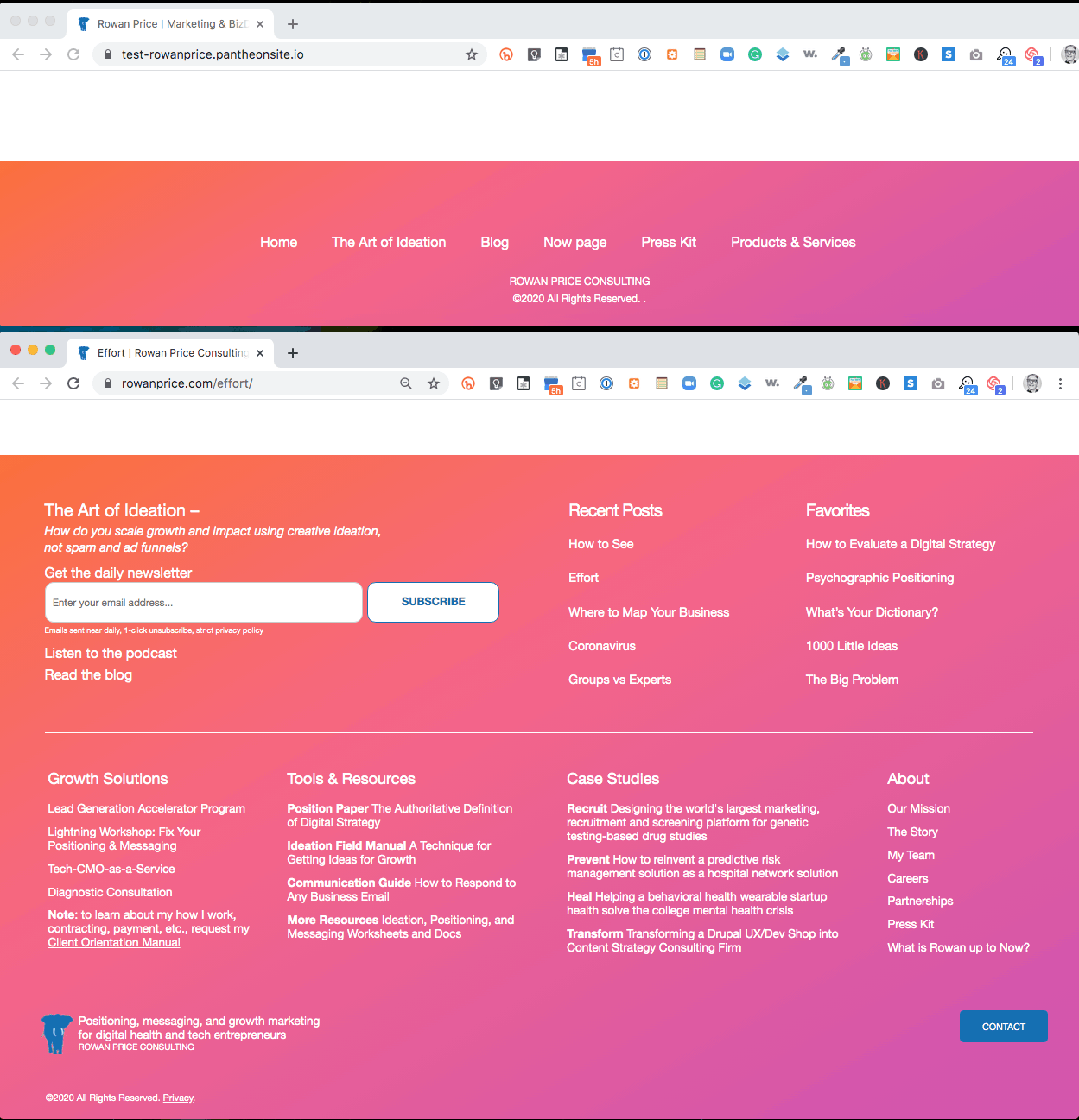
    On Friday, I’m in love.. with my own dog food. And I chose to eat some of it rather than publish a newsletter – I took my own advice from Tuesday and created a full-page footer that does a better job of explaining the scope, purpose, and personality of my business. This is a great way to take stock of the resources you have already created. I’m proud I only spent about 4 hours going down the rabbit hole of updating the website. There’s a before and after:


    Click to see the full version – or just see if for yourself

    Today – and the whole week, I think again about how we’re going to deal with this hyper-contagious pandemic. About the likelihood that COVID-19 outlasts Spring-Summer-Fall conference season, about the impracticality of travel for work, let alone flying, of meet-ups, camps, and other gatherings being canceled. It all comes down to building our equity online, throughout the web and especially on our own websites.

    Publishing articles on a high-frequency basis is something I’ve only convinced one other person to do, so I am not sure that’s the answer. But I’m pretty sure we need to change our daily marketing practices forever. 

    Over the past year, I’ve had many doctors remark in surprise how many people find them online for the first time. Granted that’s partly because my SO is a doctor. But it’s happening – lawyers and financial planners, too. As well as the obvious choices, like web designers and programmers. 

    Most marketing agencies – the new rip off artists of our time – promise leads through annoying people. And in a pretty un-artful way. Those of you who are my clients know I am not at all against outbound marketing (especially email outreach but also cold/warm advertising), but there’s an art to it. I think you can easily make the argument that unless you become world-famous, you should always be doing some kind of outbound marketing. That it’s a way of priming the pump of your lead flow but also genuinely helping people. 

    But lead generation through outbound marketing is about to get tougher, not easier. LinkedIn is already becoming a landmine of lead generation solicitations. Coronavirus is going to make that problem worse.

    A marketing agency owner I have great respect for, John Lincoln, remarked on LinkedIn that, “digital marketing just got much more important”. Others make some good points in that thread.

    That statement is true, no doubt about it. But what specifically got even more important as the result of coronavirus are three subtypes of digital marketing:

    • Effort-driven digital content marketing
    • Web equity (brand messaging, copywriting, UX on your web properties)
    • Video – learning how to pitch, sell, deliver, and support remotely by focusing our attention and mind during video calls and conferences*.

    Have a great rest of your weekend,
    Rowan

    *PS, on that note, I compiled a list of all the audio/video hardware and software I use in my business, along with ideas for how to use them. Maybe you’ll find it useful. If you have ideas on this, lemme know!! https://docs.google.com/document/d/14gk_h_HtO6-cbE1plyd8a6r7ixH-SeoTNWfzIVCEpqA/edit#heading=h.6lz6c1z4xtxm

  • How to Listen

    Just yesterday, I remarked that “if you don’t write about what you’ve listened to, you haven’t listened deeply enough.”

    That’s true without being literally true; listening happens best live, in the present. But in a sense, you can keep listening to your memory of a conversation for years after it takes place. 

    Do you have conversations in your head that have rattled around for years?

    What about things you have seen – maybe expressions on people’s faces?

    We’ve all said, “I’ll never forget the look on his face”. Or conversely, “I’ll never forget how he looked at me”.

    Speaking of how we experience the present moment in relation to others, no one ever listened to me more closely than my 83-year old former therapist, who was trained in Gestalt therapy ((Gestalt therapy is described in Wikipedia as a form of psychotherapy that, “focuses upon the individual’s experience in the present moment, the therapist-client relationship, the environmental and social contexts of a person’s life, and the self-regulating adjustments people make as a result of their overall situation.” Sounds A LOT like consulting to me.)) by Fritz Perls himself, in 1960’s Esalen. His example inspired me to write about the close similarity between therapists and consultants who deliver value through Internet video calls. I believe that in the future all knowledge workers, let alone clinicians and other advice-givers, will need to learn this skill. (That means you!)

    Listening Case Study: Sam Ovens

    There is a class of digital marketers who I’ll refer to as, “Internet Marketers”. They fall into two camps: entrepreneurial scam artists and digital marketing innovators.

    Both tend to be brilliant, original, and creative. The scam artist-entrepreneurs have figured out how to use every slimy direct marketing tactic in the book via the Internet. The digital marketing innovators know direct marketing like the back of their hand, but figure out new ways of doing things years before they are adopted by big marketing agencies and become conventional wisdom.

    Shoemoney infamously arbitraged Google AdWords and Google Adsense to the tune of 100k+ per month back in the wild oughts, in the early days of PPC advertising. He was, by his own admission, an entrepreneurial scam artist. The scam went like this:

    • Place Google search ads on lucrative keywords.
    • Have ads lead visitors to a useless webpage  keyword-stuffed with nonsense and…. display ads targeting the same keywords.
    • From the useless webpage the users, of course, clicked on the ads. Cha-ching.

    Shoemoney paid less in ads than he got paid back, hence the profitability – all at Google’s expense. Zero value created.

    In fairness, Shoemoney figured out many other ways to make money using digital marketing and many of them created a lot of value. 

    He was really good at noticing things other people didn’t.

    But Sam Ovens cleanly falls into the other category of Internet Marketer – digital marketing innovator. Early on, he made slow-mo videos of him exiting a helicopter and getting into a limo. So he had the trappings of a scam artist. But his style evolved over time to 100% authentic and non-pretentious.

    And if you look at what he says and does, he’s very clearly focused on creating value; few marketers have as fine-grained an understanding of how to create and market an online course. The fact that he may very well be the world’s foremost Facebook advertising expert (he often spends up to 10 million/month) doesn’t detract him from his focus: creating a great product which teaches others to.. create great products.

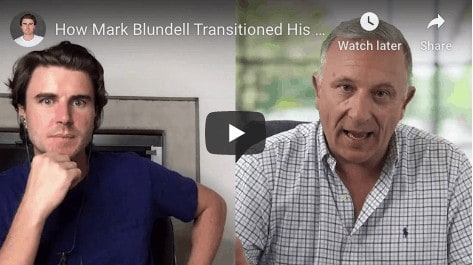
    Not surprisingly, Sam is a master listener. Many people remark on how intently he looks at and listens to those he speaks with on the interviews with students who have taken and completed his course. He recorded several hundred of them over a 2-year period.

    Watch the video below for 20 seconds and take my word for it that he maintains that level of focus for an hour straight.
    Listening and Seeing

    The intensity with which Sam listens to people is unexpected and impressive. 

    Seeing

    You’ll notice that Sam listens by seeing. His eyes do not dart, look down, or look up, and his head and upper body movement is minimal. Yet he’s responsive to his conversation partner. He gives enormous attention and focus.

    All of us need to cultivate this ability to listen and see in our – increasingly – Internet-based businesses. Especially the next year or two, but ever after we find and distribute a coronavirus vaccine. Good skill to have.

    The classic first-time startup entrepreneur will tell me their solution is a 100% self-service digital product; no interaction needed. No listening needed, no seeing needed.

    Wrong. We’re all in the relationship business; we have to listen to people and look at them.

    I described my brief lessons in seeing in a post earlier this week where I talked again about the impact of coronavirus on how we do business:

    I took a studio drawing class from artist Carrie O’Coyle, she taught us the art of the critique. She repeatedly made this point: if the painter or draftsperson puts significant effort into what she draws, there will always be something to critique, no matter how little technical ability she may at-present have.

    what struck me hardest in that art class (studio drawing) was this contrast:

    1. people with little talent who tried extremely hard
    2. people with considerable talent who dialed it in

    Because those with little talent produced much more interesting pieces of art. There was always something to offer critique on.

    What does dialing it in look like? It looks like drawing what’s in your head, or what’s in a photograph. In both cases, someone else has already done the creative work. In the case of the photograph, someone has chosen which lines, colors, perspective, and lighting to capture. They give you not reality but their own filter. Just as Snapchat product designers and engineers give not reality but their own filters. Most people are fine with that; that’s great.

    But that won’t work for as you try to improve the impact of your marketing. 

    I’ll explain that in a bit, but first let me ask you this: if I say, “elephant” what do you see? I’ll answer the question for you. You see a composite of the thousands of elephant-related images you have experienced throughout your life:

    • in real life, at a zoo or safari
    • in a Disney movie
    • on a nature show
    • in a children’s book
    • as a brand

    And you carry that composite around in your head with you, like a symbol, swapping it into your interactions as needed. That’s efficient. When someone tells you about their elephant ride in Thailand, you don’t have to imagine what it looks like, you have a symbol.

    But such symbols prevent us from observing what actually exists; it short circuits the information intake process. What you end up with is almost never quite the same as an actual elephant.

    Dialing it in is using the symbol in your head without putting effort into describing what you actually see in front of you.

    Effort in the plastic arts starts with seeing the world as is. The most common mechanism for achieving that goal is to break down what you observe into components, such as lines, perspective, colors, and lightness vs darkness.

    Wherever you are right now, stop for a moment and look. How many lines do you see, wherever you are as you read this? You see thousands. How many shades of light do you see? Colors? Sounds? 

    Now try it with your customers.

    Thank you,
    Rowan
  • How to Apply Effort

    It’s not enough just to call for effort alone, as I did by urging you to respond to the coronavirus by cultivating a content marketing practice. I said:

    you don’t have to be a good writer (and you can’t be, anyway, without practicing by publishing your writing; chicken and egg). What you do have to be is effortful. 

    Now I’ll tell you a story about a guy who sold stuff door-to-door during the Great Depression – with great success. Though if this is a parable about effort, the effort isn’t where you might expect.

    After a short-lived stint as an apprentice-chef in Paris((To learn what it was like for a young British person to work in a Parisian restaurant circa 1930, the book to read, by one of the other great writers of the 20th Century, is Down and Out in Paris and London. My father gave me this book when I moved to Europe at age 18 and I would later go on to wash dishes at food & drink establishments in Spain, Oregon, and Colorado)), a 23-year old college dropout named David got a job selling Aga Cookers, a type of desktop oven, in Scotland, mostly in small towns. He went from town to town, household to household. Any house with a car, in fact – that was his prospecting strategy (only 1 in 12 people in the UK owned a car then).

    His vision was that every single car owner in the UK should also own an Aga Cooker. By the age of 25, he became the most successful salesman in the company’s history.

    His employers took notice. At their behest, young David Ogilvy wrote down what he learned – about prospecting and many other things. The result was a dazzlingly detailed, 9,000-word manual manifesto on how to sell((I’m attaching the entire manual as a Google Doc (it’s in the public domain):  https://docs.google.com/document/d/1BTpuHaUlCfzChK_1prjMTVFUofKe43GVmlssnaurq-8/edit#heading=h.t4kaescppsy8. Note the big-picture, macroeconomic perspective, the psychological insight, the buyer-person segmentation, the prospecting insight, the exhaustive background research, and the careful curation of potential objections from customers.)). It helped other salesmen replicate his success, but it also changed the way he thought about sales and marketing forever. Just glimpsing at its outline is revealing but reading through this 1935 sales manual, you will learn more about marketing than you’ll learn from any of the 50 books on the Amazon Bestsellers list in Marketing, with the notable exceptions of This Is Marketing and Influence.

    64 years later, David Ogilvy died with a titan-esque net worth, considerable fame, and even a David Letterman appearance. How did he do that and what can we learn from his story?

    Because our world and its economy have changed so much (because Internet), Ogilvy and his “Eureka! – Big Idea” approach is no longer a viable formula. Nor is broadcast, cold advertising a sustainable growth strategy. His meticulous and obsessive research approach, however, is still the sine qua non of sales & marketing. Not an uncommon observation.

    But it was his writing efforts that crystalized his marketing and business philosophy, set him apart from his peers, and propelled him to success. That’s where the effort in this story lies.

    Case Study

    It’s also worth it to look at Ogilvy’s actual “client work”. I find that it hews to, or at least foreshadows, the “contemporary” school of marketing thought, led by Seth Godin, which asks us to change “the culture” [of those you want to help], starting by giving them something valuable for free. By the way, this is exactly what Ogilvy did by writing his sales manual – and if you ever read Zig Zigler, you’ll see evidence that Ogilvy changed the culture of medium-ticket B2C selling. 

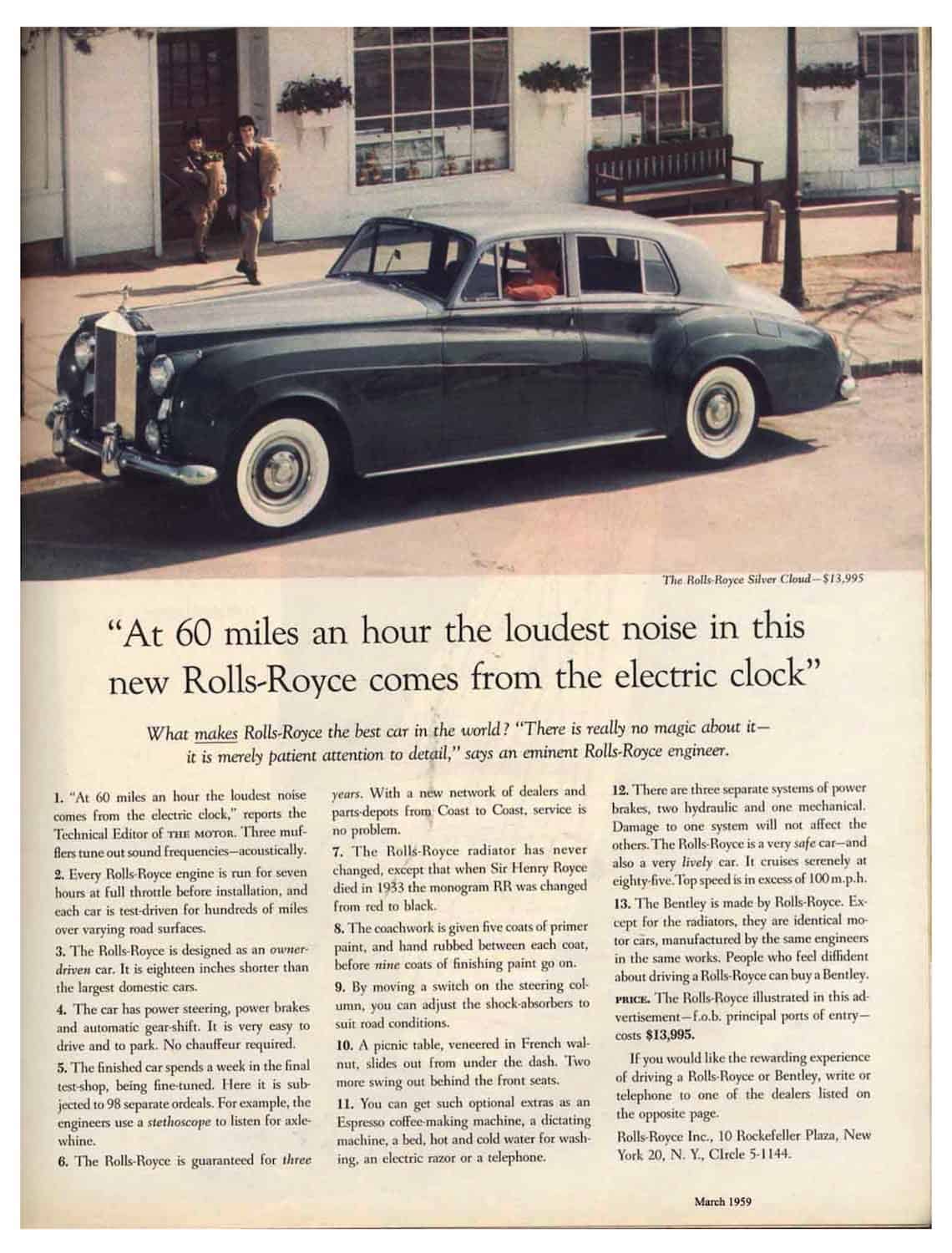
    In Ogilvy on Advertising (a must-read for anyone in any kind of business), David Ogilvy said the best ad he ever wrote was for Rolls-Royce. It was certainly one of his most successful; it helped the auto manufacturer sell a lot of quarter-million-dollar cars in a brand new market: the United States.
    Content Marketing Effort

    (See the full-size version)

    This ad is well-known among marketing bloggers but I noticed today that many, when they use this same image, crop out the details below the banner image. That’s missing the point entirely. Those 13 details are what make it work. They are truthful, pleasingly well-written, curiosity-provoking, 100% bullshit-free, and, yes, useful.

    Take detail #5, for example:

    “The finished car spends a week in the final test-shop, being fine-tuned. Here it is subjected to 98 separate ordeals. For example, the engineers use a stethoscope to listen for axle-whine”

    Details like this bring the object to life in the mind of the prospective buyer. They make it stick, they inspire trust. 

    But great effort went into acquiring those details – and a lot of listening (PDF)((This is a position paper on the value of listening, written by Oliver Cox at Landt.co. It’s excellent and I’ll be writing about it in the future)). Ogilvy spent a week at the Rolls-Royce factory just listening to people talk. Listening, observing, and finally, compressing what he learned into a specific and useful advertisement.

    He created a fact-sheet, just as a modern digital marketer might do in creating a lead magnet. Who cares if the fact sheet was distributed as an advertisement The medium is not the point.

    And you don’t need to use advertising to replicate that type of effort in your marketing, but you do need to research by listening and seeing. Then you need to write about it – or if you are less ambitious, at least commission someone else to do so.

    Because if you don’t write about what you’ve listened to, you haven’t listened deeply enough.

    It’s the same with drawing and painting – only through attempting to replicate what you think you see do you actually begin to see.

    Take action. In 1935, David Ogilvy cataloged 26 objections to the Aga Cooker. Your turn to ideate – what 26 objections do your customers have to your products and services?

    Write it down and let me see what you got – even if you come up short of 26!

    Thanks for listening,
    Rowan


  • Where to Map Your Business

    This is a small but important Business UX  idea and I’ll try to keep it short. It builds on the concept of the upside-down homepage and other articles I wrote about copywriting and UX lead generation patterns related to the homepage in particular. 

    The map of your entire business has a new home: the footer of your website.

    Take a moment and go look at your site’s footer. Now ask yourself, “is everything that is important, interesting, or useful about your business easy to find here?”

    There are infinite ways to do this, but below I depict a pattern common to B2B knowledge businesses. (You’ll have to set your email client to display images to see this below)

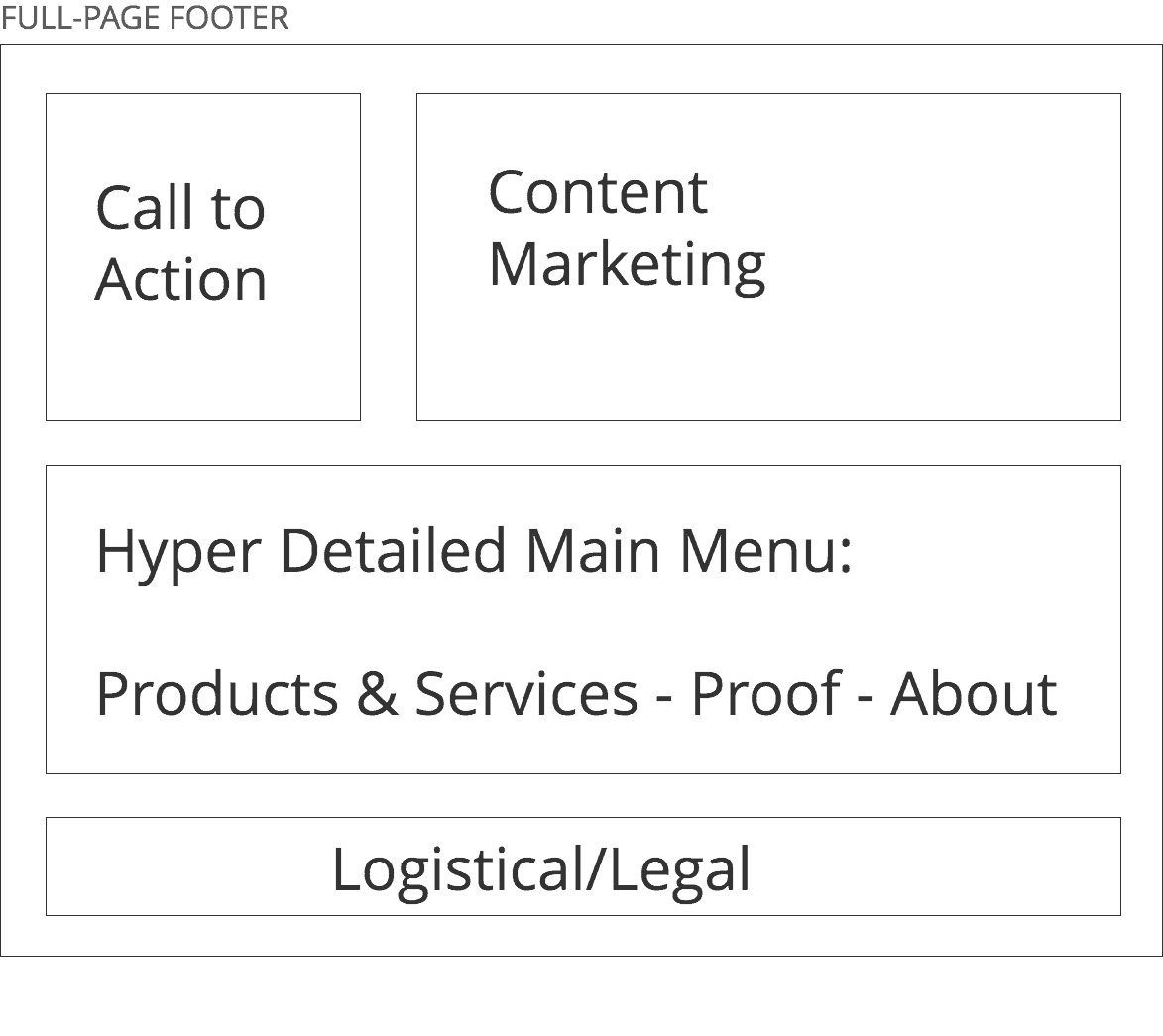
    Image: Map Your Business with Full-page Footer (enable images)I’ll walk through mechanics here because this isn’t just the upside-down model, where the header and main menu switches roles with the footer. Why not? Because the footer is, of course, never space-constrained.

    In fact, your footer should occupy an entire viewport on the most common viewport of your customer. In other words, if you view your site on most laptops, and scroll down to the bottom, the footer should take up your entire browser window. That’s why I call it a “full-page footer”.

    Why take up so much space? It’s free space first of all, but more importantly, because it should map the key parts of your business.

    I would break that down into 3 or 4 layers

    1. Call(s) to Action
    2. Content Marketing
    3. Hyper-detailed organization menu
    4. Logistical/Legal 

    As you can see in my diagram, you can fold the Call(s)-to-Action layer into your Content Marketing, giving you three layers. That’s what I recommend – because your expert, detailed, targeted content (a) is the most important part of your entire digital presence and (b) supports the conversion rate optimization of your call(s)-to-action

    Footer Calls-to-Action

    So first, the calls-to-action, things such as:

    • Get a Demo
    • Book a meeting
    • Purchase a product or service
    • Subscribe to a newsletter
    • Subscribe to a podcast
    • Download a white paper

    Can you do that in a header? No.

    Should you repeat your calls to action in a non-obtrusive way, no matter how your user interacts with your site? Yes.

    Footer Content Marketing Showcase

    Next, use your footer for content marketing. Here’s a nice formula for the content marketing block I have diagrammed above: most recent and most important. 

    So make two lists: one is your most recently produced content and the second is the most convincing content. So you might have a list of your most recent content items on the left-hand part of the Content Marketing block – and your 4 most important pieces of content on the right-hand side.

    Be creative with how you label and conceive of each piece of content. Protip: use two words to create your content labels:

    • Position paper
    • White paper
    • Demo Webinar
    • Education podcast
    • Interview podcast
    • Research Article
    • Opinion Article
    • News Article

    Footer Hyper Detailed Main Menu

    The meat-and-potatoes of your footer. This is where we start to get into “upside-down” territory – where we take what used to be the header and put it in the footer. Except in the footer, there’s an opportunity for more detail.

    So instead of a link to “About Us”, create a whole section that looks like this:

    About Us
    The Story
    Our Vision
    Our Values
    Our Purpose
    Our Team
    What We’re Doing Now
    Contact Us

    And so on – for each link that comprises your main menu, break it down, expand, explain. Don’t worry about having a page for each link either – you can link to sections of pages using hashtag jump links.

    For example, Instead of a link to proof pages (Case Studies or Testimonials) list out the specific case studies in detail.

    The idea here is to let the user easily understand the scope of your website business. This isn’t about navigability or usability or Jacob Nielsen stuff. I care about that but that’s not the point here. The point is to burnish your brand by revealing as much about your business as you can fit into about – again – a full-page viewport.

    Footer Logistical/Legal

    This used to be what footers were made of in the old days. Or a simple menu, plus this. Business name, contact, address, privacy, and copyright message. 

    As you can imagine, there is an opportunity to expand on that by providing detail. But here we’re in familiar territory. Do this part last because it provides the least value.

    And that’s what this entire concept is about – reimagining the 25-year-old convention of the website footer as the blueprint or map of your business, where you put the details for those as-yet unconvinced visitors who want to learn more.

    Yesterday, I wrote about what the coronavirus will mean for us as we try to hunker down and maintain ideal health until a proven, widely available vaccine comes out. (This could take 2 to 3 years, but please don’t look to me for medical clairvoyance). As we wait for less uncertainty, those us who communicate our business value better through the Internet have a huge advantage.

    Reimagining and reinventing your footer as I have described here is low-hanging fruit. It may even change the way you think about your business and your marketing strategy – especially if you use it to showcase your content marketing.

    My best,
    Rowan

    PS. Looking for full-page footer inspiration? Avdi Grimm


  • Coronavirus

    I don’t know if I had coronavirus in February but I had something pretty nasty. Good thing I don’t have to read you my emails in person.

    We – internet-savvy knowledge workers of some kind – have a huge advantage: because we’re used to working with each other remotely through the Internet.

    As we read about the millions of people around the world testing the waters of telecommuting for the first time we should be grateful we have this skill.

    Though I think it’s still far too underdeveloped in most of us.

    Coronavirus isn’t nearly as murderous as was the Spanish flu of 1919, the first H1N1 virus, or its 2009 cousin, swine flu. The Spanish flu took the life of my great aunt Letitia at the tender age of 23. In fact, in the US and many countries around the world, everybody knew someone who died. In the US, it took the life of about one in every 150 people – adjusting for the current population it would be as if 2.2 million US-American lives were claimed today.

    That’s not going to happen with the, apparently, much less lethal coronavirus. But it may certainly infect that many people – or more.

    I  thought about all this over the past few weeks, as I lay bedridden  wondering if I’d somehow contracted coronavirus. As I slowly started to come back to life this past week, I read some good articles on the subject, including Seth Godin’s Thoughts on a virus and Philip Morgan’s Resilience.

    In the latter article, Philip makes the case for remote work as the antidote to contagion:

    I enjoy some amount of travel, but I’d feel like I’m doing something wrong if I had to travel more than a half-dozen times a year for client work. This is a case where I’ve let me personal preferences set a constraint that dictates how I design my business.

    As a result, I’ve worked steadily for years now to figure out how to deliver remote, online experiences for my clients that are really valuable in their own right. 

    The half dozen metric feels about right for me too, maybe a dozen tops. But he also makes the flip side pretty clear in discussing recent in-person work-related experiences:

    I got to experience the flip side: in-person engagement. It was eye-opening. The potential richness and impact of in-person experiences is profound, and I can see how it’s not a fungible thing.

    For me, in-person is not so new because I did quite a bit of it as a consultant at Blackbaud. I did gradually less and less while I co-owned my own firm but I still traveled to conferences quite a bit.

    The takeaway here is that, yes, in-person interaction is irreplicável, as the Portuguese say. Ideas develop more easily when you are sitting next to someone. But in keeping with the idea of different but not necessarily worse (sauna/beach, beyond-burger/hamburger, etc), running a remote business can also be better than an in-person at delivering value.

    From here there are about 1 to 10 more takeaways but here’s the one I think matters most, the hammer I always like to hit you with, dear reader: content marketing.

    The Content Marketing Virus

    The other stuff is incredibly important. A non-definitive list of how to achieve “remote excellence” includes:

    • Minimum viable (semi-)automated tech stack, providing self-service trials, demos, meeting-bookings, payments, etc.
    • Clarity/quality of voice and video. You might actually get more facetime through a high quality video call than through in-person meetings
    • A professional yet idiosyncratic workspace environment
    • Thorough and authentic testimonials
    • Polished and coherent copy across your website, LinkedIn, and the web
    • Clearly articulated brand purpose – vision, mission, values.

    All of these things have to be better for us to thrive in the coronavirus era. 

    But highly personal content marketing is the crown jewel of building trust remotely. What does this person really think? What is their opinion and how do they put it into words? Writing is the foundation and voice (eg. podcasting) is how you build on it – one of the reasons I have been working on producing an audio version of this newsletter.

    The pushback I usually get is, “I’m not a writer”, “I can’t write”, or “I’m not a good writer”.

    But you don’t have to be a good writer (and you can’t be, anyway, without practicing by publishing your writing; chicken and egg). What you do have to be is effortful. When I took a studio drawing class from artist Carrie O’Coyle, she taught us the art of the critique. She repeatedly made this point: if the painter or draftsperson puts significant effort into what she draws, there will always be something to critique, no matter how little technical ability she may at-present have.

    In other words, some value will always be created through effort.

    So it is with content marketing: what matters first is effort, not talent. But effort is hard to muster when your health is compromised. Take Seth’s advice and take calm precautions against COVID-19, Philip’s advice and cultivate delivering value remotely, and my 2 cents: try to infect yourself with the content marketing virus – you will benefit from it when the coronavirus is but a distant memory.

    To your health,
    Rowan

  • Groups vs Experts

    This is an afterthought to the story I told about dolphins and ideation. Fused perhaps with an afterthought to the story about brainstorming being a weak ideation technique – unless tightly regimented.

    It was important to that first story that our dolphin cousins may have differing brain hemispheres, as we might, so I mentioned that I’d found 104,000 articles about “Hemispheric Lateralization” on Google Scholar. And I pointed out the plain fact that no one has ever or will ever read them all. 

    Nor will anyone ever read all 615,000 scholarly articles about “evolutionary theory”.

    That seems problematic, right? Because what if you really want to get to the bottom of evolutionary theory? You could read, say, 1,000 abstracts from the most cited of those 615,000 articles. And such a task may be doable over the course of a year, let’s say. But is it thorough? Technically speaking, no. 1 out of 615 is not thorough in any circumstance. So what if you miss the needle in that haystack? (And what if you only have a day and not a year?)

    I had to think about this problem when I saw this poignant interview (from “The Portal” podcast) with evolutionary theorist and biologist Bret Weinstein ((Yes, he’s also the Evergreen State University professor who got temporary national fame for standing up for free speech)), who seems to have developed Nobel Prize-winning caliber theories on evolutionary biology in relation to cancer cell research.

    The thing is, the crux of the story he tells in the interview: he never won a Nobel Prize because his research was stolen, or so he claims. ((Whereas the scientist who is alleged (I have NO idea whether this is true) to have stolen his work, did win a Nobel Prize https://www.nobelprize.org/prizes/medicine/2009/greider/facts/ ))

    Meanwhile, Bret Weinstein has published scholarly articles on evolutionary theory. But none is among the most popular (ie. most cited) 1,000 articles on the subject; not even close.

    So what if you miss the needle in the haystack of scholarship on evolutionary theory, such as any article by this (clearly brilliant – whether his research was stolen or not) scientist?

    Here’s the thing – you can’t find all the needles in that haystack. Nor can 10 or 50 of you. And this is also the problem in the absolutely enormous marketing haystack, which features 10 of millions of mostly terrible pieces of content – not hundreds of thousands. 

    There’s too much information about marketing for any one person to possibly digest. Too many articles, too many books, too many people((There are 10 million people on LinkedIn Sales Navigator whose job is connected to marketing)), and too many opinions.

    And that is precisely the problem with most creative marketing work: it is dumbed down into ineffectiveness under the weight of too many opinions. Good creative work cannot be achieved by reconciling the differing opinions of multiple people. Peer review is not your friend.

    As Bret’s interviewer (and brother) Eric Weinstein puts it:

    “Peer review is a cancer from outer space. It came from the biomedical community and invaded science. The old system…. I have to say this because many people who are professional scientists have this idea that peer review has always been in our literature – and it absolutely motherfucking has not – used to be that the editor of a journal took responsibility for the quality of a journal. Which is why we had journals like Nature in the first place because they had courageous, knowledgeable, forward-thinking editors”

    Don’t subject your marketing and business development ideas to peer review. What to do instead?

    Find an editor – an expert

    The antidote to the groupthink is a “courageous, knowledgeable, forward-thinking” expert you are willing to trust, at least for a time.

    Scientists such as Bret Weinstein can navigate 615,000 articles about evolutionary theory for meaning. They have to.

    And how they do so must be, like marketing, both an art and a science. I can’t tell you exactly why to avoid a period after a headline in your marketing copy. I can’t tell you why the rules of grammar are not the rules of marketing. I can cite psychiatric research and psychological theory, expert opinion from famous writers and marketers, and my own anecdotal experience. I can make a strong argument. But it’s partly based on my gut.

    It’s probably the same for you – when a client asks you why you recommend A and B decisions, you should have a good answer, of course. An argument, or even an overarching point of view. And ideally, one partly based on data/research. But behind all that, though you may not articulate it, is your gut as an expert.

    If you don’t yet trust your expert instinct on a certain question, don’t take it to a committee, take it to an expert you’re willing to trust.((Counterpoint: you can expose your ideas to large groups as if you were conducting research by asking pointed questions, assimilating answer-sets, and looking for meaning therein. But I think of the outcome of that process as a data set, not an opinion set.))

    My best.
    Rowan

  • You-Focused Copywriting?

    Nearly three months ago, I wrote: “How to write copy and UX for a homepage”. It’s not bad advice as far as it goes, but it’s missing a big IF.  

    While I left out the big if, I did include one caveat that still holds true about the advice that post contains for creating your home page:

    Caveat: these guidelines apply to niche B2B tech/creative firms (which are sort of the same thing nowadays) selling complex services or products to professionals and other businesses.

    And then I went on to give practical advice focused on optimizing the home page for lead capture. In fact, I started off with the premise that the home page is a lead capture landing page first and a lead nurturing/client retention page second.

    I went into practical tips that support this premise:

    • Reduce the clutter in the header using the Upside Down Home page theory
    • Cut down on clickable links or tools
    • Have a call-to-action
    • Repeat that call to action
    • Never have more than one call-to-action
    • Let the logo be accompanied by a straightforward tagline that supports your call to action
    • Have testimonials
    • Resolve objections with a mini-FAQ or bulleted list

    And more. In fact, if you want to generate leads or conversions from your homepage you should read the article, as it has good advice which I have been turning over in my head for probably 15 years.

    So what’s the missing if?

    “What’s in it for you” marketing

    The advice I gave on how to create copy and UX for a homepage is not marketing advice, per se. It is direct marketing advice. Or Conversion Rate Optimization. Or whatever you want to call it. It’s a form of marketing, but it’s not the only form.

    If you’re in it for the leads right now, you want direct marketing. It’s been working in a codified way for 130 years. But if you’re also interested in the leads 5 to 10 years from now, however, I suggest a different approach.

    (And that’s the missing “big IF”).

    Maybe you are in this for the long term. You are not going to give up on your business and work for somebody else’s business. Or the state’s business. And you are doing to be patient about growing your business.

    If that’s the case, then the question to ask while curating your homepage is “what’s in it for you – the visitor to my site?”. That question should lead to you giving away something useful very valuable for free. (Small print; creating something valuable takes work, whether you give it away for free or not.)

    In my case, this newsletter is a valuable thing I can offer for free, so that’s what I am pushing on my homepage. (Of course, I get something out of it – your attention.) 

    What do you call marketing that asks the question, “What’s in it for you?”.

    Seth Godin called it Permission Marketing 20 years ago. Now he just calls it, “Marketing”(( By the way, set aside the fact that this book is about marketing and explore this audio version of the book just for its sheer artistry as an audio work. It’s almost as if it were designed from the get-go to be said and heard, not written and read https://www.audible.com/ep/title/?asin=B07DKSPL43)).

    David Ogilvy called it “Image Marketing” 50 years ago, though he was speaking to a different universe.

    Now you might call it brand marketing, ethical marketing, or authentic marketing. Unfortunately, every label we can think of has been claimed and defined by someone else; every single one of these labels has been perverted by people practicing heavy direct marketing. 

    Digression: that’s why you have to create your own dictionary and define your own terms. “The dictionary” isn’t our collective taxonomic mommy anymore. Each of us in the knowledge business is responsible for defining our own terms.

    Anyway, I would like to just call it (ie the opposite of direct marketing), “marketing”, which you can think of as, “building trust and creating clarity by listening, teaching, and guiding over a long period of time”. But the word marketing, by itself, means a million things to a billion people, so instead I settle for the label “trust-based marketing”.

    So you should never use direct marketing in your marketing? Of course not that’s too simple. You should use some hybrid of direct marketing and trust-based marketing. Finding that balance is a topic I’ll have to save for another post but it’s a question of finding harmony between your now business and your future business.

    Thanks for listening,
    Rowan