Entries

  • Daily publications I subscribe to

    Have you ever sat waiting for a flight at an airport bar and overheard an interesting conversation? That sort of what being subscribed to a daily email list is like, for me at least. Except it’s just one person talking to herself. Which makes it even more interesting?!

    I kid – and actually, an email newsletter is typically a two-way conversation because many of you respond.

    In fact, a dear friend and subscriber remarked to me the other day, “I’m sorry I haven’t been reading your emails lately.” To which I had to laugh!

    Because I don’t expect her or any of you to read all of my emails. Of the 6 high-frequency email lists that I subscribe to, I rarely read any of them daily. Even though I have the right temperament for reading daily emails (some people just aren’t wired that way). So I don’t expect anyone to read each of mine.

    The Continuous Publication

    Nor do I expect any, one single email I write to give you an “aha moment”; so you shouldn’t feel like you are missing something amazing. My goal here is to help you inspire your marketing and business development strategy with small, bite-size ideas that, over time, help you make better decisions about investing in marketing. (And by “better”, I mean “less financially risky” and “more personally rewarding” … and a few other things).

    Some of these lists I fail to read faithfully are brilliant publications. And they remain brilliant even if I don’t catch every episode.

    Taken as a whole, for example, Philip Morgan’s Indie Experts newsletter and the Seth Godin’s daily newsletter are more interesting, useful, and in-depth (yes, in-depth!) than pretty much any business book. Because it’s not about the one, odd email – it’s about the ongoing stream of consciousness that you catch bits and pieces of. Taken together, they comprise a publication.

    Here are three “streamed publications” I am currently subscribed to that I can easily recommend:

    Seth Godin

    Seth’s Blog. Is it a blog or a newsletter? It’s both and Marshall McLuhan((https://en.wikipedia.org/wiki/The_medium_is_the_message)) would be impressed by how seamlessly Seth’s content fits the parameters and expectations of both mediums. It’s come out at high frequency since the dotcom boom imploded and I have been reading Seth off and on since then. As far as I can recall, he has published near-daily for 13 years in a row.

    If you could boil it down to one phrase, Seth’s newsletter is about ethical marketing.

    But his newsletter long ago transcended marketing to address big-picture stuff: not just business strategy, branding, etc., but life, death, truth, and purpose. So I listen intently when he stoops low enough to talk about things like the state of software development, client services, or Google and SEO

    Philip Morgan

    Indy Experts, by Philip Morgan. Philip Morgan was inspired, I believe(?), by Seth Godin’s publishing practice; Philip has been publishing at high-frequency (which he defines as *at least* 3 times a week) since January of 2016. His focus has evolved from the subjects of positioning and specialization to the question of how to develop expertise through – in part, at least – high-frequency publishing. Emphasis on publishing, not just writing.

    Other parts of the expertise cultivation equation include research and last – and definitely not least – doing great client work. As Seth Godin has said, the job of a freelancer (and he defines consultants as freelancers, too) is to (a) get great clients and (b) convince those clients to let you do great work.

    What better way to improve your expertise than doing great work? I don’t think there is one, but writing a lot helps. Philip has a talent for weaving strategic advice with a long-term impact on profitability (create space in your time to work on your business) with practical advice with a short-term impact on profitability (eschew marketing automation).

    Jonathan Stark 

    Jonathan Stark’s newsletter. Jonathan is the only high-frequency newsletter publisher who truly publishes daily. As in, every single day of the year, rain or shine, or death – I remember once reading an email he’d written after coming home from a friend’s funeral. It was a great one, too. If I recall it was one of many, where he made the point that life is too short to bill hourly.

    During most of my life as a services professional I have billed hourly but, man, do I wish I had a do-over. If there’s just one thing I could change about the “group-business” I co-owned (as opposed to my current solo-business), it would be how we priced or failed to price. Priced, not billed. Because to sell yourself by the hour is not pricing at all; it’s just billing. Hourly billing may have its place in limited contexts (namely: sold in pre-paid blocks), but as a go-to compensation model, it’s ruined many businesses and is bad for both clients and providers.

    Hourly Bill is Nuts.

    Others

    By the way, I am subscribed to other writers as well, but these are the (the best of) the *daily* lists I subscribe to. There are others I subscribe to to keep their subject matter within my ambient awareness, such as Neuroscience News and The New York Review of Books Daily. And then a couple more from Internet marketing consultants which are fascinatingly bad yet consistently published; I won’t call them out on this list.

    Some lists I periodically filter out of my inbox so I can read through a week’s worth at a time on Fridays. Then unfilter later when I am in the mood for daily reading. But Seth and Philip’s, and sometimes Jonathan’s, I read pretty much every day. I often re-read Seth’s best posts before I nap or sleep to let my subconscious evaluate them. ((That sounds like Marianne Williamson ideation, I know, but there’s noncontroversial science and convincing anecdote to back it up.)) 

    So it’s pretty funny to meet people who say they never use email!! If you happened to open this one, reply and let me know if there are any high-frequency newsletters you enjoy.

    Have a nice Wednesday evening,
    Rowan

  • Originality

    I got an interesting request recently from someone launching a “natural” woman’s deodorant brand. They wanted my professional opinion on a broad range of subjects, many of which I’m unqualified to speak on.

    It came with questions and remarks:

    • I need to know how and where the opportunity to enter this market is, and if there is an entry, do you think it can be exploitable to the extent where the company can experience rapid growth?
    • I need guidance on branding and strategy on how to execute the creation of a startup that can compete in this highly competitive market. 
    • I need market research conducted: such as market size, some competitor analysis, and maybe a deep dive on Native. 
    • I need to know if dumping money into a venture like such is a risk worth taking, and if so, how would I differentiate from Native while serving a similar market? 
    • I need to know where the marketing opening for opportunity in this market is and help on positioning before proceeding.
    • In your professional opinion, do you think a venture like such is worth pursuing based on the reward and risk trade off?

    Now, in my professional opinion – none of these is the right first question.

    Although deep-dive research into the successful competition (Native) is a good place to acquire the first question, which I believe is something that begins with, “what’s the problem….?”. And, “how can I help?”

    That could end up looking something like this:

    “What’s the problem that female users of deodorants face that Native doesn’t seem to solve?”.

    That first question should kickstart a Socratic sequence of questions, such as:

    • Native is a 100 million dollar brand with a large customer base; what’s a subgroup of Native-buyers who are dissatisfied with the brand?
    • Why are they dissatisfied?
    • Does Native [the category leader] actually appeal to consumers of eco or animal-conscious products?
    • Or are Native-buyers just buying it because it’s the only thing on the shelf at Target that somewhat satisfies their sensibilities?
    • Is animal testing important to these people?
    • Are these consumers in the habit of checking for a 3rd party certification indicating the absence of animal testing? 

    All these questions are designed to narrow down the questions, “Who it’s for?” and “What’s it for”, and to lead to the identification of the smallest possible viable audience.

    Why? Because you can run a Facebook ad targeting 3 people? No (although you can do this), because then you’ll know best how to solve the problem. 

    I have no idea what that solution would look like because I know so little about marketing consumer packaged goods. Always amazes me how little I know, when asked. But I do know that you have to formulate good questions and ask them directly of buyers – this is also true in B2B marketing.

    I’m also fairly certain that if your approach is to follow the leader (Native, in this scenario), you’re a copycat, but if you’re approach is to be inspired by the leader, you might be an innovator.

    Being inspired looks like this – you’re torn. You’re impressed yet dismayed.

    In fact, you might be mad. And because you’re mad, you want to do things differently.

    Are you incensed because Native is a fake animal-conscious brand? And are you passionate that mass-market shoppers at chains like Target have the chance to buy deodorant that they can be certain is not tested on animals? Fine, then you have a cause. (Though the digital marketer in me wants you to build a DTC funnel!).

    But if not, if you just want to make money by copying a successful brand, you’re just a plumber.

    Defining vision

    Because as Seth Godin has pointed out, while Marcel Duchamp was an artist, the next person to put a urinal in an art exhibit was just a plumber.

    But did Duchamp install a urinal? Or did he install a fountain? ((Was he having a laugh by buying a urinal from a plumbing company and using its name as the monogram? Yes and no. I don’t think he was being insincere. But I don’t know and it doesn’t matter; what matters is the ideas we get out of a historical event))

    Because he named this work of art, “Fountain” and then he mounted it on a pedestal, as you see from the photo. Thus, it asked the question, “can good art be purely comprised of ideas and feelings, or does it need craftsmanship?”

    But it also asked: “What is a fountain?”, and that’s not a minor question. Many great works of art, if not the vast majority, have terribly boring names ((And don’t even get me started on Artist’s Statements)). For example: “David” (speaking of originality). But Duchamp made us think about the power of naming, too; a name is an inextricable part of a product. And this is the essence of brand messaging, by the way – helping understand a brand better by choosing the right words. 

    But the point is that’s there’s a difference – and always a healthy tension – between copying something and drawing inspiration from it. If you’re not tempted to copy from your remarkable peers, as I am, you may need better peers.

    Other artists successfully followed Duchamp with art that thrived on decontextualization, irony, non-craftsmanship, and at-first-glance meaninglessness. Also known as Dada-ism. Because they noticed the idea behind his artwork, not its literal qualities. They did not copy; they were not plumbers.

    So that’s the answer to the deodorant entrepreneurs everywhere – don’t copy the category leader, whether it’s Native or anyone. Be inspired by them – like Native, consider marketing a deodorant that costs $11 instead of $3. But for different reasons, solving a different problem, ideally for a smaller group of people.

    And that means that all these questions about how to go to market, how to distribute, branding… all cart-before-horse. Those are tactical questions that should be asked until strategic questions are asked and answered.

    My best
    Rowan

  • Content Strategy

    Systematically producing, organizing, and managing content in a way that supports strategic goals

  • How to write About page copy

    Ok, I am back from Germany. And one of the first things I did when I got back was to speak to a brilliant, young solopreneur about her business. Her About page came up: How to write one?.

    And on further reflection, I get this question a lot. Maybe once a week or so.

    Here’s a good place to start – think about the questions you get that an About page should answer. They come in human language like this and are usually straightforward:

    • What are you up to nowadays?
    • What do you? What does your business do?
    • How did you get into that business?
    • What’s your background?

    These questions should all be pretty well covered in your About page and/or your Now page. But how?

    By understanding that an effective About page is built on a strategic framework. To be precise, your About page should have at least 3 and up to 5 key components:

    1. Purpose, which includes your vision, mission, and values
    2. Story
    3. Bios
    4. Just the facts
    5. Now

    Let’s jump right in. And by the way, these are arranged in order. If someone visits your about page, take the chance to tell them why you exist first. Then your story, and so on. They’ll find the contact info if they need to.

    What is your purpose?

    Simon Sinek wrote a book about this (Start With Why). Corporate marketers call this, “brand purpose”. Peter Drucker and dozens of other business thinkers address this in a different way, by encouraging us all to view our business as something more than a mechanism for making money by exploring three concepts: Vision, Mission, Principles. I absolutely encourage all of you to know your Vision (the future state you want to create), your Mission (your business’s role in creating it), and your Principles or Values (what you believe in).

    If your looking for “who invented it?”, the true answer is always someone in Ancient Greece – and usually in a more thought-provoking and directly applicable way than any contemporary business pundit. Having said that, the idea of identifying business purposes really belongs to Peter Drucker.

    It’s the foundation of your About page copy – but it’s not necessarily viable web copy. Go through the Vision Statement / Mission Statement / Values exercise, but distill down to stating your purpose. We exist to make this future status quo a reality.

    Tell your company history

    Some would say, “tell your story” but that’s a bit vague. Donald Miller wrote a book about this making the case for framing this as story branding; the book holds that the strongest way to create a brand identity express its significant parts as a narrative. Some of the things you can highlight here are “Who it’s for?” and “What It’s For?” (the central questions in Seth Godin‘s masterpiece, This is Marketing: You Can’t Be Seen Until You Learn to See.((Of all the books cited in this post, This is Marketing is the one to read)) 

    In other words, use your story to elaborate on your positioning. Philip Morgan has written an excellent book on positioning for “technical firms”, by which he means dev shops; it’s largely applicable to knowledge worker-based B2B businesses. A great way to make the transition from an internal memo to a viable copy is to write your positioning into your story.

    Provide a biography(s)

    This is collapsible and expandable, like a telescope. Try writing these as LinkedIn taglines first (about 3 to 10 words), then copy and paste the taglines back into your website and expand on them, keeping continuity. The website provides you the space for some personal touches, which can also be addressed in a Now page, as I discuss below. I have no author to cite here; when in doubt, cite William Strunk Jr’s Elements of Style. Why? To curb the instinct for talking too much about ourselves.

    Provide non-personal facts

    For larger companies, provide information about the company, your clients, your industry, or even logistical stuff like your street address. Your horizontal specializations and skills figure in here. Most About pages are some souped-up version of this element packaged together with company history. This is quite similar to the concept of providing an “Orientation Manual” about your business, which I have written about recently. An idea inspired by David C. Baker.

    Provide your “Now”

     A Now page is a marvelous framework for communicating useful information about yourself in a business context. It answers the question, “What are you doing now?”, in a way that a conventional About page or LinkedIn profile often do not.

    You can create a Now page on behalf of key individuals within a firm or on behalf of the aggregate “now” of the company. But it was developed with the individual in mind, by Derek Sivers himself.

    The last item on the list was conceived as separate to a Now page – and it certainly can be. Whether you make it part of your Now page or separate, two things:

    • Write them at the same time
    • Let the Now page be update and easily updatable – by keeping it brief.

    That should be more than enough to get you started. If you do create a Now page, reply to this email and link me to it – I’m curious! Here’s mine https://www.rowanprice.com/now/ 

    My best
    Rowan

  • Psychographic Positioning

    Back when I was in the old world – last week – I touched on sizing and segmenting markets (plural) for your products and services using psychographics((“Understanding the people in your market by assessing long-term emotional realities, values, opinions, mindset, interests, and lifestyles” https://www.rowanprice.com/dictionary/#psychographics)), which sets itself apart from the standard segmentation approach: demographics. 

    Demographics groups people by external, easily quantifiable characteristics, such as age, race, sex, employment status, education level, income, relationship status, and more. But more than that, it looks for averages and medians within groups – what’s the average income of Californians? Or the average lifespan of dog owners. 

    B2B marketing takes that approach and applies it to companies, usually by employee headcount and estimated annual revenue:

    Salesforce.com is the CRM for enterprise and SME sales forces” [meaning really big]

    Note: Salesforce is so huge and established, its positioning is really just, “CRM software”. But the rest of us have to be more demographically specialized.

    Demographic Positioning

    Vertical. The classic (and hardest yet most effective) approach to demographic positioning is to position by “vertical”: Arete provides “Mission-critical custom software for higher education”

    Horizontal. By “horizontal” (skill) specialty: Fair Winds, provides, “Kubernetes Container and Cluster Infrastructure, built and managed by a team of experts.” (Kubernetes is a type of cloud infrastructure tech)

    Platform/technology. By platform: North Peak is “Your Trusted Partner for Salesforce® Nonprofit Solutions” (that’s sort of a combined platform-vertical positioning)

    Audience. And by audience: Optimize my Airbnb provides: “Danny, the best in the world at Airbnb.”

    The last one, audience, you might call miscellaneous. It’s positioned to a demographic group of people (AirBNB hosts) that doesn’t fit neatly into a vertical. And it’s not really a platform. It’s a group of people who do something or have something in common.

    These are all valuable ways to think about positioning. There might be other ways to slice and dice demographic positioning, too. And other categories you could invent, such as Productized Service (example: Case Study Buddy), which would be a close cousin of horizontal positioning, just as audience is a close cousin of vertical positioning.

    But…

    What about psychographic positioning?

    But the point is none of the examples above are psychographic. “Audience” gets the closest, but it’s about what happens on the outside (becomes an Airbnb host), not what happens on the inside over the long-term.

    We tend to think of psychographics as the foundation for effective marketing techniques, for better copy, better UX design, color patterns, etcetera. Millennials are this. Boomers are that. Lifestyle. Values. 

    And we adjust the customer experience design accordingly.

    But if we take the time, psychographics becomes – or can become – the basis for our de facto positioning.

    A common positioning technique is: take your 10 favorite clients of all time and determine what they have in common.

    Sidebar: this is yet another exercise that works equally well for product and services firms. Again – products and services are the same exact thing; they are just two different labels you put on the value you deliver. (Reply if you disagree, I could be wrong. Or at least I have been many times in the past.).

    Anyway, this exercise usually takes place using demographic thinking. You list your 10 best clients, then start documenting their externally visible characteristics – headcount, location, industry, thing you do.

    Psychographic positioning deepens this approach by asking you to look internally. What are the opinions, mindsets, values, and interests of the owners and other buying decision-makers at your favorite firms?

    The commonalities you find there might give you much more nuanced positioning ideas than you get from plain old demographics.

    Speaking of psychography, it’s nice to be back in the Pacific time zone. The nearby ocean seems to have a calming effect and I feel relaxed. Hope you do too.

    My best,
    Rowan

  • Psychographics and Addressable Market

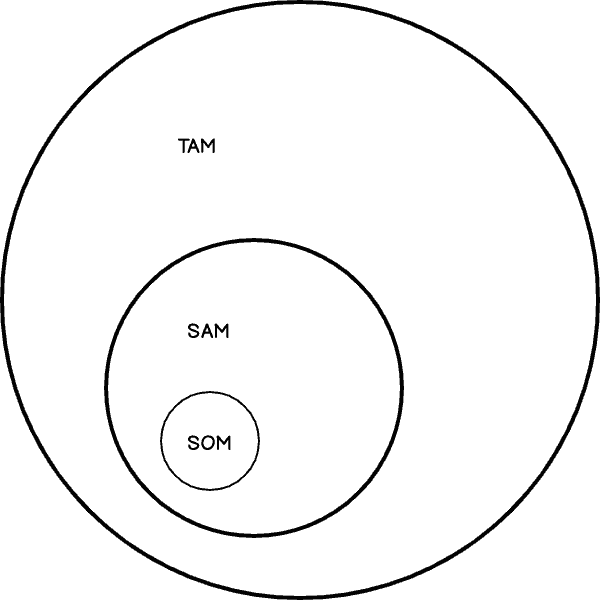
    The best way to follow up an article about TOFU, MOFU, and BOFU is to present my other friends – TAM, SAM, SOM. Is it possible that my travels this week have knocked a screw loose? Yes, but TAM, SAM, and SOM are important marketing concepts.

    And it’s interesting – and in yours and my shared interest – to think about them in terms of psychographics, not just demographics. That’s my monkeywrench thought of the day and I’ll return to it but first some nerdsplaining:

    • TAM = Total Addressable Market
    • SAM = Serviceable Addressable Market
    • SOM = Serviceable Obtainable Market

    Usually, that breaks down into something like the following: enormous TAM, small SAM, and microscopic SOM. The idea here is to draw a distinction between the theoretical size of the market for your products and services and the real size – to which you are able to (a) logistically provide services to and (b) convert from potential customers to partners.

    To take a simple example, if you are a solopreneur editor and proofreader for US-based attorneys, the TAM for your services is about 1 million (yes, there are that many licensed attorneys!).

    “Oh boy, 1 million potential customers.”

    This is the part where the “sharks” on SharkTank roll their eyes. Because there’s no way a single legal editor can provide services to 1 million customers.

    So how many licensed attorneys can she address? Even if she productized her service using a 100-person team of subcontractors all equipped with NLP text-editing software, she couldn’t even address a fraction of the market. 

    The latter scenario, the AI-assisted 100-person legal editing firm, her SAM is a tiny fraction of the TAM – perhaps 3,000/year at the most. 

    Then there’s the question of obtainability. It’s not just a sales question, but an operational question too. To build a team of 100, you need multiple managers, a finance person, a CTO, a COO,  and a remarkable HR person.

    You also need capital and cash flow. And then you need to market and sell your services. So of those 3,000 in your Serviceable Addressable Market, you end up with maybe 500 attorneys you can do business within a given year. And that might be a spectacular year.

    That’s how you start with a Total Addressable Market of 1 million and end up with 500.

    I think the entire framework was invented by someone who got sick of hearing the cliche, “the market for that is is huge”. The TAM market, maybe but not the SOM.

    The addressable market theory makes the question, “What’s the market size?” invalid at worst, and inadequate at best.

    The Psychographic Dimension

    As precise as the addressable market theory is, it has an unseen dimension: psychographics.

    I define psychographics as understanding the people you want to help by assessing their emotional realities, values, opinions, mindset, interests, and lifestyles. And for people selling expertise in the form of complex products and services, it’s extremely important.

    It’s certainly important in B2B sales and as in B2C. In either scenario, one of the key psychographic qualities is:

    Wants to transform 

    vs

    Wants to optimize

    In broad strokes, what most people want is to optimize. Fewer typos. More traffic. More efficient billing.

    Which is fine; many fortunes have been made in pursuit of optimization.

    But in transforming, the stakes are higher. The buyer who wants to transform from present state to future state is looking for deeper engagement, more results, and thus is willing to invest more.

    This is the subtlety lost on most lead generation agencies. It’s not about converting more customers to MQLs or SQLs. (marketing/sales qualified leads ). Unless you’re in the business of optimization.

    So as you can imagine, it’s important to figure out which business you’re in – are providing optimization or providing transformation? Once you know that answer, you’re on the path to psychographically sizing your market. And maybe better understanding your buyer.

    Warmly,
    Rowan


  • How to think about an editorial calendar

    Meet my friends – TOFU, MOFU, and BOFU. Was just joking with a colleague the other day that these sales & marketing acronyms sound more like imaginary Dwarf friends. I knew a guy named Dirthead once, but no BOFU; that’s marketing jargon.

    • TOFU = Top of Funnel
    • MOFU = Middle of Funnel
    • BOFU = Bottom of Funnel (also a great name for a dog)

    These acronyms were not invented to describe the funnel in your kitchen but pieces of the conceptual funnel in marketing.

    And they are often used in content marketing. Thus, TOFU content is used at the “top” of your marketing funnel, and BOFU at the “bottom”. And so on.

    The standard thinking in the design of content marketing strategy is to divide your content into these categories, to ensure strategic allocation of resources.

    This brings me to the promise I made a week ago, where I said I’d, “explore the anatomy of a content marketing-focused editorial calendar.”

    First, though – let me ask a few questions.

    Do you hate the term “content” as a descriptor of writing, speaking, creating? I do too. Content is what you put in a jar or a box, not something you create with passion. Yet… it’s also a useful blanket term for the things we create. Jargon is useful and the term content is no exception. So “BOFU content” it is.

    Now that we’ve got that out of the way, more jargon questions: do you know what content marketing is? And do you know how it differs from content strategy?

    I can be pretty sloppy about using these terms interchangeably, so I think it’s worth it now to pause for a moment and define each one.

    Content strategy is the systematic production, organization, and management of all forms of content created by a business entity.

    The bigger the organization, and the more digitalized our world becomes, the more sense it makes to have coined this early-aughts concept. Information-rich organizations – libraries, manufacturers, medical schools, city governments, large law firms – produce enormous amounts of content without necessarily using it in their marketing. 

    But even a small organization like mine, with one full-time consultant (yours truly), a pair of advisors, and a handful of part-time contractors, creates content that isn’t necessarily designed to further marketing. Examples: proposals, creative briefs, ideation worksheets, intake forms, etc.

    But one function of a content strategy is to evaluate what to repurpose for marketing. For example, I find it necessary to systematically define my own terms (create a dictionary). Et voila – organizational content repurposed for content marketing: https://www.rowanprice.com/dictionary/

    Which brings us to content marketing: content designed to further marketing goals – build trust and create clarity by listening, teaching, and guiding.

    Quick aside: is the audience for content marketing internal or external? Both. The first person you have to market to is yourself. You have to get clear in your own head on the value you create; you have to guide yourself, you have to trust in your ability to be of service to the people your business helps.

    If anything, content marketing is a subset of content strategy, though again, I fall into the same mental trap as many others by using the terms interchangeably.

    Back to the anatomy of a content marketing-focused editorial calendar, the easiest way to visualize how you implement a content marketing strategy. 

    Your editorial calendar is like any other calendar and fits into your work calendar. It tells you exactly when and what kind of content to publish, usually projected out over at least a year-long period. Here’s a very simple example:

    • Feb. 4th – publish weekly blog & newsletter article
    • Feb. 8th – publish the weekly podcast
    • Feb. 8th – distribute podcast announcement via email, LinkedIn, Twitter, and Facebook
    • Feb. 11th – publish weekly blog & newsletter article
    • Feb. 15th – publish the weekly podcast
    • Feb. 15th – distribute podcast announcement via email, LinkedIn, Twitter, and Facebook
    • Feb. 16th – record and publish monthly webinar
    • Feb. 18th – publish weekly blog & newsletter article
    • Feb. 22nd – publish the weekly podcast
    • Feb. 22nd – distribute webinar and podcast announcement via email, LinkedIn, Twitter, and Facebook
    • Feb. 23rd – publish weekly blog & newsletter article
    • Feb. 29th – publish the weekly podcast
    • Feb. 29th – distribute podcast announcement via email, LinkedIn, Twitter, and Facebook
    • March 1st – publish the monthly case study

    In the above example, we see a one-month excerpt from a fairly ambitious content strategy for a 20-person firm. There are 100-person firms that do less. For smaller firms, this is probably too much.

    And we also see, in this snippet of an editorial calendar, various types of content (webinar, podcast, blog post, case study) distributed over multiple mediums (email, blog, social media, maybe iTunes, etc).

    But we don’t see a strategy. And that’s partly because the strategy depends on you – on what a position of advantage means for you. Remember, I define strategy as deliberately interlocking ideas that inspire a move to a long-term position of advantage.

    If you Google around on content marketing strategy, you’ll start to see more TOFU, MOFU, and BOFU. In other words, you’ll typically see some kind of formula that dictates an allocation of type of content and frequency.

    60% TOFU
    30% MOFU
    10% BOFU

    This is the huge influence of Hubspot on the content marketing world. As if the proportions of your types of content had to create a funnel shape. And as if the formula for one company matches that of another. In reality, I can’t tell you what your percentage is without knowing the particulars of your business and your goals.

    Nor do I think it makes sense to associate one type of content or type of content distribution as inherently bottom of funnel or top-of-funnel. A podcast or a newsletter isn’t necessarily bottom-of-funnel. It depends on what it’s about – is it loosely related to your business but more likely to get views because it taps something universal (top-of-funnel), or is it very specific about how your business is uniquely equipped to solve a problem (bottom-of-funnel). 

    Apart from case studies, most types of content, or content channels, can help strengthen every part of your funnel. So don’t get caught up in equating one type of content with top-of-funnel and another with middle-of-funnel.

    A concrete example of a content marketing strategy

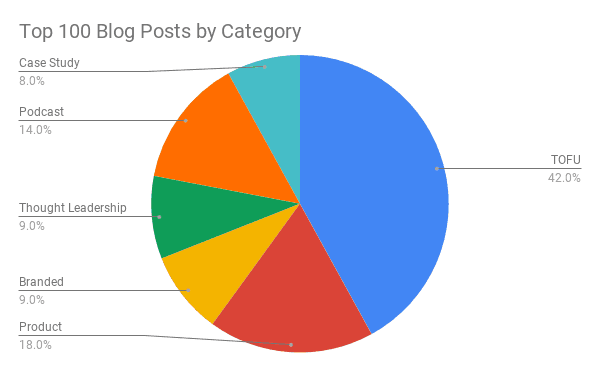
    The PPC and SEO metrics company SpyFu evaluated the content marketing strategy of Drift by evaluating postings to its blog over a two year period. Some of the postings were promotions of non-blog post content: podcasts, webinars, case studies, interviews, events, etc. It then classified all that content into 6 categories – TOFU and a few others that basically comprise BOFU and MOFU.

    Based on that research, SpyFu was able to say definitively (using their own metrics tool) that:

    1. Drift’s content marketing was enormously successful, in terms of traffic and engagement
    2. The success of Drift’s content parallels their publicly reported business success
    3. 42% of their content was (according to SpyFu’s reasonable classification system) “TOFU” 

    Content Strategy Case Study


    Does that mean 42% of your content should be TOFU? Not at all. Even for Drift, what worked in 2018 may no longer make sense in 2020. Now that they lead the chatbot-o-sphere in buzz, maybe it’s better for them to focus more on meaty case studies – or deep-dive product tours into how to create chatbots that don’t annoy the hell out of people.

    Whereas another software firm – Basecamp – probably needs more TOFU in 2020, something that was hard to imagine in 2007. Pretty much 100% of us inside the digital world at least know of Basecamp. I’ve used it on probably 50 projects over the past 12 years and I don’t even like project management tools.

    But what about the broader world’s awareness of Basecamp? After all these years of fame and success, of making the lean, bootstrapped, SaaS business model look attractive, Basecamp now faces challenges from venture-backed upstarts like Monday, which looks like it has more traction. That’s why Basecamp is finally hiring a Director of Marketing ((https://m.signalvnoise.com/basecamp-is-hiring-a-head-of-marketing/ we’ll see how this 180k investment stacks up against Monday’s 180 million in venture fun – most of which is being wasted on Google Ads)) to counter Monday’s multi-million dollar ad spend.

    Your business – are you Drift or Basecamp? Should you work on the top or the bottom of your funnel? ((Do you even have a funnel? By the way, the way the funnel concept work holds that you actually have a marketing funnel whether you think you do or not.))

    It depends. But I will say this – I wouldn’t sacrifice quality for quantity and variety. So in theory, your minimum viable content marketing strategy expressed as a 1-year editorial calendar will look like this:

    • January 31st – publish remarkable, targeted, engaging case study with word-of-mouth sharing potential

    In reality, though, it’s not that simple. Because the one thing I haven’t talked about yet is that the more often you publish content, the better your content marketing gets. If you only publish one thing a year, I will bet money it’s going to be less effective than if you publish some kind of content, with some kind of frequency, around that one great thing. That’s partly because high-frequency publishing gets you a little more clear on what helps your audience learn – what format, what length, what subtopics, what frequency, etc.

    But even if you can’t marshall the resources to create with consistency, you can design an editorial calendar.

    Take action:

    • Start with a 50% / 30% / 20% (top, middle, bottom) content marketing funnel. Remember, top attracts new people to your site, middle gets them interested, bottom makes them want to buy.
    • Adjust each part of the funnel by 10 to 20% according to your business needs – do you need more people to know about you? Or do you need those who already know about you to become more engaged? Or to actually talk to you about buying?
    • Take 5% t0 20% of your annual time and money budget and spend it on content. 5% if you’re coasting. 20% if you’re growth-focused.
    • Divide that time and money up into content production assignments over the next 12 months. Make a list of all the kinds of content you want to produce
    • At the same time, start marking up a content marketing calendar
    • Revise the last two so that they make sense next to one another

    I know this is hard work, but you have to start somewhere. Reply and let me know what’s on your new editorial calendar!

    My best,
    Rowan

    PS. I will be out early next week as I continue my travels but will pick up pen and paper again on Wednesday. I hope this longer than usual post makes up for my absence


  • Why us?

    Speaking of unretirement, starchitect Frank Gehry is 91 and continues his daily work – making cityscapes slightly weirder and more interesting. He’s currently overseeing 12 design projects worldwide.

    Gehry may be global (I once waited in line for 3 hours to see his newly released Bilbao Guggenheim from the inside) but he won’t work just anywhere in the world. ((http://nymag.com/intelligencer/2020/01/frank-gehry-in-conversation.html)) He says:

    “We’ve been asked to do stuff in Saudi Arabia. I went there a couple of times, and they tried to be nice, but it was somewhat insulting. They offered me lots of projects, and they said, “Pick a project, you design it, bring us the design, and if we like it, we’ll pay you.”

    That’s not winning without pitching. Amazing that one of the most sought after creative professionals in the world is asked to pitch his work for free.

    So it’ll keep happening to us, too, then, even if we build up a body of work as impressive as Frank Gehry’s.

    What to do if you are selling complex products or services and asked to give free samples – design comps, product trials, code critiques, analyses of data, lengthy consultations, etc? 

    Change the conversation. One approach is what Jonathan Stark has articulated better than anyone as the “Why Conversation”. To avoid conflation with the Five Whys Conversation, and to be more precise and less me-focused, you could also think of it the “Why Us Conversation?”.

    The conversation answers the question, “Why us: why are our two businesses a good fit for one another – or not a good fit?”

    And it gets there through several why sub-questions.

    • Why do anything at all?
    • Why do that now?
    • Why do you want me to help you do it?

    The last one is tricky because the answer can be, “I’m not sure yet”. Which is why it comes last – it comes after you have had the chance to discuss the other why questions. Those consist of basic why questions like:

    • Why not just do nothing at all? What would happen if you did nothing?
    • Why not use an “off-the-shelf” software product to do this?
    • Why do this now and not in a year?

    And then slightly more advanced why questions, like:

    • This project could be costly – why pursue it? Why not just cheap out on Fiverr?
    • If this goes well, what will the result be in 2 years? ((Protip: this is related to, if not equivalent to, what Blair Enns calls the value conversation https://2bobs.com/podcast/mastering-the-value-conversation. It takes intangibles though – lots of practice, confidence, and (in my opinion) examples of prior work you’ve done that closely resemble that profitable 2-year result.))

    The basic set of questions makes you explain the need to act; the advanced set speaks to the value of taking action.

    If you can show that you understand the answers to these questions, then you can talk about the final “advanced why” question:

    “Given what we’ve established so far, why do you want my business to help you do this?”

    If both sides take the time to work through these answers, a fair fee based on value can be reached without one side having to give something away for free.

    What if that doesn’t work?

    It may there are too many unknowns to answer the question, “Why us”, especially on the customized services side.

    That you can’t say for certain whether there is a good fit. This doesn’t mean there isn’t a good fit, it just means you don’t know whether there is, what it is, and you can’t price it. But you suspect there could be.

    If you suspect there’s a good fit, other options can be presented – a productized service or a self-service product. With these options, you are basically saying, “Here’s something that solves most (not all) problems for most people like you.” And it does so at a fixed price that is probably going to be lower than custom services or implementations of software products that are based on a close fit.

    For both sides, a productized service represents less risk and less value. It’s also a longer-term way to determine whether a deeper and custom engagement makes sense.

    Meanwhile, follow Frank Gehry’s lead and don’t give it away for free. (Yet give away as much helpful, non-customized knowledge as you can).

    Yours,
    Rowan

  • What’s Your Dictionary?

    business dictionary

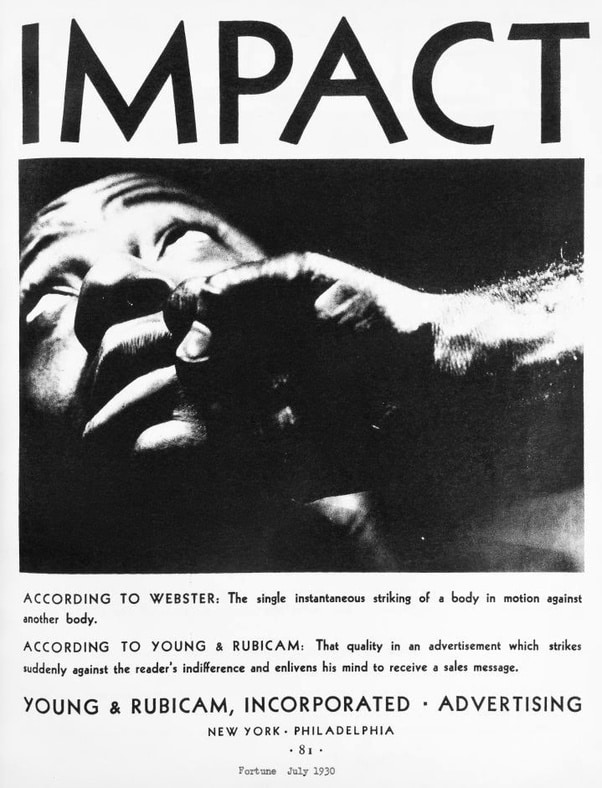
    ((Raymond Rubicam was one of the only ad agency entrepreneurs to run ads for his own business. He ran ads in Fortune magazine for 30 years. In the ad pictured, he proactively defines a term, rather than letting his reader or Webster decide what it means.

    And BTW, he makes a VERY strong case for the value of advertising per se, and for his agency’s ability to exploit it.

    One more thing – Rubicam wrote his own ad copy until he was in his 80’s, long after he’d become scandalously wealthy. So never let a consultant tell you that writing copy is “hands work” ))

    I have no data to back this up but my gut is that Google is now our most used dictionary.

    Or at least our most used dictionary search tool, since Google doesn’t create its own dictionary – instead, it just indexes content from other dictionaries and publishes it at the top of its search results.

    One of the dictionaries Google partners to be our de facto dictionary is the Oxford University Press (which now calls itself a “language provider”). ((Google uses Lexico, which uses “language” created by lexicographers at the Oxford University Press. Or at least it uses their definitions, via an API; the “Oxford dictionaries” don’t really exist anymore, or so they say. Except for the OED))

    (Sidebar: This is becoming Google’s monopolistic approach to the entire profitable Internet – buy or partner with a successful company, then put that at the top of its search results, defrauding the competition).

    The Oxford University Press publishes the mother of all English-language dictionaries, The Oxford English Dictionary (The OED).

    The OED is distinct in that it contains not only the etymology of every word in the English language but its first recorded usage. If you think of every etymology as a story, then no book has as many stories as the OED. And understanding these stories, you get a deeper sense of a word’s many shades of meaning.

    So Google’s dictionary search results must be amazing, right? 

    Nah. The search results that the Oxford University Press gives Google are just the minimum viable product, trimmed down to its leanest, most-consumable size in the aggravating style of Dictionary.com or Miriam-Webster online. 

    Look at the definition of “strategy”, for example, google.com/search?q=strategy:

    “a plan of action designed to achieve a long-term or overall aim.”

    Pretty stingy, Google and Oxford University Press.

    Especially compared that with Harry Mintzberg’s definition of strategy in his book, Strategy Safari:

    • Strategy as plan – a directed course of action to achieve an intended set of goals; similar to the strategic planning concept;
    • Strategy as pattern – a consistent pattern of past behavior, with a strategy realized over time rather than planned or intended. Where the realized pattern was different from the intent, he referred to the strategy as emergent;
    • Strategy as position – locating brands, products, or companies within the market, based on the conceptual framework of consumers or other stakeholders; a strategy determined primarily by factors outside the firm;
    • Strategy as ploy – a specific maneuver intended to outwit a competitor; and
    • Strategy as perspective – executing strategy based on a “theory of the business” or natural extension of the mindset or ideological perspective of the organization

    Now that’s a definition you can sink your teeth into. Learn from.

    Can you really do justice to a complex concept like strategy with the short definition Google offers?

    No. But dumbing it down is profitable.

    ((Interestingly, the Mintzberg’s definition of strategy is culled from Wikipedia, which is now a *distant* second place for the search word “strategy”. When there is a profit motive, Google is sneakily finding ways to displace Wikipedia as the #1 search result, a palce Wikipedia has occupied for about 15 years))

    What does this have to do with marketing and ideation?

    We all use words every day in business, whether we think of ourselves as marketers or not. And those words contain our ideas. That’s why Harry Mintzberg created his own definition of strategy (as I have myself, for digital strategy). In “A Technique for Getting Ideas”, James Webb Young puts it best:

    Thus, words being symbols of ideas, we can collect ideas by collecting words. ((James Webb Young also said, “The fellow who said he tried reading the dictionary but couldn’t get the hang of the story, simply missed the point that it is a collection of short stories.” This is in fact the concluding sentence to his book, A Technique for Getting Ideas))

    That’s why marketing copy loves statements like, “There’s a lot of confusion about what the term ______ means. People think it means ____, but actually think it means ____”.

    Sometimes this is done to try to “own” definitions of business terminology. The way that Joe Pulizzi tries to own the definition of content marketing.

    That’s a good marketing strategy in and of itself. But you really can’t do that because there’s never just one definition of any given term. Consult the OED: If a word doesn’t have more than one shade of meaning, no one actually uses it.

    You can only own your definition and use it to better communicate your ideas.

    And if you have strong ideas about your business, then there are words that will come up over and over. Words like strategy, implementation, analytics, migration, framework, analysis, discovery, etc. And these words are key to your marketing, especially your content marketing.

    Have you ever had a conversation go like this?

    “Well, wait – what do you mean by strategy in this context?”. Or, “Ok, but how do you define agile?”.

    You’d think the answer would be, “Look it up in the dictionary!”

    And it may be. But that answer ignores several key points:

    • There is no one dictionary-to-rule-them-all and never has been ((And as Abe Lincoln advised, you should always look up a given word in at least two dictionaries anyway))
    • You may be using the word in your own way, to describe your own business idea. And your idea might be a little different from someone else’s.
    • Many of the complexities of our highly technical businesses just don’t exist in dictionaries.

    So instead of saying, “look it up in the dictionary” ((Counterpoint, people should consult dictionaries more – at least as a starting point)) your answer to, “What do you mean by that?” is often you winging a definition. But “winging it” has a negative connotation for a reason.

    Just because you know what your idea is doesn’t mean you can describe it in words for me.

    So write it down. When you’ve written down your definition of a term beforehand, you go from ad-libbing to sharing your own little piece of intellectual property.

    A conversation about complex products and services and how they are used often involves multiple, “let’s define that means” moments. And subsequent negotiations between the parties involved: “Ahh, I see what you mean by dynamic integration now; I have a slightly different definition but let’s use your definition for the purposes of this conversation”.

    And it’s not just an advantage in sales; you should also create solid definitions of your business ideas in your marketing copy and content. Each idea a building block for future ones.

    That’s one of the reasons I created my own dictionary of terms. ((But the best example of creating your own dictionary is captured in the image that comes with this post. That ad was written by Raymond Rubicam, founder of Young & Rubicam, now a part of the WPP conglomerate, which also owns Ogilvy, along with 600 other agencies.))

    Take action. The next time someone asks you, “what do you mean by X?”, make a note of it, go back to it later, and write your own definition. Or definitions. You may answer the question not just for your audience but for yourself.

    My best,
    Rowan


  • Hot day at the beach in Scandinavia

    The most theatrical sauna I’ve been to seats about 80 people and requires, by custom, silence – unless you have a poem or verse memorized and would like to recite it. That’s the tradition at the Oregon Country Fair’s private sauna for staff.

    That happens in the Summer but as I write this, it’s the middle of Winter – where in the US do you go for a hot day at the beach (besides Florida or Hawaii)? You might go to a sauna. It’s not the beach on a hot day, but in some ways, it’s better.  The acoustics are better for reciting verse, for example. There are other advantages but the point is that rather than being a weak imitation of the beach on a hot day, the sauna is something different, with its own merits.

    As we move into a digital era, riding the coattails of digital marketing and other online efficiencies, we have to look for parallels to the sauna vs hot-day-at-beach dynamic.

    In the realm of psychotherapy, therapists who are used to delivering their services in-person experiment with “teletherapy” delivered over the phone or video (quite different experiences).

    As with remote consulting and online learning, our initial assumption was that neither party needing to travel was the primary value driver of teletherapy. And it perhaps still is. Online therapy has been seen as a convenient but lower-value version of in-person.

    But therapists and their patients discover ways to embrace online therapy and discover its merits. Just as all of us can embrace the benefits of online consulting, down to its most minute details:

    • A phone conversation can be more revealing than an in-person meeting (or a video conference). 
    • A video conference can bring people’s faces closer together than during an in-person meeting
    • It is more natural to record online audio/video conferences than in-person meetings; together with improving transcription services, online consulting creates resources that can be revisited and mined in ways that meetings cannot be
    • Online meetings come with the ability to easily share computer screens back and forth – and links sent in chat
    • Online meetings can fairly easily scale to 15 or even 150 people, using a product like Zoom at least, the upper end of which is very difficult to achieve in-person
    • Using the right audio technology – on both ends – we can actually make ourselves heard and understood more easily than in many typical in-person venues

    Of course, phone and online meetings can also be disastrous in ways that exceed even the worst in-person meeting. Especially if you don’t practice them. 

    Jason Fried has said that if you’re going to start a remote company, at least 50% of your staff should be remote. In other words, you don’t want an almost entirely in-person workforce with a couple of outliers on the horizons. They’ll be isolated because the rest of the team won’t know how to communicate with them.

    It’s the same with therapists and consultants who primarily do their work in-person. If they use the Internet as an afterthought or special use case, they won’t develop the necessary skills to turn it into a sales and marketing asset, not just a pale imitation of the so-called real thing.

    My best,
    Rowan