Entries

  • You’re the CMO Now

    Are you a CMO? Another trick question – to which the answer is yes – if you have any sort of leadership [1] role in your business. 

    At least according to Ad Age which says, more brands are ditching the CMO position.

    Other leadership roles are filling that vacuum, taking on a more cross-disciplinary approach (examples cited: President of Brands, Chief Growth Officer, Chief Experience Officer, Chief Brand Officer, etc).

    Ad Age is concerned with the bigger “brands” that fall somewhere between the Fortune 500 [2] behemoths and the top 10,000 funded startups [3].

    That may not or may not be you – or you may not even sell products and services to companies on this list.

    Regardless, it affects you and it means something for your business right now.

    Consider the discussion points Ad Age has identified to help explain the disappearing CMO trend:

    •  “We’re at that tipping point where we’re trying to decide what marketing really means in this era” (Keith Johnston, Forrester)
    • The word “marketing” … no longer encompasses all that goes into building brands and growing revenue
    • CMO’s were all about outbound marketing … now it’s all about having a conversation with the customer being two-way
    • Marketing has become a balance of left-brain, right-brain. It’s no longer all about creative

    A caveat: to some extent, this whole article is about “corporate governance” and business strategy – how do a board of directors and the CEO of enormous organizations design C-suite leadership roles like CMO? And more to the point – what does that mean for execs at big ad agencies that read Ad Age?

    Interesting questions but not ones I’m concerned with.

    But some of the problems Ad Age identifies here do apply to niche knowledge businesses, like yours and mine.

    • First of all, what the hell is marketing? Good question. I think everyone should make their own definition. Especially if you have decided you, “don’t like it” [4]
    • Whatever marketing is, it indeed requires a balance of the left and right brain
    • Outbound marketing kind of sucks (not always actually, but that’s for another email)
    • And as Seth Godin pointed out many years ago [5], marketing is now two-way

    Hopefully, most of this is a given but it still requires careful contemplation as you allocate resources to growing your business.

    But what’s most interesting to me about this article is this sentence: 

    One reason some companies have moved away from CMOs is that the role, in some cases, lacks financial accountability.

    I don’t know about you, but that’s a sentence I can relate to. Because I’m at least partly concerned with the financial aspect of marketing: will it result in more leads, more demand, higher prices, longer client relationships, a healthier financial future for my business?

    If you’re a leader in your business, you’re the CMO now. [5.1]

    And as CMO, you are responsible for original, ideas-driven marketing that creates financial benefits.

    Ideation seems like an abstract concept, a luxury. It’s not – it’s subject to financial accountability.  At its core, marketing ideation is a profitability accelerator.  A way of surviving and – hopefully – thriving.

    It’s how our Homo erectus grandparents started imagining technology (handaxes) when they looked at rocks [6].

    If we know one thing for sure, it’s that marketing and business development has to eat, breathe, and sleep with (literally, in my view) a continuous supply of original ideas. And those ideas have to be pretty good or better. 

    Congratulations on your new role as CMO!!

    Here’s to sleeping with good ideas,

    Rowan


    FOOTNOTES 

    [1] I like Blair Enns’ off-the-cuff definition of leadership, “directing people to better versions of themselves …  the idea is the focus is entirely on the other person and helping them get to a more beautiful place”. https://2bobs.com/podcast/four-segments-of-new-business

    [2] it’s always interesting to look at trends here… did you know that the fourth biggest employer in the US is Yum China Holdings? It employs 435,000 people https://fortune.com/fortune500/

    [3] This is just the US… which may not be so useful. You can browse some of the data with a free account https://www.crunchbase.com/hub/united-states-companies#section-overview

    [4] If you really don’t like marketing, try defining – and thinking of it – like this: teaching. Teach people what you do and how it can help them. Et voila, you’re marketing. (Seth Godin paraphrase)

    [5] Permission Marketing is the cornerstone of inbound marketing, content strategy, and other ideas that define modern digital marketing. If you don’t have time to read the book, https://www.amazon.com/dp/0684856360, try the blog post https://seths.blog/2008/01/permission-mark/

    [5.1] BTW, don’t tell me that you don’t know enough about marketing – because you’re talking about tactics and tools. NOBODY knows everything there is to know about marketing to tactics and tools. Every years, hundreds if not thousands of new tactics and tools enter the market. The question is whether you can teach people what you do and how it can help them transform.

    [6] One of the joys of living in London was getting to see in person one of the most disruptive technology innovations ever, the lower paleolithic handaxe https://www.britishmuseum.org/research/collection_online/collection_object_details.aspx?objectId=1477908

  • A Little Idea

    “God is in the details”, said Mies Van Der Roh. But did he end that statement with a period?

    When I examined the bold claim that machine learning outperformed human copywriters, I noticed instantly that this competition was flawed.

    Why?

    Because the human in this competition ended his or her headline with a period:

    “Access cash from the equity in your home.”

    This means that the machine had an unfair advantage.

    Here is a small piece of advice for you… 

    Don’t Use a Period in Your Headlines or Messages

    Why not?

    Because periods make people stop reading – that’s the reason usually given, and it’s true.

    But for two other reasons – a period after a headline reduces comprehension and it can impart hostility.

    You’ll often see a quote ending in a period, but a quote is not a headline. A quote is self-contained; it is its own content. Whereas a headline exists only in relation to something else.

    Headlines are everywhere – I define them as simply, “the most visible phrase in a given user interface, digital or not”. Examples include the title of a blog post, an email subject line, or the classic example, an ad.

    Data scientist Daniel Starch established that periods didn’t work well in headlines by doing analytics on a vast data set – 5 million direct mail advertisements.

    In 1930. We figured this out long ago.

    Speaking of History

    Sidebar – in From Dawn to Decadence, Jacques Barzun established beyond any reasonable doubt that the lifestyle we enjoy today was pioneered in the 1880s.

    In a very real sense, you and I live an 1880’s lifestyle: separate residential and commercial zones, mass public transport, ubiquitous electricity, indoor plumbing, networked communications/news, elevators for multi-story building use, mass office work, knowledge workers, urban anonymity/angst, etcetera.

    Of course, that’s been reshaped a little by mass automobiles, airplanes, the labor movement, the ’60s, and other technological and cultural novelties. But not much. Even the Internet culture has only slightly modified our basic 1880’s lifestyle. Interestingly, it has done so with respect to the period, which I address down below.

    Anyway, if we’re living in the 1880s, it should come as no surprise that much of what we know about modern digital marketing was discovered in the 1920s.

    To bring it back around, we have known about the period a while.

    But it wasn’t until the 1970’s that we started to figure out why the period doesn’t work in headlines. David Ogilvy commissioned a research study found that it had to do with – counterintuitively – comprehension levels. 

    When you encounter a headline with a period, you assume it stands on its own two feet. So you try to reexamine it until it makes sense. But it might not make sense, not until you read the rest of the content it goes with – that’s how some headlines work (eg “curiosity headlines”).

    So with the caveat that all rules are made to be broken, here’s a slightly bigger but still small idea: be very skeptical of hiring a marketer who uses periods in their headlines – and in their chat/messaging communications with you.

    And not just because of marketing concerns but because of emotional intelligence concerns: periods can be hostile.

    Linguistics Has an Opinion 

    Over the past 12 years, multiple scientific, peer-reviewed studies1 have been published establishing the hostility and rudeness of using periods in messaging.

    Of course, in a multi-sentence message, they are needed for clarity. But they are not needed to end a paragraph and are certainly not needed in single or fractional sentence messages.

    In a 2016 New York Times interview, linguist and author David Crystal, has come right and said it – the period is now just a harsh emoticon:

    “The period now has an emotional charge and has become an emoticon of sorts. In the 1990s the internet created an ethos of linguistic free love where breaking the rules was encouraged and punctuation was one of the ways this could be done”

    I can attest to the historical veracity of this statement.

    And it’s not just hostile, it stops the flow of interaction, just as advertising researchers discovered for periods after headlines.

    Consider the following:

    Well, no further thoughts on the subject

    Versus:

    Well, no further thoughts on the subject.

    The respondent to the latter message is somehow less invited to respond. If they do respond, more effort is required. A justification is required.

    To this point, another linguist named Mark Liberman has remarked in a New Republic interview:

    “In the world of texting and IMing … the default is to end just by stopping, with no punctuation mark at all … In that situation, choosing to add a period also adds meaning because the reader(s) need to figure out why you did it. And what they infer, plausibly enough, is something like ‘This is final, this is the end of the discussion or at least the end of what I have to contribute to it.’”

    I think that’s a good note to end this letter on.. but let me know if you have further thoughts on the subject

    Rowan


    FOOTNOTES

    1 Here are direct links to three peer-reviewed studies on the period https://www.sciencedirect.com/science/article/pii/S0747563215302181https://www.sciencedirect.com/science/article/pii/S0747563217306192, https://www.researchgate.net/publication/258153166_Text_Messaging_and_IM_Linguistic_Comparison_of_American_College_Data

    Also, the Guardian’s Joel Golby published an amusing analysis: https://www.theguardian.com/technology/shortcuts/2015/dec/09/science-has-spoken-ending-a-text-with-a-full-stop-makes-you-a-monster

  • What AI Software Do You Use for Marketing Ideation?

    Here’s the Ad Age headline that caught my eye a few months ago, “Chase Commits to AI After Machines Outperform Humans in Copywriting Trials”. 

    I follow the subject of AI closely enough to know that someday, this headline could be dismissed: “Obviously“.

    But I also know that such a day is probably really far off. Like The Really Big One that will hit the Pacific Northwest, a wise, self-aware AI entity, with human level intelligence, might manifest in 15 years – or not for another 150.

    This meant there had to be a hole in this headline, because copywriting is just writing.

    And writing is not chess and it’s not a self-driving car. It’s not a science, at all – no matter how scientific your measurement of its impacts.

    In fact, performance marketing itself really only exists in theory. You can never, ever fully measure the impact of marketing. All we know is that it works.

    That’s partly because a machine (and people struggle with this too) cannot resolve the essential tension that copywriting usually (not always) deals with: long-term vs short-term interests.

    This tension calls for protecting an organization’s long-term, strategic interests using “brand messaging” while maximizing impact in the present using “conversion copywriting”. 

    By the way, can you guess which of these two Chase digital ads got more clicks?

    1. Access cash from the equity in your home.
    2. It’s true—You can unlock cash from the equity in your home

    A human copywriter, we are told, wrote #1, while  #2 was written by a machine learning algorithm provided by a machine learning software company called Persado, with whom Chase has contracted.

    Of course it was #2 – a rigged test? Who knows.

    But despite my skepticism, I was interested in this story because I know that we’re all of a sudden deep into the era where AI (or Machine Learning, actually) is our extremely useful assistant, in so many walks of life, banking, driving, healthcare, and on and on.

    It’s already in use in Gmail, LinkedIn, and – quite a bit more interestingly – on Crystal app. And two of those tools are used at enormous volume around the world in marketing and in business.

    Machine Learning for Ideation

    Reading deeper into the article, the implication of the headline (that machines write better copy than human copywriters at Chase) is contradicted. As it turns out, the machine language software in questions hasn’t replaced anyone’s jobs. 

    But it has served as a useful ideation tool.

    Chase plans to use Persado for the ideation stage of creating marketing copy on display ads, Facebook ads and in direct mail, according to Yuval Efrati, chief customer officer at seven-year-old Persado. He says that the AI company works alongside Chase’s marketing team and its agencies.

    When asked if the new relationship will impact staffing at Chase in terms of downsizing or changes, a spokesman for the bank said, “Our relationship with Persado hasn’t had an impact on our structure.”

    With that context, the article makes a lot more sense. Machine learning software as an ideation tool – a tool for seeding the human mind with the thousands of little ideas to make marketing work over an extended period of time.

    This is similar to what SEO/AdWords keyword concatenation tools do, such as https://kombinator.org. Like most “AI Software” firms, Persado claims to do a lot more than concatenate; it uses NLP to evaluate and predict ideal word usage. 

    I’m sure there’s something to that; it’s something any business owner should be aware of.

    What’s Next?

    So how do you harness machine learning for your marketing ideation if don’t have Chase Bank’s R&D budget or marketing technology budget? Persado is not open source.

    Not a rhetorical question – I really have no idea. I do think you have an enormous opportunity to leverage analog ideation approaches.

    But there’s no point in ruling out software wherever it can help.

    Maybe we just wait until machine learning starts showing up within accessible marketing technology like MailChimp and WordPress and Google Docs; it’s already part of Google Ads, which writes ad copy for you, if you want, in much the same way that Persado describes its products behavior: through text analysis and acquired learning.

    So does another Google product – Gmail, though I’m not sure it’s solving for inspiring action in your favor, as Google Ads supposedly is. Maybe Gmail thinks what you want is for people to be less – not more! – likely to respond to your emails.

    Meanwhile, most of the ideation-for-ideation’s-sake software (IdeaScale, Spigit, Qmarkets) seems to offer a digitalized version of the office-hallway “idea box” that employees drop anonymous notes into. 

    That approach is probably not leveraging machine learning in a significant way. And really not doing much more than facilitating a large, low-energy brainstorming effect.

    I haven’t done an exhaustive analysis here, though, so correct me if I am wrong, but “Idea Management” doesn’t really seem like ideation software at all.

    It certainly doesn’t square with my concept of ideation for marketing and business development: condition your individual mind to produce as many new, valuable ideas as it can within given project constraints.

    That’s pretty much the straightest path to creating a marketing strategy that will yield more revenue than whatever somebody else is doing.

    But let me know if you have something better up your sleeve..?

    Best,
    Rowan

  • 1000 Little Ideas

    it takes hundreds if not thousands of little ideas to create a single big idea
    – Bryan Collins, The Power of Creativity

    I also wrote about ideation in this rambling, 20,000-word review of “A Technique for Getting Ideas”, a book first published in 1965.((

    It’s really hard to find a good copy of A Technique for Getting Ideas unmarred by low-budget production. The digital copies I’ve seen were apparently transcribed from print because they are so full of typos, formatting, and grammatical errors that sometimes the meaning is lost. 

    Thus, I made my own copy on Google Docs: https://docs.google.com/document/d/1cPwK-1Av2PJGYj5X5br-djwEdCN_EzFIYJv74kd6i0o/edit. Feel free to comment on it, as I have over the past couple of years. Bear in mind that I took the enormous liberty of revising the chapter outline, though, and inserting chapter titles… that’s the beauty of open source.

    )) This was an attempt to reconcile the book’s approach to ideation with marketing. Not hard since the book was written with advertising in mind. Like its 1926 predecessor Art of Thought, is beyond marvelous. 

    Why the emphasis on ideation in your marketing?

    Because approaching ideation in a systematic way will help you with:

    • content strategy
    • copywriting/UX
    • product design
    • paid advertising

    I’m probably leaving something out here, but the point is it makes all these things produce better results – because all these things require a consistent flow of good ideas. Lots of little ideas over a few big ones.

    This lets us to get away from copying formulas of others – and move towards ideating our own formulas for doing these kinds of work.

    Case: Outbound Email Marketing

    Take outbound email marketing as a case in point. Let’s count how many little ideas are involved.

    To dive right into the particulars, when you reach out to new prospective clients via outbound email, you customize your opening line, even while the remainder of the email – and even the entire outreach sequence – is templated.

    That custom opening line should not be something shallow, common, or formulaic, which is the usual approach. It should contain an original, creative idea related to the business or person you are writing to.

    Put yourself in the shoes of the recipient? What will spark your interest from a stranger?

    If you write 20 such outreach emails per week, that’s 20+ new ideas. Factor in email subject line ideation (a good rule of thumb is to test a new subject line every 10 or so email sent), and you can see the direction in which we’re headed. 

    Over a year, that’s 1000 little ideas.

    And that’s not even counting the prospecting and campaign strategies that got you your outreach list in the first place.

    If you practice ideating on an iterative basis, a daily basis, you’ll be more likely to produce good ideas – and the X number of execution hours you invest in execution will yield much better results.

    In summary: there is a direct relationship between how seriously you approach ideation in your outbound marketing and how many leads you actually generate from it.

    1000 Exceptional Business Ideas

    Have you ever heard the saying, “Ideas are a dime a dozen”?

    Completely false.

    At least when taken at face value – what this saying actually means is, “stop talking and do the work”. Which is often a good point.

    But ideas are not a dime a dozen – at least not ideas that are valuable in a business context.

    Counterpoint #2: you need a lot more than a dozen ideas to make your marketing work. In the example above, we needed at least 6 dozen valuable ideas just to run a one-month email outreach marketing campaign.

    Not sure how you value your time, but unless you produced those ideas in a fraction of a millisecond, I’m guessing those ideas cost you hundreds or even thousands of dollars worth of effort. A lot more than 6 dimes, let’s put it that way.

    Case: Facebook

    So-called “big ideas” are overvalued compared to the aggregate outcome of little ones. Was a Facebook a big idea? Not really. It was just a hyper-niched down version of Friendster and MySpace; it was a classy MySpace for Harvard University students.

    There was no big idea; there were some medium ideas, such as “make the interface templatized and clean, unlike MySpace”, “make the product psychologically addictive to increase ad revenue”, and “just run AdWords to monetize until we sort out our ad network”.

    But nothing truly innovative, like the original Napster, or like Wikipedia.

    It was those 1000’s of little ideas that made Facebook enormously successful.

    I guess that relates somewhat to why daily publishing makes sense – if it communicates ideas ((

    One of my favorite passages from A Technique for Getting Ideas is about words-as-ideas:

    Another point I might elaborate on a little is about words. We tend to forget that words are, themselves, ideas. They might be called ideas in a state of suspended animation. When the words are mastered the ideas tend to come alive again.

    Take the rather recent work “semantics” for example. The chances are you will never use it is an advertisement. But if you have it in your vocabulary you will have a number of symbols which will be of very practical value indeed.

    Thus, words being symbols of ideas, we can collect ideas by collecting words. The fellow who said he tried reading the dictionary but couldn’t get the hang of the story, simply missed the point that it is a collection of short stories.

    (The OED: the world’s largest short story anthology)

    )). If I can give you one little idea that will help, then my work is done. Not saying I’ll keep this up for 1000 days though (:

    Warm regards,

    – Rowan

  • Pricing Value with Ideation

    Pricing, like value, might fluctuate more than you think. Two experts from both the consulting and SaaS worlds agree on setting prices based on value. Find your value pricing through ideation.

    What is the most money you have ever paid for a book? Why do airline ticket prices change daily but not the value of what you provide? Is the value of what you provide magically constant, day by day?

    And what is value anyway…? Ok, I prematurely digress, but let me answer the first question.

    I was given a book, the Oxford English Dictionary, “worth” (whatever that means) about $400 dollars once, but the most I ever paid for one was $200 – Pricing Creativity by Blair Enns.

    Actually, I got more than a book.. I got the 5 digital downloads of the book and a sort of glossy binder manual that now sits on my desk.

    Absolutely remarkable book, even if you’re not “in business”, let alone in marketing, consulting, etc.

    I “bought” another book for $0 that was almost as good – SaaS Pricing Strategy, by Patrick Campbell. SaaS Pricing Strategy is shorter and really more of an ebook but it’s terrific –  one of the most engrossing PDF files ever penned.

    Pricing Creativity is about pricing as applied to creative and technical consultative services; SaaS Pricing Strategy is about applying pricing to subscription SaaS software and mobile apps.

    Each of these pricing books is interesting to me because firstly, my last name is Price and I – aha, just kidding! This post isn’t about nominative determinism.

    No, it’s interesting to me – preamble – that tech products and tech services are two sides of the same coin, different ways of solving the same kinds of problems.

    Jonathan Stark’s The Pricing Seminar really drives that idea home, albeit through a kind of sneaky, socratic teaching method. By the way, it starts on Monday and I’d recommend it.

    So it’s interesting to evaluate both types of solutions, products and services, through the lense of pricing.

    But it’s also interesting because creating (revenue) growth for a product using marketing strategy, something I’ve worked on, seems like a pointless exercise unless pricing is considered.

    The four p’s of marketing: product, promotion, place, and price. Bit dated but worth mentioning them now and then – the digital world is so focused on promotion that product and pricing fall off the radar.

    Nothing wrong with changing your pricing, either; you could change it every single day, like a stock price, or the aforementioned fluctuating airline ticket.

    Pricing is something you should “edit” when you are about to design and invest in a digital marketing campaign, let alone build an ongoing digital marketing program.

    How to think about pricing 

    Rather than fix the price, decide on a model for setting fluctuating pricing over time, in response to various factors, foremost of which is understanding your customer and the evolving ways in which she uses your product.

    This truth bears out in the marketplace. If you look at, say, 50 of the top SaaS products under the lense of the archive.org’s wayback machine, you see a constant changing of pricing (with a few weird exceptions, like Slack – they nailed it the first time). 

    Which makes this the perfect place to insert Patrick Campbell’s definition of pricing:

    Pricing is the exchange rate on the value you are creating 

    Speaking of value..

    Blair Enns says the same thing, basically, in Pricing Creativity: that the best model for pricing services is value.

    In fact, both books are predicated on the assumption that price be based on the value the solution creates. 

    And of all the pricing models, pricing on value requires:

    1. the deepest understanding of your customer
    2. the most creative thinking with respect to how you constitute and convey your offers
    3. the most research, due to items 1 and 2

    And that is where ideation becomes so valuable, especially with services but more so than you’d expect with products.

    There’s no limit to the ways in which digital products can be packaged and priced.

    The trick for your SaaS product then is systematically uncovering as many of those ways as possible, to set yourself up to “pull a Slack” – and get your pricing right the first time.

  • Making the Complex Simple

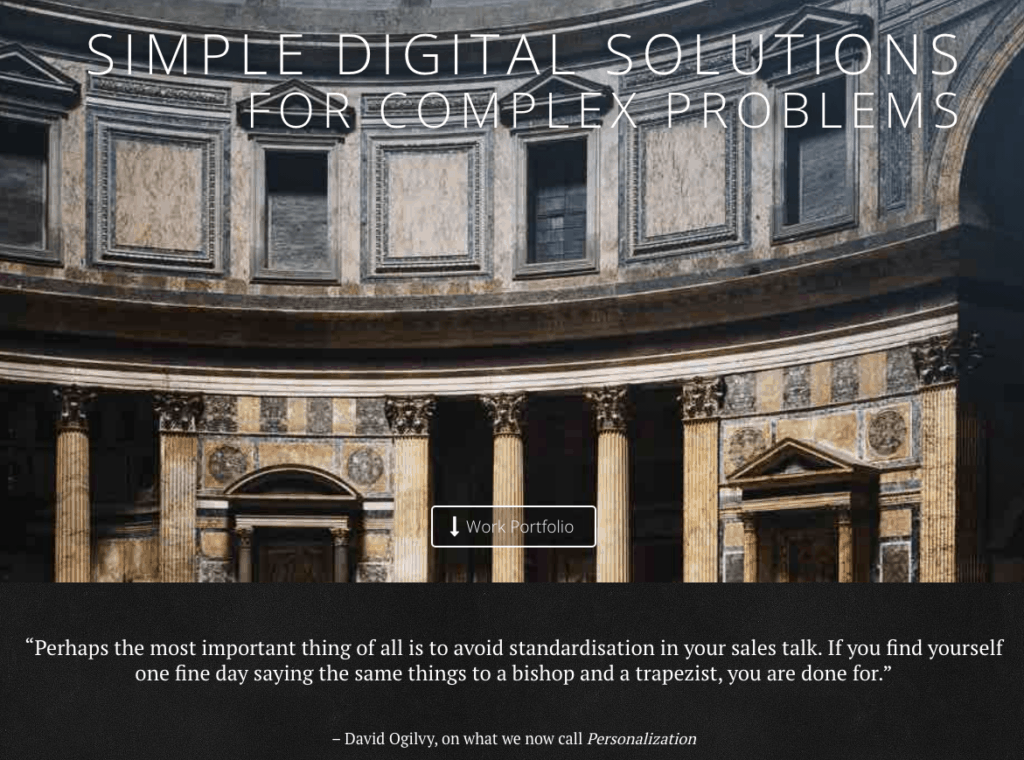
    Making the complex simple – a good way to describe the process of writing slogans, yet a terrible slogan by itself. 

    Yesterday I tried to empty my mind of everything I know about ideating slogans for niche B2B tech firms – at least at a high-level; I spared you the fascinating details… thank you, thank you.

    To suggest how you might approach writing a slogan for your business, or product, or type of service, I shared a worksheet revealing the classic “worst possible idea” creativity technique.

    The #1 Worst Possible Slogan Idea? We Make the Complex Simple

    Perhaps if you were the only business on planet earth who made “the complex” (whatever that is) simple, then it would be a good slogan.

    But google it; there are literally hundreds of thousands of businesses using this slogan or a close variant thereof. It’s what people use to call a “meme” before that word was repurposed to describe homemade cartoons.

    By the way, I should know – the website for my practice fell into this my trap, and not too many years ago. Pretty good David Ogilvy quote, though.

    The worst part about this slogan is that it doesn’t establish your positioning – what do you make simple and for whom?

    Mini-Teardown/Takeaways

    • If you don’t have a slogan, then your headline becomes your de facto slogan, as in the example above
    • Your headline is there to trigger action, not, as the slogan is supposed to do, describe what your business does
    • If you don’t have a call-to-action, you’re crazy. Viewing a “work portfolio” is not the worst call-to-action, but it’s pretty weak

    Start with your slogan, and the other key pieces of your messaging start to fall into place. But I digress.

    Actual Takeaway – Brand messaging is a backwards exercise in positioning ideation

    Sure, it’s not the most thorough approach.

    But then didn’t Steve Jobs say, “You’ve got to start with the customer experience and work backwards to the technology.” There’s something to that as applied to crafting messaging.

    That’s the thing about positioning as a business exercise – if it doesn’t yield serviceable messaging and copy, then what’s the point? 

    David Ogilvy was with Steve Jobs on this one – he knew that messaging by itself is the purest form of business strategy. And that if you can’t put a message in front of a client it’s an incomplete thought.

    That’s partly why he wrote ads until well in his late 70’s, even though he was already a billionaire by the point. Writing was his method of entrepreneurship; it communicated for him at scale.

    Not saying write the slogan to find your positioning exactly… but it’s a good way to refine or reconsider it.

    It’s a good way to think about how exactly you plan to actualize your vision of the future state for your corner of the world.

    Takeaway II – Ideation is a systematic form of problem-solving

    Placing a bunch of ideas on a grid, as I did in the slogan worksheet, takes you from “coming up with an idea” to actually ideating.

    So that you systematically explore all (or damn near all) of the possible good ideas you can produce given whatever standard project constraints you are faced with.

    In that sense, it’s an exploration, just as a detective might identify all possibilities in a whiteboard with thumbtacked photos and pieces of string… AKA murder board, crazy wall, concept map, relationship chart, entity relationship model, mind map, flow chart, organigram, idea chat, linkboard, graphic organizing chart, or working wall.

    Sidenote – did I spend two hours obsessively compiling every possible synonym for a detective’s whiteboard? Why yes, yes I did. Now you know how I like to have a good time!!

    By the way did you know that detective whiteboards are rarely used nowadays to solve crimes?

    Why? Office space is now too expensive in high-density areas where heinous crimes occur. So they use a specialized form of ideation software instead… but I’ll save that for some other post.

  • Practical Slogan Ideation Advice

    Question – are you a slogan writer? That was a trick question and the answer is yes.

    At least in a sense, as long as you:

    • Have a LinkedIn profile
    • Accept the premise that a slogan, at its core, is just the phrase that you most often see next to a brand’s logo

    Because on LinkedIn, the phrase most often seen next to your personal brand’s logo (your photo and name) is what LinkedIn labels your “headline”. And you probably wrote it.

    I don’t know too much about writing slogans for LinkedIn profiles, but I do have experience writing slogans for complex, niche technology businesses.

    I want to take you through the creative process I’ve used to write slogans. I’ll aso share a Google slide worksheet (link down below) that helps explain the mechanics of this process. 

    First though, some useful base operating assumptions related to coming up with slogans for niche tech brands:

    • Most people in your target market have probably never heard of you
    • Even if they have heard of you, they probably can’t describe what you do – at least not in the way you’d like
    • If you don’t use a slogan, people will make one up for you in their head

    Based on those rules of engagement, here’s my general advice on slogans:

    1. Firstly, always use one; not to use a slogan is a tragic missed opportunity. Never let your logo out the door if it’s not wearing a slogan
    2. Write it as a description of your business; a good starting point is “X for Y positioning” – parts 1 and 2 of this 7-part brand messaging formula. 
    3. Make it complement and extend the message contained in the logo
    4. Be as pithy as possible, but don’t be afraid of a long slogan
    5. Don’t be afraid to be boring – conversely, don’t attempt funny, cute, or catchy. That’s for consumer brands.
    6. Don’t design your slogan – write it. Write it with zero regard with how/whether it complements the existing visual design elements that are part of your brand.
    7. Lastly, don’t be afraid to iterate new versions of your slogan as your business – or at least your positioning – evolves

    Armed with that advice, let me share with you some of the specific techniques I use to ideate slogans:

    • First, review customer interviews for words they use to describe you. This is a high-value opportunity for you, because no one else ever does it
    • Look at examples from similar firms. Browse the usual directories: Crunchbase.com, Clutch.co, AngelList, etc. Let me know if you notice any patterns.
    • Write or rewrite slogans for a couple of business similar to yours, asking yourself, “What is the essential thing I need to know about this company?”, as if you were cataloging these companies in your notebook for future reference
    • Look at other slogans in completely different contexts – consumer brands, slogans written in different languages, slogans written a century ago, slogans belonging to fictional brands in movies, books, and TV shows

    Ok… that’s an abbreviated ideation research process. Now down to the actual mechanics:

    • Put together various “X for Y” slogan ideas. I like to use a 3×4 grid, to create 12 slogans. I also like the technique of writing not just “good” slogans, but “bad” slogans. Bad, or “worst possible”, ideas can be thought-provoking – not always, but in this case yes
    • Here’s a really important tip on mechanics – write the slogan “in place”, right next to your logo. You may have a visual designer improve on your work, but try to make it pleasing to look at for you
    • Select a few slogans you like from the two steps above, then write them out by hand; try using your non-dominant hand, and let yourself alter the slogans as you write them out. Alternatively, try holding your pen “on side”, as does an artist who works with paint
    • Print everything out – look at printouts and at your handwritten notebook before you go to sleep

    To understand this process, I’m providing you with a link to a worksheet from my free email course on marketing ideation. Feel free to make a copy for yourself.

    If nothing else, the work described up to this point will yield plenty of slogan ideas – the last parts of this process including choosing what ideas to choose to think about, and refine, and finally what ideas to present back to your group (co-workers, partners, clients, customers, etc.). That peer review piece is so important to all this work, of course – thank you so much for your thoughts on that!

    Curious as to your thoughts on the example slogans in the worksheet itself – what makes the BAD ones bad? (Assuming you agree that they are bad).

    We should also discuss some of the ideation techniques built into the worksheet so you can extrapolate them from this process and apply them to the kind of creative work you do.

  • Ideating the Perfect Slogan

    Ideation in marketing (or other creative pursuits) is just a way of thinking that improves your output.

    It helps you improve a product’s welcome screen; product sells better. Or it helps you write a better slogan; product sells better. Yeah, ideation is a sales tool.

    It’s more than that, of course – it’s also repeatable behaviors that induce a consistent flow of “business-valuable” ideas over a period of time – a campaign, a quarter, a year, even the lifespan of a business.

    But at its core, it’s a way of thinking, just like “critical thinking”, which David Foster Wallace discussed in his “This is Water” speech. My paraphrase:

    Critical thinking is not how to think but what to think, or more to the point – how to choose what to think about

    If you know mindfulness meditation, you’ll recognize it here – that once you quiet your mind, you realize that a neverending stampede of mostly stupid ideas runs through it.

    But prime your mind properly with ideation, and worthwhile, non-stupid slogans synaptically appear.

    The question becomes, which thoughts do you choose to think about? Choose the right ones and you’re halfway there.

    Sorry if you were looking for practical advice on writing slogans!! In my next post, I’ll give you five tips (but maybe they’ll be ideation tips in disguise).

  • Group vs Individual Ideation

    On the “Solving Interesting Problems” episode of Akimbo podcast, Seth Godin said, “Interesting problems are solved by groups”.

    I couldn’t agree more (the “but” comes later). Seth even cites the example of people who seem to solve problems by themselves: scientists. 

    Scientists’ work may be conducted in a solitary way, but it relies on the work of a larger group – the other scientists who provided scientific building blocks. One scientist won’t have found a cure for cancer; 10’s of thousands  will have.

    Peer review encodes group participation into problem-solving.

    But… before peer review, the work is solitary. 

    For me this is how it goes: the more time spent alone, the better the solution.

    This might be just me – maybe what I do (marketing for tech firms) requires activities that are foolish to delegate or which can’t be done by a group. A few examples:

    • Gauging the emotional state of a prospective “user” of a product
    • Evaluating demographic data for patterns 
    • Writing something persuasive to a particular individual

    That’s all individual work.

    Of course, there’s immense value (ie valuable ideas) to the “peer review” process, to exposing one’s work up to a group. 

    But meanwhile, in marketing tech solutions at least, valuable ideas come from individual labor, more so than the group.

    What about in your work?

  • Is Reading a Book Market Research?

    How do you figure out how to design your product, market it, sell it, and constantly improve on it. In other words, how do you ideate?

    Research. The bedrock of ideation.

    So two days ago, I wrote about conducting research and the magical number 30 as a sample size. Then yesterday I wrote about “think different” by hacking software, citing InboxCollective’s usage of Google Slides as a CMS. (Sidenote: with the departure of Jono Ivy, has Apple moved from innovator to status quo-holder?).

    Writing about research was enlightening just because I realized how little I knew about how to do it according to a structured framework.

    Reading Books as Research

    Historically, my typical approach with regards to research for client work is to read, scoping the volume of reading to the length and duration of the engagement. Ideally, I read a “starting point book” and hopefully use that book’s bibliography to conduct further reading.

    When building a marketing and recruiting platform for a Big Pharma client for example, I read a book about the history of the clinical trial industry (as depicted in the racy HBO series) and another about Alzheimer’s and genetics. Along with a great deal of “further reading”. But that was an enormous project.

    For a small engagement, my reading may be limited to a handful of articles, summaries from peer-reviewed research projects, or excerpts from books. The last of the three is ideal, I think, because who puts more effort into what they say than a book author?

    Books as Evidence of Research

    In some books (anything by Richard Francis Burton, for example), the footnotes comprise further reading in and of themselves, almost like Talmudic commentary, though this is a sadly infrequent occurence. In Burton’s A Personal Narrative of a Pilgrimage to Al-Madinah and Meccah, for example, we hear not just a travel tale, but an entire lifetime of study and research into “the Orient”, as the Middle East was known -its food, economy, government, customs, and more, along with study of Islam, the Haj, etcetera.

    Consider what another writer, W. H. de Winton, once said of another of Burton’s books, a translation The Scented Garden (sort of a Middle Eastern variant of the Kama Sutra):

    So far as I can gather from all I have learned, the chief value of Burton’s version of The Scented Garden lay not so much in his translation of the text, though that of course was admirably done, as in the copious notes and explanations which he had gathered together for the purpose of annotating the book. He had made this subject a study of years. For the notes of the book alone he had been collecting material for thirty years, though his actual translation of it only took him eighteen months.

    And if you ever read one of his books, you will think the same – the enormity of Burton’s research becomes obvious, and the annotations start to form a parallel novel within the novel. The sheer enormity is erudition is so overwhelming as to be disorienting, as is the case with Jacque Barzun’s Dawn to Decadence.

    These two unusual authors did much broader research than any Nobel Prize-winning scientist ever has. And maybe more research period, in the case of Barzun, who seems to have never to have been without a book until he died at the age of 102 (he wrote his best and largest book, Dawn to Decadence, at 95).

    Two problems though – these writers, for all the research they did, is it the kind of research we need to do to get business insight?

    Because business insight – into (A) how to reduce risk ( hat tip to Philip Morgan) and (B) how to ideate solutions – is the goal here.

    And with that goal in mind, Richard Francis Burton levels of research seems impossible. We don’t have time. Also…

    Does Reading a Book Actually Comprise Research?

    Like me, you probably don’t have 30 years to research your market. Or even time to read a book.

    But is reading a book really the best way to “research” with the goal of gaining business insight?

    Is “reading” even research per se?

    Technically, no it is not research. It’s the interpretation of someone else’s research, usually. And some business books are a fantastic example of the value of conducting one’s own research.

    Think of Peak: Secrets from the New Science of Expertise, by Anders Ericsson. What makes the book so compelling, whether you agree with its conclusions or not, is that it’s based on original research conducted by the author himself.

    Ericsson cites, for example, the research he did with Berlin musicians, from music school students to virtuoso soloists in one of the world’s most prestigious orchestras, the Berlin Philharmonic Orchestra. He finds a strong correlation between ability (expertise) and time spent practicing in solitude. In fact, regular solitary practice is a stronger indicator of expertise than total hours of practice per week.

    Having established solitude as an indicator of expertise cultivation through his own research, he goes on to explore other walks of life for more evidence of the same, sometimes not even using structured research to do so.

    Can you imagine if he’d written two hundred pages of opinion not backed by original research? It would fall quite flat. Somewhat less offensive is using others’ research. This can work very well, or very poorly, depending on how often that research is used.

    Be it fiction or non-fiction, any book editor will tell you that original research is fundamental.

    In Conclusion:

    • Research is essential to cultivating business insight
    • Reading a book is a great “starting point” for research
    • But reading a book is not research in and of itself
    • But many non-fiction books (“business books” or not) are excellent examples of the value of research
    • Original research > secondary research > no research

    So where does that leave us? We need a way to conduct lightweight, structured research. If you have any ideas about how to do this, let me know.