What I want you to give me is 20 insights that emerge from your expertise as applied to a particular focus… As you read your list of 20 things to me, nearly off the top of your head, will I have some aha moments? Will I learn something? … If you can’t articulate your expertise quickly and concisely and in a compelling manner, it’s just simply not true.
~ David C. Baker
I base my feeble-by-Bakerian-standards list on about 10 years of experience in technology, marketing, and fundraising consulting to the nonprofit/NGO sector. It skews towards US-based 501c3 organizations, which by no means represents the entire sector – I also worked for associations, healthcare orgs, political groups, and higher ed.
(I also wrote another “20” for B2B firms, partly based on my experiences owning and growing a marketing technology agency that served nonprofits.)
Here’s what I’ve learned.
Most organizations write most of their content by committee; this is the Achilles Heels of the nonprofit sector across most of the major verticals.
On a related note, “content production” (how writing is often described) is often relegated to ghostwriters and junior staffers. When it is performed by experts in senior positions, it’s not done so within the context of a cultivated writing practice.
A nonprofit’s need for a Mission statement is pronounced but that doesn’t mean it has to be exhaustive or laborious. In fact, all of these things can be efficiently expressed in a compelling way: values, purpose, mission, and vision.
Simon Sinek’s “Start With Why” approach to marketing is a good methodology for defining a purpose statement and makes for good about page copy. A nonprofit’s about page can be very compelling and is a wonderful opportunity to engage potential supporters.
Most organizations are large and complex enough to justify multiple strategies; that’s OK. Devise as many strategies as the company’s mission statement logically dictates you do, and find ways for them to complement one another.
Nonprofits often conceive of other nonprofits, NGOs, or government agencies, as their competitors. In fact, the for-profit world is their competition, particularly businesses who target discretionary income or leisure-time attention. Society spends only 2% of its GDP on social welfare.
The goal of a website redesign is to improve the ability of your organization to communicate clearly and inspirationally to your audience. The goal is not to look good, be impressive, be funny, or be memorable, or be creative.
Copywriting and the art of content creation are severely undervalued, relative to UX design and strategy. This is even more pronounced in the nonprofit verticals than elsewhere, given a) a cultural ethos that draws an invisible line between strategic thinking and writing and b) a lack of supporter/donor focus in written materials.
All websites are content marketing tools, first and foremost. Some are only content marketing websites and nothing more. Most nonprofits tell impact stories at the point of engaging with a digital agency who recommends they do so, instead of as the result of systematic internal processes.
Your website doesn’t need a blog for it to be a successful content marketing or fundraising website. It’s about 10x easier and more practical to publish a news feed than a blog. It’s also much less risky.
Publishing a high-value, lead generating blog costs $30,000 per year, to start, in equity effort (approximately 20% the output of a senior staff member, plus UX, design, and content marketing costs). Outsourcing the writing of a news feed might make sense; outsourcing blogging rarely does.
Nonprofits often invest in redesigning their entire websites when they might be better off rewriting them (and for a much more modest investment).
Email marketing is the highest-ROI marketing function that a nonprofit’s website supports but each communication should be presented as a one to one conversation moving forward.
CRM has been broadly adopted by the nonprofit sector but it’s still underutilized as a mechanism for unifying marketing, fundraising, and development efforts. At its core, CRM is not a technology; it’s a practice that aligns a nonprofit more closely with its supporters.
Paid advertising is widely under-utilized in most nonprofit verticals; even if you don’t have a Google Grant, paid advertising might make sense. If you do have a Google Grant, make sure you optimize for it. Think of paid ads the way David Ogilvy encouraged advertising professionals to think of them: signposts in a crowded market, helping connect one person to another.
Contrary to conventional wisdom, it is impossible to accurately and objectively measure the performance of advertising; also A/B split testing is over-rated because of the high cost of ownership. Also, testing itself requires gut calls and experience to conduct well, just like writing survey questions. It’s one of those “you’ll know when you’re ready” things – if you’re unsure whether you should be testing performance, then probably you shouldn’t be.
Every organization should understand how it is perceived and described (and what its competition is) by analyzing the search keywords that their audience uses to learn about the issues they want to own.
SEO is still broadly misunderstood and underutilized. Especially the art of link building, which is not about being devious but about making meaningful value-connections. Exploiting SEO is an opportunity to unify supporters with their causes and a strategic imperative for most organizations.
Every organization should be able to perform their own cold outbound marketing to generate development leads and SEO value backlinks, using some kind of refined list-building technique.
Positioning was originally conceived by Al Ries as a brand messaging strategy for mass market B2C brands to deal with the information inundation of the day (the mid-20th Century). It’s now more relevant than ever for causes competing against millions of for-profit brands for attention. “Cause positioning” should be able to answer this question: what do you do, for whom do you do it, why do you do it, and – most importantly and most often neglected – how does your audience ultimately shape that formula?
What I want you to give me is 20 insights that emerge from your expertise as applied to a particular focus… As you read your list of 20 things to me, nearly off the top of your head, will I have some aha moments? Will I learn something? … If you can’t articulate your expertise quickly and concisely and in a compelling manner, it’s just simply not true.
~ David C. Baker
Not sure if I measure up to those inspiring standards but I do have something to say (much to the chagrin of friends and family!). These insights apply to services consultancies with business customers and skew towards digital agencies, where I have 18 years of experience, including co-owning and growing a marketing integration consultancy.
(BTW, I wrote another “20” for nonprofits, the sector I served during most of my agency career).
Positioning is the most important process an organization or individual can undertake. It’s more important than branding, or brand messaging. Who cares what your personality is if it’s not clear what you do and for whom you do it? You should probably get objective, outside help to understand your positioning, especially if it’s “crosshair’” positioning: horizontal + vertical. What is the problem you specialize in solving and for whom?
A “Reason Why” is a “Purpose Statement” and can make for very compelling web content. In fact, a statement of values (and the purpose, mission, and vision statements that it spawns) don’t have to be boring. Your mission statement is the right place from which to derive your strategy
A written strategy is a form of conversion copywriting in that it inspires action, in addition to prescribing it with logic.
Do we even need to prefix strategy or marketing with the word digital anymore? No. Everything is digital so the term is redundant. Just marketing or strategy will do from here or at least be a valid substitute. Now you, the digital agency, have expanded your practice area by choosing the right description of what you do.
The goal of a website redesign is to improve the ability of your business (or your clients’ businesses) to communicate clearly and compellingly with your audience. The goal is not to look good, be impressive, be funny, or be memorable. UX design should not be noticed (though photography should be).
All websites are content marketing tools, first and foremost. Some are only content marketing websites and nothing more.
Your website doesn’t need a blog for it to be a successful content marketing website. The only functionality that a content marketing sites needs is whatever helps users find content – navigation elements, search, taxonomy, email opt-ins.
Some websites can also deliver value by offering useful features and functionalities to a specific set of people. Facebook, for example. These websites are essentially web-based products, even if they are a product of one.
The creation and launch of content marketing websites doesn’t need to take more than one week.
The creation and launch of product websites doesn’t need to take more than one month, and should never last more than three.
Email marketing is the highest-ROI marketing function that is supported by a website.
SEO is still broadly misunderstood, even by marketing or digital agencies. Especially the art of link building, which is not about being devious but about making meaningful value-connections. Exploiting SEO is an opportunity and a strategic imperative for most agencies.
Paid advertising is widely underutilized in most verticals; establishing a limited paid advertising practice is advisable not so much for agencies, but for their clients.
Every business should understand how it is perceived and described (and what its competition is) through analyzing search keywords.
Account-Based Marketing is a buzzword that is also a high-value idea. It should probably be the goal of your future marketing efforts if your ideal client has 20 employees or more.
Every business should be able to perform their own cold outbound marketing to generate leads, using some kind of refined list-building technique.
List-building can be used for many purposes: understanding your audience better, creating a cold email outreach list, creating a cold phone outreach list, creating an in-real-life outreach list, creating an SEO backlink list. Even if you have a steady client flow, you should still do some list building, and you should pass this advice on to your clients.
It is impossible to accurately and objectively measure the performance of advertising; also A/B split testing is over-rated because of the high cost of ownership.
A web presence without one or more landing pages is a missed opportunity. Also, it’s advisable to target SEO traffic (or any kind of traffic) with landing pages but this is hardly ever done.
“Business people – with the exception of a few clients I’ve met – are human beings” – Drayton Bird. In other words, it’s not the messaging that sets B2B marketing apart from marketing to consumers; it’s the market strategy.
“Once properly positioned, building your target list of prospects to whom you will be most compelling and relevant should be easy.
~Blair Enns
I was skeptical when I first heard this concept. Build a list? Why? To ask strangers for business – rather than rely on word of mouth?! I built a 23-person tech consulting firm on word of mouth and relationships. For years, I never even contemplated a prospect list, let alone cold email outreach. Well, I was a dumb business owner because word of mouth leads only last so many years. And they’re unpredictable.
At some point, you have to get proactive about your business development. To do so, you need to use software designed for effective lead generation.
Not only should you be able to build a list but you should build one “now” – at a moment’s notice. Even if you don’t think you need it now. There is no such thing as too many identified prospects and acquiring them doesn’t have to break your bank.
So if you don’t have that B2B prospect list on hand right now, keep reading.
By the way, while list-building can be used for many purposes (including an SEO backlink building campaign) this article is about building a list to reach out to via cold/lukewarm email – with the intention of introducing yourself as an ideal services provider. It mostly deals with Sales Navigator, but also considers several other tools and resources.
This is a very long article, so feel free to skip ahead
By the way, we’re not talking about known quantities here, such as businesses connected to family and friends, or businesses belonging to people you’ve met. Those ones should already be on your list.
What we’re talking about are organizations you may have never heard of – and vice versa.
The first step is a matter of mental conditioning – finding the right mindset. Ask yourself, “why am I taking this step”.
Answer yourself this: to provide people who you can help with the opportunity to benefit from your services.
That may sound manipulative. But it’s true – your doing this to help. Get in touch with that mindset.
But am I the kind of person who needs a B2B prospect list for?
But but. Emailing or calling people you don’t know, to sell your own services? Is that even legal? Is ethical? Yes and yes, as long as your intention is, per the mindset conditioning above, to create value. Not just value for yourself but for whoever is on your list when you reach out to them.
They used to call it direct marketing and do it by postal mail. Here we’re calling it B2B direct marketing. It’s not the only way to market what you have, but it’s a valuable tool in your arsenal.
For the purposes of this article, we’re going to be building an email list. Which is because I have very little experience with cold calling, though this kind of list building is more commonly used for that purpose.
Why is B2B prospect list building a valuable tool?
Because it can be a way to regulate the demand for your services and create predictable growth, as opposed to the kind of haphazard growth that comes from word-of-mouth marketing. Inbound marketing based on SEO (perhaps the most powerful and cost-effective type of lead generation there is) is also unpredictable.
The first and most important step in this process is deciding what type of person should be on your list. For me, that means owners of B2B products and services firms who need help with marketing strategy and lead generation, in particular.
The Role of Positioning in Building a B2B Prospect List
For some of you, your product speaks for itself (or at least it should if it’s well named, designed, and packaged). It’s pretty obvious what your positioning is if you’re selling dog waste bags made from organic, earth-friendly materials. But what if you’re selling a service or software-as-a-service – coaching, recruiting, social media marketing, event planning, SEO, web design, financial planning?
As a general rule, you probably have to be a little more specific than that. What kind of recruiting? What industries, what geographic region. What kinds of events do you plan and what do you do exactly in your role as an event planner?
Bad positioning
The more specific you are, the easier it is to build your list.
It’s obvious when you think about the absurd extreme on the other end of the spectrum. What if you put nothing more than the word “bags” on your box of biodegradable doggy waste bags.
Now, who would buy that? A friend or family member might if they knew the box contained amazing eco-friendly dog bags.
But would you buy a box of “bags” from a stranger? Of course not. So don’t be a plain box of bags. Qualify your services with some level of subspecialty and set yourself apart from the other 10,000 “SEO consultants” out there.
That’s a very rudimentary overview of positioning, but hopefully, I’m making the point. All marketing is difficult with good positioning; direct marketing to strangers is damn near impossible. For more about positioning, read any of the many things that Blair Enns has written about it over the years. Ten tests of your positioning, for example.
If you have what Blair and others call “vertical positioning”, then you’re in luck when it comes to building a list because vertical positioning gives you an industry to search through. As he puts it in that article
The importance of positioning becomes even more obvious when we look at where to find data.
Ok, so I’m Well Positioned. Now what?
Now comes the fun part, for me at least. This is the hunt, the databases we mine for your prospective clients. Where we do this hunting depends a lot on your positioning, but here are a few possibilities:
For local-based services, Chamber of Commerce websites or other Business Associations
For national or international services, websites like Crunchbase or ProductHunter
Commercial business listings providers, such as Experian, Data.com Connect (as Jigsaw was cleverly[?] re-branded after Salesforce bought it), or melissa.com.
Audience data providers (offering granular demographic and psychographic prospect enrichment data), such as AudienceScience and BlueKai; there are dozens of options and each one is quite different. If you’re running a multi-channel cold outreach campaign that combines in-person or direct mail contact, audience data providers can provide terrific insight.
Attendee lists of conferences in your industry (protip: look for sponsors as they tend to have more money); also tradeshows.
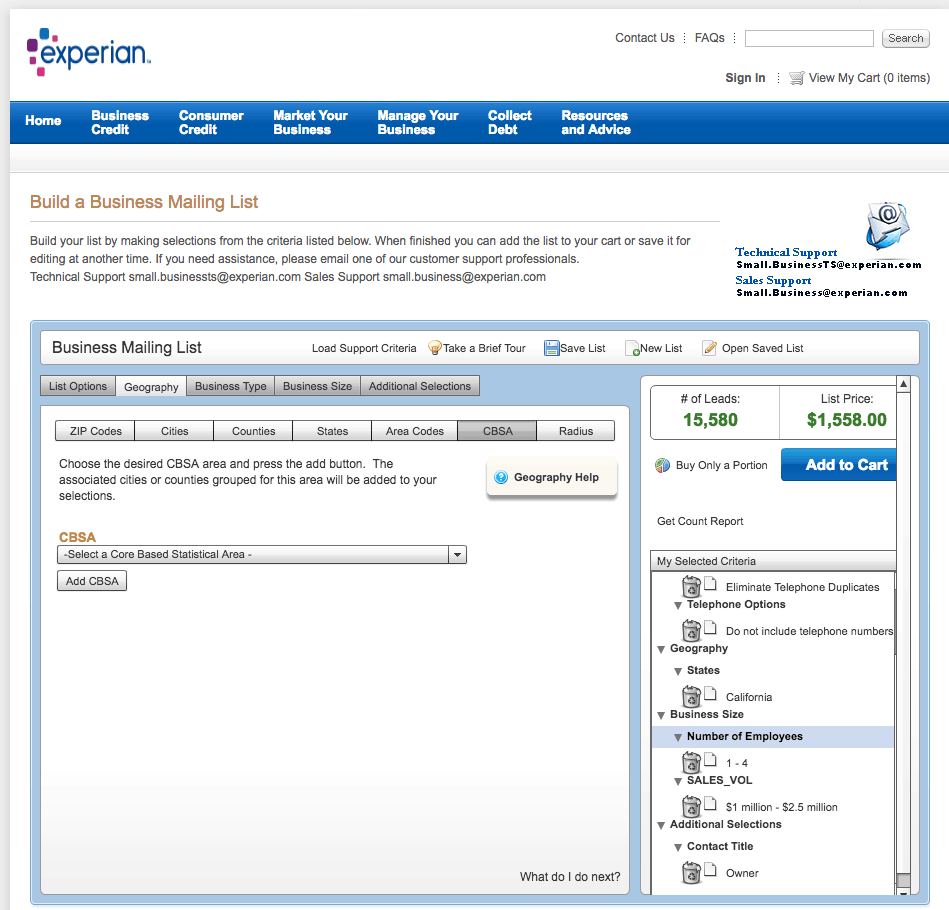
Experian will sell you a list of owners of small coal-industry firms who are doing well.
And that’s just scratching the surface. Some people buy “pre-built” lists too. In the example to the left, Experian will sell you a list of the owners of every profitable small business in the coal mining industry in the state of California ($1500 for about 15,000 prospects). It uses the SIC categorization system, which I discuss later in this article.
If you have something very useful to those business people, you might be able to turn a profit on that $1,500. Especially if it’s something especially useful to people in the coal mining business.
A word about buying lists. It’s really not immoral to buy lists, in my opinion; especially from vendors of commercial business listings. People confuse buying “done-for-you” lists and buying “pre-built” lists (“done-for-you-and-any-other-sucker”).
What’s really unwise is buying those”pre-built” lists. Why? Mostly because you’re paying too much. Then you have to spend the time to qualify the lists manually anyway.
With a little work and research, you can probably build a better list yourself than commercial providers can give you. That’s especially true if you’re in a rapidly evolving industry, unlike coal mining, which is what my ancestors did when they came from Wales to a British colony known as Georgia in the mid-1600s. What I’m trying to say is that some businesses, like coal mining, have been around a lot longer than others, like being an Instagram influencer.
That’s why we’re talking about building your own, positioning-derived B2B prospect list. In a sense, you are designing it, curating it, shaping it… for high conversions. And that brings us to one of the most effective listing building tools on the market, LinkedIn.
Building a B2B Prospect List Using Market Segmentation
In the old days, and still today, the business landscape was segmented by a system called SIC, “Standard Industrial Classification”. In fact, Experian and many other commercial providers of list-buying services allow you to filter their business listing by SIC code. SIC is a well-intentioned attempt to categorize all businesses in existence by 10 groupings and 89 subgroupings.
Undoubtedly, thousands or millions of marketing campaigns have been run against prospects lists segmented using SIC codes over the 80 years that it’s been in existence. And while it will still work for some industries (the SIC code for anthracite mining is 1231, FYI), SIC is showing its age.
SIC is an inadequate marketing segmentation system in the digital era, but NAICS is hardly an improvement
Actually, SIC was already showing its age before the digital era. In 1977, in response to a more dynamic, fragmented economy that saw the rise of small businesses as a major driver of the United States economy, a new system was introduced, called NAICS, the North American Industry Classification System. The newer NAICS system continues to be widely used today. In fact, it is in use by none other than… LinkedIn!
But that’s not what makes LinkedIn probably the best database available to build a custom, manually curated B2B prospect list. In fact, it’s because LinkedIn doesn’t rely on NAICS that it’s such a valuable resource.
One more small qualm with SIC/NAICS (which are both provided to you courtesy of the American taxpayer-sponsored Bureau of Labor): it mostly applies to the US and Canada, so if you’re targeting the global marketplace with those tools, you’re out of luck. So while understanding your audience within the context of NAICS is a wonderful exercise, there are probably better ways to segment your audience.
Using LinkedIn Sales Navigator to Build Your Outreach List
If you were waiting for the catch, here it is: this entire post is predicated on building a list not using just LinkedIn, but LinkedIn Sales Navigator, which costs $80/month. That adds up over a year, so you might just want to try the one-month free trial. Catch #2, though, is that list-building takes practice and you’re definitely not master it in a month.
At least you’ll have a better idea of whether this could be an effective lead generation strategy for you, however.
As you may know, LinkedIn allows you to search for “People”. With Sales Navigator, that ability is extended by (a) unlimited searches, (b) the ability to save those searches as exportable lists, and (c) the ability to filter your search by an extraordinary range of demographic segments.
(This is the same reason why LinkedIn Ads is such an effective B2B advertising platform.)
Consider a few all of the search facets that LinkedIn makes available to you, and it quickly becomes clear why LinkedIn is a much more precise list building tool than the SIC/NAICS database or anything else currently on the market:
[table id=1 /]
* these segments only available on Sales Navigator (or LinkedIn Ads)
As you can see, there is an enormous amount of data to build a targeted lead list on. In fact, there is enough to do more than segment by “vertical”. One of the most powerful fields is the title field, probably the most useful field available in the free version, but 5x as powerful in Sales Navigator. Why?
Nuanced Segmentation by Job Title
For one thing, titles are becoming extremely variegated and specific, as job roles take on finer and finer nuances. Consider these common job roles in the software industry:
Programmer
Software Engineer
Software Developer
Software Architect
QA Engineer
Software Consultant
Pre-sales Engineer
Solutions Architect
Some of these titles are close in meaning, some are very different. But in 1980, all of these roles might simply have been called “Programmer”.
Here’s where it gets interesting, though. What if you could target not software architects, but professional who used to be called software architects? Chances are, you have a decision-maker, given that the architect role tends to be a fairly senior one, to begin with. Add in extra qualification, such as:
Formerly held “Software Architect” and “Senior Sofware Architect” roles (implying promotion pattern)
12+ years of experience
Posted content keyword includes “business analysis”
Company size 100 or greater
And chances are you have a high-level technical decision-maker without even knowing her current title.
This example just scratches the surface, but hopefully, you get the idea.
The next step is to get your targets out of LinkedIn and into a CRM.
But we’re missing one crucial step.
Custom, Manual Qualification: Find Decision Makers You Can Help
I would encourage you not to use this technique to gather as many contacts and you can and blast emails at them. I would encourage you not to email anyone that you cannot be of service to either. And when I say of service, I mean your product or service is the perfect fit for them, not just that you think you can (or want to) sell it to them.
This goes back to the importance of positioning that we discussed at the outset of this article, but it goes even deeper than that. Not only should the people in your outreach list fit your vertical (industry, company type) and horizontal positioning, but there should be demographic qualifications.
Does their job title indicate that they’ll understand your services, does their authority (as inferred from the collection of parameters we looked at above, for example) allow them to purchase or recommend your service?
Look at their website and digital presence; based on their blog posts, social content, and other factors, do you see that your services or product are needed?
What you want, ultimately, is a small, fine-tuned list of prospects. Don’t think 10,000, think 10.
And start with one. Thoroughly evaluate your possibilities and identify that one person who might definitely benefit from hearing from you.
Now you have captured the proper spirit of this exercise and are permitted to proceed to the final step.
Assigning Email Addresses to Your B2B Prospect List
Fortunately for you and me, we’re building an email prospecting list, not one used for telemarketing, so we don’t need a phone number, just an email address.
If you make a connection with someone on LinkedIn, you may have access to both, but this strategy is not a LinkedIn outreach one, but a LinkedIn research one. So we need to get the email address by using name and company name for each of our contacts. This is honestly trivial, if time-consuming. Pretty much every work email address in existence is easily reverse engineered using the email permutator.
The idea is that based on first name (Rowan), last name (Price), and company domain name (rowanprice.com), you have about a 99.99% that their work email will be one of the following:
rowan@rowanprice.com
price@rowanprice.com
rowanprice@rowanprice.com
rowan.price@rowanprice.com
rprice@rowanprice.com
r.price@rowanprice.com
rowanp@rowanprice.com
rowan.p@rowanprice.com
rp@rowanprice.com
r.p@rowanprice.com
pricerowan@rowanprice.com
price.rowan@rowanprice.com
pricer@rowanprice.com
price.r@rowanprice.com
prowan@rowanprice.com
p.rowan@rowanprice.com
pr@rowanprice.com
p.r@rowanprice.com
rprice@rowanprice.com
r.price@rowanprice.com
rowanprice@rowanprice.com
Figuring out which is the right one is just a matter of testing.
Respona and other tools
There are plenty of other tools available, including ones that collect actually email addresses off of websites, such as Hunter.io (which has a handy Chrome extension for picking up email addresses when you are investigating your prospects’ websites).
Some of them offer limited list generation features, too, like Zoominfo, RocketReach, and Skrapp.io, allowing you to glean details like address or location (useful in account-based marketing).
If you can identify commonalities among your prospects, you might also think about doing some advanced personalization beyond, “Hi [First Name]”. But that’s not as important as it sounds. Here’s what matters:
There are many tools on the market that let you send cold emails from your own mail service (ie Gmail) that will let you get around the limitation on using an ESP. Quickmail and MailShake are just two examples.
But there’s another category of tool that gives you an all-in-one – prospecting, Gmail-based outreach, and automation. This is the approach used by Respona, an innovative new product that combines fine-grained prospecting with email-based outreach marketing. Respona is used for a variety of purposes, including SEO link building, media pitching, or just old-fashioned lead generation; Respona even has a new HARO-focused feature, greatly simplifying your efforts at using HARO resource for “digital PR”.
Final Step: Don’t Spam, Be of Service
As a final note of caution, please be aware that we cannot use this technique to send commercial appeals in some countries and that even in the US, it’s a violation of the CAN-SPAM Act to use this technique in conjunction with a commercial email services provider.
Whatever tools you use to reach out to prospects – of any kind – the larger point is your approach. Only use the techniques described in this guide in a very targeted, conscientious way: 1-on-1 emails (and this applies equally to asking for an SEO backlink and to asking for a sales conversation). You should have gone over your list and your prospects enough times to have a pretty good sense who they are and what their companies are like. Some of the best practitioners apply cold email outreach to the larger context of account-based marketing, using tools like Outreach.io.
Most importantly, though is, know how you can be of service to each prospect on your list.
I love the word facilitate; it reminds of a care-free youth where student co-op meetings were “facilitated” (not run or managed) by an equal among equals. Now set that image in your mind next to that of a sales conversation between a professional services provider and a business owner and you have an amusing juxtaposition united by our word of the day, facilitation.
In fact, Blair Enns explicitly defines selling as “facilitating the buying process”. And rejects the notion of selling as persuasion.
Meanwhile, copywriting is essentially sales in print. Which is why B2B copywriting’s purpose is to facilitate the buying process, right?
The purpose of B2B copywriting … depends
Two days ago, I wrote about B2B Brand Messaging, where I argued defined it as the practice of defining your positioning in a way that reflects your personality. Because “Branding”, as its used to today, essentially means personality. Betty Crocker, Colonel Sanders, etc. (That’s why you shouldn’t try to define a “personal brand”. You are who you are, just go with it!).
I followed that up yesterday with a reflection on Soft sell vs Hard Sell B2B marketing copy, also relevant to this topic. In that article, I talked about what corporate-copy calls the “Buyer’s Journey”, an attempt to co-opt the customer stages of awareness concepts laid out 50 years ago by Eugene Schwartz (who also said, “This is the copy writer’s task: not to create this mass desire – but to channel and direct it.”). The key point my article makes are
Hard sell B2B marketing has its place
Its place depends on which stage of awareness your customer is at
You can’t know what that stage of awareness is without doing research
So, should you be facilitating the buying process in your copy? It depends; sometimes, you should be actually persuading your reader to buy, or learn more, or be in touch, whatever action is appropriate to where they are in relation to your products and services.
Here’s what those stages of awareness look like for your customers:
Your customer is completely unaware that she has a problem (that you or someone like you can solve)
Your customer is aware she has a problem but doesn’t know how to solve it
Your customer is aware she has a problem and has learned about ways to solve it
Your customer is aware she has a problem, has learned about ways to solve it, and has learned that your business provides those ways
Your customer is strongly considering engaging your business to solve her business’s problems
(Note that there are many ways to express this same concept; many have crafted their own stages – all are some derivation of the concepts laid out by Eugene Schwartz.)
Somewhere between (d) and (e), by the way, it’s appropriate to present hard sell copy; more reasons why, more evidence, more testimonial. And a stronger call to action. In other words, here’s where you really want to focus on “facilitating the buying process”.
Step (b) not so much.
But wherever they are, this much is certain: your copy should facilitate a conversation, if not a sale, between your company and its customer (and the process, forestalling conversations with non-customers).
And if you’re in consulting, also known as the “long-game” or the “50 year” game, because I just made that up, think about your copy as just a few opening remarks in a thousand-page novel.
fin
Postscript: I could have used the annoying buzzword “brand conversation” and I resisted. Your welcome. Brands don’t converse, people do.
Most providers of B2B products and services think they should adopt a light sell for their service. They don’t like the hard sell because it feels bossy and demanding. Hard sell B2B marketing makes them feel uncomfortable.
In fact, Ford made a killing in the 80s and 90s by introducing a car line whose entire value proposition is that it would be extremely soft sell. It was and it sold well for quite a while, despite being a mediocre product for its non-negotiable price.
In fact, there is a bias in business to business marketing against the hard sell. I think this bias exists for good reason. Consider the following stereotypes of business customers vs individual consumers:
Services pitched to business customers are likely to be more expensive and you can’t hard-sell something that’s expensive
Business customers are more sophisticated than consumers or have a cultural bias against commercialism
Business customers are more likely to have researched the product or service they intend to purchase
Mom, get this house now!
Now ask yourself – how true are those statements?
Consider the cost argument – you can’t hard sell something because it’s expensive. First of all, define expensive. Exactly, it’s relative. Second of all define cost. Is it a cost or an investment.
If you see an opportunity for your parents to purchase an expensive home, but you know it’s a great value, do you give them the hard sell of the soft sell.
“Well, you might want to considera home like this one” or “Mom, get this house now!”
When you write marketing copy, and you believe in what you’re selling, hard-selling might be in your reader’s best interests.
People are people, whether at work or not
Is a business customer less more wary of being sold to at work than when she’s in the checkout aisle of the grocery store?
First of all – who cares?
Second of all – it completely depends on your customer.
The cultural bias question is tricky and hard to measure. I was in a pre-contract meeting with a major cultural institution based in Washington D.C. once. One of my colleagues said, towards the end of the meeting, “Is there anything else I can do to make you feel more comfortable buying our services”?
You could hear the tension in the room in the awkward silence that followed. These clients were sophisticated professionals with graduate degrees. They lived lives insulated from direct or even indirect sales pitches. This was a violation.
Or so I felt then. Having reflected on that precise moment several times over the past few years in considering the “salesy-ness” of copy and approach, now I’m not so sure. For one thing, who cares whether a transaction is awkward? Isn’t the end goal to make a match of the ideal customer and their ideal product?
Don’t try hard sell B2B marketing without research
I think I was wrong to conclude from experiences like that though, that a high-sell pitch is a wrong approach. It completely depends on (a) your customer demographics and psychographics and (b) their market awareness.
The buyer’s market sophistication, as established by Eugene Schwartz Breakthrough Advertising, is not a reference to how many graduate degrees your customer has but to their understanding of their own business problem and the capacity for the market to address that problem.
He describes that dynamic using progressive stages of sophistication paradigm as outlined below:
The Most Aware: Your prospect knows your product, and only needs to know “the deal.”
Product-Aware: Your prospect knows what you sell, but isn’t sure it’s right for him.
Solution-Aware: Your prospect knows the result he wants, but not that your product provides it.
Problem-Aware: Your prospect senses he has a problem but doesn’t know there’s a solution.
Completely Unaware: No knowledge of anything except, perhaps, his own identity or opinion.
The general idea is that the sell-quotient should be pitched the prospect’s stage in the buying journey. Stage 2, for example, might be the place where it makes sense to make the hardest sell, providing the most reasons, evidence, and buy-urgency.
This is also an extremely useful lens through which to make a decision about what marketing channel to use, by the way.
But by itself, it’s not enough. Personality does matter. A lot. In the end, people are people. How would you sell to someone you were in a conversation with, one person to another, given everything you know about that person. How hard or how soft would your pitch be?
There you have the answer to how hard to sell in your marketing copy, and the only way to get it is through research.
I do brand messaging, which is the expression in writing of positioning and brand identity.
On the most basic level that means writing compelling words, which applies to every kind of sales and marketing. Sometimes it’s useful to refer to this as just key copy, or key messages. But to really understand how brand messages are composed, you have to understand where they come from:
The mother of brand messaging is branding, also called the process of creating and curating a brand identity.
And the father of brand messaging is positioning.
Without positioning, brand messaging is aimless. Without brand identity, positioning lacks soul. A brand message appeals to the mind and the heart.
Positioning is owning a word in the mind
– Al Ries
A Short Story About Branding
Let’s back up. I talk more about positioning later in the post but first I want to discuss branding, which is the older of the two concepts.
If branding is the mother of brand messaging, what does branding mean? I get asked this question sometimes by people outside of the internet and marketing worlds. People are understandably skeptical
At one point, branding meant holding down a cow and burning its flesh with a hot iron fashioned with a symbol, or initials.
Ranchers branded their cattle to mark ownership in an era when cattle theft was rampant. For more on that, read the Lonesome Dove tetralogy set in frontier-Texas. Or set in frontier-Mexico, depending on your vantage point. In fact, the branding tradition was inherited by Anglo-American ranchers from their Mexican counterparts. The conquistador Hernán Cortez branded his herds with three crosses, an allusion to his religious beliefs. Among both people’s, a brand was one’s name, initials, or often a complex symbol.
Branding is one of those things that’s probably been practiced in every part of the world for a long as animal husbandry has existed.
So it’s not surprising that a brand came to mean a logo. So would you think that “to brand”, the verb, would mean, putting a logo on something? Does your business need a logo? Let’s “brand” your business.
Except that’s not all. When people love a word, they’ll apply it to anything. That’s why we now use the word culture, which use to be a variant of cultivation, to mean “ethos”. So brand and branding kept acquiring new meanings over the years until finally, it made the leap from the small little symbol to … everything, according to Dan Pollata.
Brand is everything, everything is brand.
– Dan Pollata
When I got started in web design and development 20 years ago, branding was not a common term. It was still confined to the design team and even then it was used gingerly. The word “design” was much more common. It did mean something more than design though; it meant creating a personality or a psychological profile and associating it with an organization.
Sidebar on Personal Branding
Like Aunt Jemima and Betty Crocker. So the challenge became unifying design elements, typography, colors, patterns with the brand. And to some small extent, that challenge wasn’t just visual but also behavioral. Is the way a user interacts with a website “on-brand”?
But branding has continued to evolve since then.
Now branding is used to mean expressing your personality, I suppose. And we have this concept of “personal branding”, which Amanda Hess wrote about yesterday in the NYT Magazine. She laments the dominance of branding over our lives
“ But now branding has taken over not just work but life itself, seizing control of our appearances, our social relationships, even our approach to civil society. “
Can’t argue with that. And that’s what makes brand messaging an important practice for someone like me who uses words in their work. Here’s how I define brand messaging:
Choosing the words that accurately describe a company’s unique value proposition but in a way that is consistent with its collective personality.
The starting point is positioning
Speaking of unique value proposition, earlier I touched on the importance of positioning to good brand messaging.
Anytime you practice marketing your services, the first step is to determine (or re-determine fairly consistently) your positioning. As we saw from the Al Ries quote, positioning can be thought of as owning a word in the mind. In the mind of your buyers, that is. And usually more than one word.
Actually, Al Ries, who introduced the concept of positioning to the business world with his 1974 classic entitled Positioning, was concerned with the world’s largest consumer goods products, Coke, Ford, etc. So he really meant a single word, such as “cola” or “sedan”.
But when it comes to complex technical or creative services like technology consulting, UX design, enterprise CMS development, digital advertising, or high-level recruiting, it’s probably impossible to reduce your positioning to one word, let alone own it. A newer generation of positioning experts, like David C Baker, Blair Enns, and Philip Morgan, have expanded on the classic paradigm put forth by Al Ries.
Brand messaging as a way to dress up crosshair positioning
There are several types of positioning, but the most reliable formula is horizontal + vertical, or what is known as crosshair positioning. Crosshair positioning for B2B consulting firms and agencies answers the questions: what kind of problem do you solve and for whom? And by implication, how?
My own positioning, for example, answers that questions as follows: helps B2B consulting and SaaS firms with lead generation – by providing positioning-based SEO and conversion copywriting.
Who is my audience: B2B consulting and Saas firms
The problem I solve: lead generation
How I solve it: SEO and conversion copywriting based in positioning
That’s why I believe every brand messaging initiative, whether one-time or ongoing, has to start with positioning. Positioning is not easy but it makes lead generation MUCH EASIER.
And it provides you with the starting framework for all your marketing efforts: your brand messaging – your keywords, literally.
Throw in your brand identity, the type of company you are, the type of personality you have, the way you speak and now you have a not only a unique value proposition but a distinct and memorable identity.
UX (user experience) design is a fancy word for the age-old practice of layout, meaning how you present written content visually.
And no one – certainly not designers – understands the value of layout as well as a copywriter.
And whenever you make statements like this, it’s never a bad idea to cite Ben Franklin.
After all, few writers have influenced layout and design as he did. And aside from being one of the most important inventors, diplomats, and entrepreneurs in modern history, consider his writing and copywriting body of work:
Poor Richard’s Almanac, the best selling publication in the New World for 26 years in a row. It was sort of like the New Yorker, Wikipedia, and Vice Magazine, all rolled into one
News and opinion for the most-read newspaper (which he also owned) in the American colonies
The slogan United We Stand, Divided We Fall, among many others
The Declaration of Independence of the United States (well, co-authored along with Thomas Jefferson)
We hold these truths to be self-evident, that all men are created equal, that they are endowed by their Creator with certain unalienable rights, that among these are life, liberty and the pursuit of happiness.
So his opinion on how to present writing probably matters.
But did you know that he also wrote advertising copy? He is in fact considered the first American copywriter and was considered in his day “the patron saint of advertising”.
Anyway, forget all those interesting bona fides; here’s what’s most interesting to me: Benjamin Franklin set his own type.
And it appears he had a flair for what we now call “UX design”. A Journalism history publication observed that he “made ads more readable byusing large headlines and considerable white space”.
The importance of “setting your own type” in copywriting
In the digital world, it’s impossible to be an effective UX designer without a strong understanding of technology, especially CMS software, the primary type of software used to create websites and deliver content.
But the connection between UX design and technology expertise is nothing new.
First, what does setting type mean? In the context of printing presses, it simply meant arranging (metal) letters on a printing press to print content onto paper. An enterprising newspaperman might forge his own letters (his own stylized alphabet, in other words), providing control over font style, font-size, and so on.
But even using someone else’s letters, a printer exercises considerable control over the effect of words simply by arranging, aligning, and spacing them on a page.
Today when we write on digital mediums, we accomplish the same task using CSS or a text editor such as WordPress, MS Word, or Facebook provides. These tools let us “set digital type”.
Now, why would the founder of a major open source project (and CTO of an 800-employee company) spend time learning CSS? Because he writes web copy and an essential part of writing good web copy is “setting type” – controlling it’s displayed.
I can’t speak for all writers in the three centuries between Ben Franklin’s 1729 newspaper and Dries Buytaert’s 2018 blog, but I’m officially calling it a trend.
Isn’t controlling type the “job” of the web designer?
The short answer is yes, absolutely. The long answer is yes, but it’s not the exclusive job of the designer.
But the “job of” concept makes us chuckle and reflect, ultimately, doesn’t it? Aren’t all job roles, positions, titles, etc., just abstractions and arbitrary divisions of labor – I wonder what Ben Franklin would have thought between the division of labor between UX designer and copywriter?
Well for my part, I think there’s an awful lot of overlap; that’s why I call what I do “copywriting UX design”. In my view, the author of the message should develop the ability to determine precisely how that message is presented.
Counterpoint – are you pumping out “fluff” blog posts as if what mattered was not what you said but that you said something. “Content”, in other words, as opposed to insight? OK, then you might as well ignore the presentation of your message.
But if you are publishing strong opinion, insight, calls to action, sales & marketing copy that works, or just trying to tell a good story, I suggest you learn to set your own digital type.
Enter Zeldman
On a recent webcast entitled Web Typography & Layout: Past, Present, and Future, web design and development legend and standards-advocate Jeffrey Zeldman, talks about this same idea – but from the designer perspective.
As he frames it in the show’s introductory paragraph, “Can typography encourage long-form reading—not just scanning?”
What a great question. I think Ben Franklin would say yes, as would other copywriters like David Ogilvy, who thought that “short copy is for amateurs”. Writers like Neil Patel have written about the strategic SEO benefit of very long, well-researched articles.
No one doubts Neil’s remarkable marketing brain (or writing ability), but the question is: how do we make long content readable? Or if we want to get really ambitious, how do we make long content read?
Of course, step 1 is to write well. And that step can be further subdivided hundreds, if not thousands of times. But there are a few key themes that keep coming up when writing digital content:
Keep paragraphs short (1 to 3 sentences)
Use bullets to express facts or ideas with a tight thematic structure
Use tables to express even more tightly structured data
Break up your content into mini-articles, each with its own header, following the best practices of the great copywriters
That’s enough to get you started! And that’s also a lot of material and formatting to control. That’s why a comprehensive style guide is such an important part of a web design process. And why a great designer is such a massive asset to the presentation of content.
But a designer can’t always anticipate the exact messages, headlines, and passages that need to be produced.
A designer’s typography work is a guideline
Consider how many ways the “UX” of web copy affects its presentation – and its ability to persuade, amuse, or educate:
Font family (the one thing I wouldn’t change as a copywriter)
Font-size
Size of the line-height
Letter spacing, if necessary
Spacing between paragraphs
Spacing and line height of each kind of title, subtitle, header, and subheader (h1 through h6)
The arrangement of pull quotes and/or blockquotes
Use of dual columns, in such cases as long bullet lists
Padding and margins or bulleted and numbered lists
“The devil is in the details”
~Mies Van De Rohe
Of course, a good designer will pick out good starting points for pretty much everything on this list.
But even so, they can’t prescribe the flow of your content, writer. That’s your job.
To make it interesting, not only should our writing be readable and enjoyable, but web copy, at least, is multi-dimensional. In fact, it generally balances three goals, from most to least important:
Creating conversions, ie, getting people to take action
Attracting visitors by being optimized for SEO
Strengthening the brand image
So more than any other type of copywriting, web copy is a balancing act between multiple potential outcomes. Here again, controlling the spacing and layout is a lovely asset to have at your disposal.
Ready to practice? If you want a great place to practice “copywriting UX design”, try Medium.com – their designers have made it easy for you to express yourself clearly and in an aesthetically pleasing way.
If you keep writing there (or in a similar place) long enough, however, you may find yourself unsatisfied with the relationship between your content and what you want to say.
And now you know you’re ready to follow in the path of Ben Franklin, Jeffrey Zeldman, and Dries Buytaert: open up a CSS editor, and set your own type.
A commission-based compensation arrangement is not a good idea when it comes to B2B marketing and business development. At least not when the sale of complex and consultive services is at stake.
Not good for the business owner, not good for the sales and marketing consultant, and not good for the client.
Lose-lose-lose.
That said, it’s not easy to rule out commissions; they occupy a huge space in the popular imagination. And to be fair, they still make enormous sense for many kinds of B2C, and for some kinds of B2B, transactions.
Selling cars, to take the classic example.Another classic: selling consumer goods through direct mail marketing. Or services that have been neatly productized into software packages.
Quantifying Value Creation Through Consultation
But even there, with software, we have a gray area.
Take a product like the newly popular Tableau, a productization of a consulting service called data science, which can roughly be described as the business analysis of large data sets through visualization and mapping. In theory, you could incentivize Tableau salespeople to sell more based on commissions earned (whether the company actually does this, I have absolutely no idea).
But though the transaction is “Tabelau software for money”, the sale is still consultive in nature. That’s because the salesperson needs to develop a close enough understanding of her prospect’s business to understand whether it is appropriate to to attempt to close a sale. Tableau may be a fine product but it doesn’t necessarily make sense for any customer and any time. How does one make this determination – whether it makes sense? Through consultive sales.
That means developing an understanding and a diagnosis that’s quite a bit more complex than “has a temperature of 101, must be a fever”. Factors need to be considered in determining whether a prospective Tableau client has a fever include:
Business process analysis that asseses the prospect’s “data ecosystem”
Market analysis that asseses opportunities that could be pursued through improving internal and external data analysis
Organizational and behavioral analysis that asseses whether prospective customer effectively evaluates information available to them
And what’s the inevitable by-product of this kind of consultive sales? Strategic, actionable business insight – whether or not the sale is made.
Quantifying the Value of Consultive Selling is Impossible
How do you quantify the value of that insight? How do you define where it starts and where it stops? You can’t.
In way, this is a rehashing of the age-old problem of attribution among sales teams. Who do you give credit to for a sale, or if you have to divide credit among multiple parties, how do you do so?
Answer: you don’t, because you don’t compensate this kind of value creation with commissions. Instead, you let a senior experts make subjective determinations of the value created by their understudies. In other words, you reward performance with a salary (or fee), not commissions.
To a business owner, the commission makes a lot of sense, especially to that type of person who likes to reduce problems to formula. And to be honest, I used to like the idea when I ran a services firm. Why not incentivize and motivate a marketer to produce results in the forms of leads or closed deals? It seemed so simple.
And the concept is going strong. In fact, at least once a week, a prospective client pitches me a business development opportunity predicated on a commission arrangement.
Here’s how those proposals go: I provide my services as a marketing strategist, or copywriter, or both (these are really the same thing, but that’s for another article); they compensate me based on numbers.
The added benefit for them? They don’t have to make an upfront investment in my services. Meanwhile, the benefit to me is being able to scale my revenue based endlessly.
How to Re-Frame The Compensation Conversation
But that’s a risk on the part of the marketer, isn’t it? If they product or service being sold involves any kind of conversational transaction, how do I know how well it’s going to perform. You’d be surprised how often conversational, story-telling dynamics enter into business to business transactions. Even when the product in question is a consumer packaged good, like dog food or hair brushes.
That’s because almost all sales transactions are partly emotional. But it’s also because reality one series of blurry lines after another.
For example, you’d think a wholesaler selling hairbrushes to mass market retail chains would have a fairly straightforward sale – but that’s never the case. There are kinds of unquantifiable intangibles that affect the sale, from likelihood of prompt delivery, to long-term reliability, to depth of market-testing. These are ultimately subjective values that a merchandise buyer attributes to her merchandise wholesaler.
So your job as any kind of complex services provider– or buyer – is to get better at making subjective valuations of your services. That’s how to arrive at your compensation model. Whether you bill hourly or by value is another debate, but it’s very unlikely that a commission structure makes sense.
His go-to book on conversion copywriting and metrics
Maybe you are like me in that you find marketing fascinating. If so, you might like to know about David Ogilvy’s “secret weapon”, as he called it.
“This is, without a doubt, the most useful book about advertising that I have ever read.” ~ David Ogilvy, on Tested Advertising Methods
It’s not collapsible nun-chucks, a switch-blade comb, or anything like that; it’s a book called Tested Advertising Methods, written by John Caples in 1974. The book is based on Caples 49 years of experience writing mail order ads and could also have been titled “100s of Tested Advertising Methods” without being misleading; perhaps I wouldn’t have put off reading it so long!
(Note of caution: if you seek out this book, make sure you procure the 4th edition or earlier; the so-called 5th edition was re-written by an entrepreneur who acquired the rights to the title and is widely regarded as flawed.)
Tested Advertising Methods may not have been written as long ago as Scientific Advertising by Claude Hopkins, the one Ogilvy said you should read 5 times. But Caples career stretched back to the 1920’s, when people like Claude Hopkins were creating the modern discipline of data-driven marketing.
In fact, I wanted to share my thoughts on this book because of just how useful it is to me as a digital marketer.
Ogilvy on Caples
In his book Ogilvy on Advertising, David Ogilvy casually mentions the book twice; he once says, “Anyone wishing to learn more about headlines should read Tested Advertising Methods by John Caples”.
That’s Ogilvy putting it mildly, judging by what he wrote in the foreword to the book’s 1981 edition:
An earlier edition taught me most of what I know about writing advertisements.
Coming from the inventor of the Marlboro man, and creator of a multibillion-dollar ad agency, that’s not faint praise. But in case there was any doubt as to how he felt, Ogilvy then goes on to conclude, after praising John Caples for continuing to write ads into his advanced years (unlike, he points out, Raymond Rubicam and Claude Hopkins): “This is, without a doubt, the most useful book about advertising that I have ever read.”
John Caples as the father of Digital Marketing
Like Ogilvy, I find this book to be the most useful one I’ve encountered on writing copy. Caples goes into much more detail than Hopkins and Ogilvy. The latter two cover the broader themes of advertising strategy and business (and are extremely fascinating). Caples? He offers 35 formulas for writing headlines.
It’s because of its attention to the science of testing that Tested Advertising Methods is particularly relevant to digital marketing (By the way: “marketing is just a new word for advertising” – Drayton Bird) because it draws from John Caples’ data-driven approach to both analysis and targeting.
How do you think he did all this with no computer? As he explains, he worked in mail-order marketing, with three communications mediums:
Postal mail
Print publications
Telephones
He integrated these “channels”, as we now call them, with sources codes, which he called “keys”. Analog integrated marketing, essentially. Perhaps he was a more careful custodian of his data because of how hard he had to work to get it.
In a sense, John Caples was more of a digital marketer than a lot of us who claim that title today. After all, he used the same infrastructure without which digital marketing wouldn’t exist:
an address-based communications protocol (postal mail system)
the electric grid
One thing that sets the book apart from the get-go is the premise Caples gives it: it’s not about rules or best practices; instead, it’s a list of factual observations.
That doesn’t mean it’s a list of mere ‘tips n tricks’, though, because each method he offers comes with an explanation of the behavioral psychology that supports it. And as the book proceeds, he weaves these psychological insights into his explanations as recurring patterns — not just of consumers but of advertising professionals. He warns us against our mental laziness and psychological weaknesses.
</h3″>
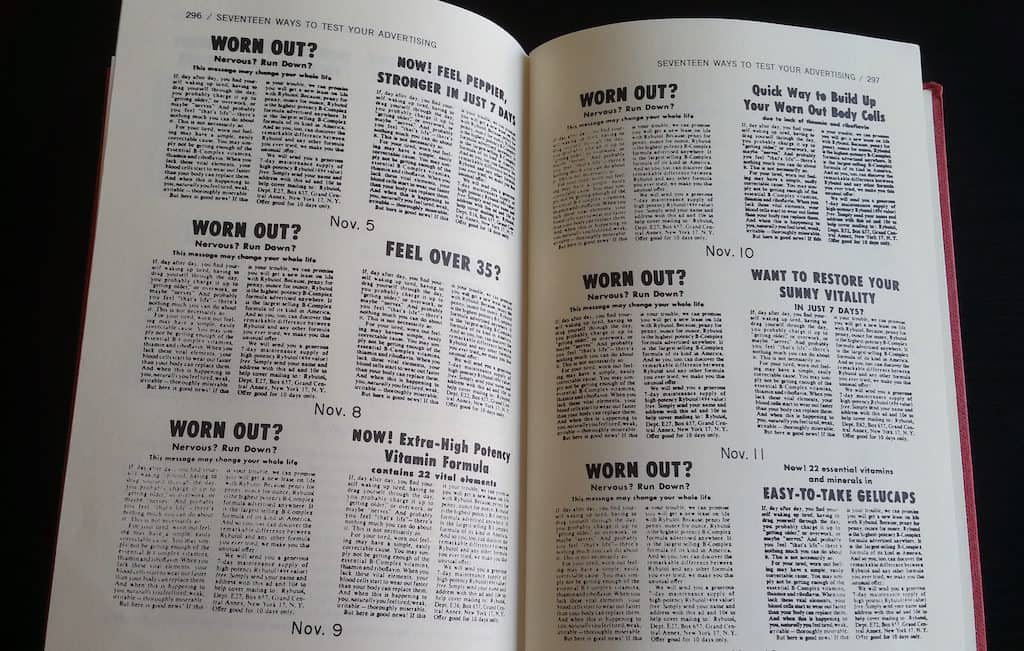
Testing a series of ads by split-run. One pulled 235% more replies than the control; another 34% fewer.
Caples was a meticulous collector of advertising data over the 5 decades he himself wrote and tested copy (or “49 years” as he puts it; John Caples wasn’t one to round up). In that sense, Tested Advertising Methods is the final summary of one man’s life work.
Sales Copy, not Brand Messaging
This book isn’t applicable to just any kind of marketing. It’s about what digital marketers call “conversion copy” or “sales funnel copy” (and 6 other things — thank you Internet). The copy that goes right next to, and literally on top of, the buy button.
It’s not about brand messaging and awareness, which Caples calls “corporate-image copy”.
Nor is it, in theory, about lead generation.
I say in theory because, despite his disclaimers to the contrary early on, it becomes apparent as you read through the book that John Caples was actually obsessed with the art of lead generation. He calls it “advertising leads” and seems to see himself as a defender of the business practice of generating them, rather than going straight for the sale.
The Hubspot Inbound methodology is a useful frame of reference for understanding John Caples terminology.
The Hubspot Inbound Methodology, circa 2010 <– John Caples, circa 1950
attract strangers <– “corporate-image copy”
convert leads <– “advertising leads”
convert customers <– “sales copy”
create fans <– not applicable
Five Quotes from Chapter 1 of Tested Advertising Strategy
Like Ogilvy on Advertising, this book is so dense with wisdom and insight you’d think it was a Walt Whitman poem. There are at least a dozen brilliant ideas in just the first chapter (of 18 total) alone.
I have quoted 5 of them. This first one, though, might get you hooked on Caples-juice:
I have seen one mail order advertisement actually sell not twice as much, not three times as much, but 19 1/2 times as much goods as another. Both advertisements occupied the same space. Both were run in the same publication. Both had photographic illustrations. Both had carefully written copy. The difference was that one used the right appeal and one used the wrong appeal.
This excerpt captures the book’s confident tone, subject matter, writing style. And his devote focus on headlines (a term he uses interchangeably with “appeals”). Of the books 18 chapters, 5 deal with headlines.
You may have read before, too; I believe I had, even before I saw it quoted in Ogilvy on Advertising. And there are certainly many similar statements.
But what Caples says immediately afterward is striking and not something I’ve ever heard repeated.
To discover the correct appeal is often difficult. There may be many wrong appeals and only one right one. If my advertising agent had a year in which to prepare a campaign for my product, I should be perfectly satisfied if he spent eleven months in search of the right appeal, and one month — or one week, for that matter — preparing the actual advertisements.
So somewhere between an 11:1 and a 54:1 ratio of research to writing. Let me just ask this: when did we last spend 1 to 4 hours researching a headline for the 5 minutes we spent wordsmithing it?
After continuing to”tirelessly”pour over the text another gem of wisdom, I finally found one — 4 paragraphs down! A mere obvious sidenote for Caples, but something we need to deal with in digital marketing.
Every logical advertising medium should be tested.
Let’s be honest — I don’t know about traditional offline marketing, but this (testing every logical medium) almost never happens in digital marketing.
The paid search marketer says “paid search is the best approach to digital marketing because of XYZ”. His counterpart says, “Yes, but only AdWords”, because that’s the only network he knows. And so on; each specialist often makes a similar argument. It’s the blind men and the elephant. Chatbot messenger marketers are fanatics, for example.
And of course, each specialist is right — sometimes. And wrong, other times. If there’s one discipline I *think* we digital marketers can agree is always a good investment, it is good, call-to-action web copy. But that by itself is never enough.
Do we need to know all digital marketing mediums? No, but we need to understand the limits of what we do know if the client’s results are what matter most to us.
I was recently doing some communications and marketing work in South Sudan, managing web and social content and traffic. The UN had hired me to design a digital communications strategy. But what medium do you suppose was most effective to the audience I was working with (the 14 million people of that country)? Not Facebook, not television, and not print. Radio. The only communications medium that more 10% of the population has access to. The “logical advertising medium”.
[Steps down off soap box].
…
[Steps back up on the soap box].
Anyway, how did they test back before they “had computers”.
I previously mentioned Caples’ strong belief in lead generation, which is what “digital marketing” divorced from e-commerce is primarily concerned with. Caples knew from the data (BIG data) that lead generation was a worthy cause unto itself:
It has been proved many times and by many advertisers that in a properly controlled test the advertisements that bring the most inquiries usually bring the most sales.
Advertisers who employ salesmen to follow advertising leads have found this to be true. Daniel Starch, a famous advertising analyst, reached the same conclusion in his analysis of five million inquiries received by 163 firms over a period of 12 years.
5 million leads analyzed.
And we thought “Big Data” was a new idea.
A Formulaic Approach to Composing Copy
Finally, Caples give us:
 A secret formula for a successful ad,
 from Ogilvy’s "Secret Weapon" of a book
  - Proven through scientific research
  - Endorsed by David Ogilvy himself
  - Created millions in revenue
 If you just keep reading — it's yours!
A Formula for a Successful Ad
Here is a formula: (1) Write an irresistible headline. (2) Back it up with facts in the copy. (3) Make an unbeatable offer in the coupon.
The point, of course, is not this formula. The point is: use this book to find formulas.
On that note, don’t stop reading at chapter 1.
In fact, if you thought my assessment of chapter 1 was good, wait till you read the 800-word preface: it probably contains more digital marketing wisdom than I’ve ever seen published in a blog post.
<h3″>Become a Better Hypothesizer
Why study what someone else has done and not figure it out yourself?
In this case, it’s not to memorize the outcome of their work, necessarily. But it very much is to memorize their starting points, such as their psychological insight (for example, never put an benefit into a headline that a reader can’t imagine experiencing for herself).
And why not identify our own “starting points”?
Well, we should and we do. But when you have the benefits of decades of testing of analysis, not a bad idea to give yourself a head start.
This is why scientists must be educated, so they can build on the discoveries of their predecessors and not repeat their hypotheses.
I don’t know of one single written work that will better improve your marketing hypothesizing than this one.
As Ogilvy himself puts it plainly in the book’s forward:
You will increase your chances of writing good [ads] if you read this book, and commit its conclusions to memory.
<h3″>What Do We Get to Memorize Anyway
Let’s let Tested Advertising Methods speak for itself. Below are the “tested facts” that you’ll understand from reading it.
The categories are mine so that we can understand them in terms of contemporary digital marketing. The italicized items are quoted verbatim from the book. Some are principles, some describe examples of ads that worked.
How to attract strangers and generate leads
What kinds of headlines attract the most readers?
The most important part of an advertisement
Twenty-nine formulas for writing headlines
How to put enthusiasm into advertising copy
How to write an interest-arousing first paragraph
Thirty-two ways to get inquiries
How to appeal to the masses
How to solve special problems in copywriting
Editorial ads get the most attention
The most important part of an advertisement
How to create desire
Twenty ways to increase selling power
How to make small ads pay
How to get sales that are profitable and plentiful
Don’t be afraid to use long copy
How to get immediate action
29 ways to get attention
How to make type work for you
How to use images
This ad needs no logotype
How to discover the most effective sales appeal for your product
Seventeen ways to test your advertising
Tested Advertising Versus Untested Advertising
How split-run copy testing works
Applying Ogilvy’s Secret Weapon to the Digital Era
Is this book (and by extension other pieces of the pre-digital advertising cannon) all that a digital marketer needs to know?
No way, not even close.
In fact, here’s where I differ from folks in the advertising industry: Digital media is different, digital content is different, and so is digital strategy.
Of course, copywriting is the foundation of digital content, as I have acknowledged in the Digital Content Manifesto. Words are the building blocks of our funnels. People read more of them now than ever before.
But the way that digital content is experienced is completely novel; it’s not something that either John Caples or David Ogilvy were able to analyze (they sure would have mastered digital marketing if they had).A digital strategy, which I clumsily define as a set of ideas inspiring the move to a lasting position of advantage through distinctly digital methods, requires, well distinctly digital methods.
That said, this book, in particular, lays the foundation for what we do as digital marketers, designers, writers, and developers. I think it’s required reading for every one of us trying to move people to act through digital content.
Book publication date: NEVER (This is an imaginary book).
I have (not) written this book to because I wanted to share what I learned running a complex technology consulting firm for 7 years. The book teaches you to find and cultivate happy and high-quality customer relationships.
Additional note: to clarify, I did not write this book.
But I wrote the outline below, hoping it might be helpful.
It answers the question, “if you were to write a book about your experience running a technology consulting firm, what would it look like – what would you write about”?
Unawkward Your Business Development: A Guide for Complex Services Firms
Foreward, by Al Ries – Positioning and Business Development
Part 1: Introduction – who is this book for?
Chapter 1: Who are you? What is a “complex services firm“? A short history of your business and its ecosystem.
Chapter 2: How do you know if you need a lead generation strategy?
BTW, what’s in a word: lead generation vs. marketing (and poised vs awkward)
Chapter 3: The immense benefits of learning elegant digital lead generation.
Part 2: Positioning Your Complex Services Firm
Chapter 4: Nothing to See here: If you’re not going to specialize, there’s no point in reading this book
Expert Craftsman vs Strategic Advisor: why either one (or a blend of both) is a desirable outcome of good positioning
Chapter 5: Positioning 1, Branding 0: Why positioning is the foundation of lead generation
Bonus section: The comic absurdity of “Personal Branding”
Chapter 6: Positioning by the numbers: numeric guidelines for making decisions.
Part 3: The Psychology of Lead Generation
Chapter 7: Ethical Marketing
Chapter 8: Persuasion, Influence, and Charm
Part 4: Inbound Lead Generation Via Content Marketing and Other Arts of War
Chapter 9: What makes content “Good”, anyway?
Chapter 10: SEO: Good digital content is easy to find by its target audience
Chapter 11: UX: The effect of good UX on lead conversion and lead flows
Chapter 12: Copywriting for compressing complex ideas into short statements
Chapter 13: You gotta own it: content creation duties that business owners CANNOT outsource or delegate
Chapter 14: How to make digital content quotable, citable, shareable, and social media-friendly
Chapter 15: Systemization and technology (aka Content Strategy)
Part 5: Outbound Lead Generation in a Charming and Non-Awkward Way
Chapter 16: Stop chasing: the art of introducing yourself
Chapter 17: The ephemeral outbound channels
Chapter 18: The eternal outbound channels
Chapter 19: The crucial relationship between content marketing and outbound marketing
Chapter 20: Systemization and technology (aka Contact Strategy)
Part 6: The Relationship between Lead Generation, Selling, Pricing
Chapter 21: How “stop selling” and other beneficial Sales effects of a lead generation strategy
Chapter 22: The Immutable Law of Lead Generation and Pricing
Part 7: Resources
Appendix A: Case studies in lead generation strategy
Appendix B: The best books on positioning, lead generation, selling, and pricing